
What Rutgers Research Says About Brain Foods for Home Workouts
New Rutgers research suggests that combining time-restricted eating, regular exercise, and specific brain-healthy foods can sharpen cognitive function for home exercisers. This article synthesizes three studies into practical nutrition timing strategies you can apply today.
- Citation source
- Rutgers University
- Evidence level
- restrained inference
There is no single “Rutgers study brain foods for home workouts” that proves blueberries, salmon, or green tea will make a living-room workout sharpen your mind. What does exist is more useful than that: a Rutgers-centered pattern suggesting that cognitive payoff may come from pairing regular exercise with a consistent daytime eating window and foods that support brain plasticity.
The strongest practical takeaway is timing first, food quality second, and no miracle food at all. For a home exerciser, that means an 8–10 hour eating window during the day, workouts placed where they can actually happen, and meals built around omega-3 DHA foods, flavonoid-rich foods, and B vitamin or choline sources.
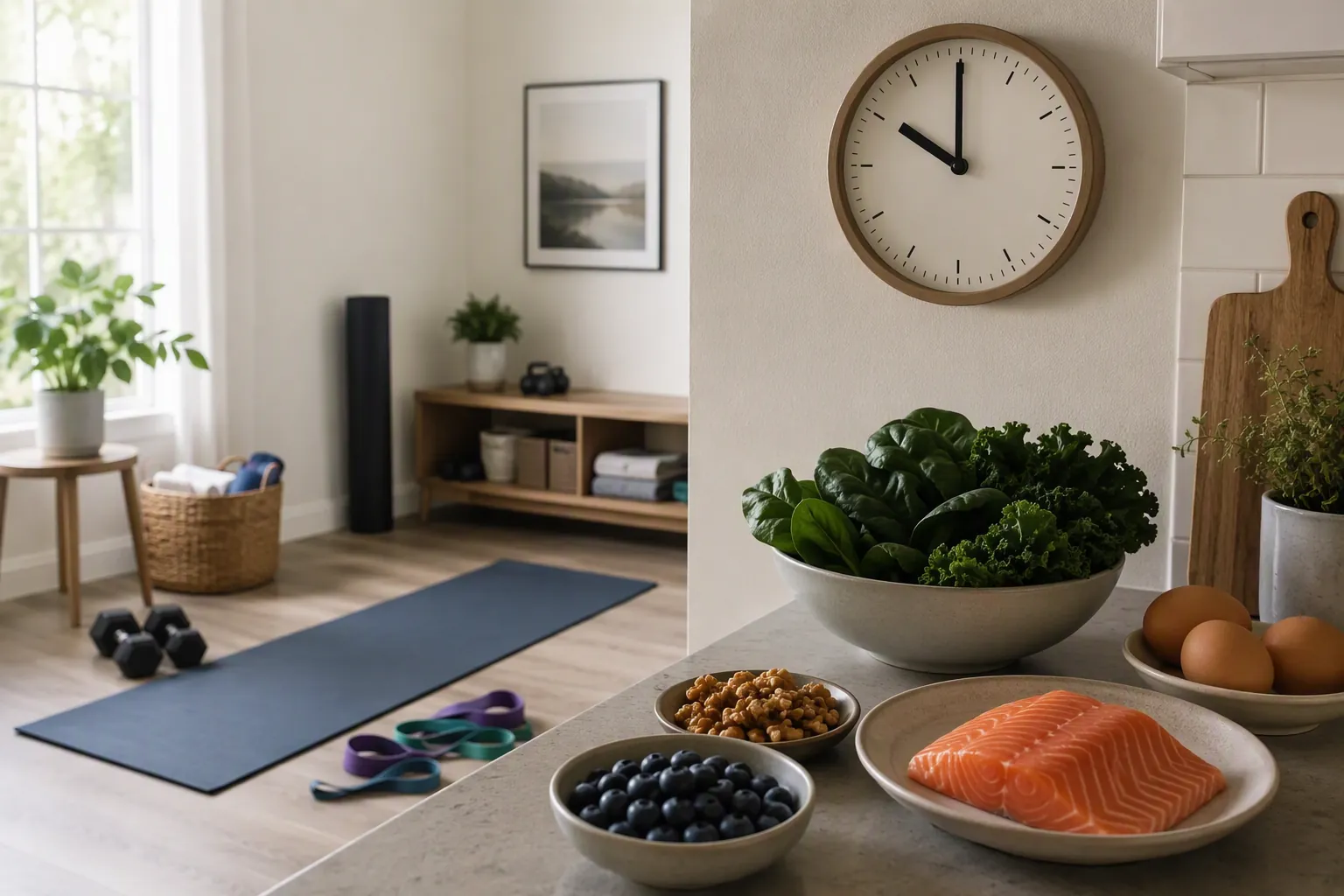
The Rutgers Timing Signal
The freshest Rutgers-linked finding comes from work presented at NUTRITION 2026 by Sue Shapses and colleagues. In a trial of 47 women ages 50–79, participants who ate within an average 8.2-hour window, roughly 10am to 6pm, scored significantly better on spatial planning and problem-solving measures than those eating across an average 12.3-hour window. The cognitive improvement appeared independent of the roughly 15-pound weight loss reported in the trial, which matters because it suggests the timing pattern may deserve attention beyond the usual weight-control framing.[1]
That is promising, not settled. The findings were reported from a conference presentation and should be treated as preliminary until the full peer-reviewed paper is available. It also studied older women, not a mixed group of home exercisers doing dumbbell circuits in spare bedrooms. Still, the details are concrete enough to be usable: a daytime window, not an extreme fast; older adults, not only college students; and cognitive tests that go beyond a vague claim of “mental clarity.”
The part worth noticing is how ordinary the schedule is. A 10am–6pm window does not require skipping food until midafternoon or eating dinner in a rush at 4pm. It asks for a clean edge: breakfast becomes late morning, dinner lands earlier, and the evening stops being an open-ended grazing period.
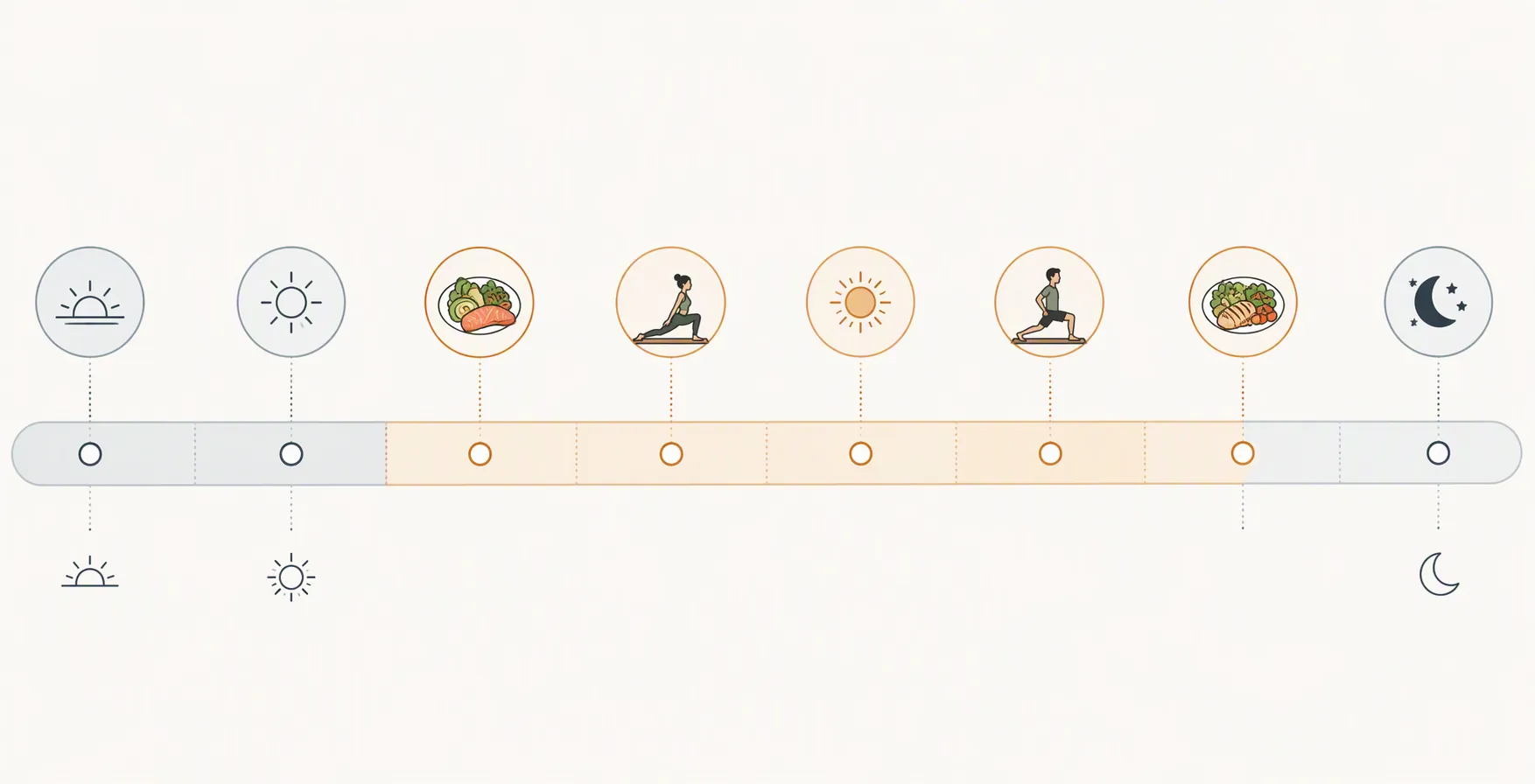
Why Exercise Belongs In The Same Conversation
Meal timing alone is not the whole Rutgers story. A 2025 Rutgers study led by Steven Malin looked at 21 participants around age 60 with prediabetes who completed 12 supervised exercise sessions over 2 weeks. The sessions were 60 minutes each at moderate-to-high intensity, and researchers found increased brain insulin signaling measured through neuronal extracellular vesicles, a mechanism tied to memory and cognition.[2]
The study does not prove that a 35-year-old doing bodyweight squats at home gets the same brain response. It was small, short, supervised, and focused on people with prediabetes. But it gives the timing idea a plausible partner: exercise may make the brain’s insulin-related signaling more responsive, and meals eaten around that training may matter because they arrive when the body is already adapting.
This is where home workouts become relevant, with one important boundary. None of these studies tested “home workouts” as the exercise mode. The application is practical rather than direct: people training at home often have more control over workout time, kitchen access, and the gap between exercise and the next meal than someone commuting to a gym after work.
That control is not glamorous, but it is powerful. If the mat is ten steps from the kitchen, the post-workout meal does not have to become a protein bar eaten in traffic. If the bands hang near the door, a lunch-break session can be paired with a planned meal instead of whatever is left in the pantry at 9pm.
The Food Pattern Behind The Timing
The nutrient side of the strategy comes from a broader brain-food framework, not from a Rutgers-only food trial. Fernando Gómez-Pinilla’s 2008 review in Nature Reviews Neuroscience, from UCLA, summarized evidence that omega-3 DHA, flavonoids, and caloric restriction can upregulate brain-derived neurotrophic factor, or BDNF, and support synaptic plasticity. The same review also emphasized that diet and exercise together produced greater synaptic plasticity gains than either one alone.[3]
BDNF does not need to become a household buzzword to be useful here. In plain terms, it is one of the signals involved in how the brain adapts, maintains connections, and supports learning-related processes. The working strategy is not to “eat BDNF foods,” but to build meals that supply nutrients associated with a brain environment more favorable to adaptation.
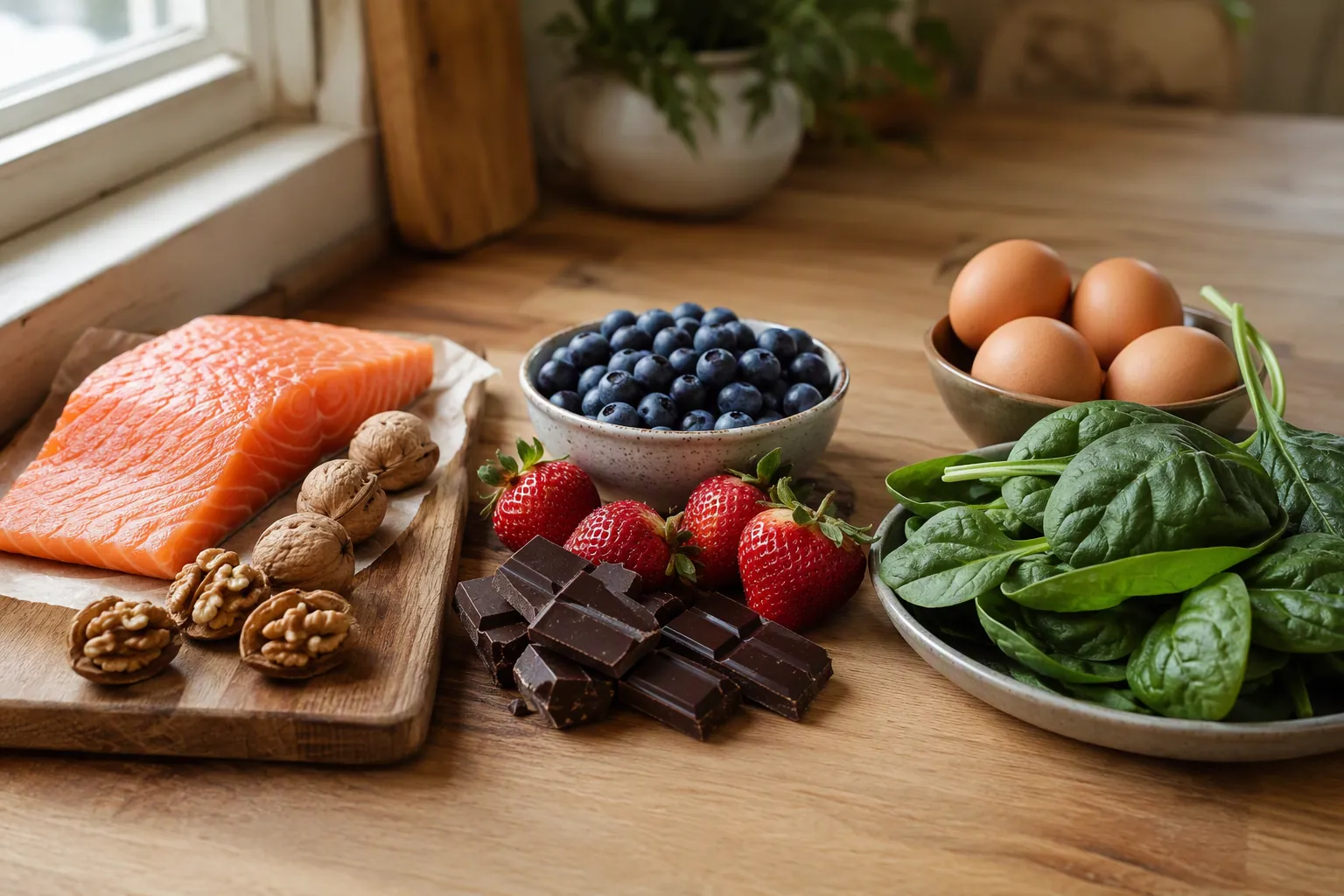
| Food group | Practical home-kitchen examples | Why it belongs in this strategy |
|---|---|---|
| Omega-3 DHA pattern | Salmon, sardines, mackerel; walnuts and flaxseed as plant-based supportive options | Used in the brain-food framework around BDNF and synaptic plasticity |
| Flavonoid-rich foods | Blueberries, mixed berries, cocoa, green tea, dark chocolate at 70% cacao or higher | Fits the nutrient pattern associated with brain plasticity support |
| B vitamins and choline | Eggs, leafy greens, beans, lentils, other legumes | Supports normal brain and metabolic function around the broader meal pattern |
| Foods to limit | Frequent high-sugar foods and high-saturated-fat meals | High-fat/high-sugar patterns reduced hippocampal BDNF in rodent models in as little as 3 weeks, though that finding should not be treated as a direct human trial result |
The table is deliberately ordinary. A brain-supportive home-workout meal does not have to look like a supplement stack. It can be eggs with spinach, Greek yogurt with berries and walnuts, sardines on whole-grain toast, salmon leftovers over greens, lentils with olive oil and herbs, or a small square of dark chocolate with tea after lunch.
The caution on sugar and saturated fat also needs a narrow reading. Gómez-Pinilla’s review described rodent evidence in which high-fat and high-sugar diets reduced hippocampal BDNF in as little as 3 weeks, and exercise reversed the decline.[3] That is not the same as proving one dessert harms human cognition. It is a reason to stop letting evening snacks dominate the eating window, especially when the goal is cognitive recovery as much as muscle recovery.
For a deeper look at sweeteners and recovery tradeoffs, FitAtHome’s piece on artificial sweeteners, gut health, and recovery is the better place to go. Here, the main point is simpler: if the eating window is short but filled mostly with ultra-sweet or high-saturated-fat foods, the schedule is doing work the food pattern is undoing.
A Workable 10am–6pm Rhythm For Home Training
The cleanest way to apply the Rutgers timing signal is to make the eating window boring enough to repeat. A 10am–6pm window is not magic, but it closely resembles the Shapses trial pattern and fits many home-workout schedules better than a late-night cutoff.
| Time | What happens | Brain-focused fueling idea |
|---|---|---|
| Before 10am | Hydrate, coffee or tea if tolerated, light movement if desired | Keep the fast simple rather than turning it into a willpower contest |
| 10am | Open the eating window | Meal with protein, fiber, and a brain-food category such as eggs with greens or yogurt with berries and walnuts |
| Late morning to midafternoon | Home workout, ideally after some food if intensity is moderate or high | Train 1–3 hours after a meal when possible |
| After training | Eat a meal or snack within the window | Include protein plus DHA, flavonoids, or choline-rich foods |
| By 6pm | Close the eating window | Dinner that does not leave the evening open to grazing |
For morning exercisers, the decision is whether the session is light enough to do before food. Mobility, easy cycling, walking, or a short band session may be fine before 10am for many people. A harder strength circuit, interval session, or long workout usually pairs better with a meal 1–3 hours beforehand, which may mean training around late morning instead of first thing.
For lunch-break exercisers, the rhythm is almost built in. Eat at 10am, train at noon or 1pm, then have a post-workout meal that includes one of the emphasized food groups. That could be salmon and greens, eggs with beans and spinach, or a smoothie-style bowl with berries, flaxseed, and a protein source. The important part is not culinary perfection; it is removing the gap where the workout ends and random snacking begins.
For after-work home exercisers, the 6pm close is tighter. One option is a small pre-workout meal around 3:30pm or 4pm, a short training session, and an early dinner. Another is shifting the eating window later, such as 11am–7pm, while staying within an 8–10 hour daytime pattern. The Shapses trial points to a roughly 8.2-hour window; it does not prove that 10am and 6pm are the only useful clock times.[1]
The broader pre- and post-workout rhythm is covered in FitAtHome’s daily eating habits for home fitness recovery. The brain-focused layer is choosing foods that make the meal do more than refill calories.
What A Day Could Look Like
- 10am: Eggs with spinach and beans, or Greek yogurt with berries, walnuts, and ground flaxseed.
- 12:30pm: Home strength workout, bike intervals, aerobic dance, or a mixed resistance-band session.
- 1:30pm: Salmon, sardines, or lentils over greens; add berries, green tea, or cocoa if it fits the meal.
- 5:30pm: Early dinner with protein, vegetables, legumes or whole-food carbohydrates, and a clear stopping point.
- After 6pm: Kitchen closed except for water or unsweetened drinks that fit the person’s routine and sleep.
This kind of day is not meant to be copied exactly. It shows the sequence: food before meaningful training, food after training, and a defined end to eating. The cognitive promise in the Rutgers materials sits in that sequence, not in whether the berries are frozen or fresh.
How Strong Is The Evidence?
The evidence is strongest as a practical synthesis and weaker as a direct prescription. Shapses gives the human timing signal, but it is preliminary. Malin gives an exercise-related brain insulin mechanism, but the sample was small and metabolically specific. Gómez-Pinilla gives the nutrient framework, but it is UCLA work and includes animal evidence alongside human-relevant mechanisms.[1][2][3]
A 2021 Rutgers aerobic dance report adds secondary support that structured exercise can be studied as part of aging-brain cognitive health, but it should remain secondary.[4] The central claim stays narrower: regular exercise, daytime time-restricted eating, and brain-supportive foods fit together plausibly, and the newest Rutgers-linked human data make the timing piece harder to ignore.
That distinction protects the usefulness of the idea. A home exerciser does not need to believe that a single lunch will improve memory by dinner. The better test is whether a stable eating window makes training, recovery meals, evening appetite, and next-day focus easier to manage over several weeks.
The Verdict For Home Exercisers
If you came looking for a Rutgers-approved brain food, the answer is to widen the frame. The best-supported move is not adding one food to an otherwise scattered routine. It is building a repeatable daytime eating window, placing workouts where meals can support them, and stocking the kitchen with foods that fit the DHA, flavonoid, B vitamin, and choline pattern.
For most home exercisers, the most usable experiment is simple: try an 8–10 hour daytime eating window, eat 1–3 hours before harder sessions, follow training with a real meal or snack, and make the default foods salmon or sardines when you eat fish, berries or cocoa when you want something sweet, and eggs, greens, or legumes when you need an easy base. The science does not justify miracle claims. It does justify taking meal timing as seriously as the workout itself.
References
- Time-restricted eating may improve cognition in older women, ScienceDaily, July 27, 2026.
- Exercise improves brain insulin signaling in older adults with prediabetes, Rutgers University, 2025.
- Brain foods: the effects of nutrients on brain function, Nature Reviews Neuroscience, 2008.
- Aerobic dance study, Rutgers Brain Health Alliance, 2021.
This is general fitness education, not medical advice. For diagnosis or treatment of pain or injury, consult a qualified clinician.
Pick your next session
Browse all routines to find an appropriately-spaced next session.
Spot something off?
This content sits adjacent to health guidance — tell us if a citation or figure needs a correction.