
How Much Does a Bad Night of Sleep Hurt Your Workout
A single short night of sleep reduces strength by about 3%, endurance by about 6%, and makes every rep feel harder. This article quantifies the performance hit by workout type and gives you a practical rule for deciding whether to train or rest.
- Citation source
- Craven et al. 2022 (Sports Medicine)
- Evidence level
- Meta-analysis
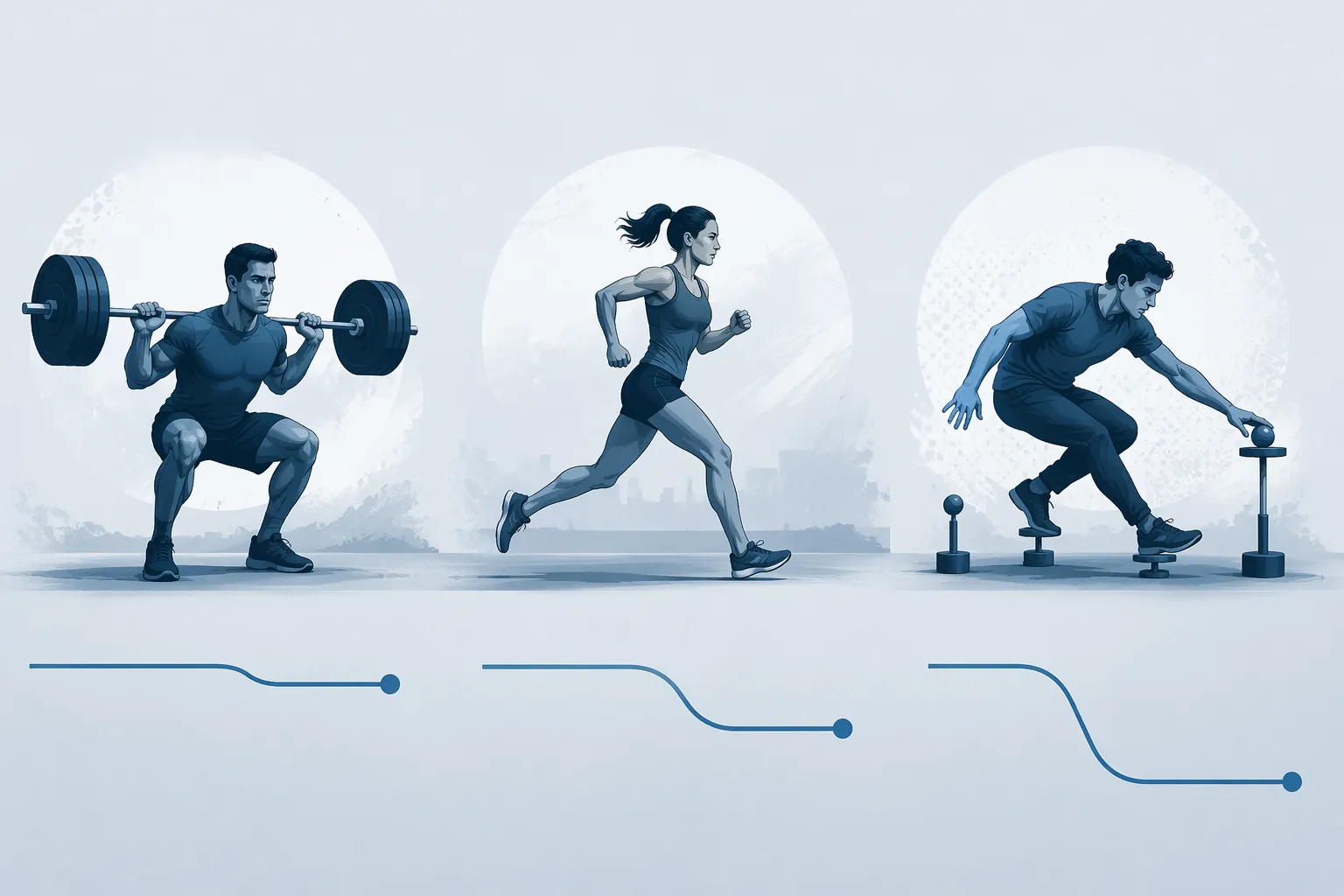
You slept badly, the rack is already loaded, and the useful answer is not “sleep matters.” It is this: after one short night, strength usually drops a little, endurance drops more, skill-based work drops the most, and the whole session may feel harder than the numbers on the bar suggest. In a 2022 systematic review and meta-analysis of 69 studies, acute sleep loss was associated with a −2.85% change in strength, −5.55% in endurance, −20.9% in skill performance, and a +0.51 standardized mean difference increase in perceived exertion.[1]
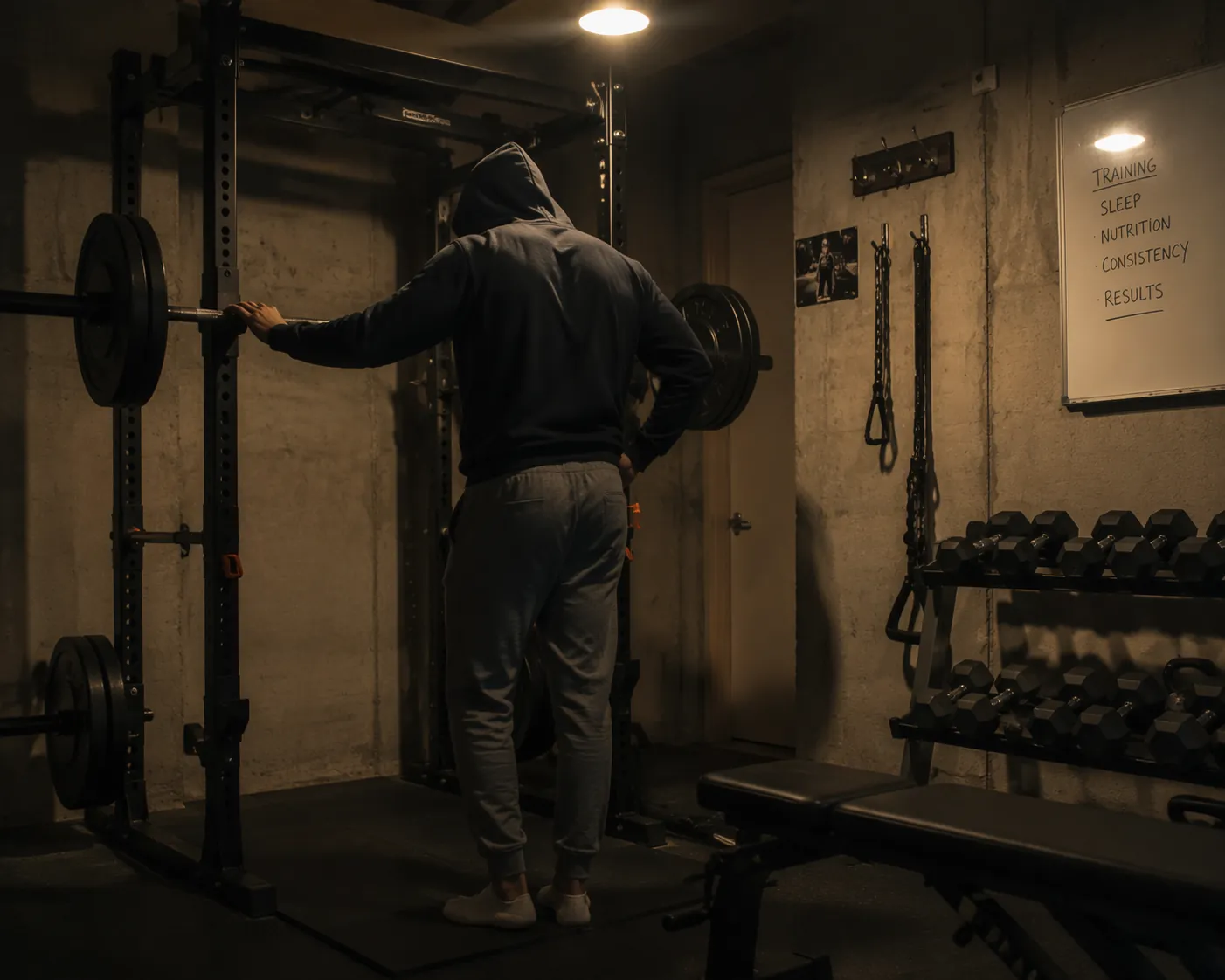
That is enough to change the day, but not enough to automatically erase it. A 3% strength hit is not the same problem as a 20% skill hit. Missing the last rep of a dumbbell press is annoying; practicing a technical lift while coordination is off is a different risk-reward trade.
The Performance Hit Depends On The Workout You Planned
The mistake is treating “bad sleep” as one condition with one training answer. The same short night can be manageable for a low-complexity strength session and a bad setup for high-skill work.
| Workout type | Average effect after acute sleep loss | What it means in a home gym |
|---|---|---|
| Strength | −2.85% | Lower top-end expectations; avoid making the day about a true max. |
| Endurance | −5.55% | Expect pace, output, or repeatability to fade sooner. |
| Skill and coordination | −20.9% | Be cautious with technical lifts, complex drills, and movements where mistakes carry a cost. |
| Perceived exertion | +0.51 SMD | The session can feel disproportionately hostile even when performance only drops modestly. |
For a home lifter, the strength number is the least dramatic and often the most useful. If your planned top set was five hard reps, a small drop may turn that into four clean reps or five grindy ones. That does not prove you lost fitness overnight. It means today is probably a poor day to judge your ceiling.
Endurance work is less forgiving. A 5–6% decrement does not sound huge until the session depends on sustaining output: intervals on a bike, repeated kettlebell complexes, long circuits, or density blocks where rest periods are short. The first round may look normal. The cost shows up when repeat efforts stop repeating.
Skill work is where the downgrade should be blunt. The Craven review separated skill from strength and endurance, and the reported decline was far larger.[1] That matters if the plan involves Olympic-lift derivatives, heavy free-weight movements you do not own technically, fast direction changes, or anything where a sloppy rep is not merely unproductive but risky.
Why The Session Feels Worse Than It Performs
The hidden cost is not always the load you fail to lift. It is the extra friction around the same work. Craven et al. found perceived exertion increased after acute sleep loss, with an effect size of +0.51 SMD.[1] In plain gym terms, the warm-up feels stickier, normal sets ask for more attention, and the point where you start negotiating with yourself arrives earlier.
That matters because RPE changes decisions. If you use auto-regulation, a set that should land at RPE 7 may feel like RPE 8 or 9. If you do fixed programming, the written session may still be possible, but it may pull more recovery than it usually does. The same numbers on paper can have a different cost today.
This is where a compact home gym can be both helpful and dangerous. There is no commute, no class time, and no public pressure. You can adjust the session instantly. You can also talk yourself into chasing the original plan because the equipment is sitting right there.
Strength Training Usually Gets A Downgrade, Not A Cancellation
If the planned workout is basic strength work, one short night usually argues for narrowing the target rather than skipping by default. Keep the movement pattern. Reduce the demand that depends on sharpness.
- If the plan was a true max or near-max single, move it.
- If the plan was heavy working sets, cap the load slightly or stop one rep earlier than usual.
- If the plan was moderate dumbbell or machine-free accessory work, keep it, but cut a set if effort climbs too fast.
- If bar speed or technique is clearly worse in warm-ups, treat that as information, not a character test.
A practical example: if you planned several hard sets of squats before work, the short-sleep version might keep squats in the session but remove the top-set ambition. Warm up normally, take the first working set seriously, then let that set decide whether the day becomes normal volume, reduced volume, or technique practice. The goal is to preserve the week without pretending today is a peak-readiness day.
Endurance And Conditioning Need More Respect
Conditioning is where “I can still start” can mislead you. The early minutes may not reveal the drop. The problem is sustaining pace, recovering between rounds, and keeping mechanics from degrading while breathing gets loud.
For a long steady session, reduce duration before you increase intensity. For intervals, reduce the number of repeats before you force the original pace. For mixed circuits, remove the movement that gets ugly first. A short night is a good reason to choose clean output over proving that you can suffer through the written version.
Explosive work belongs closer to this cautious category than to ordinary strength work. A 2025 meta-analysis of 51 studies reported a negative effect of sleep deprivation on explosive power in athletes, with an SMD of −0.63.[2] Jumps, throws, sprints, and fast barbell work depend on timing and intent; if the snap is gone, forcing more volume usually does not bring it back.
Morning And Afternoon Are Not The Same After Bad Sleep
The time-of-day finding is one of the most useful pieces for anyone who trains at home. Craven et al. reported an estimated performance decline of about 0.4% per hour awake after sleep loss.[1] That is not a precision tool for calculating your next set. It is a good mental model: the longer you drag the short night through the day, the more the workout tends to inherit.
Kong et al. also found that morning workouts after sleep loss were largely unaffected, while afternoon sessions showed more consistent negative effects across strength, power, and skill outcomes.[2] This fits the home-gym reality better than generic advice does. A 7 a.m. lift after a short night is not the same decision as a 6 p.m. session after a short night plus a full workday.
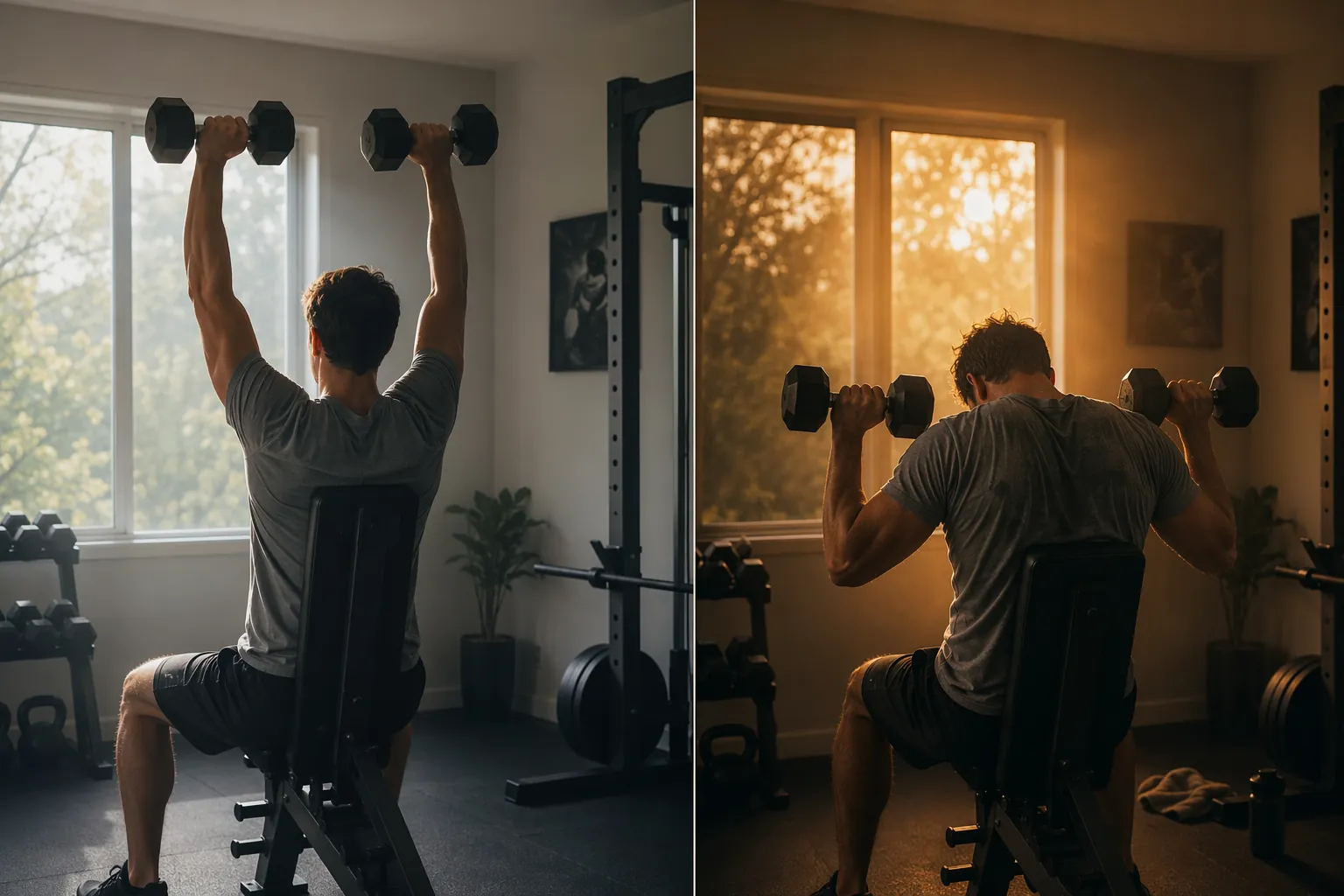
That does not make morning training magic. It means that if you already train before work, one short night may be less damaging than you expect, especially for straightforward strength work. If you train late, the same sleep loss deserves a more conservative plan: fewer top-end sets, less explosive work, and no technical heroics.
How Short The Night Was Still Matters
A five- or six-hour night is not the same as being awake for 30 hours. Most useful training decisions live in that middle zone: you slept less than you wanted, but you are not dealing with total deprivation. The evidence is strongest for acute sleep loss in controlled settings, and the exact size of the hit can vary by person, training status, caffeine use, motivation, and the task being tested.
There is also a difference between going to bed late and waking earlier than usual. Craven et al. reported that late restriction, where sleep is shortened by early waking, appeared to hurt performance more than early restriction, where sleep is shortened by delaying bedtime, although the subgroup evidence was thinner than the main performance findings.[1] Stronger by Science highlighted the same practical interpretation while noting the limits of the underlying data.[3]
So the rule should stay modest. If you have control over the night before an important session, how the sleep is shortened may matter. But this is not strong enough to build an elaborate personal doctrine around one subgroup result.
A Simple Train-Or-Rest Rule For Today
Start with the workout type, then adjust for time of day. That gives a better answer than asking whether you feel motivated while standing in front of the rack.
| Planned session | Morning after short sleep | Afternoon or evening after short sleep |
|---|---|---|
| Basic strength | Train, but cap max attempts and accept slightly fewer reps. | Train conservatively or reduce volume if warm-ups feel unusually heavy. |
| Long conditioning | Shorten duration or reduce repeat targets. | Downgrade more aggressively; avoid turning it into a survival session. |
| Explosive power | Keep only if warm-ups feel sharp; cut volume early. | Usually move it or replace with lower-speed strength work. |
| High-skill lifting or coordination | Practice lightly if technique is crisp. | Postpone heavy or complex versions. |
| Easy recovery work | Good choice. | Good choice, especially if the original plan was high intensity. |
The best short-sleep substitution is not always rest. Sometimes it is the same movement with less load. Sometimes it is fewer rounds. Sometimes it is swapping a skill-heavy lift for simpler accessories. The common thread is reducing the part of the session most likely to go bad: coordination, repeatability, or late-day intensity.
Use the warm-up as the final filter. If loads move normally but feel a little more unpleasant, continue with a cap. If coordination is off, downgrade skill work immediately. If effort is high before the session has earned it, cut volume before you start bargaining with the last third of the workout.
What The Evidence Can And Cannot Promise
The main numbers come from meta-analyses, which is better than building rules from one memorable bad workout. Still, the research base leans heavily on young male athletes, and the findings are group averages rather than predictions for one lifter in one garage or spare room.[1][2] Older lifters, women, newer trainees, and people under heavy life stress may not match the average response.
Controlled studies also cannot perfectly recreate a home session squeezed between an alarm clock and a workday. Caffeine, music, heat, equipment setup, and how much you care about the workout all change the experience. Those factors do not erase the sleep effect; they are reasons to use the numbers as guardrails, not as a verdict.
After one short night, most home-gym users do not need to panic. Keep simple strength if it is moving well. Downgrade endurance volume, explosive work, and technical lifts. Be more conservative later in the day. And do not treat a harder-feeling session as proof that your fitness disappeared overnight.
References
- Effects of Acute Sleep Loss on Physical Performance: A Systematic and Meta-Analytical Review, Sports Medicine, Springer, 2022.
- Effects of sleep deprivation on sports performance and perceived exertion in athletes and non-athletes, Frontiers in Physiology, 2025.
- How does sleep deprivation affect your workouts?, Stronger by Science, 2025.
This is general fitness education, not medical advice. For diagnosis or treatment of pain or injury, consult a qualified clinician.
Pick your next session
Browse all routines to find an appropriately-spaced next session.
Spot something off?
This content sits adjacent to health guidance — tell us if a citation or figure needs a correction.