
How Sleep Apnea Sabotages Home Workout Recovery (What Helps)
Sleep apnea fragments deep sleep and lowers overnight oxygen, directly stalling muscle recovery and progress from home workouts. This article explains the mechanisms and offers targeted adjustments—workout timing, protein timing, sleep positioning, and CPAP use—to help you keep making gains while pursuing treatment.
- Citation source
- CDC
- Evidence level
- general guideline
- Recommended frequency
- 2-3 strength sessions per week; 2 cardio sessions per week
You can follow the program, hit the sets, eat reasonably, and still feel like your home workouts are landing on dead ground. The next morning is the giveaway: legs still heavy, shoulders oddly sore, brain foggy before the coffee even helps. If sleep apnea is in the picture, the problem may not be your discipline. The night after training may not be giving your body the uninterrupted deep sleep and steady oxygen it needs to turn work into adaptation.
The practical answer is to protect the recovery window first. Sleep apnea can fragment sleep and lower overnight oxygen saturation, which plausibly interferes with the same recovery processes you are counting on after resistance training, intervals, or a long conditioning session. There is not a single clean clinical trial that follows “people doing dumbbell workouts at home with sleep apnea” and measures their soreness timeline. The case here is built from adjacent evidence: sleep-apnea physiology, exercise-and-OSA research, and basic recovery biology.

The recovery bottleneck happens after the workout
A home workout does not make you stronger while you are sweating through it. The session creates a demand: repair tissue, restore energy, regulate stress, and arrive tomorrow with enough freshness to train again. Deep sleep is one of the main places where that demand gets answered. When breathing interruptions repeatedly pull the body out of stable sleep, the night becomes less like a repair shift and more like a series of restarts.
That matters for muscle recovery because deep sleep is tied to growth-hormone release and the broader repair environment that supports muscle protein synthesis. It also matters for fatigue because lower overnight oxygen means the body is spending part of the night under respiratory stress instead of simply downshifting. For a lifter training in a spare room, that can show up as a strangely familiar pattern: the plan looks consistent on paper, but each session starts with a smaller margin.
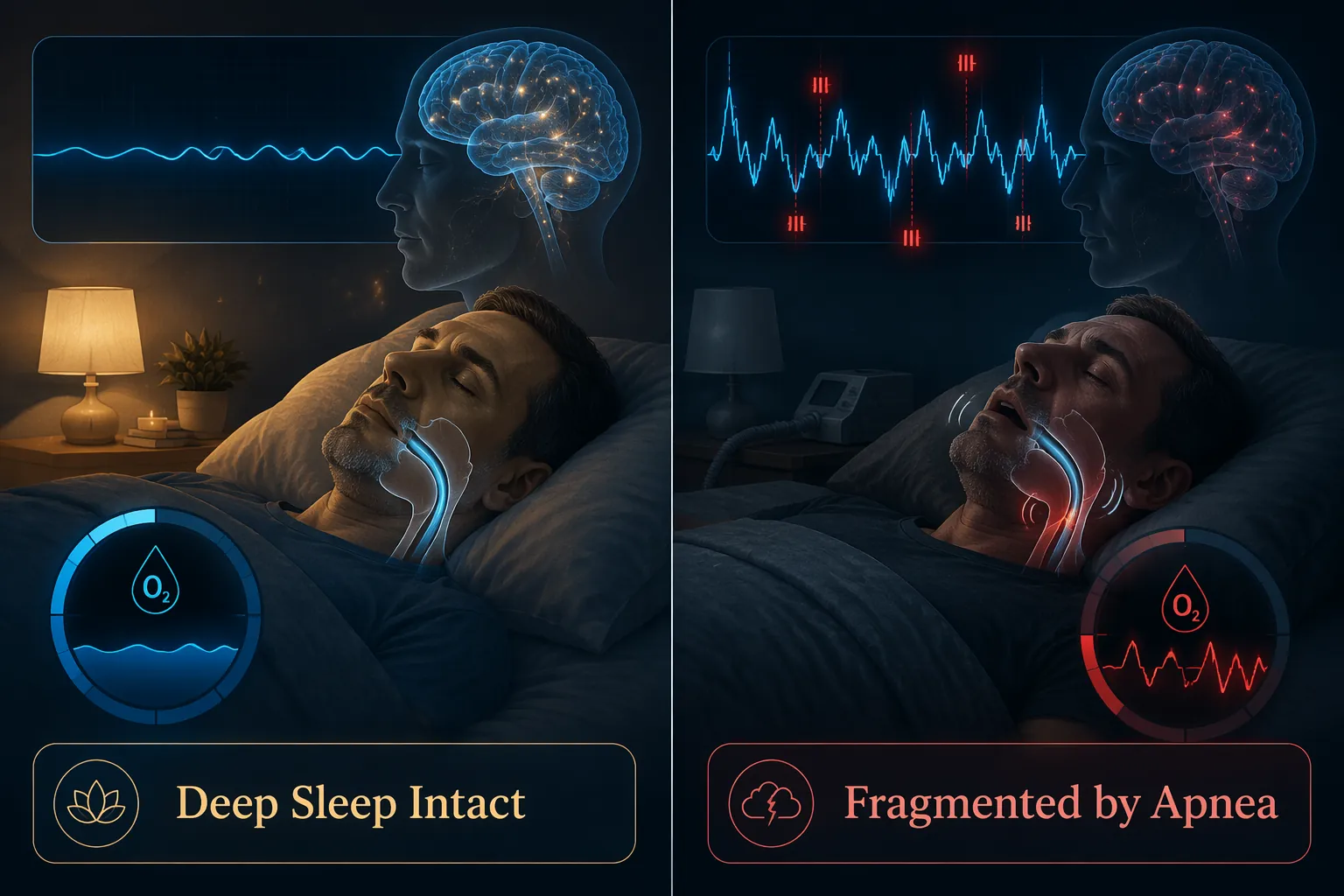
The oxygen side is easy to underappreciate because it does not feel as dramatic as missing a workout. But if overnight oxygen drops repeatedly, the body may have a harder time clearing byproducts of hard exercise and restoring normal function by morning. That does not mean every sore day is sleep apnea. It does mean that if you are waking unrefreshed, snoring heavily, gasping, dealing with morning headaches, or needing unusual amounts of willpower to complete normal sessions, recovery advice that only says “be more consistent” is incomplete.
This is also not a niche concern. In an American Academy of Sleep Medicine report on more than 155,000 adults, 6.9% reported diagnosed sleep apnea, and those with sleep apnea sat 4.4 more hours per week than those without it.[1] That does not prove sitting causes an individual person’s apnea or that exercise alone treats it. It does show why a training site should take the recovery problem seriously: sleep apnea and low activity often live close enough together to affect the same person.
Move the hard session away from bedtime when you can
The first adjustment is not glamorous: stop making your most intense session compete with sleep onset. If a late workout leaves you wired, hot, hungry, or coughing through a dry throat after you lie down, it may be stealing from the very recovery window you trained to earn.
This does not mean evening training is forbidden. Many people only have the room, quiet, and childcare coverage after work. The useful distinction is between training late and training so late, so hard, and so under-fueled that your nervous system is still arguing with the pillow. If sleep apnea is already fragmenting the night, you do not want to add avoidable friction on top.
- Put heavy lower-body lifting, hard intervals, and long conditioning earlier in the day when your schedule allows.
- If you must train late, keep the session more technical or moderate: mobility, controlled accessories, easy zone-style cardio, or a shorter full-body lift.
- Leave enough time after training to cool down, eat, shower, set up CPAP if prescribed, and get into bed without rushing.
- Track how you sleep after different session types instead of assuming all workouts affect your night the same way.
The goal is not to make training timid. It is to stop stacking a high-arousal workout directly on top of a vulnerable sleep window. For home trainees, even moving the hardest work from 9:30 p.m. to 6:30 p.m. can be a meaningful experiment.
Give repair materials before the night gets messy
Post-workout protein will not override untreated sleep apnea. It also should not be dismissed as minor. If your sleep may be fragmented, it becomes more important to handle the parts of recovery you can control: enough total protein, a reasonable post-exercise meal or snack, and not going to bed after training with only willpower in the tank.
Think of it as reducing the number of jobs your body has to negotiate overnight. A late resistance session followed by no protein, dehydration, and disrupted breathing is a rough setup. A session followed by a simple protein-containing meal, fluids, and a calmer wind-down is not a cure, but it removes unnecessary obstacles.
| If this is your pattern | Try this recovery adjustment |
|---|---|
| You train after work and skip dinner because it feels too late | Have a planned protein-containing snack or light meal after training instead of relying on breakfast to catch up |
| You wake up sore and foggy after hard evening sessions | Move the hardest session earlier or reduce late-session intensity for two weeks and compare morning readiness |
| You use CPAP but delay setup until you are exhausted | Set up the mask, water chamber, and hose before training or before the evening gets crowded |
| You suspect sleep apnea but have not been evaluated | Use training notes as evidence to discuss with a clinician, especially if fatigue, snoring, gasping, or morning headaches are present |
There is a discipline trap here. When progress stalls, the home-gym instinct is often to add volume, add finishers, or tighten the program. Sometimes that is exactly the wrong direction. If the night cannot complete the repair work, adding more damage can make the plan look more serious while making recovery worse.
Use sleep position as a low-risk experiment, not a fake treatment
For some people, breathing obstruction is worse on the back. Side sleeping can reduce airway collapse in positional sleep apnea, and it is one of the few adjustments you can test tonight without buying a new training program or pretending to self-diagnose. The key word is “test.” If you have moderate-to-severe obstructive sleep apnea, positional changes are not a substitute for medical treatment.
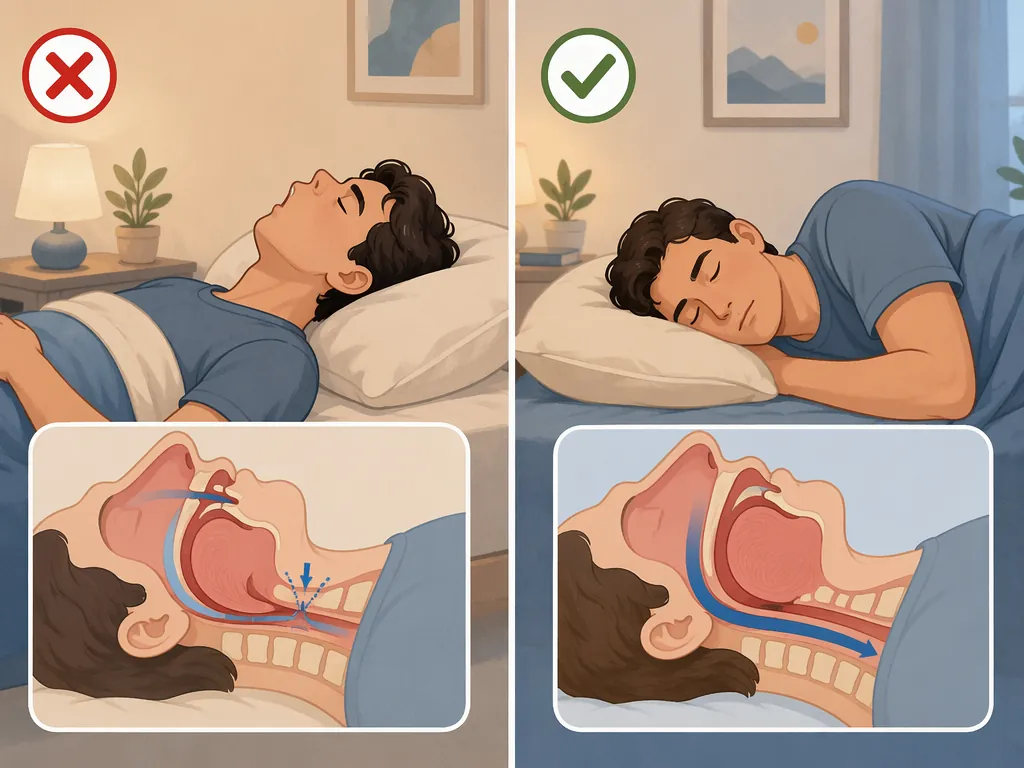
A practical setup is boring but useful: side-sleeping pillow support, a pillow between the knees if hips complain, and enough shoulder room that you do not roll onto your back because the position feels punishing. The best sleep position is the one that improves breathing without creating a new joint problem that ruins tomorrow’s workout.
If you use CPAP, comfort details matter more than most recovery articles admit. Dry air, mask leaks, pressure discomfort, and skin irritation are not small lifestyle annoyances when they decide whether you keep the mask on at 3 a.m. A humidifier can make therapy more tolerable for some users. So can mask refitting, hose management, cleaning routines, and asking the sleep clinic for adjustments instead of silently quitting.
Treat prescribed CPAP like part of the training plan
CPAP is easy to mentally file under “medical equipment,” separate from the dumbbells, mat, pull-up bar, and bike. For a person trying to recover from workouts with sleep apnea, that separation is not useful. If CPAP is prescribed, using it consistently is one of the most direct ways to protect the sleep window that training depends on.
The performance promise should stay modest. CPAP is not a guaranteed strength booster, and a device company’s marketing page should not become your coach. Still, there is supportive context: SleepApnea.org reports that CPAP users logged 20% more moderate physical activity over more than three years compared with untreated controls.[2] That is not proof that CPAP automatically improves your squat, push-up volume, or VO2 max. It does suggest that treating sleep apnea may help people stay active over time.
That matches the lived version of the problem. If therapy helps you wake with less fog, fewer headaches, and more stable energy, you are more likely to train at the planned intensity instead of bargaining your way through a shortened session. The recovery win is not only what happens inside the muscle. It is also the restored ability to show up without needing to overpower exhaustion every day.
- Set up CPAP before you are sleepy, especially after evening workouts.
- Clean parts on a schedule you can actually maintain, not an ideal schedule you abandon.
- Use humidification if dryness makes you remove the mask during the night.
- Report leaks, pressure discomfort, congestion, or panic sensations to your clinician or equipment provider instead of treating nonuse as a character flaw.
Exercise can help the loop, but it does not replace treatment
The encouraging part is that training still belongs in the solution. Sleep Foundation summarizes evidence that exercise can reduce obstructive sleep apnea severity even without weight loss.[3] That matters because it gives the tired home trainee a reason to keep going. You do not have to wait for the perfect sleep setup before doing useful work.
The type of work may matter. SleepApnea.org reports that combined aerobic and resistance training reduces apnea-hypopnea index more than aerobic-only training.[2] For a home setup, that points toward a balanced week rather than a single recovery fantasy: some resistance training, some aerobic work, and enough restraint that the plan supports sleep instead of constantly testing it.
A reasonable home week could include two or three full-body strength sessions, two moderate cardio sessions, and light mobility or walking on the days between. The Centers for Disease Control and Prevention points adults toward regular aerobic activity plus muscle-strengthening work on at least two days per week, which fits the same general direction.[4] The exact split should bend around symptoms, schedule, equipment, and medical guidance.
There are also treatment-adjacent ideas that deserve caution. Myofunctional therapy, for example, is often discussed in sleep-health content because airway and tongue exercises may help some people. The problem is not that the idea is silly. The problem is that commercial summaries often get repeated without readers checking the original study design, population, and outcome measures. Treat it as something to ask a clinician about, not as a shortcut around diagnosis, CPAP, oral appliances, or other prescribed care.
What to change this week
If you suspect sleep apnea, or you have a diagnosis and your recovery is still poor, the useful move is to adjust the system instead of blaming your effort. Keep training, but stop treating sleep as a soft variable. The recovery environment is part of the program.
- Move your hardest workouts earlier for two weeks, or make late sessions shorter and less intense.
- Eat a protein-containing meal or snack after training, especially if the session happens at night.
- Try side sleeping if back sleeping seems to worsen snoring or breathing interruptions.
- Use prescribed CPAP consistently and solve comfort problems with your clinician or equipment provider.
- Track soreness, morning alertness, headaches, workout readiness, and mask use so your doctor has more than vague fatigue to work with.
This is general education, not diagnosis or medical treatment. Loud snoring, witnessed pauses in breathing, gasping, severe daytime sleepiness, morning headaches, or persistent unrefreshing sleep deserve formal medical evaluation. Exercise can improve the loop, and home workouts are worth keeping, but moderate-to-severe sleep apnea needs proper care. The plan is not to out-discipline oxygen loss. The plan is to train, recover, and treat the breathing problem seriously enough that the work finally has somewhere to land.
References
- Study links increased exercise with lower sleep apnea risk, American Academy of Sleep Medicine
- Sleep Apnea and Weight Lifting, SleepApnea.org
- Sleep Apnea and Physical Exercise, Sleep Foundation
- Adult Activity: An Overview, Centers for Disease Control and Prevention
This is general fitness education, not medical advice. For diagnosis or treatment of pain or injury, consult a qualified clinician.
Pick your next session
Browse all routines to find an appropriately-spaced next session.
Spot something off?
This content sits adjacent to health guidance — tell us if a citation or figure needs a correction.