
What to Do Immediately After a Youth Soccer Head Injury
This guide explains the current 24–48 hour recovery protocol for a youth soccer head impact, including when to seek care, how to manage the first days, and the step-by-step return-to-play progression. It replaces outdated 'cocooning' advice with evidence-based relative rest and gradual aerobic activity.
- Citation source
- ACSM; CDC HEADS UP; Concussion Alliance
- Evidence level
- General guideline
- Recommended frequency
- 24–48 hours relative rest; at least 24 hours per return-to-play step
After a youth soccer player takes a header, head-to-head collision, fall, or hard knock and something looks off, the next decision is not whether the kid is tough enough to finish the half. Treat a suspected concussion as a stop sign for soccer participation. Get the player out of play, shift from game mode to evaluation mode, and keep the return-to-play decision out of the team huddle.
This is where heading-safety rules become practical instead of theoretical. U.S. Soccer’s Concussion Initiative includes a modified substitution rule: a player suspected of having a head injury can be removed for evaluation without the removal counting against the team’s substitution limit. That rule matters because it gives the coach and parents room to do the safer thing without making the team pay for it competitively. [1]
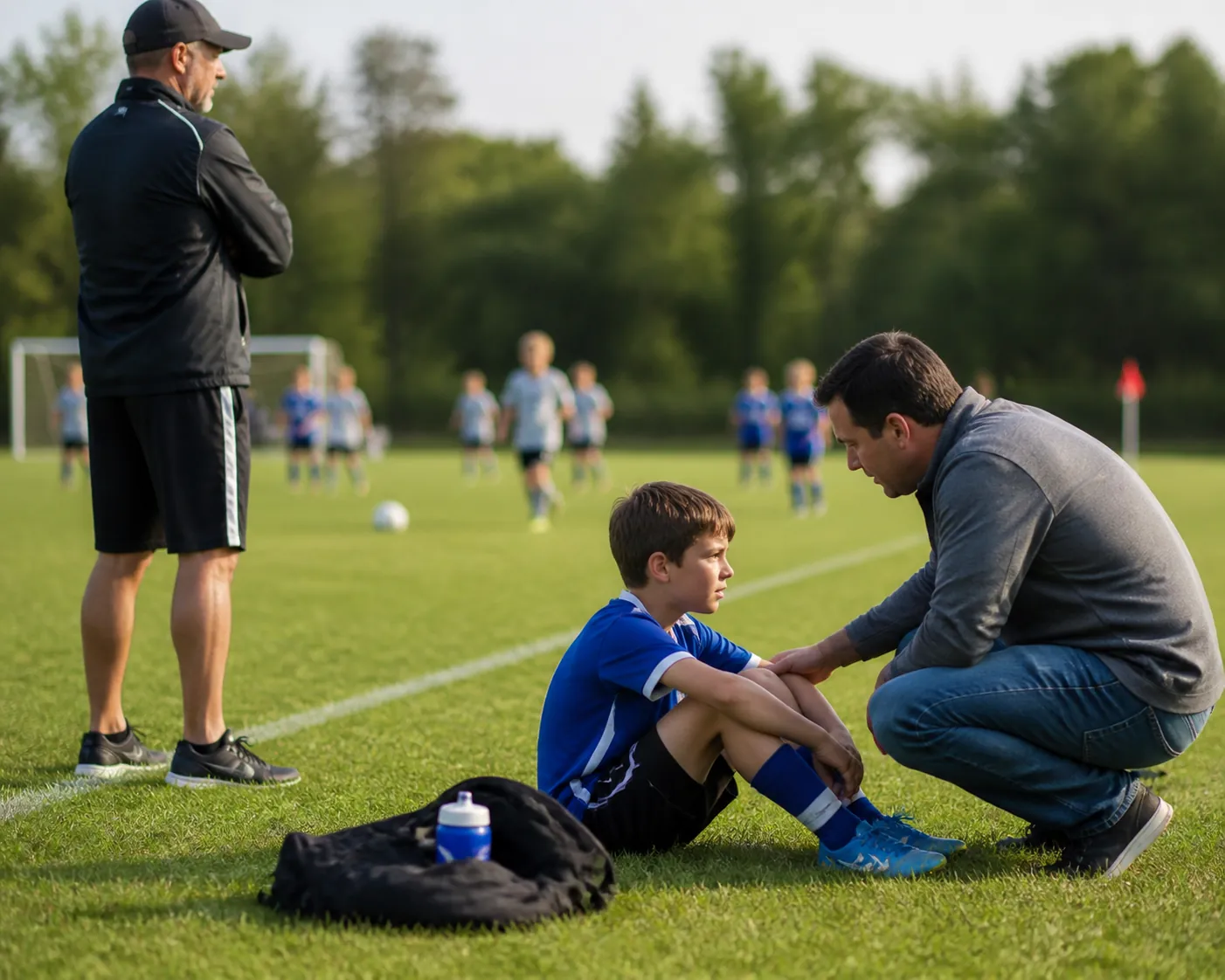
That does not mean diagnosing a concussion on the sideline. It means accepting that the sideline is a poor place to prove a child is fine. The safe job for the adults nearby is narrower: remove the player, watch the symptoms, involve an appropriate healthcare professional, and do not let the player talk their way back into soccer before recovery has even started.
The first ten minutes: remove, observe, hand off
Once the player is off the field, the adult job becomes procedural. The coach should not be sorting through conflicting parent opinions while the next whistle is blowing. One adult can stay with the player, one can contact the parent or guardian if they are not present, and the team can continue without making the injured child the center of a public debate.
- Stop soccer participation for the day unless a qualified healthcare professional directs otherwise through the appropriate process.
- Do not use the child’s desire to keep playing as evidence that they are safe to keep playing.
- Use the modified substitution protection when it applies, so evaluation is not treated as a tactical penalty. [1]
- Keep notes simple: what happened, what symptoms were noticed, when they appeared, and whether they worsened.
- Arrange medical evaluation and follow the clinician’s instructions for school, activity, and sport.
The player may be embarrassed. The coach may feel pressure. Another parent may say their kid had one last month and was fine. None of that changes the first boundary: suspected concussion moves the child out of soccer and into observation and recovery.
The first 24–48 hours are not a dark-room sentence
A lot of adults still carry the old instruction in their heads: put the child in a dark room, no screens, no schoolwork, no movement, and wait. That “cocooning” model is no longer the recommended default. Current concussion recovery guidance favors 24–48 hours of relative rest, followed by gradual, symptom-limited activity. The American College of Sports Medicine describes strict rest as detrimental and supports early aerobic activity after that initial relative-rest period. [2]
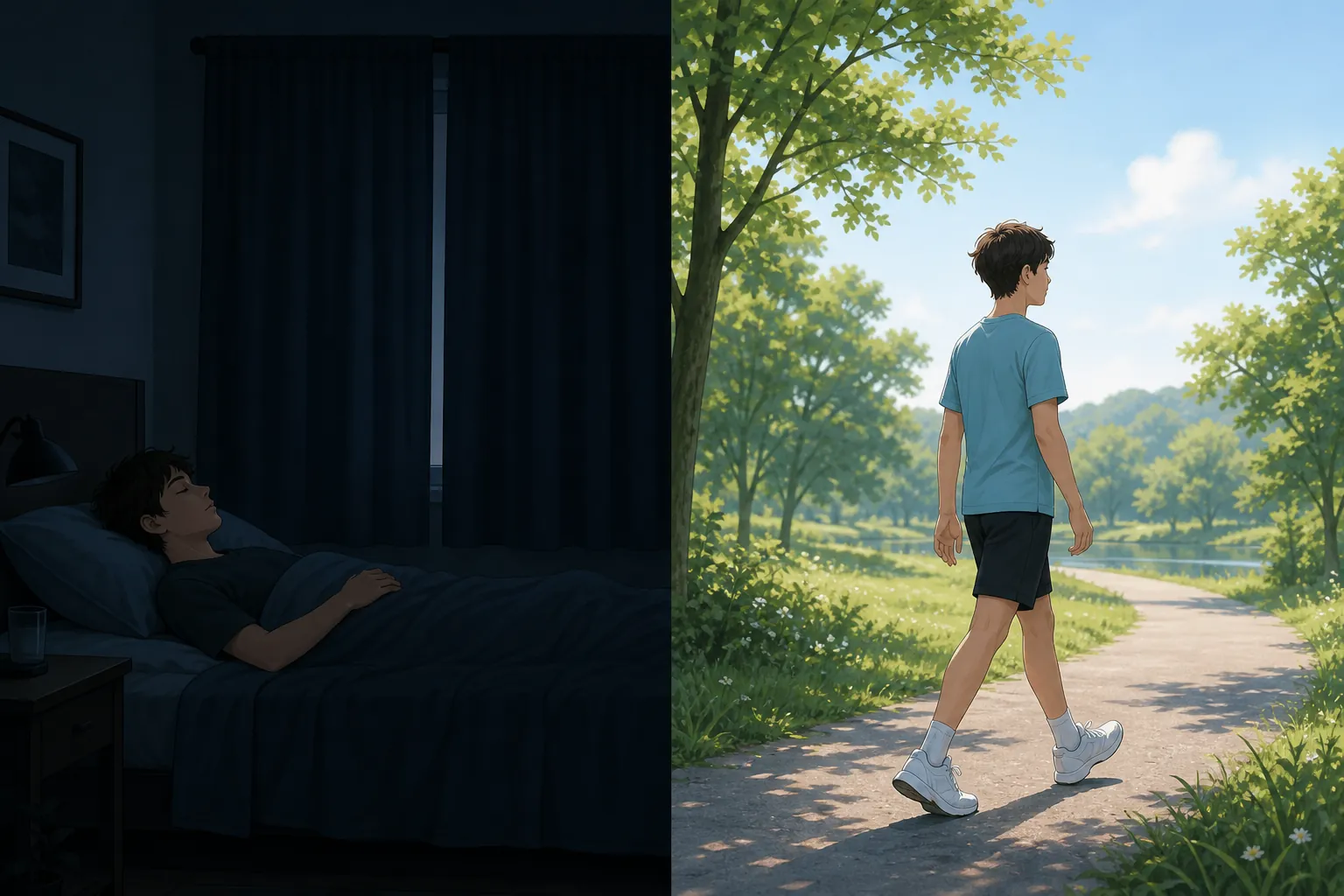
Relative rest is not pretending nothing happened. It means lowering the load while still allowing ordinary, quiet life when it does not make symptoms worse: getting up, eating meals, moving around the house, short calm conversations, and light walking if tolerated. Pediatric concussion guidance from Concussion Alliance also warns against cocooning and says light-intensity physical activity in the first 24–48 hours reduces the risk of persistent symptoms beyond one month. [3]
The useful question during these first two days is not, “Can we make symptoms disappear by removing every stimulus?” It is, “What can this child do without clearly worsening symptoms?” If reading, screens, noise, or walking make symptoms climb, back off. If a short walk is tolerated, that is different from soccer conditioning. The line is not between bed and normal life; it is between light daily activity and anything that drives symptoms or adds head-impact risk.
| During the first 24–48 hours | What it means in practice |
|---|---|
| Relative rest | Quiet daily activities and light movement that do not worsen symptoms |
| Light walking if tolerated | Easy pace, no training goal, stop if symptoms increase |
| Reduced cognitive and sensory load | Adjust schoolwork, screens, noise, and busy environments based on symptoms |
| No soccer | No practice, games, heading, scrimmage, sprint work, or contact risk |
| Medical involvement | Follow the evaluating healthcare professional’s guidance for the individual child |
This article is a reference guide, not a diagnosis or treatment plan. If symptoms are concerning, worsening, unusual for the child, or simply beyond what the adults present know how to judge, the answer is medical care, not sideline confidence.
After relative rest: begin with symptom-limited aerobic activity
After the first 24–48 hours, the recovery path usually begins with light aerobic activity that stays below the child’s symptom threshold. This is still not soccer practice. It may be an easy walk or similarly light movement, depending on the clinician’s guidance and the child’s symptoms. The Amsterdam consensus approach, summarized in pediatric recovery guidance, supports early aerobic exercise that causes only mild symptom exacerbation lasting less than one hour. [3]
That “mild and brief” idea is important because it prevents two bad reactions. One is panic at any sensation at all, which can keep a child unnecessarily inactive. The other is pushing through symptoms because the player has a tournament, tryout, or state cup game coming. Symptom-limited activity is not a loophole for training; it is a controlled way to reintroduce load.
For a broader phased framework on returning after injury, our return-to-sport guide may help parents separate general fitness from sport-specific risk. After a concussion, though, the medical clearance gate matters more than any conditioning plan.
The return-to-play ladder has gates, not suggestions
The CDC HEADS UP return-to-sports progression uses six steps. Each step takes a minimum of 24 hours, and the athlete advances only if they have no new symptoms at the current step. If symptoms return, the athlete stops, rests, and follows medical guidance before trying again. [4]
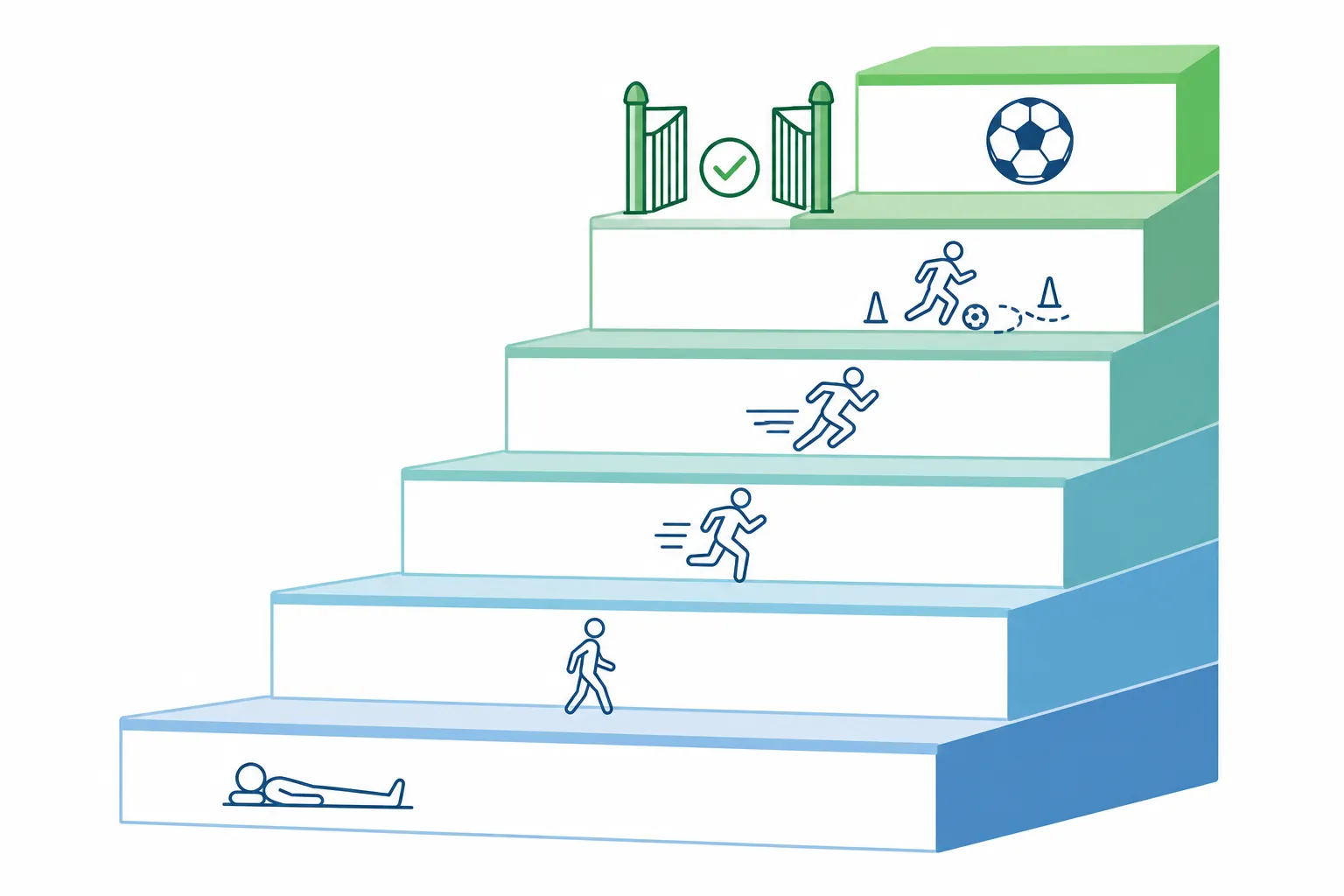
| CDC step | What this looks like for a youth soccer player | Adult checkpoint |
|---|---|---|
| 1. Back to regular activities | Regular daily routine such as school, as tolerated and guided by the healthcare provider | The child is functioning in ordinary life before sport is added |
| 2. Light aerobic activity | Easy walking or light stationary movement; no resistance training and no soccer ball work | No symptom return at this level |
| 3. Moderate activity | More movement and moderate aerobic work, still controlled and non-contact | Symptoms remain absent during and after the activity |
| 4. Heavy, non-contact activity | Harder exercise, sprinting-type work, and non-contact sport-specific drills if cleared for that stage | Still no heading, scrimmage, collision, or uncontrolled play |
| 5. Practice and full contact | Normal training activities only after medical clearance for contact risk | A healthcare professional has cleared the player before contact/collision exposure |
| 6. Competition | Return to games | Heading and match play return last, not early |
The minimum timing matters because a child can look fine at breakfast and still have symptoms return after exertion. A six-step progression with at least 24 hours per step cannot be honestly compressed into a weekend. If symptoms reappear at Step 3, the player is not “basically at Step 4.” They are a child whose brain and body did not tolerate that level yet.
The adult roles should be clear. The healthcare professional clears medical readiness. The coach controls access to practice activities. The parent watches the child outside the field, where symptoms often show up after the brave face comes off. The player gives honest symptom feedback, but the player does not own the final decision to return.
What if symptoms return during a step?
Stop that activity. Do not negotiate down from scrimmage to “just a few headers” or from sprints to “just finishing the drill.” The CDC progression is built around the rule that the athlete advances only when symptom-free at the current level, with each stage taking at least 24 hours. [4]
A practical way to handle this is to write down the step, the activity, when symptoms appeared, and how long they lasted. That gives the clinician something better than a vague report that practice “didn’t go great.”
Where heading rules fit—and where they do not
U.S. Soccer’s heading restrictions are part of the safety background, especially for younger age groups. The Concussion Initiative, effective in January 2016, bans heading in practice and games for players 10 and under. For players 11 to 13, it limits heading training to 30 minutes per week, with 15–20 headers per player per week, while games are not restricted in the same way. [5]
Those age-band rules reduce exposure, but they do not replace concussion management. A child can sustain a concussion from a fall, elbow, ball impact, head-to-head collision, or awkward landing. And once a concussion is suspected, the recovery protocol is concussion-general. The CDC ladder, ACSM rest guidance, and Amsterdam-style gradual exertion approach are not proof that soccer heading has a youth-specific recovery shortcut. They are the safer general process after suspected concussion.
Heading comes back last because it is not just fitness. It deliberately reintroduces head impact. A player who can jog, sprint, and run non-contact drills without symptoms has not yet shown that they should be heading balls in traffic. Medical clearance comes before contact or collision risk, and heading belongs on the far side of that gate. [3]
Set expectations without promising a fixed recovery date
Parents usually want a calendar answer: tournament next weekend, school tryouts in two weeks, championship at the end of the month. The honest answer is that recovery varies. Concussion Alliance summarizes typical youth recovery as about one month for children and about 28 days for adolescents, and says 15–30% develop persistent post-concussive symptoms. [3]
Those numbers are useful for expectations, not for forcing a deadline. A player who feels better quickly still has to progress step by step. A player whose symptoms persist is not failing recovery; they need continued medical guidance and adjusted expectations. The process protects both children: the one who wants back too soon and the one who needs more time than the sideline expected.
The boundary for parents and coaches
After a youth soccer head injury, the safest adult script is plain: remove the player, use the evaluation protection built into the substitution rule, get medical guidance, allow 24–48 hours of relative rest, reintroduce light activity only as symptoms allow, and then follow the six-step return-to-play progression with at least 24 hours per step.
No complete cocooning by default. No early return because the child looks eager. No heading until the final stage after medical clearance.
References
- The Concussion Initiative and Reducing Heading, U.S. Soccer
- Exercise & Rest in Concussion Recovery, American College of Sports Medicine
- Recovery Guide for Children & Adolescents, Concussion Alliance
- Returning to Sports, CDC HEADS UP
- Head Injuries, US Club Soccer
This is general fitness education, not medical advice. For diagnosis or treatment of pain or injury, consult a qualified clinician.
Pick your next session
Browse all routines to find an appropriately-spaced next session.
Spot something off?
This content sits adjacent to health guidance — tell us if a citation or figure needs a correction.