
When an Excessive Heat Warning Means It's Time to Rest
An Excessive Heat Warning makes unconditioned home gyms dangerously hot. This article explains the heat index thresholds, physiological risks, and when the safest choice is to rest instead of train.
If your phone says Excessive Heat Warning and the plan says heavy lower body, the weather alert gets a vote. In many National Weather Service offices, that warning means the heat index is expected to reach at least 105°F for two or more consecutive hours; some regions use different criteria, including higher thresholds, because local heat risk varies. The NWS guidance at this alert level is blunt: avoid outdoor activities.[1] A sealed garage, shed, or small room without air conditioning is not a loophole.
For home training, the precaution is simple: do not decide from the calendar, the program, or how disciplined you felt yesterday. Decide from the heat index where you will actually train, the airflow in that space, and whether your body is acclimated to that level of heat.
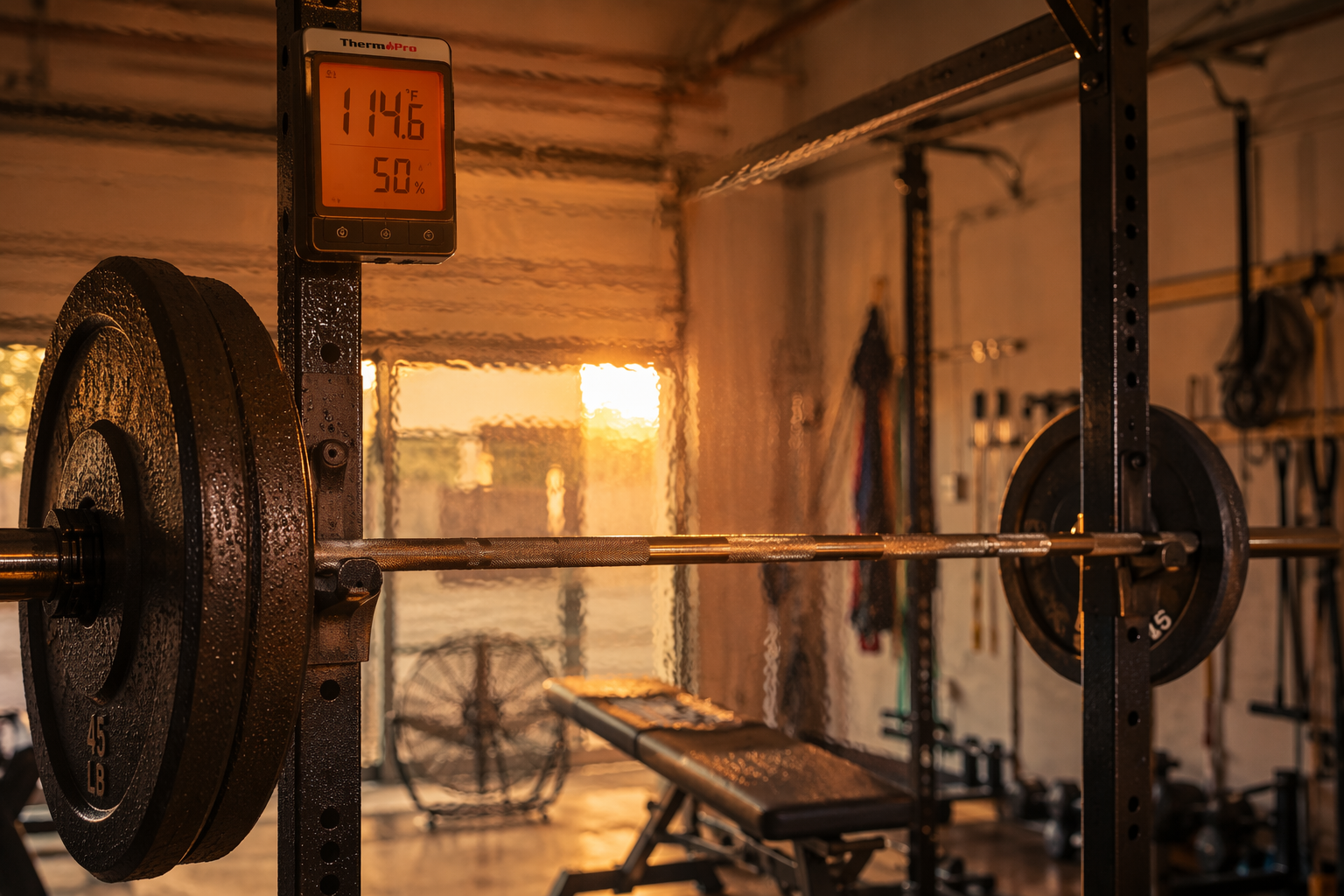
The Warning Applies Before the Warm-Up Starts
A weather warning is not a prediction that every person will get sick. It is a public-health threshold saying the environment is dangerous enough that ordinary behavior needs to change. For a home gym owner, the mistake is assuming “indoors” means protected. Mayo Clinic cautions that garages and other enclosed workout spaces can trap heat, especially when they lack air conditioning or meaningful ventilation.[2]
That matters because a garage session is often more thermally stubborn than an outdoor session. Outside, even a small breeze can help sweat evaporate. In a closed garage, the air may barely move. Concrete, vehicles, metal doors, roofing, and stored equipment can hold radiant heat. Humidity slows evaporation. A fan that only pushes hot, humid air around may feel better without making the room safe enough for heavy work.
The practical question is not “Can I tolerate discomfort?” It is “Can this room help my body dump heat faster than the workout adds it?” During an Excessive Heat Warning, an unconditioned home gym often gives the wrong answer.
Why a Hot Garage Changes the Physiology
Training already generates heat. Add extreme ambient heat, still air, and humidity, and the cooling system has to compete with the workout itself. Heat stress pulls more blood flow toward the skin so the body can cool itself, while working muscles still need oxygenated blood to keep producing force. Researchers and exercise scientists describe this as a direct competition: skin and muscle are asking for the same cardiovascular supply at the same time.[3]
That is why the same set of squats or kettlebell swings can feel strangely expensive in a hot room. Heart rate climbs for a workload that would normally be manageable. Power output can drop. Rest periods stop feeling restorative. The session becomes less about training adaptation and more about whether the body can keep core temperature from rising too quickly.
Sun is not the only heat problem, either. NPR’s heat-exercise guidance notes that shade can be more than 20°F cooler than direct sun, which helps explain why radiant exposure matters outdoors.[4] Indoors, the equivalent problem is trapped heat: a garage door, roof, pavement, and walls can keep releasing warmth into a space long after the day has peaked. By late afternoon, the garage may be hottest exactly when the training plan says it is time to lift.
This is where toughness becomes a poor screening tool. Early heat strain can look like an unusually bad workout: heavy legs, high breathing, a headache, or an odd inability to focus. Waiting until dizziness or confusion appears means the decision has already moved from prevention to response.
Three Checks Before You Train
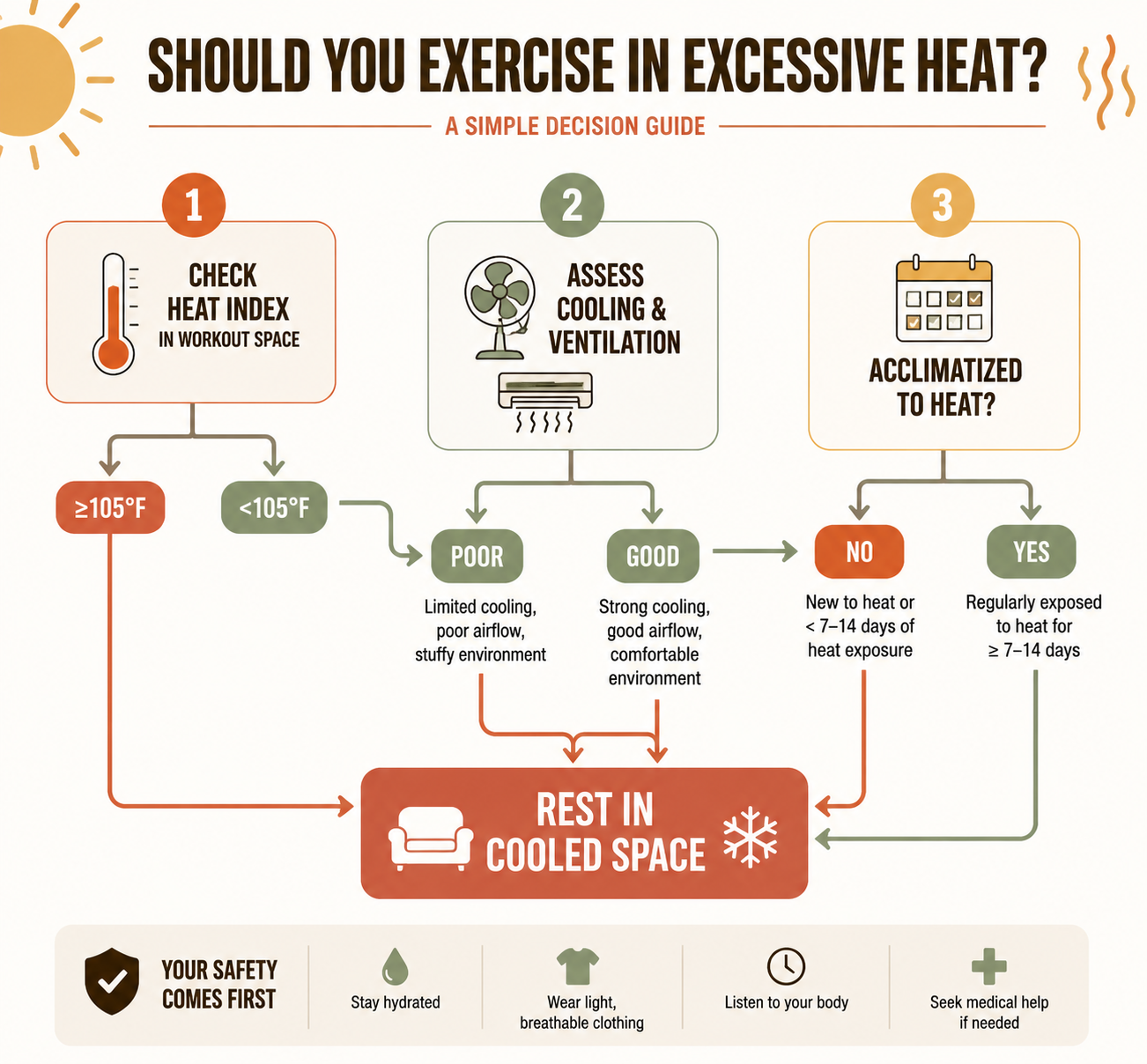
Before a home-gym workout during an Excessive Heat Warning, use three checks. They are intentionally plain because the decision has to work while you are standing near the rack, not after reading a sports-medicine textbook.
| Check | What You Are Looking For | What Stops the Workout |
|---|---|---|
| Heat index in the actual workout space | Temperature plus humidity where the workout will happen, not just the forecast for town | The room is at or near warning-level heat, or you cannot tell because you have no reliable reading |
| Cooling and ventilation | Air conditioning, cooler replacement air, or real cross-ventilation | No AC, no meaningful airflow, or only a fan moving hot stagnant air |
| Heat acclimatization | Repeated recent exposure to similar heat over roughly 7–14 days | This is your first hot session, you have been training mostly in AC, or the heat jumped suddenly |
The first check is the one many home gym owners skip. The outdoor forecast is useful, but your workout space has its own conditions. If you do not know the temperature and humidity in the room, you are guessing. Guessing is not a good precaution when the public alert is already telling you the environment is dangerous.
The second check is not just “Do I own a fan?” Airflow helps when it supports evaporation and brings in less hostile air. Cross-ventilation, open doors at cooler times, insulation, dehumidification, and air conditioning all change the risk calculation. For long-term fixes, a garage gym environmental checklist is worth treating as training infrastructure, not home-improvement decoration.
The third check is acclimatization. Mayo Clinic and other exercise-heat guidance describe heat acclimatization as a process that takes roughly 7–14 days of repeated exposure, not a mindset you can declare on the first brutal afternoon.[2][3] If you have been training in air conditioning and the first warning of the season arrives, your body has not earned the same margin as someone who has gradually adapted.
When Rest Is the Correct Training Decision
There are days when modification is reasonable: early morning, cooled room, low intensity, plenty of airflow, and a body that has already adapted to similar heat. An Excessive Heat Warning in an unconditioned space is often not that day.
Rest or move to low-intensity recovery in a cooled space when any of these are true:
- The heat index in the workout space is at or near the warning threshold.
- The garage, shed, or room has no air conditioning and no meaningful cross-ventilation.
- You are not acclimated to this level of heat over the past 7–14 days.
- The planned workout is heavy, high intensity, long, or conditioning-based.
- You already have a headache, nausea, unusual fatigue, dizziness, weakness, cramps, or trouble concentrating.
- You have a history of heat illness, cardiovascular disease, relevant medication concerns, or another medical risk factor that has not been discussed with a healthcare provider.
The CDC lists symptoms such as heavy sweating, cold or clammy skin, dizziness, headache, nausea, weakness, and muscle cramps among heat illness warning signs for athletes and exercisers.[5] Confusion, fainting, or loss of consciousness moves the situation into emergency territory. Those are not cues to shorten the finisher. They are cues to stop, cool down, and get medical help when needed.
Heavy lifting deserves special caution because it is easy to underestimate its heat load. A long set of squats in a still room, followed by bracing, belt pressure, and repeated setup attempts, is not a gentle mobility session. Conditioning circuits are even more obvious: they add metabolic heat fast and leave less time for the body to recover between efforts.
Hydration Helps, but It Does Not Cancel the Alert
Water matters. It is just not a permission slip. Texas Heart Institute suggests drinking 16–20 ounces one to two hours before exercise, then 5–10 ounces every 15–20 minutes during activity, with post-exercise replacement based on sweat loss.[6] NPR’s heat-exercise guidance gives a similar practical range of about 0.5–1 liter per hour during exercise, while CDC heat guidance commonly uses broader cup-per-hour prevention language for hot conditions.[4][5]
Those numbers are reference points, not a guarantee. A hydrated person can still overheat in a trapped, humid garage. Electrolytes may become more relevant when sessions last longer than about an hour or sweat losses are high, but the better decision during a warning may be to remove the heat-generating workout rather than engineer a longer fluid plan.[6]
The same restraint applies to cooling tricks. Cold towels, ice, and cool showers can help lower heat strain. Johns Hopkins Medicine recommends cooling areas such as the neck, armpits, and groin when treating exercise-related heat exhaustion symptoms.[7] BBC Future describes pre-cooling approaches such as ice slurry and hand or forearm cooling in athletic contexts.[3] Useful does not mean sufficient. Cooling tactics are supports around a safe plan, not a way to make an unsafe room safe.
If You Modify, Make the Workout Smaller Than Your Ego Wants
Modification belongs in a narrow lane: cooled space, lower intensity, shorter duration, more rest, and a clear stop rule. The American Heart Association recommends choosing cooler times, such as before 10 a.m. or after 6 p.m., when being active in warm weather.[8] In a garage, that advice still depends on the room itself; some enclosed spaces stay hot well after the outdoor temperature starts to fall.
A modified session might be light mobility in an air-conditioned room, easy walking indoors, gentle bands, breathing work, or technique practice that never raises breathing hard. It is not the same heavy workout with longer rest periods and an extra bottle nearby.
This is similar to making a workout decision around wildfire smoke or poor air quality: the environment changes the session before motivation enters the conversation. If that way of thinking helps, the same condition-based logic used for an indoor workout when air quality is bad applies here too. The room is part of the workout prescription.
What to Do Instead
The replacement for a dangerous heat session does not have to be dramatic. Move into a cooled space. Walk easily if that space allows it. Do mobility, light stretching, soft-tissue work, or the low-effort pieces of your usual post-workout recovery routine at home. Keep the ritual without adding a heat load.
If symptoms are already present, stop exercising and cool down. Move to air conditioning if possible, loosen clothing, sip fluids if alert and not nauseated, and use cold towels or cool water. The Academy of Nutrition and Dietetics notes that heat exhaustion can progress to heat stroke in as little as 10–15 minutes in extreme heat, which is why waiting to “see if it passes” is a poor bargain.[9]
People with cardiovascular disease, prior heat illness, pregnancy, older age, certain medications, or other medical vulnerabilities need more individualized advice than a general training article can provide. That is a healthcare-provider conversation, especially before exercising in severe heat.
The Safer Call
Extreme heat is not a minor inconvenience. CDC climate-health materials report that more than 700 people die from extreme heat in the United States each year.[10] A garage workout is not worth becoming part of the preventable side of that statistic.
So if the warning threshold is high, the room is unconditioned, airflow is poor, and you are not acclimated, the precaution is not a better playlist, a bigger bottle, or a promise to stop if things get weird. The safest training decision is to skip the heat-generating session and recover in a cooled space.
References
- Understanding Heat Alerts, National Weather Service.
- Mayo Clinic Q&A: Safety tips for hot weather exercise, Mayo Clinic News Network.
- How to exercise safely in hot weather, BBC Future.
- How to exercise safely in the heat, NPR, July 19, 2021.
- Heat and Athletes, Centers for Disease Control and Prevention.
- Hot Weather Exercise Tips, Texas Heart Institute.
- Exercise-Related Heat Exhaustion, Johns Hopkins Medicine.
- How to Be Active Safely in Warm Weather, American Heart Association.
- Exercise Safely in Hot Weather, Academy of Nutrition and Dietetics.
- Protect Yourself From the Dangers of Extreme Heat, Centers for Disease Control and Prevention.
Have a question about this guidance?
This is a question and correction channel, not an open discussion thread — recovery topics sit close to a medical-advice boundary, so we review submissions rather than publishing them instantly.