How to Spot Heat Exhaustion Symptoms During Home Workouts
Learn to recognize the warning signs of heat exhaustion during home workouts in non-climate-controlled spaces, distinguish them from normal exercise fatigue, and know when to seek emergency medical attention.
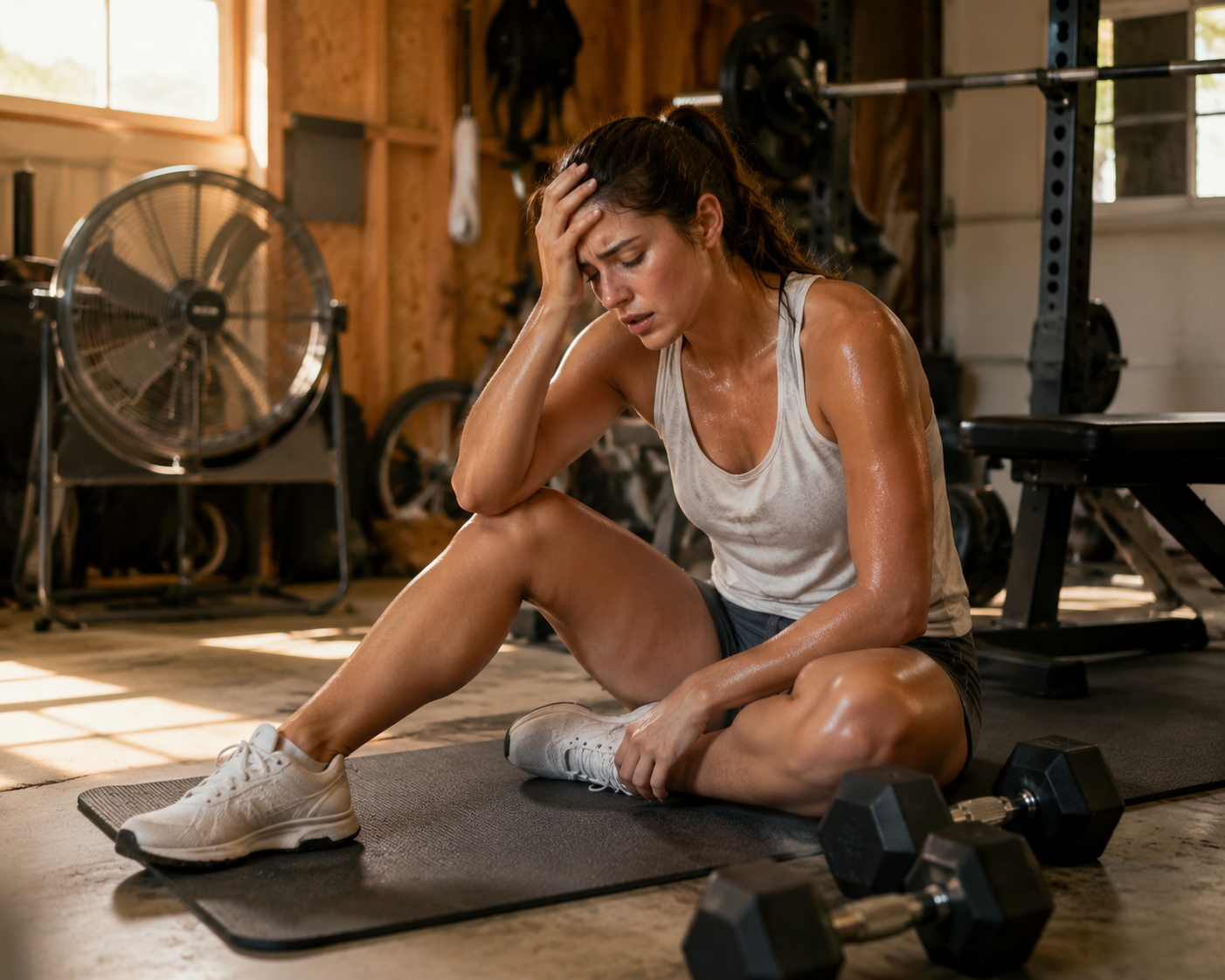
Halfway through a hard home workout, heat exhaustion symptoms during exercise can look frustratingly similar to ordinary effort: you are sweating hard, your heart is racing, your legs feel unreliable, and nausea may feel like one more signal that the interval is doing its job. In a garage, spare room, or apartment without reliable cooling, that uncertainty is the problem. The safer question is not, “Can I finish?” It is, “Do I have signs that should stop this session now?”
Stop the workout when overheating comes with a cluster such as heavy sweating, dizziness, nausea, headache, cool or clammy skin, a weak rapid pulse, or feeling faint when you stand. Mayo Clinic lists heavy sweating, faintness, dizziness, fatigue, weak rapid pulse, low blood pressure upon standing, muscle cramps, nausea, and headache among heat exhaustion symptoms, and it advises seeking medical help if symptoms worsen or do not improve within one hour after cooling and rest.[1]
The Decision Point: Stop First, Diagnose Later
A solo exerciser does not need to prove heat exhaustion perfectly before acting. Symptoms overlap with dehydration, poor pacing, lack of sleep, and a hard training day. That overlap is exactly why the first move should be conservative: stop exerting, move to the coolest available place, loosen unnecessary layers, rest, and drink fluids if you are alert and able to swallow normally.
Temperature numbers can help clinicians, but they are not a useful home-gym sorting tool. Cleveland Clinic describes heat exhaustion as often involving a body temperature between 101 and 104°F, while heat stroke involves a core temperature of 104°F or higher with brain-related symptoms such as confusion, slurred speech, or loss of consciousness.[2] At home, you are not reliably measuring core temperature during a workout. You are watching behavior.
| What you notice | What to do |
|---|---|
| Heavy sweating, dizziness, nausea, headache, clammy skin, weakness, or a weak rapid pulse | Stop exercising, cool down, rest, and hydrate at a first-aid level if you can do so safely |
| Symptoms improve with cooling and rest | Do not restart the workout; keep monitoring and recover |
| Symptoms do not improve within 60 minutes | Seek medical help |
| Confusion, irrational behavior, altered consciousness, or loss of consciousness | Treat it as an emergency and get help immediately |
The Two Questions That Matter Most
Once the workout has stopped, use two questions. First: are there central nervous system signs? In plain home-gym language, that means confusion, irrational behavior, altered consciousness, strange decision-making, or passing out. If yes, do not wait for the one-hour mark. Heat stroke is a medical emergency, and CDC/NIOSH notes that during heat stroke body temperature can rise to 106°F or higher within 10 to 15 minutes.[3]
The Korey Stringer Institute describes exertional heat stroke as a core body temperature over 104°F with central nervous system dysfunction, including disorientation, confusion, dizziness, irrational behavior, or loss of consciousness.[4] That list matters because a person training alone may try to reinterpret dangerous behavior as grit: wandering around instead of cooling down, insisting on finishing one more round, failing to follow simple steps, or acting unusually agitated.
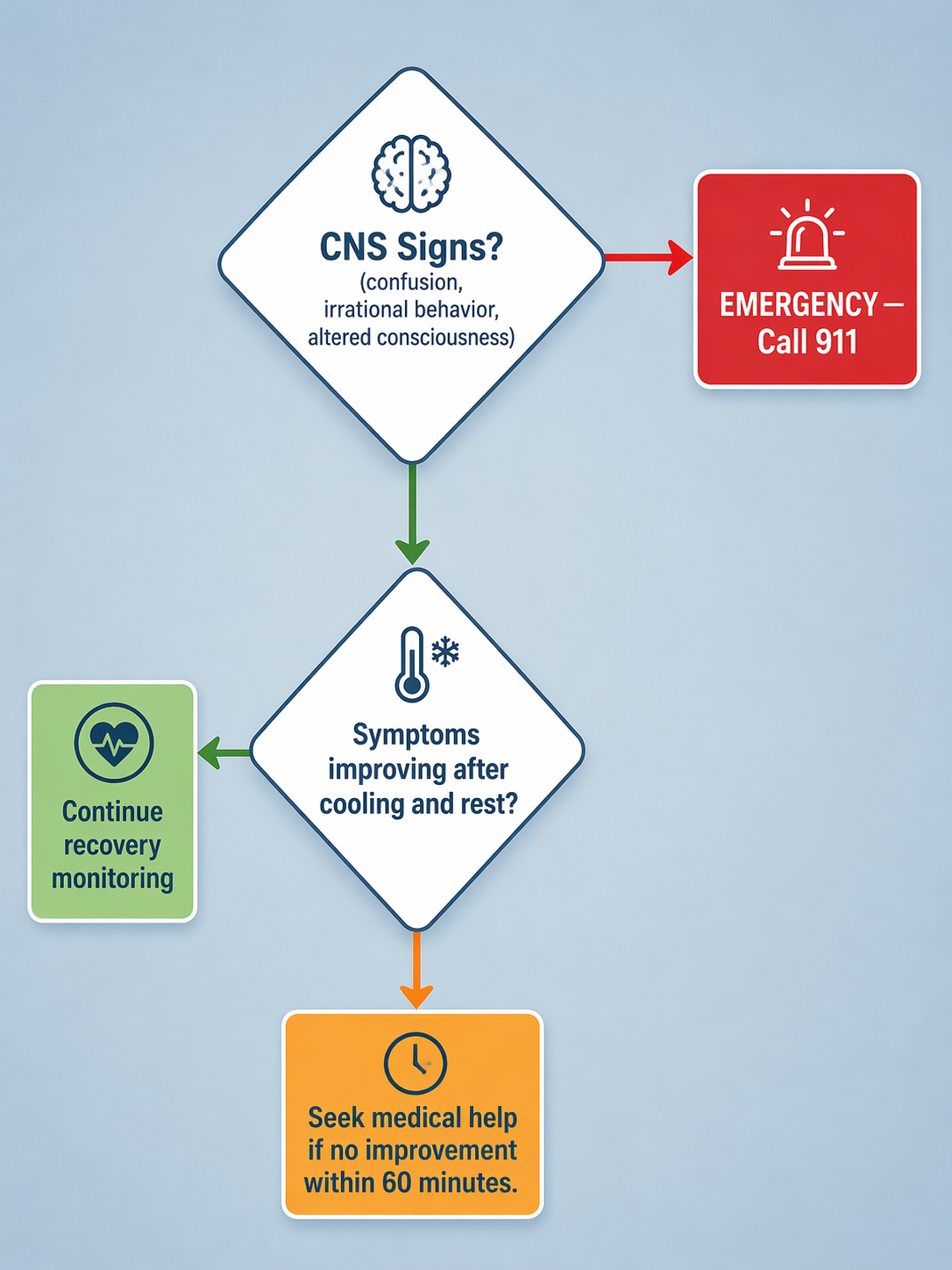
Second: if there are no CNS signs, do symptoms improve within one hour after cooling and rest? Mayo Clinic’s one-hour boundary is useful because it gives a tired person a line that does not depend on motivation or pride.[1] If dizziness, nausea, headache, weakness, clammy skin, or faintness are not improving after that hour, medical help is the next step.
Why Home Workouts Make Heat Symptoms Easier to Miss
The symptom list is not special to indoor training. Heat illness can happen outdoors, at work, in sport, or in a home workout space. What changes at home is the setting around the symptoms. A garage can heat gradually while you warm up. A fan may move hot air without making the room meaningfully safer. A second-floor apartment may hold heat even after sunset. A spare room can feel tolerable during mobility work and punishing once intervals begin.
This home-gym risk profile is an application of established heat-illness guidance, not a direct finding from a home-gym-specific study. The practical concern is still real: enclosed heat, limited airflow, and solo training remove cues that often interrupt outdoor exercisers. There may be no shade to step into, no coach watching your face, and no training partner saying you are acting off.
Garage exercisers should treat the room itself as part of the workout load. If the space is hot before the first set, the session starts with less margin. For setup-level checks around temperature, moisture, flooring, and electrical safety, see the garage gym environmental checklist. Apartment exercisers have a different version of the same problem: small rooms, neighboring noise concerns, and limited equipment footprint can push training into tight corners with poor airflow. The compact home gym equipment guide for apartments is useful when space constraints are shaping where and how you train.
Reading the Symptoms Without Overreading Them
Heavy sweating alone does not prove heat exhaustion. Neither does nausea after a brutal conditioning block. A headache could come from several causes. The safer reading is cumulative: symptoms that appear together, intensify in a warm space, or fail to ease after stopping deserve a heat-illness response.
- Heavy sweating matters more when it comes with weakness, dizziness, nausea, headache, or clammy skin.
- Dizziness matters immediately if you feel unstable, faint, or unable to move safely around equipment.
- Nausea matters more when it does not settle after stopping or when drinking normally becomes difficult.
- A weak rapid pulse, cool moist skin, or low blood pressure when standing fits the heat exhaustion pattern described by medical sources.[1][2]
- Confusion, irrational behavior, altered consciousness, or loss of consciousness changes the situation from monitoring to emergency action.[2][4]
The person most likely to minimize these signs is often the person training hardest. That is why the decision should be made before the bargaining starts. If you feel dizzy and nauseous in a hot room, the set is over. If cooling and rest work, you still do not need to resume the session. If they do not work within an hour, you need medical help.
What Cooling and Rest Mean at a First-Aid Level
For a home exerciser, first-aid-level cooling is deliberately simple: stop moving, get out of the hottest room if you can, sit or lie down, remove extra layers, use cooler air or cool cloths if available, and sip fluids if you are fully alert and not vomiting. This is not a treatment protocol for heat stroke. It is the immediate response while you judge whether symptoms are improving or whether the situation has crossed into medical care.
Do not use the one-hour rule as permission to sit alone through worsening symptoms. Mayo Clinic’s self-care window applies when symptoms are not worsening and there are no emergency signs; it also says to seek immediate medical attention if symptoms get worse.[1] If behavior changes, consciousness changes, or the person cannot safely drink and cooperate with cooling, the hour is no longer the relevant clock.
After the heat-illness question is resolved, general recovery habits can wait their turn. For ordinary post-session recovery practices, use a broader guide such as your complete post-workout recovery routine at home. During a possible heat illness episode, recovery content is secondary to stopping, cooling, monitoring behavior, and knowing when to get help.
The Threshold to Keep
Heat exhaustion is not identified by one symptom in isolation, and a home exerciser cannot depend on an accurate core-temperature number. Use the signs you can observe. A cluster of heavy sweating, dizziness, nausea, headache, clammy skin, weakness, or a weak rapid pulse should stop the workout and start cooling and rest. Any confusion, irrational behavior, altered consciousness, or loss of consciousness means emergency help now. If symptoms do not improve within 60 minutes after cooling and rest, seek medical help.
References
- Heat exhaustion - Symptoms and causes, Mayo Clinic
- Heat Exhaustion: Symptoms & Treatment, Cleveland Clinic
- Heat-related Illnesses, CDC/NIOSH
- Heat Stroke, Korey Stringer Institute
Have a question about this guidance?
This is a question and correction channel, not an open discussion thread — recovery topics sit close to a medical-advice boundary, so we review submissions rather than publishing them instantly.