
Broadway Dance Workouts at Home, No Equipment Needed
Broadway dance workouts are a surprisingly effective zero-equipment cardio option for apartment dwellers. This guide covers the space requirements, free online resources, and evidence showing dance can reduce body fat and waist circumference while being more enjoyable than traditional cardio.
Before you start
- Equipment required
- none
- Assumes build tier
- No specific tier required
- Difficulty
- beginner
- Noise level
- quiet
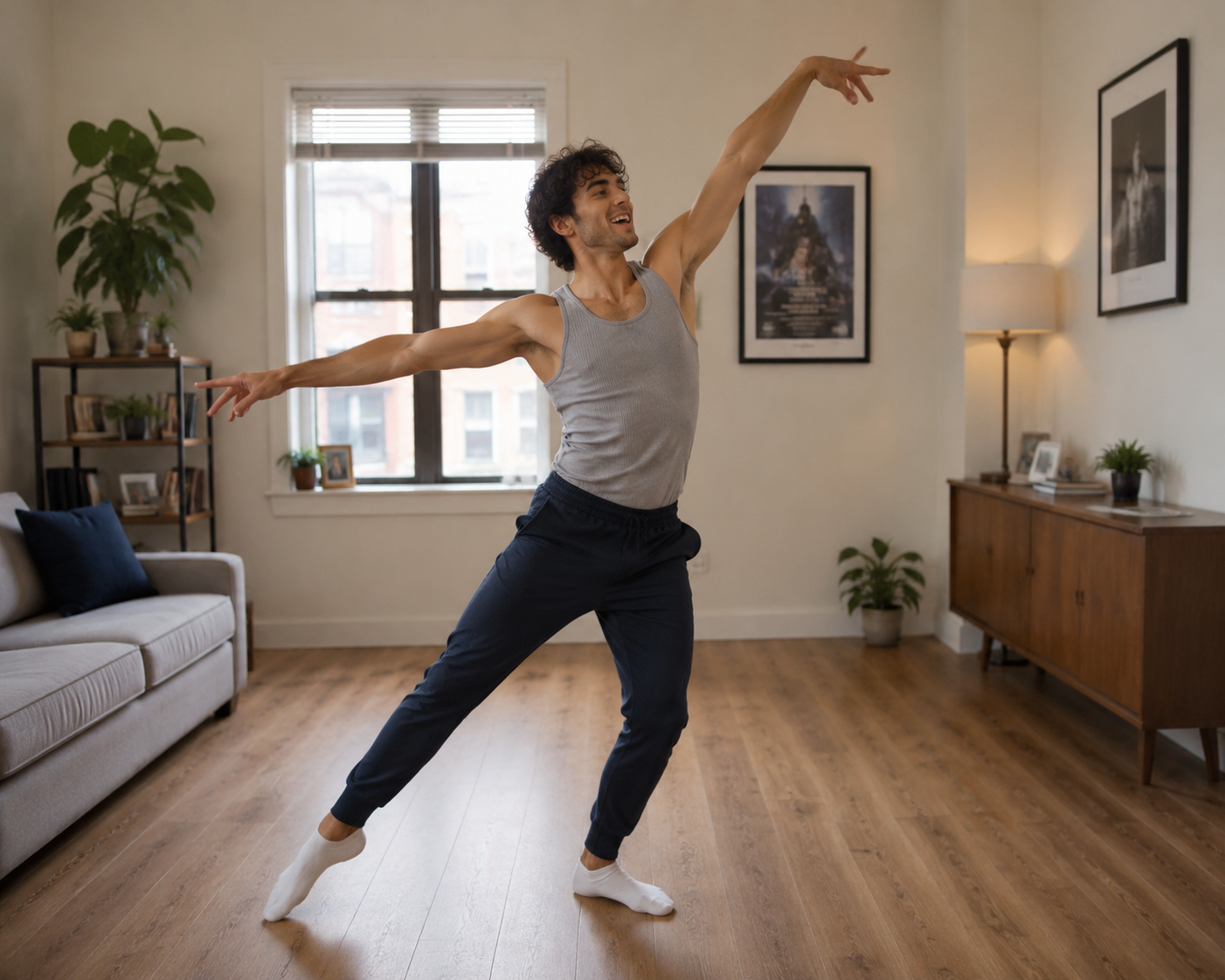
Yes, you can do a Broadway dance workout at home without equipment, without a dedicated workout room, and without turning your apartment into a tap studio. The practical version is simple: clear about a 4x4 ft patch of floor, choose low-travel choreography, filter for low-impact or no-jumping videos, and treat the session like cardio instead of a performance. That 4x4 ft figure is a practical estimate, not a lab-tested rule; it lines up with small-space apartment workout guidance and dance-in-apartment advice that emphasize compact movement, furniture shifting, and low-impact choices over big traveling steps.[1][2]
The appeal is not that Broadway branding magically makes cardio better. It is that the music carries the work. Instead of counting down another set of silent high knees, you are stepping, reaching, turning, and hitting accents in a way that can feel like a real routine even when your coffee table is shoved against the wall.
For the CDC’s 150 minutes per week of moderate-intensity aerobic activity, five 30-minute sessions is the cleanest way to think about it: Monday through Friday, or three weekday sessions plus two weekend sessions. If 30 minutes sounds too optimistic on week one, start with 10 or 15. A short routine you repeat beats the perfect cardio plan you close after two videos.
Why dance counts as more than “fun movement”
The strongest evidence here is not a Broadway-specific trial. It is broader dance-intervention research, which is the right place to be careful. A YouTube Broadway jazz class in your living room is not identical to a supervised randomized trial. Still, the evidence makes it hard to dismiss dance as lightweight exercise.
A 2024 systematic review and meta-analysis in PLoS One looked at 10 randomized controlled trials with 646 participants and found that dance interventions, compared with normal lifestyle, reduced body mass by 1.92 kg, BMI by 1.03 kg/m², body fat by 2.23%, and waist circumference by 2.95 cm.[3]
Those are body-composition outcomes, not just mood scores or “people liked the class” notes. The review also concluded that dance produced body-composition improvements comparable to other aerobic exercise, and that creative dance forms showed more pronounced improvements than traditional dance forms, especially among adults younger than 45 years.[3] Broadway-style home workouts sit closer to that creative-dance side than to a fixed folk or ballroom format, but that connection should stay modest: the review supports dance as a credible aerobic intervention, not every video with jazz hands as an equal dose of exercise.
The limits matter. The meta-analysis focused on people with overweight and obesity, using a BMI threshold above 24, so the results should not be stretched to every body size and training background.[3] The study samples were also predominantly female, with an approximate 1:5 male-to-female ratio, which means the evidence base says less about male participants than it should.[3] None of that cancels the finding; it just keeps the conclusion honest.
For an apartment exerciser, the useful takeaway is narrower and stronger: dance can create measurable aerobic work and body-composition change when practiced consistently. Broadway dance workouts at home are one accessible way to get that dose without buying a machine, drilling into a ceiling, or negotiating with a treadmill you cannot store.
Set up the room before you choose the video
The apartment problem is usually solved before the warm-up starts. Move the coffee table. Check for rug corners. Put water somewhere you will not kick it. If you are above someone else, shoes matter: a soft sneaker or bare feet on a stable surface will usually be quieter than hard soles, but the right choice depends on your floor and your joints.
| Constraint | What to do before pressing play |
|---|---|
| Small floor area | Clear about 4x4 ft and pick low-travel choreography. |
| Downstairs neighbor | Choose no-jumping or low-impact videos and replace hops with step-touches. |
| Beginner coordination | Start with shorter jazz cardio or beginner-labeled Broadway workouts. |
| Low motivation | Use songs you actually like; adherence is the point. |
| Uncertain intensity | Use the talk test: you should be breathing harder but still able to speak in short phrases for moderate work. |
A real no-jumping Broadway dance workout should not suddenly become burpees-with-music halfway through. Preview the video timeline if you are on an upper floor. Look for words like “low impact,” “no jumping,” “apartment friendly,” “beginner,” or “standing.” Then watch the first minute of movement, not just the title. YouTube labels are useful, but they are not heart-rate testing and they do not guarantee a measured intensity level.
The easiest substitutions are boring because they work. A jump becomes a heel lift. A traveling grapevine becomes two side steps. A turn becomes a pivot or a step-tap. A dramatic reach can stay dramatic while your feet stay glued to the floor. If the instructor adds a hop on the chorus, you do not need to follow it to stay in the workout.
If you want a broader menu of quiet cardio swaps, keep this no-jumping apartment cardio guide nearby. Broadway dance is one good lane, not the only way to avoid thudding through your floor.
A workable week without turning your home into a studio
The mistake is trying to make the first week feel like a class package you bought. Keep the first week almost too easy. The win is proving that the setup is tolerable: the furniture moves quickly, the noise stays reasonable, and you finish wanting to do it again.
| Week | Session target | Best video type |
|---|---|---|
| Week 1 | 3 sessions of 10-20 minutes | Short beginner jazz cardio or low-impact Broadway dance |
| Week 2 | 3-4 sessions of 20-30 minutes | Beginner to intermediate Broadway dance or no-jumping HIIT/Pilates |
| Week 3 | 4 sessions of 25-35 minutes | Mix short cardio with one longer class-style session |
| Week 4 | 5 sessions around 30 minutes, if recovery feels good | Use favorite routines and repeat them instead of searching every day |
Repeating a video is not cheating. It is often the point. The first pass is choreography tax: you are learning where the arms go and which direction the combination travels. The second or third pass is where the workout usually gets better, because less attention goes to decoding and more goes to effort.
If you prefer a more formal progression, compare this with the 4-week progressive home cardio plan. The bodyweight plan is cleaner if you like structure and exercise names. Broadway dance is better if music and repetition make you show up.
Free places to start, current as of July 2026
Free YouTube workouts are a gift and a small nuisance. They can disappear, gain ads, change upload patterns, or shift behind paid offers. As of July 2026, these are still useful starting points, but it is worth saving two or three backups instead of depending on one perfect video.
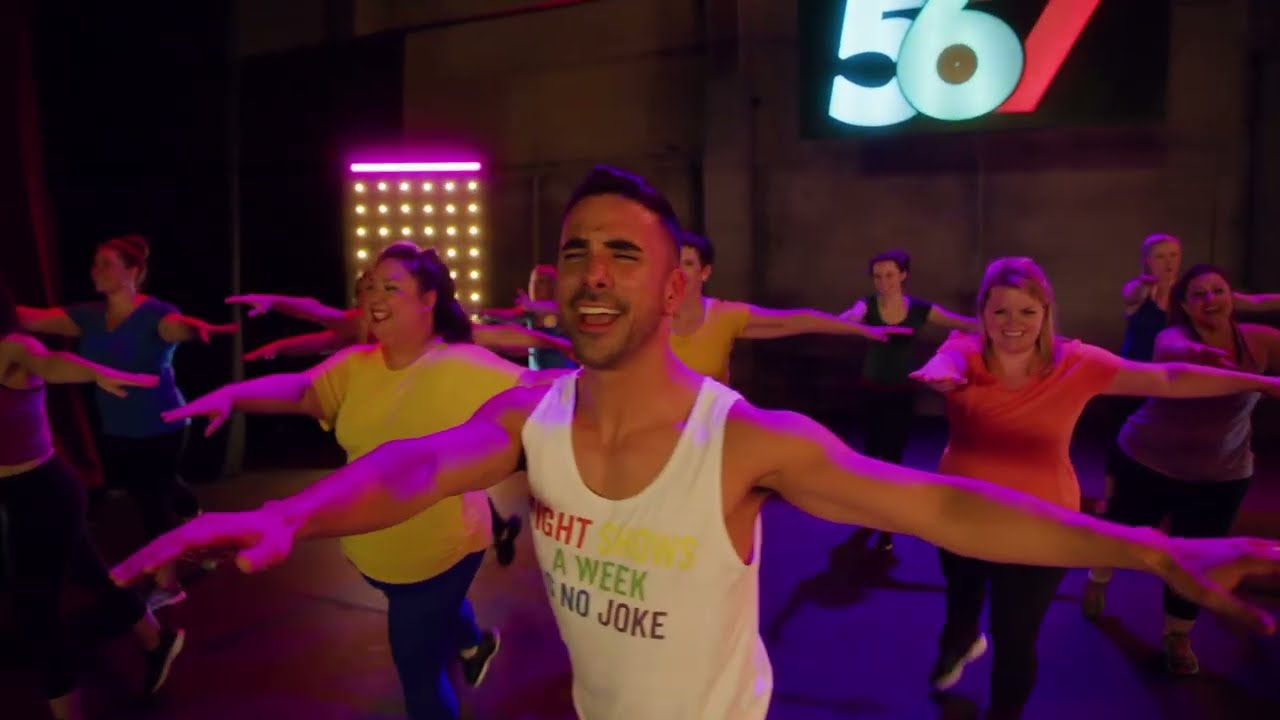
- Joseph Corella’s 567BROADWAY: a recognizable Broadway-dance workout lane with sessions described as 15-60 minutes and suitable for multiple levels, including free YouTube content.[4]
- emkfit: useful when you want Broadway Pilates, Broadway HIIT, or no-jumping formats that feel more fitness-class than dance-class.
- Frank Soares: a good place to look for short jazz cardio when 10 minutes is the difference between doing something and doing nothing.
- Lainie Munro: better for days when you want a longer, class-style session rather than a quick cardio burst.
Pick by constraint, not by which thumbnail looks most exciting. If your floor is thin, start with emkfit-style no-jumping formats. If you are choreography-curious, try 567BROADWAY. If your attention span is the limiting factor, use a 10-minute jazz cardio video and stop negotiating. If you miss the feeling of an actual class, a longer Lainie Munro-style session may feel less like a clip and more like an appointment.
How to tell whether the workout is doing enough
A Broadway dance workout does not need to leave you flattened to be useful. For moderate cardio, breathing should be clearly elevated. You can talk, but you would not want to sing the whole number. If you finish every session feeling as if you only marked the choreography, add arm range, deepen the steps, choose a longer video, or reduce pauses between songs.
If the routine feels too intense for your knees, downstairs neighbor, or coordination, take out the bounce first. Keep the arms. Keep the timing. Keep the direction changes if they feel safe. The musicality can stay even when the impact drops.
This is where Broadway-style cardio has an advantage over many $0 apartment workouts. A silent circuit of squats, mountain climbers, and jumping jacks often depends on discipline from the first minute. Dance gives you another handle: the next phrase of music. That does not make it magic, but it can make consistency less grim.
When Broadway dance is the right $0 cardio choice
Choose a Broadway dance workout at home if your main barrier is not knowledge but friction. You already know you could do bodyweight cardio. You just do not want another routine that asks you to jump in place beside the sofa while hoping no one downstairs notices.
It is a weaker fit if you hate choreography, need precisely programmed intensity, or want strength training to be the main event. In that case, a structured bodyweight plan or another no-equipment indoor routine may serve you better.
For the second-floor renter, though, Broadway dance solves a very specific problem better than most free options. It needs no equipment. It can fit in a small cleared square. It can be modified to stay low-impact. The broader dance evidence supports real body-composition benefits when the work is repeated consistently. And because the session has music, phrasing, and a little drama, it has a better chance of becoming something you return to rather than another tab you meant to finish.
References
- Apartment Friendly Workouts That Pack a Punch - Workout Videos for Apartments & Small Spaces, Fitness Blender.
- Using Dance as a Workout in Your Apartment, Ayre & Oxford.
- Dance intervention improves body composition in people with overweight and obesity: A systematic review and meta-analysis, PLoS One, 2024.
- 567BROADWAY Workout, Joseph Corella.
Don't have the gear this routine assumes? Find the build that covers it.
Wondering how much rest you need after this? Read our ACSM-cited recovery reference.
Questions about form, substitutions, or a correction? Leave it below.
Comments
Join the discussion with an anonymous comment.