Dance Fitness Routines Inspired by DWTS for Home Workouts
Compare five DWTS dance styles — Cha-Cha, Samba, Jive, Salsa, and Quickstep — as effective no-equipment home cardio workouts. Learn which style burns the most calories, how much space you need, and how to get started without a partner or previous dance experience.
Before you start
- Equipment required
- none
- Assumes build tier
- No specific tier required
- Duration
- 15 minutes
- Difficulty
- beginner
- Noise level
- low
Clear the coffee table, check that the rug will not slide, and give yourself about a 6×6-foot patch of floor. That is enough room to turn five familiar ballroom and Latin styles from TV into no-equipment cardio: Cha-Cha, Samba, Jive, Salsa, and Quickstep. Twinkle Star Dance Academy gives 6×6 feet as a beginner-friendly home dance practice target, which is conveniently close to what many apartment living rooms can offer once one piece of furniture moves sideways [1].
The useful version is not a full ballroom routine. No partner frame, no costume, no heels, no dramatic travel across the floor. For home cardio, the question is simpler: can the step pattern repeat in place, raise your heart rate, and work your legs, glutes, and core without making the downstairs neighbor learn your playlist?
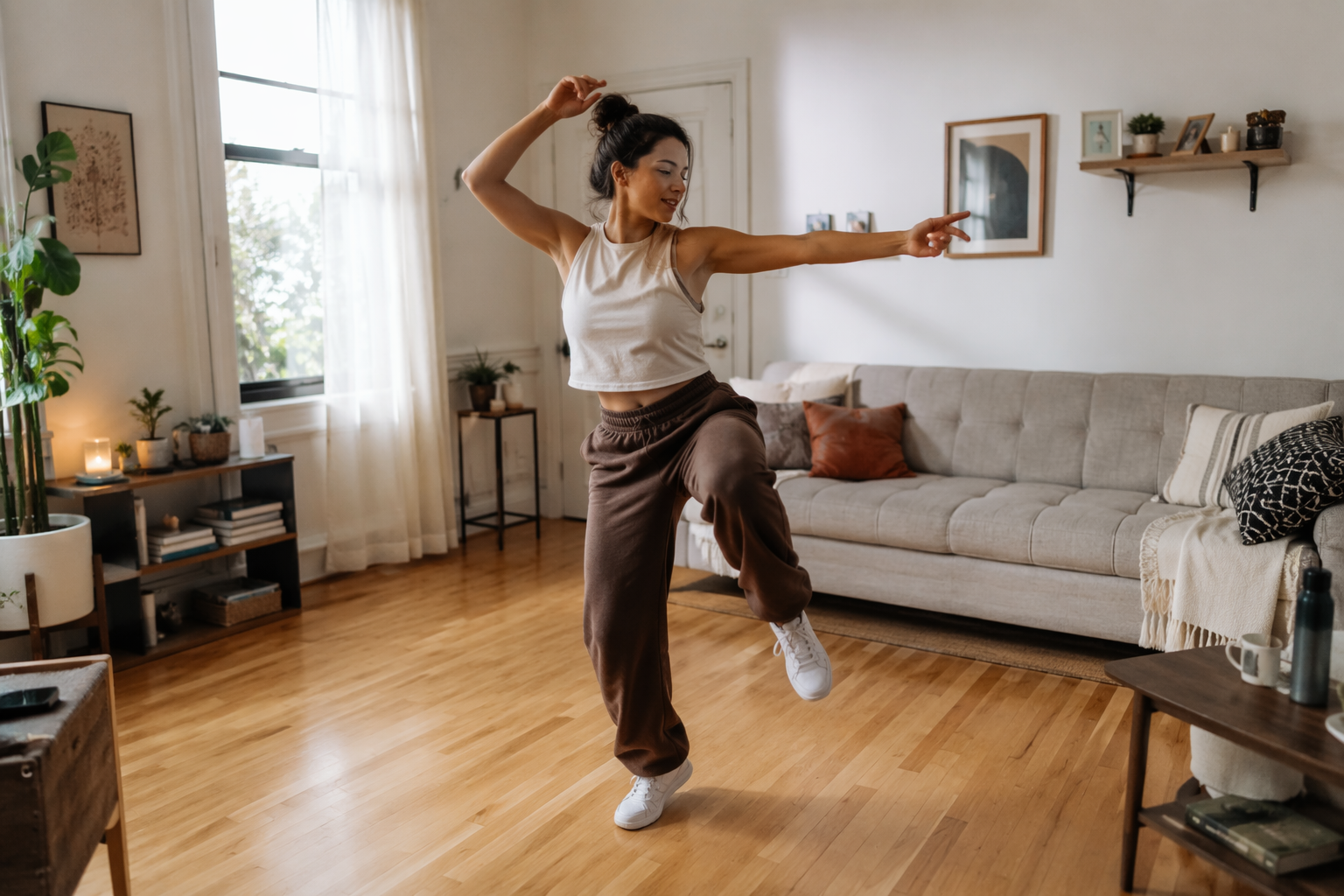
The quick comparison: which DWTS-inspired style fits your room?
Calorie numbers for ballroom styles get messy fast. Fred Astaire Dance Studios Montville and Dancewear Central publish per-style estimates and both treat Jive as one of the biggest calorie burners, with Fred Astaire Montville citing Jive at 500–700 calories per hour [2][3]. Healthline gives a steadier general anchor: a 150-lb person may burn about 200–300 calories in 30 minutes of fast ballroom dancing [4]. So the table below uses calories as a practical intensity guide, not as a promise your watch will match.
| Style | Calorie expectation | Space demand | Impact / noise | Beginner difficulty | Main muscles you’ll feel |
|---|---|---|---|---|---|
| Cha-Cha | Moderate; fits within the broader 200–700 cal/hr dance range when intensity rises | Very apartment-friendly; mostly compact side and forward-back steps | Low to moderate | Easiest starting point if you can count a steady rhythm | Calves, quads, glutes, hips, obliques |
| Samba | Moderate to high depending on bounce, tempo, and arm work | Compact if you keep the bounce under you | Moderate; can get noisy if you over-bounce | Moderate because the rhythm takes practice | Core, glutes, hips, calves, thighs |
| Jive | Highest cited range here: 500–700 cal/hr in Fred Astaire Montville’s estimate [2] | Needs the most caution; kicks and rebounds spread out quickly | High unless you deliberately lower the impact | Hardest for true beginners | Calves, hamstrings, quads, glutes, hip flexors, core |
| Salsa | Moderate to high when the tempo is quick and arms stay active | Very good for small rooms; the basic can stay almost in place | Low to moderate | Beginner-friendly once the weight shifts click | Glutes, quads, calves, hips, core |
| Quickstep | High-cardio potential; Dancewear Central describes it as strong cardio without the jumping emphasis of Jive [3] | Naturally travels, so it needs small-room modification | Moderate if you avoid hops and big runs | Moderate to hard because footwork feels brisk | Calves, quads, glutes, hamstrings, core |
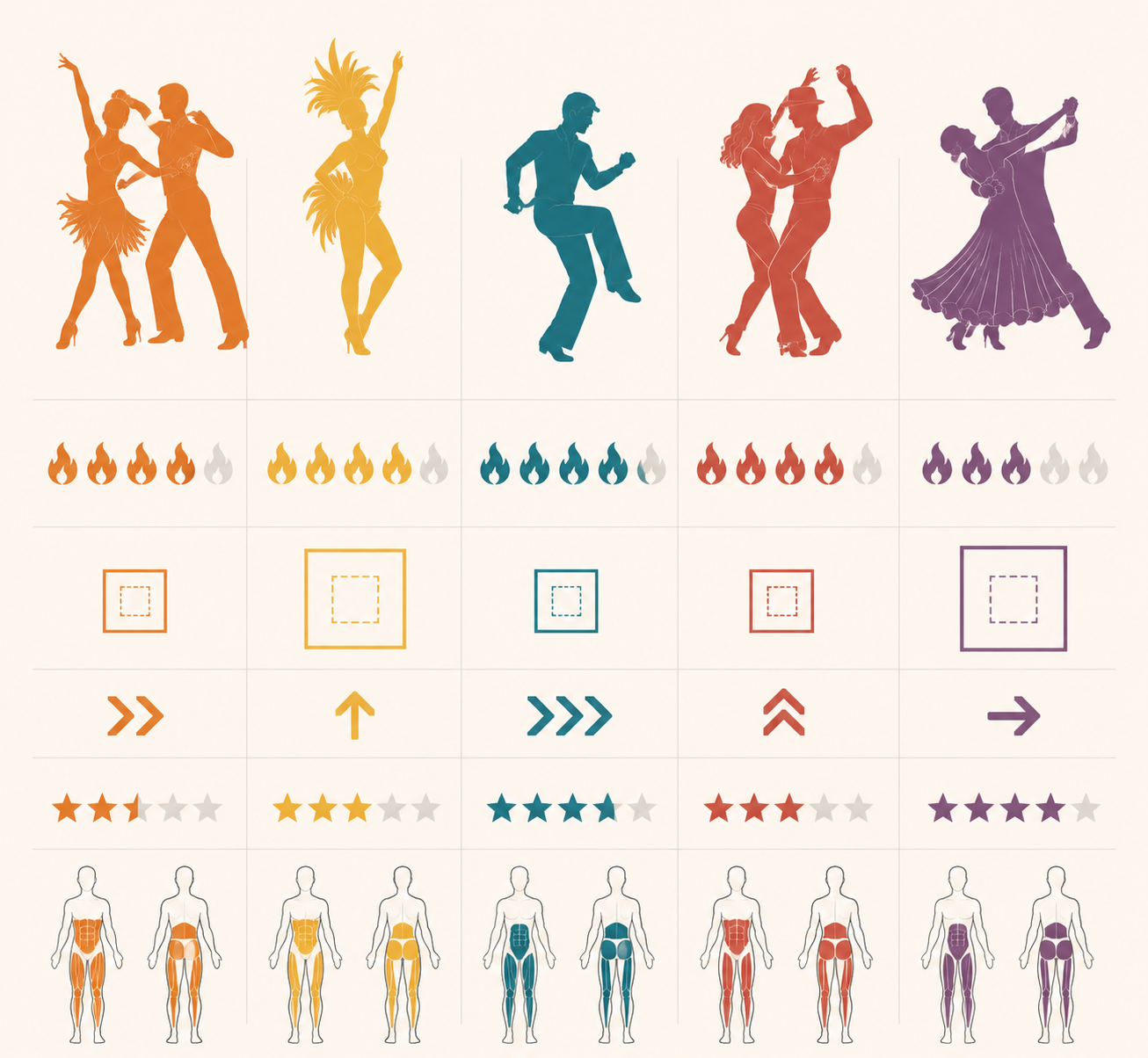
Dance fitness is already treated as a structured exercise category, not just recreational dancing. Chicago Athletic Clubs describes dance fitness as choreographed movement used for cardio, coordination, balance, and muscular endurance [5]. That matters here because a living-room Cha-Cha block is not pretending to be a ballroom lesson. It is using a dance style as the container for repeatable cardio.
How to read the calorie claims without getting sold glitter
The exciting number is Jive at 500–700 calories per hour. It also deserves the most suspicion, not because Jive is easy, but because it is hard. A beginner doing low kicks in socks, pausing to find the beat, and protecting a rental-floor ankle is not doing the same workout as an experienced dancer hitting fast kicks and rebounds continuously for an hour.
Use the ranges this way: if you are around the 150–160 lb reference point, moving at moderate-to-high intensity, and actually sustaining the routine, these styles can sit somewhere in the 200–700 calories-per-hour neighborhood. Healthline’s 150-lb example for fast ballroom dancing — about 200–300 calories per 30 minutes — is a helpful reality check because it comes from a broader health publisher rather than a dance studio trying to get you excited about lessons [4].
The biggest drivers are not the name of the dance. They are how long you keep moving, how much bounce or travel you add, whether your arms work instead of dangling, and whether you can repeat the pattern without long reset breaks. Salsa done continuously can beat a Jive routine that stops every 20 seconds because the kicks got chaotic.
Cha-Cha: the smallest-room starter
Cha-Cha is the style I would hand to the person who has exactly one cleared rectangle between the couch and the TV. The basic action is compact: step side, replace weight, close or collect, then repeat. The rhythm has personality, but the floor pattern does not demand much travel.
Try this as a solo block:
- Stand tall with soft knees and your weight slightly forward over the balls of your feet.
- Step right, shift weight back to the left, then take three quick small steps in place: right-left-right.
- Reverse it: step left, shift weight back to the right, then left-right-left.
- Add bent elbows and sharp arm pulls once the feet feel automatic.
To make it more cardio, shrink the pauses instead of making the steps huge. A tiny, fast Cha-Cha is more useful in an apartment than a dramatic one that clips the side table. Your calves and quads handle the quick footwork; your hips and obliques wake up when you rotate the torso instead of just stepping side to side.
Salsa: easy to keep in place, easy to scale up
Salsa may be the best first pick if you want a workout tonight and do not want to study. The basic forward-and-back pattern works alone, and it can stay inside a yoga-mat-sized footprint even though you do not need the mat.
Start with a plain version: step forward with the left foot, replace weight onto the right, bring the left foot back under you, then step back with the right, replace onto the left, and bring the right foot home. Keep the steps short enough that your knees stay comfortable and your feet do not slide.
Once the pattern is steady, the workout comes from layering: sharper weight shifts, active arms, light torso rotation, and fewer dead moments between sets. If you live above someone, Salsa is friendlier than Jive because you can keep the feet close to the floor and still move quickly.
Samba: more core and glutes, but control the bounce
Samba feels like it should need a parade route. At home, it works better as a contained bounce-and-step pattern. The useful part is the pulsing rhythm: your ankles, calves, glutes, and core keep absorbing and redirecting movement.
For a no-equipment version, try a small side Samba:
- Step right with soft knees.
- Tap or lightly place the left foot near the right while keeping your weight mostly on the right.
- Pulse through the knees and ankles without jumping.
- Repeat left, then alternate sides for 30–60 seconds.
The beginner mistake is making the bounce vertical. That turns a rhythm workout into apartment percussion. Keep the movement springy but low, almost like your body is absorbing the beat instead of launching off the floor. Add arm sweeps across the body when you want more heat without more noise.
Jive: the biggest burn, with the biggest apartment warning
Jive is the calorie headline for a reason. Fred Astaire Montville lists it at 500–700 calories per hour, and Dancewear Central also frames Jive as a very demanding cardio dance style [2][3]. Fast kicks, rebounds, and quick changes of direction can turn a short block into real conditioning.
That same intensity is why Jive is not the automatic best home workout. It asks more from your calves, hip flexors, coordination, and floor surface. It is also the style most likely to get loud if you turn every rebound into a hop.
Make it apartment-usable by starting with a low-impact Jive basic:
- Rock back gently on the right foot, then replace weight onto the left.
- Do a small triple step in place: right-left-right.
- Do a small triple step in place: left-right-left.
- Add low front kicks only after the rhythm is clean, keeping the standing knee soft.
If you want the higher-intensity version, use intervals instead of trying to survive a full hour. Do 20–30 seconds of low Jive kicks, then 20–30 seconds of basic triple steps or marching Cha-Cha. That keeps the style recognizable without turning form into flailing.
Quickstep: brisk cardio after you shrink the travel
Quickstep is awkward to translate because the ballroom version wants to move. In a living room, you need to steal the tempo and leave most of the travel behind. Dancewear Central’s useful distinction is that Quickstep can deliver strong cardio without relying on the same jumping emphasis as Jive [3].
Use a box-like pattern instead of a traveling run: step forward, step side, close; step back, step side, close. Keep the steps small and brisk. If you have slightly more room, angle the pattern diagonally for one set, then bring it back to center before you run out of floor.
Quickstep works best when you want cardio that feels lighter and more upright than squat-heavy bodyweight training. It is less forgiving if you are half-asleep, because the pace can make sloppy foot placement show up quickly. Socks on slick hardwood are not the move here; bare feet or grippy sneakers are safer if your floor allows them.
A 15-minute no-equipment routine you can build from any style
You do not need choreography. You need a loop you can repeat without stopping to negotiate with your furniture.
| Time | What to do | How hard it should feel |
|---|---|---|
| 2 minutes | March in place, step side to side, roll shoulders, test the floor | Easy warm-up |
| 3 minutes | Practice one basic step slowly: Cha-Cha, Salsa, Samba, Jive, or Quickstep | Light, coordinated |
| 6 minutes | Repeat 30 seconds faster, 30 seconds easier, using the same step pattern | Moderate to hard during faster rounds |
| 3 minutes | Add arms, torso rotation, or slightly quicker footwork without increasing travel | Steady cardio |
| 1 minute | Step-touch and breathe until your heart rate comes down | Easy cool-down |
If the pattern falls apart, lower the intensity before you change the style. Make the steps smaller, remove the arms, or switch from kicks to taps. A clean compact routine is a better home workout than a big one that keeps stopping.
Small-space dance workouts are not a fantasy category. STEEZY has published small-space dance workout examples and includes a self-reported calorie figure of about 262 calories for one routine, though that number should be treated as individual and unverified rather than a general benchmark [6]. The Movement Club also lists Jenna Johnson’s DWTS Bootcamp classes, which lightly supports the idea that DWTS-style training can be packaged for solo home practice, though the full class details were behind a login wall and should not be treated as reviewed here [7].
Which one should you do tonight?
Choose Jive if calorie burn is the priority and you can tolerate higher impact, faster coordination, and some noise management. Keep it low first, then add kicks once your feet know where they are going.
Choose Salsa or Cha-Cha if your room is small, your floor is questionable, or you want the lowest-friction start. Both can stay compact, both work without a partner, and both let you raise intensity with tempo and arms instead of jumping.
Choose Samba if you want a rhythm workout that hits core and glutes more noticeably, as long as you keep the bounce controlled. Choose Quickstep if you want brisk cardio and upright posture, but be ready to compress the travel into a box or diagonal pattern.
For FitAtHome, this belongs squarely in the space-efficient routines category with equipment required: none. If dance cardio sticks, a mat or resistance bands can later expand your options, but the first session does not need a cart, a subscription, or a partner. It needs one cleared square of floor and a step you can repeat.
References
- Tips for Beginners: Starting a Dance Workout Routine — Twinkle Star Dance Academy
- Dance Styles That Burn the Most Calories — Fred Astaire Dance Studios Montville
- How Many Calories Do Different Types of Dance Burn? — Dancewear Central
- Dancing to Lose Weight — Healthline
- What is Dance Fitness? — Chicago Athletic Clubs
- 16 Dance Workouts You Can Do In Small Spaces — STEEZY
- Jenna’s DWTS Bootcamp — The Movement Club
Don't have the gear this routine assumes? Find the build that covers it.
Wondering how much rest you need after this? Read our ACSM-cited recovery reference.
Questions about form, substitutions, or a correction? Leave it below.
Comments
Join the discussion with an anonymous comment.