Luis de la Fuente's Bicep Workout You Can Do at Home
Build arm strength like the 65-year-old Spain manager using this simple dumbbell bicep workout. Based on Luis de la Fuente's known routine and 2026 ACSM guidelines, it requires just one pair of dumbbells and fits any small space.
Before you start
- Equipment required
- dumbbells
- Assumes build tier
- No specific tier required
- Duration
- 20 minutes
- Difficulty
- beginner
- Noise level
- low
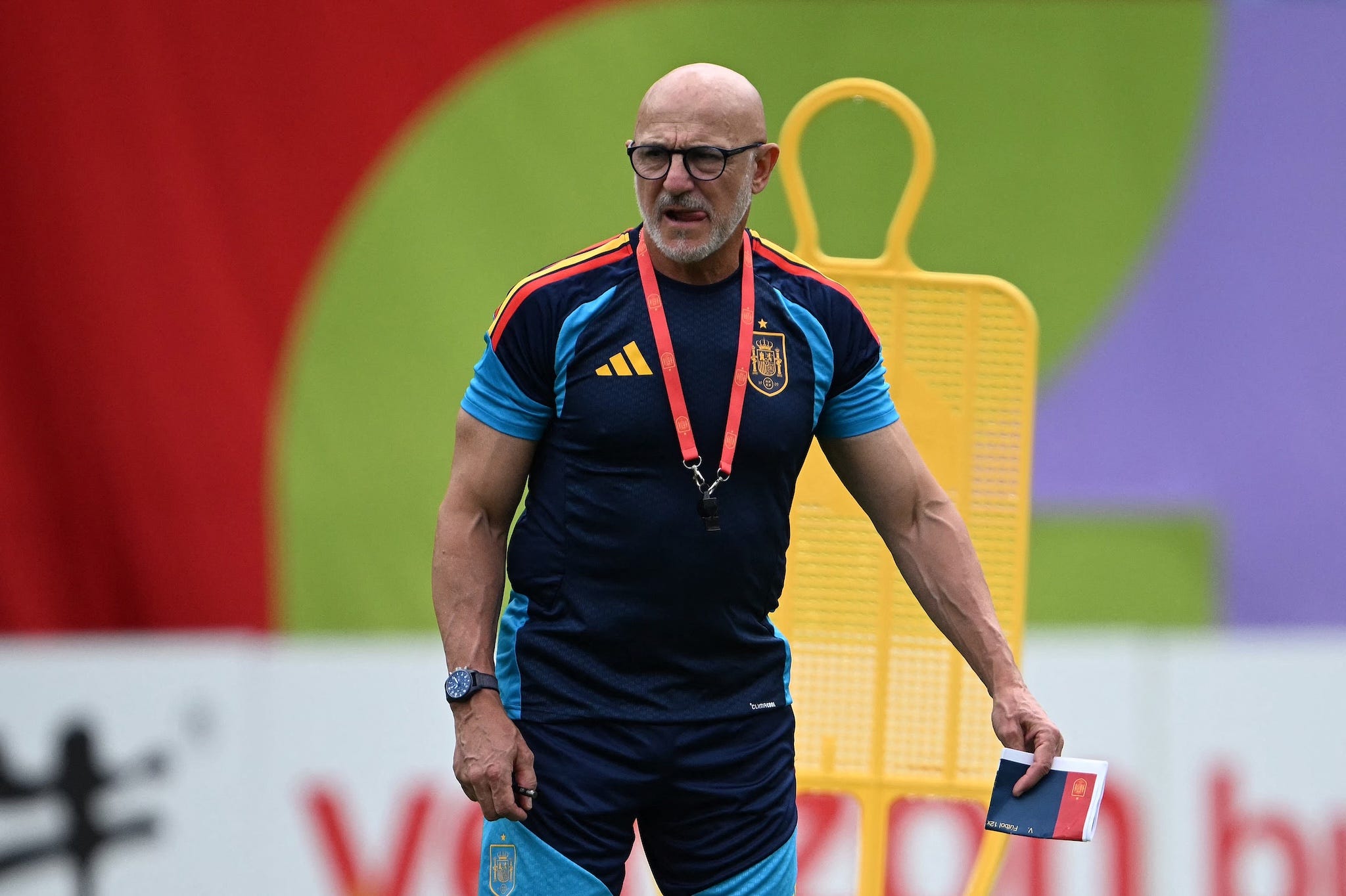
The photo does most of the work before anyone reads a word: Luis de la Fuente, Spain’s manager, past the age when many men start quietly surrendering their arms to sleeves, standing there with the kind of biceps that make people zoom in. The useful part is that the known training behind it is not exotic. De la Fuente has publicly mentioned “a little shoulder press with dumbbells” and “bicep curls,” and has described lifting as “a relaxing moment, an hour when I’m just thinking about my things.”[1][2]
That does not mean his exact private program is public. His sets, reps, weekly split, dumbbell weights, and full exercise menu have not been documented in a way that would let anyone honestly print “the Luis de la Fuente workout” as a transcript. So the home session here is a practical reconstruction: it uses the dumbbell movements he has named, adds the supporting arm work that makes sense around them, and follows the 2026 American College of Sports Medicine resistance-training update for loading, frequency, and progression.[3]
What De la Fuente’s Routine Tells Us
The most important clue is not that he trains. Plenty of public figures say that. The useful clue is the plainness of the exercises: dumbbell curls and shoulder presses. Those two movements say a lot. They can be done at home, they do not need a bench or cable stack, and they reward steady repetition more than cleverness.
Reports around De la Fuente’s late-career physical change describe his gym work as beginning around rehabilitation after knee problems and then becoming a daily habit, with visible mass built after 60.[4] That is a better model for a midlife lifter than any unverified maximum-lift rumor. Rehabilitation turning into routine is believable. A secret heroic protocol is less useful.
The ACSM update is what makes the home version worth taking seriously. Its 2026 Position Stand drew on more than 30,000 participants and 137 systematic reviews, and it states that home-based resistance training with equipment such as dumbbells can produce marked strength and hypertrophy gains; a commercial gym is not the deciding factor.[3]
The Dumbbell-Only Arm Session
Do this workout twice per week, leaving at least one day between sessions. If you already train regularly and recover well, a third lighter session can be added, but the baseline is two focused arm sessions. ACSM recommends training all major muscle groups at least 2 times per week and using loads around 60% to 80% of one-repetition maximum for resistance training.[3]
| Exercise | Sets | Reps | Rest | Purpose |
|---|---|---|---|---|
| Standing dumbbell curl | 3 | 10–15 | 60–90 sec | Main biceps builder |
| Hammer curl | 3 | 10–15 | 60–90 sec | Biceps, brachialis, forearm thickness |
| Dumbbell shoulder press | 3 | 8–12 | 90 sec | Shoulders and triceps support |
| Bent-over dumbbell row | 3 | 10–15 | 90 sec | Back, elbow flexors, arm balance |
| Concentration curl | 2 | 12–15 each arm | 45–60 sec | Controlled biceps finish |
| Reverse curl | 2 | 12–15 | 45–60 sec | Forearms and elbow resilience |
If 20 minutes is all you have, keep the first four exercises and rotate the last two from session to session. The curl variations are not there for decoration. A standard curl gives you the most direct biceps work. A hammer curl shifts more demand toward the brachialis and forearm. A reverse curl makes lighter dumbbells useful when your elbows need less strain and your grip needs more attention.
How Heavy the Dumbbells Should Feel
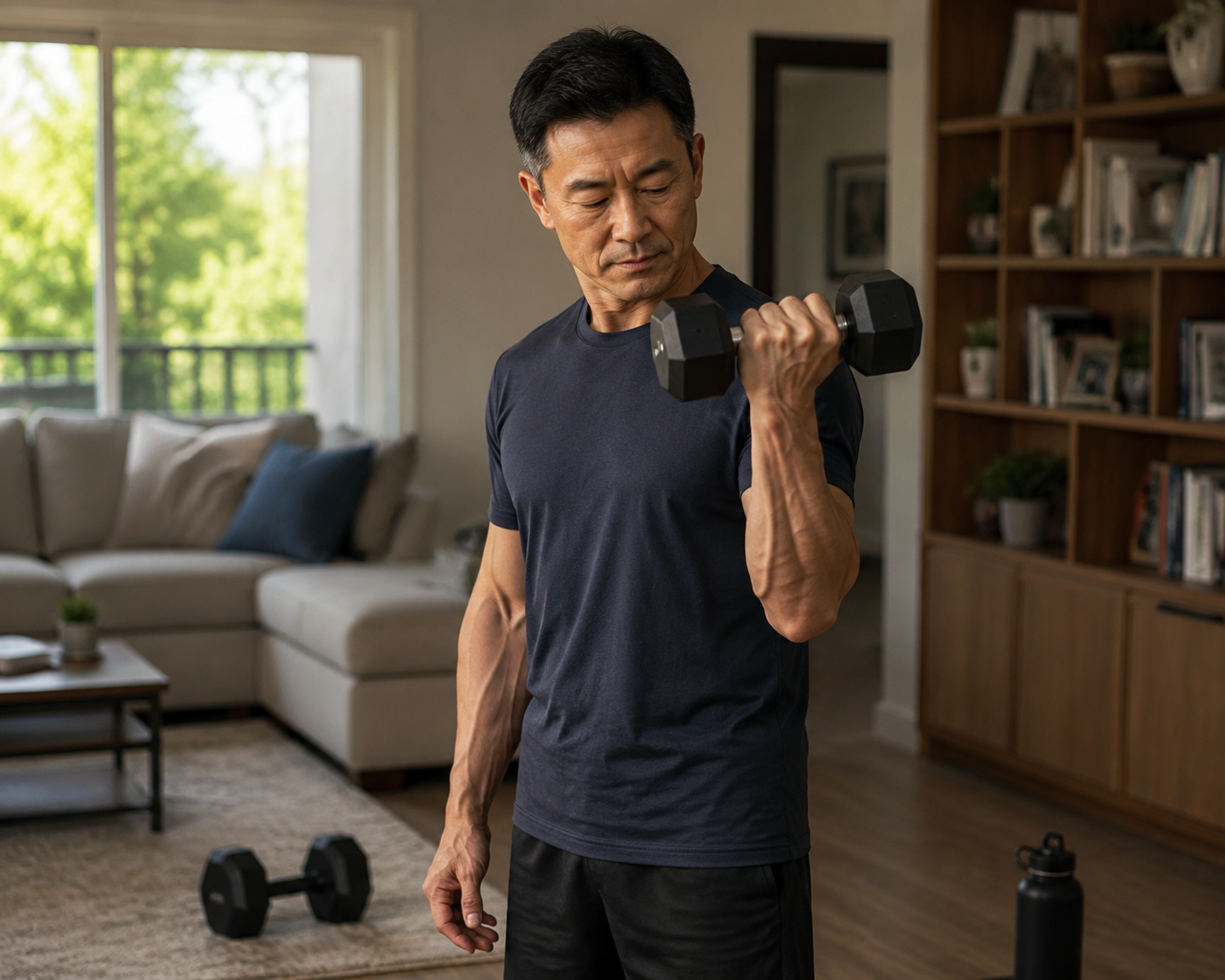
Most home lifters choose the wrong weight in one of two ways. They either grab a dumbbell so light that the set becomes arm-waving, or they go so heavy that every curl turns into a lower-back exercise. For this routine, the right weight is the one that lets you finish the target reps with clean form while still feeling that the last 2 or 3 reps require real concentration.
That is the practical version of the 60% to 80% effort range. You do not need to test a true one-rep max at home, and older lifters usually should not chase max loads just to calculate a percentage. The Spanish sports medicine recommendation reported by Marca also points older adults toward 60% to 80% of one-repetition maximum, combining higher- and lower-rep work while avoiding maximal loading.[4]
- Too light: you can do 20 or more reps and your form never slows.
- About right: reps 10 through 15 are controlled, slower, and clearly harder.
- Too heavy: you swing your torso, shrug your shoulder, or cannot lower the dumbbell under control.
- Stop the set early if elbow or shoulder pain changes your movement.
Exercise Notes That Matter More Than Novelty
Standing Dumbbell Curl
Stand tall, palms facing forward, elbows close to your sides. Curl both dumbbells up without leaning back, then lower them for about 2 seconds. The lowering phase is where many home workouts lose their value. If gravity is doing all the work on the way down, the dumbbells are probably too heavy or your attention has wandered.
Hammer Curl
Turn your palms so they face each other and keep them that way through the set. This is the curl most men should keep even when they shorten the workout, because it trains the arm in a grip position that tends to feel friendlier on the wrist and elbow than endless supinated curls.
Dumbbell Shoulder Press
This is one of the movements De la Fuente has actually named, and it belongs in the session even if the search started with biceps.[1] Pressing builds the shoulders and triceps that frame the upper arm. Use a neutral or slightly angled grip if that feels better, brace your midsection, and stop each rep with the dumbbells above the shoulders rather than drifting behind your head.
Bent-Over Dumbbell Row
Rows are the quiet insurance policy in an arm program. They train the back and make the biceps work as elbow flexors under a different angle. Hinge at the hips, keep your spine long, pull the dumbbells toward your lower ribs, and pause briefly before lowering. If your lower back complains, do one arm at a time with the free hand supported on a sturdy chair or table.
Concentration Curl and Reverse Curl
The concentration curl is not magic; it is useful because it removes some cheating. Sit or hinge forward, brace your upper arm against your inner thigh, and curl slowly. The reverse curl uses a palms-down grip and will usually require lighter weight. Treat it as forearm and elbow-support work, not as a place to prove anything.
Progression Without Chasing Max Loads
The cleanest way to progress at home is the rep range. Start with a weight you can lift for 10 good reps. Over the next sessions, add reps until you can complete all prescribed sets at the top of the range with the same control. Then increase the dumbbell weight slightly and return to the lower end of the range.
| Week | What to Do |
|---|---|
| Weeks 1–2 | Learn the movements; stop each set with 2–3 reps left in reserve. |
| Weeks 3–4 | Add 1 rep per set where form stays clean. |
| Weeks 5–6 | Reach the top of the rep range on most sets. |
| Week 7 onward | Increase dumbbell weight slightly, or slow the lowering phase if heavier dumbbells are not available. |
Fixed-weight dumbbells can still work. If you cannot increase load, increase control first: slower lowering, a brief pause near the top, stricter posture, or shorter rest. Do not turn every set into a marathon. Once a weight is far too easy for the rep range, it is time to buy the next pair or move to adjustable dumbbells.
Why This Is Especially Relevant After 40
Arm size is the hook, but strength is the reason to keep going. Harvard Health describes sarcopenia as age-related muscle loss that can accelerate to about 3% per year after 60, while also noting that strength training can slow or reverse that decline.[5] Marca’s reporting quotes Dr. Miguel Del Valle of the Spanish Society of Sports Medicine on the scale of the drop: muscle strength falls about 15% in the sixth decade and 30% to 40% by ages 70 to 80, yet “even people over 90 can increase their muscle conditioning through strength training.”[4]
That is why De la Fuente’s example lands differently from a younger celebrity transformation. A man building visible muscle after 60 is not just showing that his sleeves fit tighter. He is showing that the training window is still open, provided the work is repeatable and the joints are respected.
Curls alone are not enough for that. They are useful, and they are satisfying, but a fuller arm session needs pressing and rowing. The shoulder press gives the upper arm a stronger frame. The row keeps the pulling side honest. The curls then do what curls do best: direct, measurable work for the muscles most people actually notice.
A Simple Weekly Setup
For most men training at home, this is enough:
- Monday: dumbbell arm session
- Tuesday or Wednesday: walking, mobility, or lower-body work
- Thursday: dumbbell arm session
- Weekend: optional lighter full-body session or outdoor activity
If you enjoy lifting daily, keep some days deliberately easy. De la Fuente has described training as a daily habit and a relaxing hour, but that is his personal rhythm, not a requirement for copying the useful part of the method.[2] Two well-done sessions per week beat seven careless ones.
The home setup is almost embarrassingly small: one pair of dumbbells, enough floor space to stand and hinge, and a chair if you want support for one-arm rows or concentration curls. Adjustable dumbbells make progression easier, but they are not mandatory on day one. The first job is to make the work regular enough that progression has something to attach to.
The Takeaway From De la Fuente’s Arms
The realistic lesson is not that one pair of dumbbells will automatically make a 40-, 50-, or 60-year-old man look like Luis de la Fuente. Genetics, diet, training history, and consistency all matter. The useful lesson is narrower and better: basic dumbbell work, done often enough and hard enough, can still build visible arm muscle after midlife.
Start with the curls and shoulder press he has actually mentioned. Add rows, hammer curls, concentration curls, and reverse curls so the arm is trained from more than one angle. Keep the effort moderate, the reps clean, and the progression boring. That is not a diminished version of the story. It is the part most men can actually use.
References
- Luis de la Fuente, seleccionador de España, músculos a los 61 años - Men's Health Spain, June 2023, link
- Luis de la Fuente, 63 years old: aging recipe, training, healthy eating, mental relaxation - La Vanguardia, July 2024, link
- Resistance Training Guidelines Update 2026 - American College of Sports Medicine, 2026, link
- Luis de la Fuente and his fitness: why you should strength train after 60 - Marca, December 2025, link
- Age and muscle loss - Harvard Health, February 2026, link
Don't have the gear this routine assumes? Find the build that covers it.
Wondering how much rest you need after this? Read our ACSM-cited recovery reference.
Questions about form, substitutions, or a correction? Leave it below.
Comments
Join the discussion with an anonymous comment.