
Can You Exercise Outdoors During Code Orange Air Quality?
Code Orange air quality doesn't mean you must cancel your workout. This guide explains when healthy adults can safely modify outdoor exercise and when everyone should move indoors, with science-backed timing and duration limits.
Before you start
- Equipment required
- bodyweight
- Assumes build tier
- No specific tier required
- Duration
- 30 minutes
- Difficulty
- beginner
If today’s forecast says Code Orange, the answer is: modify if you are a healthy adult, move indoors if you are in a sensitive group, and do not treat the workout like a normal training day. Code Orange means an Air Quality Index of 101–150, a range the air-quality system labels “unhealthy for sensitive groups.” The American Lung Association’s outdoor-exercise guidance separates those groups clearly: children under 18, adults over 65, pregnant people, people with heart or lung disease, and people with diabetes should avoid outdoor exertion at this level.[1]
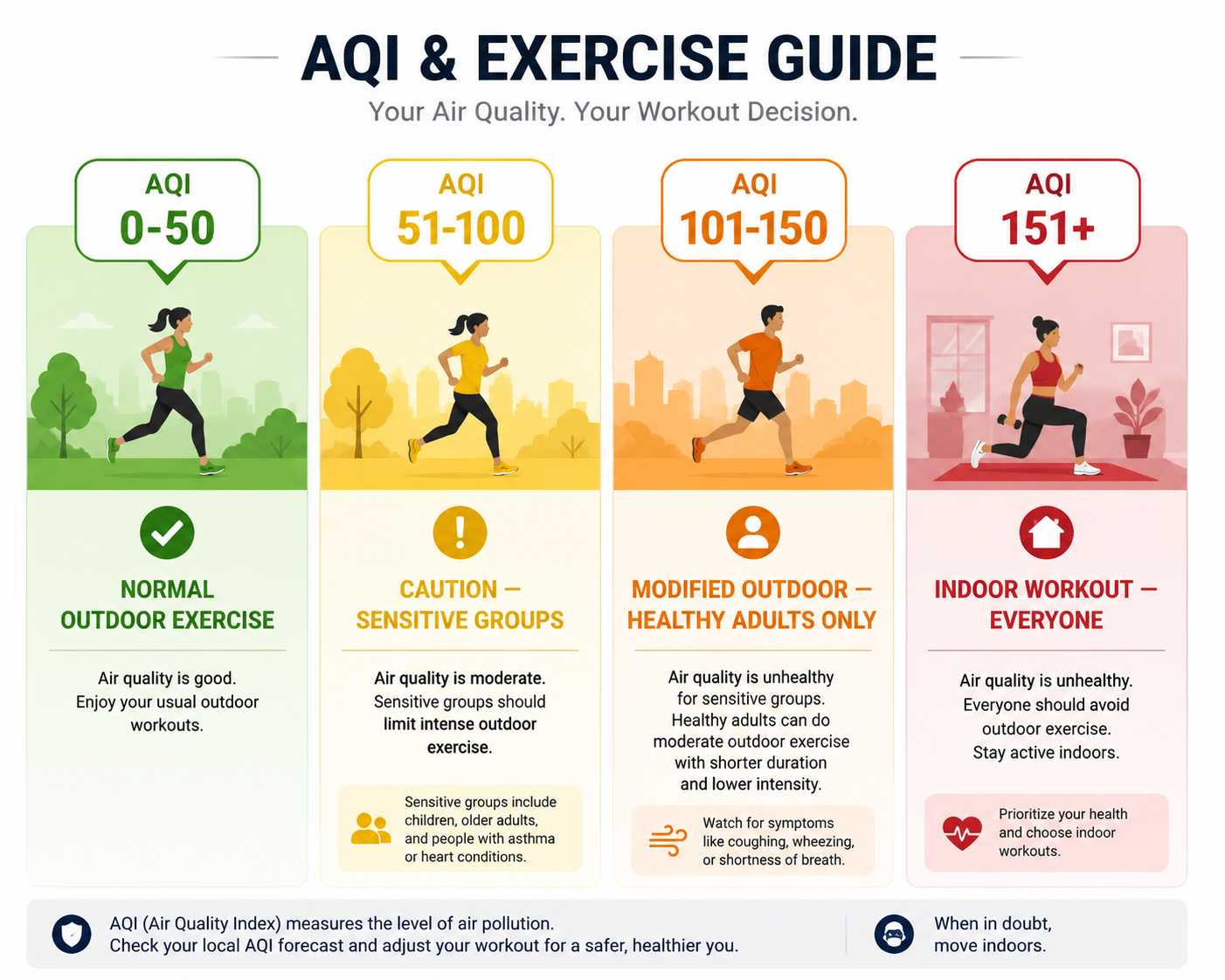
| AQI level | Outdoor workout decision |
|---|---|
| Green, 0–50 | Normal outdoor exercise |
| Yellow, 51–100 | Use caution if you are in a sensitive group |
| Orange, 101–150 | Healthy adults only, with a shorter and easier workout |
| Red, 151+ | Move the workout indoors |
That table is the practical rule. The hard part is Code Orange, because it sits in the uncomfortable middle: not an automatic cancellation for every adult, but also not a green light for intervals, hill repeats, a long ride, or a sweaty outdoor circuit near traffic.
Why a Workout Changes the Air-Quality Decision
Air quality advice can sound oddly calm until you remember what exercise does to breathing. At rest, a person may take in roughly 12 liters of air per minute; during hard exertion, that can rise to about 100 liters per minute.[2] That is why “I felt fine walking to the store” does not tell you much about a tempo run.
The exposure problem is not only that the air is worse. It is that the workout pulls much more of that air through your lungs, often through an open mouth, while your body is asking for more oxygen. A casual walk, an easy jog, and a hard run are different air-quality decisions even when the AQI number is identical.
That also explains why “listen to your body” is too weak as a stand-alone rule. Irritated eyes, coughing, chest tightness, unusual shortness of breath, dizziness, or wheezing are reasons to stop, but waiting for symptoms means the exposure has already happened. On Code Orange days, the smarter move is to set limits before you start.
Who Should Go Indoors Immediately
For sensitive groups, Code Orange should be treated as an indoor-workout day, not as a puzzle to solve with a slower pace. The American Lung Association and ACSM both frame AQI decisions around higher-risk groups, and Code Orange is specifically the point where outdoor exertion becomes unhealthy for them.[1][3]
- Children and teenagers under 18
- Adults over 65
- Pregnant people
- People with asthma, COPD, heart disease, or other heart or lung conditions
- People with diabetes
If you are in one of those groups, the useful question is not how to make the outdoor session barely acceptable. It is which indoor option preserves the habit with the least friction. A small-space strength circuit, low-impact cardio session, mobility block, or short resistance-band workout is a better substitution than trying to bargain with an AQI category that already names you as the group at risk.
FitAtHome’s home workout guide for air-quality alerts is the better next stop if Code Orange puts you indoors today. For a broader alert-level breakdown beyond this single threshold, use the outdoor exercise during air-quality alerts guide.
The Narrow Outdoor Window for Healthy Adults
A healthy adult can usually keep an outdoor workout on a Code Orange day only if the session changes in four ways: earlier, easier, shorter, and farther from traffic. If any one of those is not possible, the case for going indoors gets much stronger.
Go Early, Especially When Ozone Is Driving the Alert
Morning is usually the safer outdoor slot on ozone-heavy days because ozone builds through the day and tends to peak in the late afternoon. ACSM’s guidance on air quality and outdoor exercise points athletes toward timing workouts when pollution levels are lower, and ozone timing is one of the clearest ways to make that advice usable.[3]
That timing matters more than many runners want it to. A 7 a.m. easy jog and a 5 p.m. hard run can both appear on the same calendar, but they are not the same exposure decision. If the only available outdoor slot is late afternoon, Code Orange should push the workout indoors unless the local pollutant details show that ozone is not the issue.
Keep the Effort at Nose-Breathing Intensity
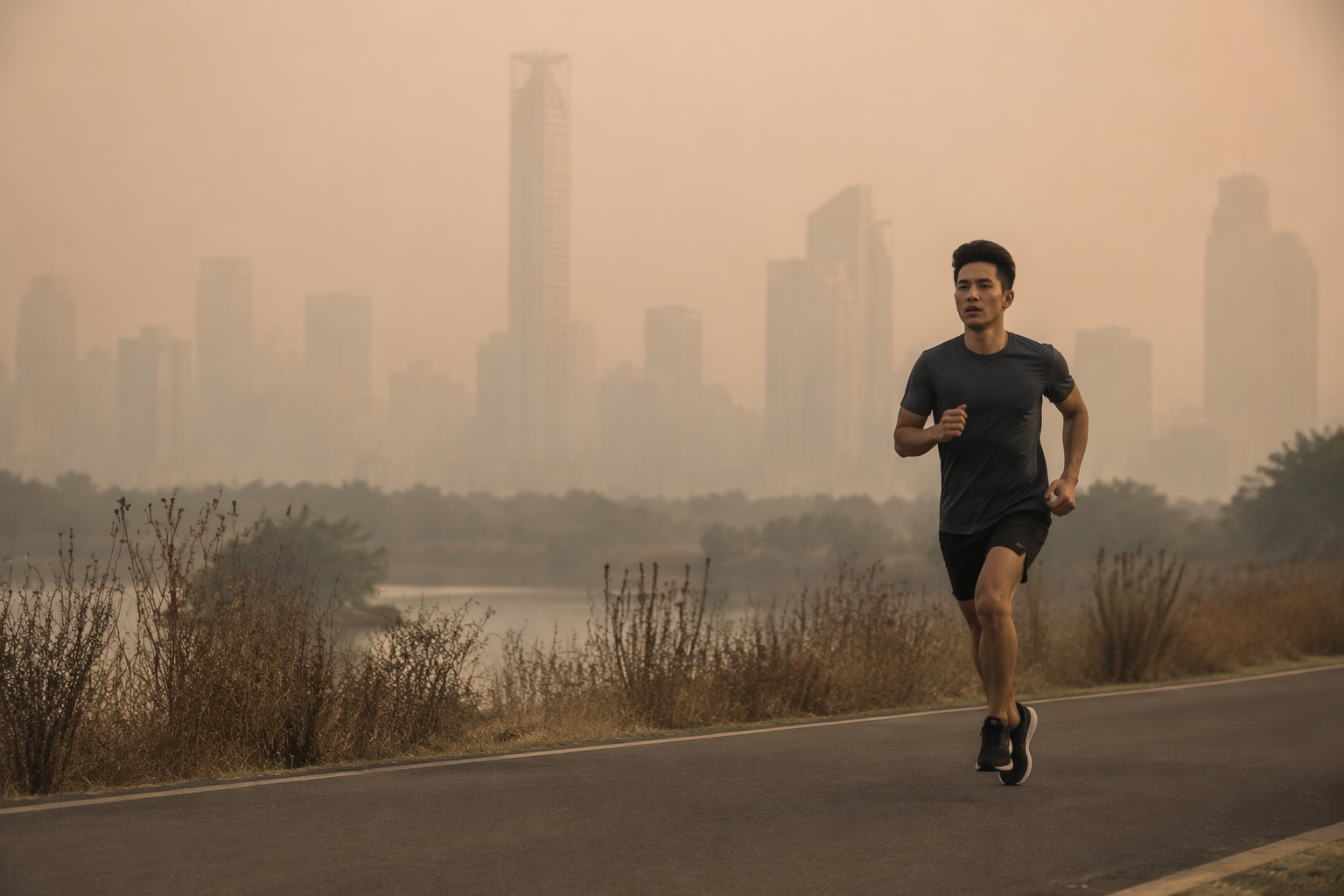
The day’s workout should feel deliberately undercooked. Think easy jog, relaxed ride, brisk walk, or light bodyweight movement rather than speed work. A useful field test is whether you can keep the effort close to nasal-breathing intensity. It is not a medical measurement, but it keeps the session away from the ventilation spike that makes hard exercise a different exposure category.
This is also where masks become less simple than they look online. Cloth and surgical masks are not a reliable fix for fine-particle exposure, while N95 or KN95 respirators can filter particles but may make harder exercise feel more constrained.[2] A mask is not a license to turn a Code Orange run into a normal workout.
Cap It at 20–30 Minutes
On a Code Orange day, the outdoor portion should be short. Public Health Institute advice from a Stanford expert recommends limiting outdoor exertion during smoke events to about 20–30 minutes.[4] That cap is a useful guardrail even when the alert is not wildfire-specific, because it turns “just an easy one” into an actual endpoint.
The practical version is simple: do the warm-up indoors, step outside for a short easy session, and finish indoors if you still want more training. In a small apartment, that could mean 10 minutes of mobility before you leave and a compact strength circuit when you return. The outdoor part does not need to carry the whole workout.
Stay 350–600 Yards From Major Roads
Traffic changes the route decision. The American Lung Association advises staying 350–600 yards away from major roadways to reduce exposure to particle pollution.[1] That is not always convenient, especially in a dense neighborhood, but it is one of the few route adjustments with a concrete distance attached.
If your only realistic route runs beside a highway, arterial road, bus corridor, or truck-heavy stretch, the Code Orange modification window may not exist for you that day. A short loop through quieter residential streets or a park is different from a longer run where every breath happens next to exhaust.
When “More Exercise” Stops Being the Safest Assumption
Exercise is usually protective for long-term health, and polluted air does not erase that automatically. The evidence is more cautious than a simple “outside is bad” message. A review on physical activity in polluted air notes that several large cohort studies still found protective associations from exercise even when air pollution was present.[5]
The same review also discusses a South Korean cohort of 1.47 million young adults in which large increases in physical activity in high-pollution areas were associated with elevated cardiovascular disease risk.[5] That finding should not be stretched into a universal warning against outdoor exercise. It does, however, weaken the lazy assumption that adding more outdoor volume is always the better choice no matter what the air is doing.
For today’s Code Orange decision, that nuance points to moderation rather than panic: preserve the habit, cut the exposure, and move the harder work indoors.
Make the Call Before You Lace Up
Use this quick filter before heading out on a Code Orange day:
- If you are in a sensitive group, work out indoors.
- If you are a healthy adult, keep the outdoor option open only when the session can happen in the morning.
- Keep it easy enough to avoid heavy mouth-breathing.
- Stop the outdoor portion at 20–30 minutes.
- Avoid major roads by 350–600 yards.
- If one or more of those conditions is not realistic, take the workout indoors.
For runners, that might turn a planned 50-minute run into a 25-minute easy loop through quieter streets. For cyclists, it may mean skipping the traffic-heavy route and doing a short spin only if there is a lower-exposure path. For outdoor bodyweight circuits, it means avoiding high-rep, breathless work and moving the harder blocks inside.
If indoors is the right call, do not translate that as “skip.” Choose the closest replacement: low-impact cardio if you wanted a run, strength intervals if you wanted intensity, mobility if the plan was already light. FitAtHome’s guide to the best indoor workouts when air quality is bad can help with that swap, and the small-space wildfire-smoke workout guide is useful when the indoor air setup matters too.
Code Orange is workable for some healthy adults, but only inside a small window: earlier in the day, easier than planned, no longer than 20–30 minutes, and away from major roads. Outside that window, the smart workout is the one you can do indoors without turning one bad-air day into a bigger setback.
References
- Four Things to Know about Air Quality and Exercising Outdoors, American Lung Association.
- The AQI Dilemma: Is it Safe to Exercise?, GU Energy.
- Air Quality and Outdoor Exercise, ACSM.
- Experts Offer Advice on Working Out During Wildfire Smoke Events, Public Health Institute.
- Physical Activity in Polluted Air—Net Benefit or Harm to Cardiovascular Health?, NIH / PMC.
Don't have the gear this routine assumes? Find the build that covers it.
Wondering how much rest you need after this? Read our ACSM-cited recovery reference.
Questions about form, substitutions, or a correction? Leave it below.
Comments
Join the discussion with an anonymous comment.