
Wildfire Smoke Exercise Safety Tips for Every AQI Level
A practical, tiered guide that maps each EPA AQI color band to specific exercise decisions — when to go out, when to move indoors, and how to modify intensity or duration to reduce smoke exposure.
Before you start
- Equipment required
- dumbbells, bodyweight, resistance bands
- Assumes build tier
- No specific tier required
- Duration
- 30 minutes
- Difficulty
- beginner
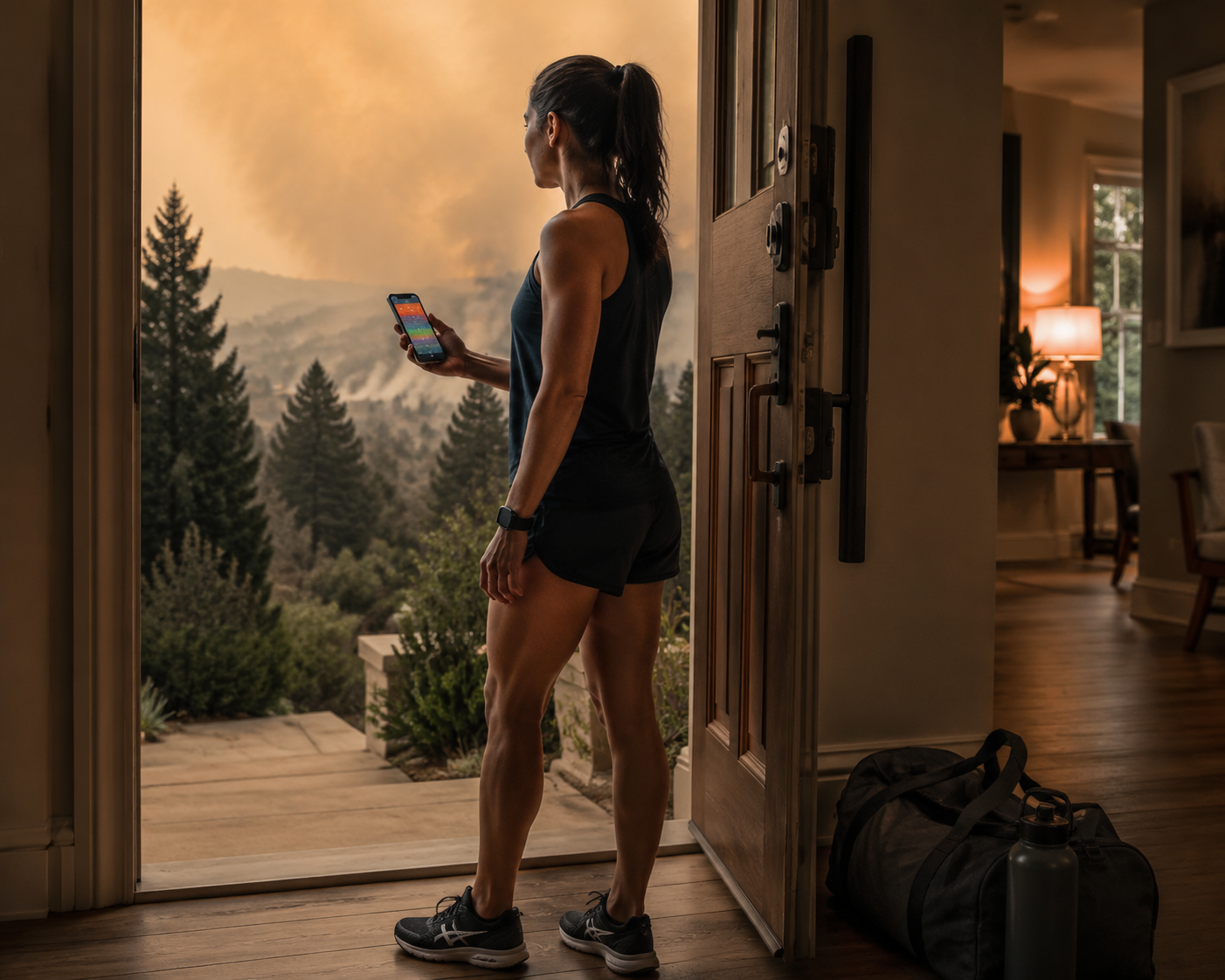
You have the AQI open, your shoes are on, and the workout could go either way. The useful question is not whether wildfire smoke is “good” or “bad” for exercise. It is what today’s color means for this specific session: normal run, shorter easy outing, indoor bike, dumbbells, or rest.
Updated for Q3 2026, the simplest decision frame is still the EPA’s six-color Air Quality Index. It is not a perfect biological switch, and your own symptoms matter, but it gives you a shared starting point before motivation starts negotiating with your lungs.
AQI exercise map: what to do at each color
| AQI color | AQI range | Outdoor exercise decision | Practical workout choice |
|---|---|---|---|
| Green | 0-50 | Normal outdoor exercise is reasonable for most people. | Do the planned run, ride, walk, or outdoor strength session. If smoke odor or symptoms show up, adjust. |
| Yellow | 51-100 | Most healthy adults can exercise outside; sensitive people should reduce long or hard efforts. | Keep the session, but sensitive groups can choose an easier pace, shorter route, or indoor option. |
| Orange | 101-150 | Sensitive groups should avoid outdoor exercise. Healthy adults should shorten and reduce outdoor sessions. | Think 20-30 minutes easy-to-moderate outside, or move the full workout indoors. |
| Red | 151-200 | Move exercise indoors. This is the clean cutoff I would use for outdoor workouts. | Use an indoor bike, treadmill, dumbbells, bands, mobility work, or a rest day. |
| Purple | 201-300 | Indoor-only exercise, and only if your indoor air is meaningfully cleaner. | Train in a closed-window room with HEPA or MERV-13 filtration; keep intensity moderate if air indoors is uncertain. |
| Maroon | 301+ | Avoid physical activity if possible. | Rest, do only necessary movement, and prioritize cleaner air. |
Sensitive groups deserve the front seat in this decision, not a tiny disclaimer. That includes people with asthma or cardiovascular disease, older adults, children, and anyone who gets coughing, chest tightness, unusual shortness of breath, dizziness, headache, or throat irritation when smoke arrives. If that is you, the yellow and orange rows should feel more conservative than they do for a healthy adult with no symptoms.
For everyone else, the key mistake is treating the AQI number like a toughness test. At 151 and above, outdoor training is no longer a clever adaptation challenge. It is a good day to use the home setup you keep promising yourself you will use.
Why exercise changes the smoke dose
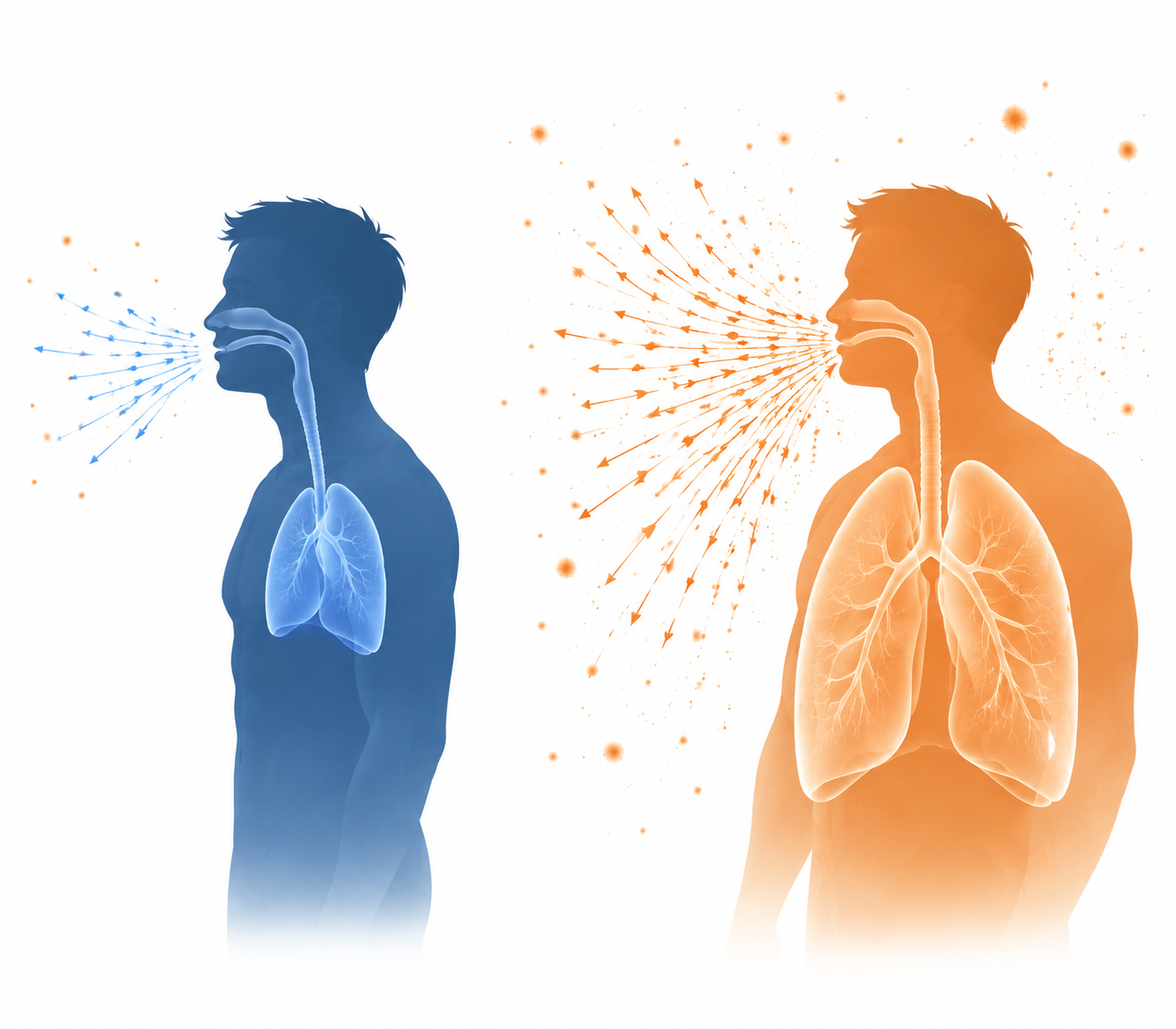
Wildfire smoke decisions get clearer once you stop thinking only about the AQI outside and start thinking about dose. During rest, a person may breathe about 15 times per minute and move roughly 12 liters of air. During exercise, breathing can rise to 40-60 breaths per minute and roughly 100 liters of air.[3] More air moved through the lungs means more opportunity for fine particles to come along for the ride.
That is why “I’ll just go easy” is only half a solution on orange days. Lower intensity helps because it usually lowers breathing rate. But time still counts. A long easy run can keep you breathing smoky air for much longer than a short hard effort, and cumulative PM2.5 exposure rises with the time you spend ventilating that air.
This is the part that changes the workout choice. At moderate smoke levels, do not only ask, “Can I hold a conversation?” Ask, “How many minutes am I going to keep pulling this air in?” For many people, the better outdoor compromise is a short easy session, not a long “responsible” slog.
Green and yellow: train, but do not ignore symptoms
Green is the easy one. If AQI is 0-50 and you feel well, keep the planned outdoor workout. Run hills, ride, walk, lift in the park, or do the long session you already had on the calendar.
Yellow, AQI 51-100, is still workable for most healthy adults. I would not cancel a normal 30- to 60-minute outdoor workout just because the map turned yellow. I would pay closer attention to smoke smell, symptoms, and the person in the group who always feels it first.
If you are sensitive, yellow is where you start trimming the sharp edges. Swap intervals for steady cardio, shorten the route, choose a flatter loop, or move strength work indoors and save the outdoor piece for an easy walk. Children, older adults, and people with asthma or heart disease should be treated as the early-warning group, not as afterthoughts.
Orange: shorten the session before you bargain with intensity
Orange, AQI 101-150, is the zone where people make the most questionable training decisions because it often looks survivable. The sky may be hazy but not apocalyptic. The app may say “unhealthy for sensitive groups,” which a healthy adult can too easily translate as “not about me.”
For sensitive groups, orange should mean no outdoor workout. Walk from the car to the store if you need to, but do the training session inside. That applies even if the workout is “just easy,” because symptoms and underlying risk matter more than the plan on the calendar.
For healthy adults with no symptoms, orange can be a modified-outdoor day. The modification should be concrete: cap it at about 20-30 minutes, keep it easy to moderate, avoid intervals and hill repeats, and stop if your chest, throat, breathing, or head feels off. If you were planning 75 minutes, the smoke-safe edit is not simply doing 75 minutes slower. It is making the outdoor exposure shorter.
- Good orange-day outdoor choice: 20 minutes easy run-walk, nasal-breathing optional but not mandatory, no fast finish.
- Better orange-day cardio choice: 25-40 minutes on an indoor bike with a fan and filtered room air.
- Good orange-day strength choice: 30 minutes of dumbbell or bodyweight work indoors, with longer rests than usual.
- Bad orange-day compromise: turning a hard outdoor workout into a long easy outdoor workout and calling it safe.
A small 2025 University of Montana controlled-exposure study gives some useful context without giving anyone a free pass. In that study, 20 healthy participants cycled for 2 hours at 50% of maximum effort while breathing simulated wildfire smoke. Blood vessel and nervous system function declined immediately afterward, then recovered within an hour in clean air.[4] That is interesting, but it was a small, young, healthy sample. It does not tell an older adult with cardiovascular disease to go ride outside in smoke, and it does not make a two-hour smoky workout a smart default.
Red: take the workout indoors
At red, AQI 151-200, the decision should get boring: no outdoor exercise. Several expert and public-health sources converge around the red range as the point where outdoor workouts become unsafe even for healthy adults, though some sources draw the firmest line closer to purple.[2][4] I would rather be slightly conservative here than spend an hour breathing hard in air everyone already agrees is unhealthy.
This does not mean the training day is ruined. It means the workout changes location and often changes shape. If you have cardio equipment, use it. If you do not, a red-AQI session can be simple: 5 minutes easy warmup, 20-30 minutes alternating squats, hinges, rows, presses, carries, and dead bugs, then 5 minutes of mobility. Keep the windows closed, avoid kicking up dust, and do not turn the session into a breathless circuit just to prove you worked hard.
| Outdoor plan you wanted | Red-AQI indoor swap |
|---|---|
| 45-minute run | 30 minutes indoor bike, treadmill walk, step-ups, or low-impact cardio intervals |
| Hill repeats | Dumbbell lower-body strength with full recovery between sets |
| Long ride | Shorter indoor ride plus mobility or core work |
| Outdoor boot camp | Strength circuit indoors, kept at a controlled breathing pace |
| Easy walk | Indoor walk, mobility session, or rest if symptoms are present |
The biggest red-day upgrade is having a default workout that requires almost no decision-making. A cheap indoor bike, a pair of adjustable dumbbells, resistance bands, or a bodyweight template is enough. Smoke season is not the time to start negotiating every workout from scratch.
Purple and maroon: indoor air quality becomes the workout variable
Purple, AQI 201-300, is indoor-only exercise, but “inside” is not automatically clean. AirNow notes that indoor air during smoke can be lower than outdoor levels when windows are closed, air conditioning is set to recirculate, and effective filtration is running.[1] CSU describes indoor particle levels during smoke events as potentially less than half of outdoor levels under cleaner-air conditions, but that depends on the home, ventilation, filtration, and leakage.[3]
For a home workout, the clean-air setup matters more than the brand of equipment. Close windows and doors. Set central AC or a window unit to recirculate if that option exists. Use a HEPA purifier in the room where you train, or use an HVAC system with a properly fitted MERV-13 filter if your system can handle it. If you use a box fan filter setup, keep it stable, do not leave it unattended, and understand that it is a practical mitigation, not a medical-grade clean room.
On purple days, I like controlled indoor sessions: easy cycling, incline walking if you have a treadmill, strength work with normal rest, Pilates-style core, mobility, or a shorter full-body dumbbell workout. If your indoor air still smells smoky or you feel symptoms inside, reduce intensity or skip the workout. The point of moving indoors is to lower exposure, not to preserve the exact workout at any cost.
Maroon, AQI 301 and above, does not need creative programming. Avoid physical activity if possible. Keep necessary movement brief, stay in the cleanest available indoor air, and let the missed workout be a missed workout.
Masks are not a workout loophole
Cloth masks do not protect you from wildfire smoke PM2.5. CDC guidance points to properly fitted NIOSH-approved respirators such as N95s for smoke protection, and AirNow gives similar advice for reducing particle exposure.[5][1] That is useful for necessary errands or brief outdoor tasks. It is not the same as making a smoky tempo run safe.
A respirator has to seal well to work, and sweaty exercise is hard on fit. Breathing resistance also becomes more noticeable as effort rises; GU Energy Labs’ discussion of the AQI dilemma notes the practical problem of trying to train hard through a mask that resists airflow and loses fit as you sweat.[6] If the air is bad enough that you are considering an N95 for the workout, the cleaner decision is usually to move the workout indoors.
If you use Canada’s AQHI instead of the EPA AQI
Not everyone checks the EPA AQI. In Canada, the Air Quality Health Index uses a different scale. Canadian sport and exercise medicine guidance recommends modifying outdoor activity when AQHI is above 4 for at-risk people and above 7 for the general population.[7] The translation is not one-to-one, but the operating principle is the same: as smoke risk rises, sensitive people move indoors earlier, and everyone eventually stops treating outdoor exercise as a good idea.
A practical smoke-day rule
Use the AQI color to make the first decision, then let symptoms and sensitivity make it stricter. Green is normal. Yellow is usually fine with modifications for sensitive people. Orange is the shorten-and-soften zone for healthy adults and an indoor day for sensitive groups. Red and above is the outdoor exercise cutoff. Purple requires a cleaner indoor-air setup. Maroon is a rest-and-minimize-movement day.
The one adjustment worth remembering is duration. At moderate smoke levels, a shorter workout usually solves more of the exposure problem than simply making a long workout easier. That is not fear-based training. It is just counting the minutes you spend breathing hard.
References
- When Smoke is in the Air. AirNow.gov. https://www.airnow.gov/wildfires/when-smoke-is-in-the-air/
- Outdoor Physical Activity. Yolo-Solano Air Quality Management District. https://www.ysaqmd.org/outdoor-physical-activity/
- Is it safe to exercise outside when there is wildfire smoke in the air?. Colorado State University. https://chhs.source.colostate.edu/is-it-safe-to-exercise-outside-when-there-is-wildfire-smoke-in-the-air/
- Wildfire smoke can make your outdoor workout hazardous to your health: An exercise scientist explains how to gauge the risk. The Conversation. https://theconversation.com/wildfire-smoke-can-make-your-outdoor-workout-hazardous-to-your-health-an-exercise-scientist-explains-how-to-gauge-the-risk-255812
- How to Safely Stay Safe During a Wildfire. Centers for Disease Control and Prevention. https://www.cdc.gov/wildfires/safety/how-to-safely-stay-safe-during-a-wildfire.html
- The AQI Dilemma: Is It Safe to Exercise?. GU Energy Labs. https://guenergy.com/blogs/blog/the-aqi-dilemma-is-it-safe-to-exercise
- Is it safe to exercise in extreme heat and smoky skies?. UBC Faculty of Medicine. https://www.med.ubc.ca/news/is-it-safe-to-exercise-in-extreme-heat-and-smoky-skies/
Don't have the gear this routine assumes? Find the build that covers it.
Wondering how much rest you need after this? Read our ACSM-cited recovery reference.
Questions about form, substitutions, or a correction? Leave it below.
Comments
Join the discussion with an anonymous comment.