
Routine
Use Tennis Match Data to Design Your Home Drills
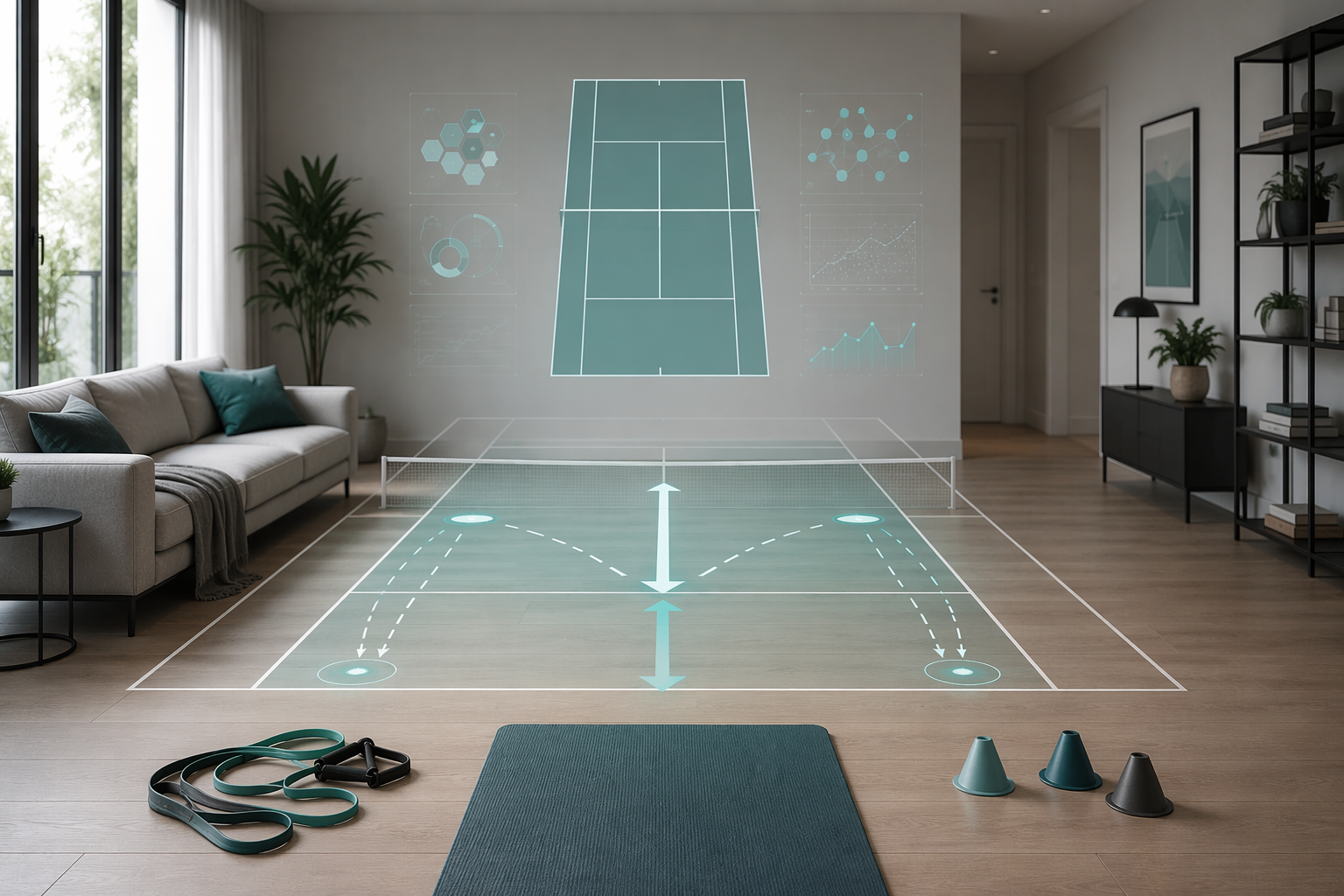
This article uses actual tennis match physiology data—point duration, work-to-rest ratios, and movement distribution—to build a home workout that trains the right energy system and movement patterns. The result is a tennis-specific routine that preserves shot quality under fatigue, not a generic HIIT circuit.
- Equipment Required
- markers (cones or tape), optional mini-bands, optional mat
- Space Needed
- 3m x 4m
- Noise Level
- low
A lot of home tennis conditioning fails in the same quiet way: the workout feels hard, the shirt is soaked, and then the third set still exposes you. The legs burn before the lungs quit. The forehand lands shorter. The first serve starts looking optional. That mismatch is not mysterious if the session was built like generic HIIT instead of tennis.
A better tennis-specific home workout starts with a less flattering question: did the workout ask your body to repeat the same kind of effort a point demands? In a review of tennis physiology research, Kovacs reported an average point duration of 8.00 ± 2.58 seconds and a typical work-to-rest ratio between 1:2 and 1:5. The same review cites fatigue research in which hitting accuracy dropped by as much as 81% and first-serve accuracy by 30% under fatigue.[1]
Those numbers change the workout immediately. They point away from 40 seconds of burpees and 10 seconds of rest. They point toward short explosive bouts, enough recovery to keep quality high, and movement that looks more like a rally: split, push, shuffle, stop, recover, repeat.
The Clock Comes Before the Exercise
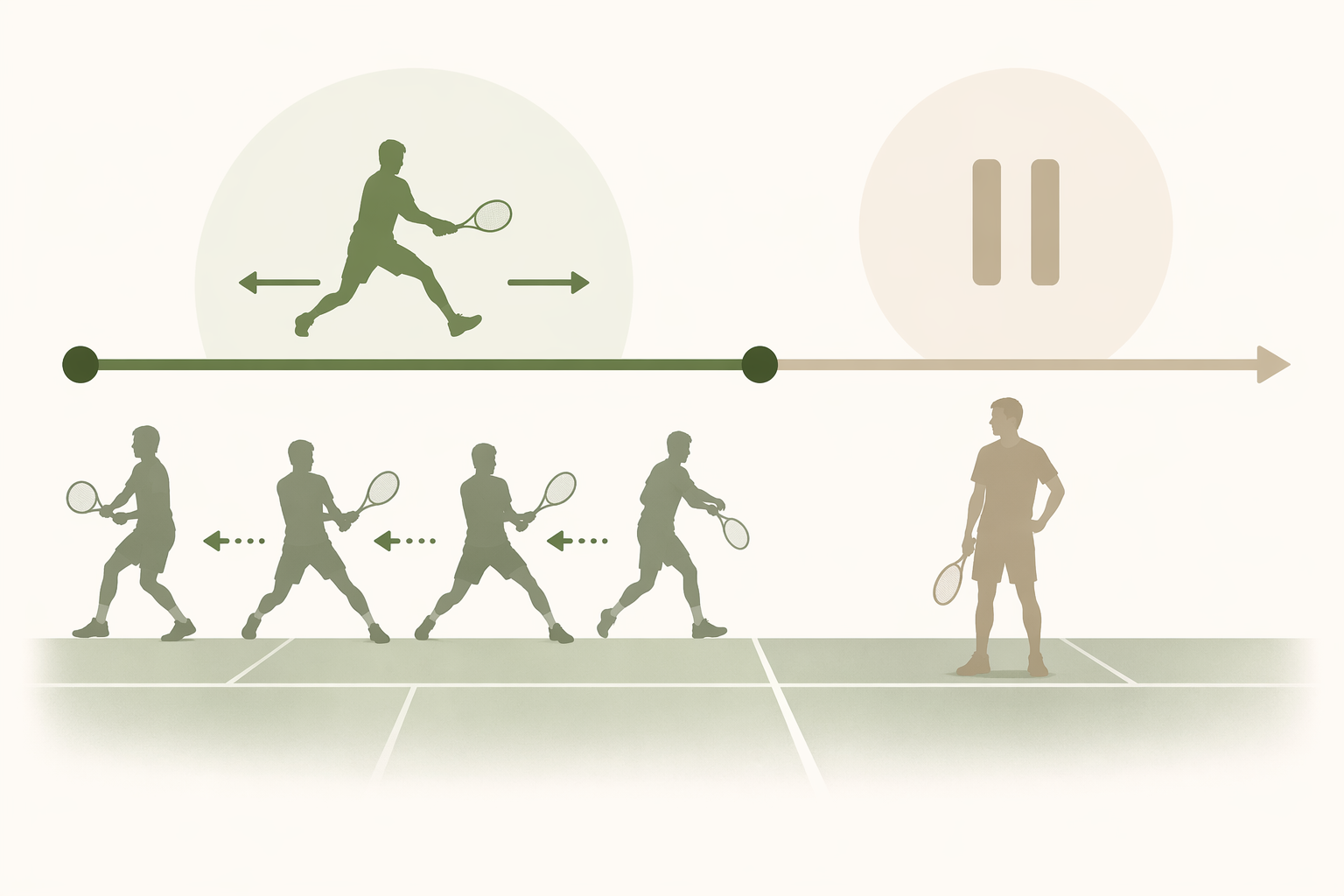
If a tennis point usually asks for roughly 4.6 to 8.0 seconds of high-quality work, the first design decision is not which drill looks athletic. It is how long the burst lasts. Pereira and colleagues found a 4.6-second average rally duration in a small analysis of four clay-court matches involving eight professional baseliners, while Kovacs’ broader review reported the 8.00-second mean across studies.[1][2]
For a home session, that gives you a useful training window: 6 to 8 seconds for most work bouts, with occasional 4- to 5-second bursts when you want the drill to feel sharper and less metabolically heavy. Longer intervals are not useless for general fitness, but once a “tennis drill” becomes a 30-second grind, it starts training a different problem.
| Match finding | Home-training translation |
|---|---|
| Points often fall around 4.6–8.0 seconds | Use 4–8 second work bouts, not long continuous circuits |
| Work-to-rest ratio commonly sits around 1:2 to 1:5 | Rest 12–40 seconds after an 8-second burst, depending on drill intensity |
| Movement is heavily lateral in the available match sample | Give shuffles, jab steps, pivots, and recoveries more volume than forward sprints |
| Tennis relies heavily on short, explosive energy production | Stop the set before the feet get sloppy and the simulated stroke loses shape |
The rest interval is where many hard-working players sabotage the transfer. An 8-second lateral burst followed by 10 seconds of rest produces a very different session from an 8-second burst followed by 24 or 32 seconds of rest. The first becomes a conditioning blur. The second gives you a chance to repeat a clean split step, a hard first push, and a stable recovery position.
Set Up a Small-Space Court
You do not need a full baseline to train the physical pattern. A 3m-by-4m footprint is enough for most home versions because tennis accelerations are usually short. The point is not to recreate court geometry. It is to rehearse the burst, brake, recover, and repeat sequence without turning your apartment into a downstairs-neighbor complaint.
- Use two markers as a “center” and “wide ball” target, spaced as far apart as your room safely allows.
- Train on a mat only if it does not slide; a moving mat is worse than no mat.
- Wear court shoes or stable trainers when the floor is slick; socks turn braking drills into luck.
- Use mini-bands only when they preserve foot speed; if the band makes every step slow, it has changed the drill.
- Keep jumps low. A split step can be quiet and useful without becoming a vertical plyometric contest.
If you already organize your equipment by space and budget, this routine sits naturally beside a broader tennis home training routine. Cones, bands, mats, and shoes are useful here only when they help you hit the timing and movement pattern. They are not the workout.
The 8-Second Point Block
This is the core block. It should feel crisp, not heroic. You are training the ability to produce a tennis-like burst, recover, and produce another one before mechanics fall apart. Human Kinetics describes tennis as relying heavily on the ATP-PCr system for the first roughly 10 seconds of intense work, which fits the short-point timing from match analysis.[3]
| Drill | Work | Rest | Sets |
|---|---|---|---|
| Split-step to lateral shuffle and shadow forehand | 8 seconds | 24 seconds | 6 reps |
| Split-step to lateral shuffle and shadow backhand | 8 seconds | 24 seconds | 6 reps |
| Center recovery: wide ball, recover, wide ball | 8 seconds | 32 seconds | 4 reps each side |
| Serve stance reset: shadow first serve, split, first step recovery | 6 seconds | 24–30 seconds | 6 reps |
The 24-second rest after an 8-second rep gives a 1:3 ratio. That sits inside the 1:2 to 1:5 match range without pretending your living room is a match court. If the drill includes a harder stop, a band, or a shadow serve, use the longer end of the rest range. The goal is not to prove you can suffer. The goal is to make rep eight look like rep one.
A clean rep has four pieces: a quiet split step, a decisive first push, a controlled brake, and a recovery step that leaves you ready for the next ball. If you skip the recovery because the timer is rushing you, the timer is wrong for the purpose.
How an 8-Second Rep Actually Looks
Start in an athletic ready position at the center marker. On the beep, split step. Push laterally to the wide marker in two or three quick steps. Plant outside foot, shadow the stroke, then recover toward center. If time remains, repeat the same side once more or finish in a ready position. Stop at eight seconds even if you feel you could squeeze in another sloppy movement.
That last instruction matters. Tennis fatigue is not just a burning-quad problem; it becomes a technical problem when contact height changes, recovery gets late, and the serve toss loses its usual relationship to the legs. The fatigue-to-accuracy findings cited by Kovacs make the cost visible: under fatigue, shot accuracy and first-serve accuracy can drop sharply.[1]
Make the Work Mostly Lateral
In Pereira’s clay-court analysis, lateral movement accounted for 79% of observed movement and forward movement for 21%. That is a small, surface-specific sample, so it should not be treated as a universal law for every player, surface, or style. It is still a useful warning against home routines that spend half their “tennis conditioning” time on forward lunges, squat jumps, and straight-line sprints.[2]
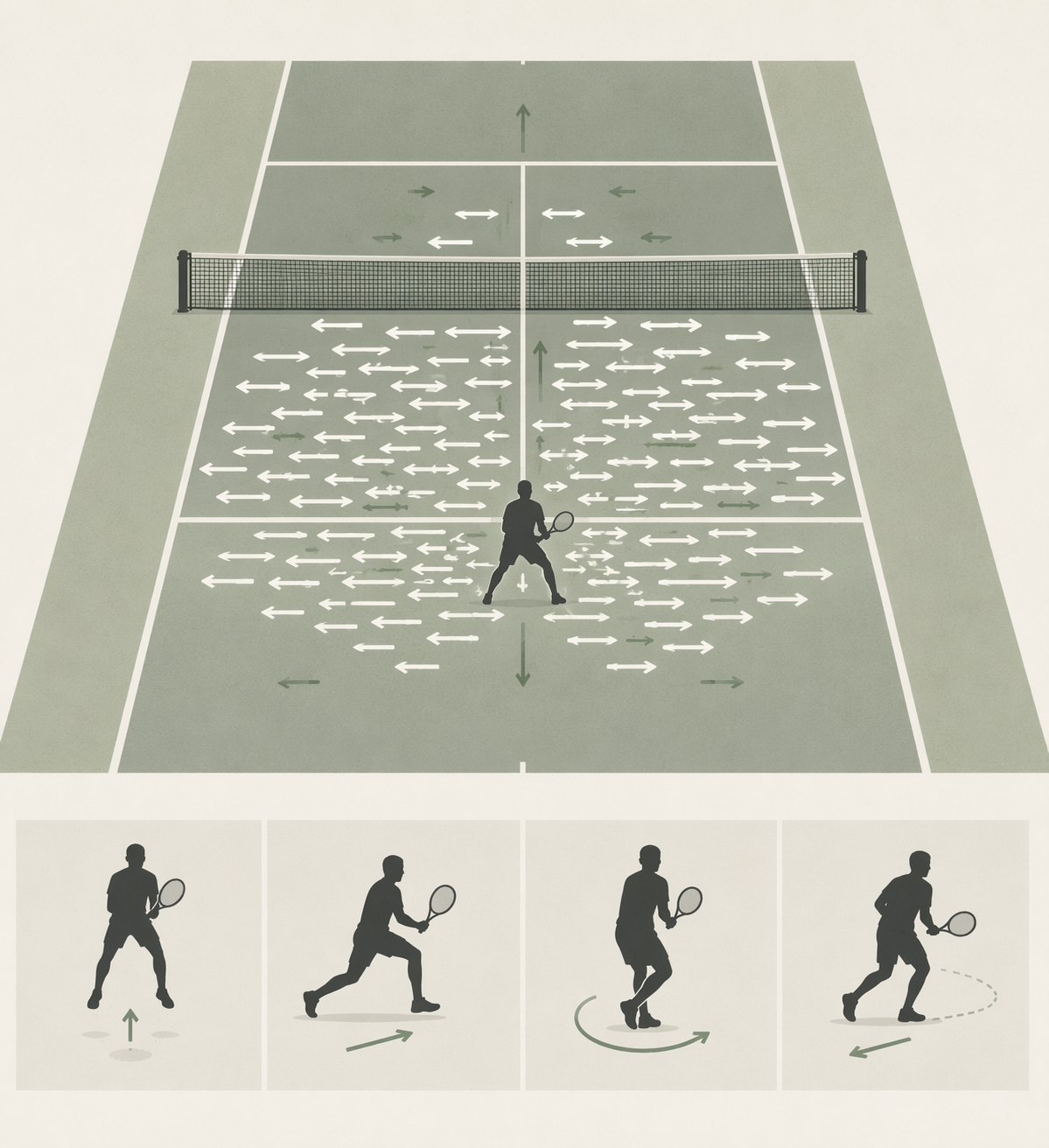
The practical bias should be clear: most of the volume goes sideways. Forward and backward steps stay in the session, but they are supporting actors unless your own game or injury history says otherwise.
| Footwork pattern | Home drill | Why it belongs |
|---|---|---|
| Split step | Low split into immediate lateral push | Every rep starts with readiness, not from a dead standstill |
| Jab step | Short outside-foot jab before recovering to center | Trains the first adjustment step before a wider move |
| Pivot step | Open hip, turn, and shadow recovery after a wide ball | Builds the transition from stretched position back into balance |
| Drop step | Small backward diagonal step into shadow overhead or deep-ball recovery | Keeps backward movement present without overbuilding it |
Human Kinetics names the split step, jab step, pivot step, and drop step as foundational tennis movement patterns. Those labels are useful because they stop the workout from becoming random foot tapping around cones.[4]
The distance also fits apartment training better than people assume. A tennis movement review summarized match-tracking work showing roughly 5.2m of movement per point when serving, roughly 7.7m when returning, and maximum sprint distances typically under about 9m per direction.[5] A small room cannot reproduce the court, but it can train the first two or three explosive steps that decide whether you arrive balanced or late.
A Match-Data Home Session
Do this session after a light warm-up, not cold. Five minutes is enough for most players: easy marching, hip circles, ankle rocks, low split steps, and a few slow shadow swings. Save the intensity for the timed work.
| Block | Work |
|---|---|
| Primer | 5 minutes easy mobility and low split steps |
| Point block | 4 drills, 6–8 seconds each, 1:3 to 1:4 rest |
| Lateral volume block | Two rounds of lateral-dominant footwork patterns |
| Accuracy-under-fatigue block | Short bursts followed by controlled shadow strokes or serve resets |
| Cool down | 2–4 minutes easy walking and breathing |
Lateral Volume Block
Run two rounds. Each drill lasts 8 seconds. Rest 24 to 32 seconds after each rep. Take 90 seconds between rounds if your foot speed is dropping.
- Split-step shuffle right, shadow forehand, recover to center.
- Split-step shuffle left, shadow backhand, recover to center.
- Jab step right, recover, jab step left, recover.
- Pivot from wide forehand stance back to center.
- Drop step diagonally back, shadow deep-ball recovery, return to ready position.
Do not make every rep maximal. Tennis points include hard accelerations, but they also demand braking and posture. If you are skidding, standing tall, or reaching your shadow swing with the torso falling sideways, cut the distance before you cut the rest.
Accuracy-Under-Fatigue Block
This block is where conditioning has to answer to tennis. After each short movement burst, finish with one deliberately shaped action: a balanced shadow forehand, a stable two-handed backhand, a serve stance reset, or a controlled shadow first serve. The rep only counts if the finish looks playable.
| Rep type | Work | Rest | Quality rule |
|---|---|---|---|
| Wide forehand recovery plus shadow target | 8 seconds | 32 seconds | Finish balanced enough to recover without a hop |
| Wide backhand recovery plus shadow target | 8 seconds | 32 seconds | Hold head and trunk position through the swing |
| Serve reset under fatigue | 6 seconds | 30 seconds | Toss arm path and landing stay controlled |
| Return split plus first-step reaction | 5 seconds | 20–25 seconds | First step is decisive, not guessed early |
A simple scoring rule helps: give yourself one point for speed and one point for shape. If the speed is high but the shadow stroke is late, off-balance, or rushed, that is a one-point rep. Tennis does not reward the athlete who wins the conditioning drill and donates the next ball short.
Where Generic HIIT Still Fits
There is nothing wrong with general conditioning when it is labeled honestly. Longer circuits can build work capacity, help with body composition, and make training easier to schedule. They just should not be confused with a tennis-specific point pattern.
If your week already includes a broader tennis fitness routine at home, use this match-data session as the specificity day. If you like seeing how a compact space can support serious tennis work, the Barbora Krejcikova workout routine is a useful pro-informed example rather than a template you need to copy exactly.
Progress It Without Ruining It
Progression should protect the match fingerprint. Add complexity before you add long fatigue. For example, keep the 8-second work interval but make the movement choice reactive: call “forehand,” “backhand,” or “drop” out loud from a shuffled card stack or timer app. Add a mini-band only if the step still looks quick. Add a third round only if the final round stays clean.
- Beginner: 6-second reps, 30-second rests, one round of each block.
- Intermediate: 8-second reps, 24–32-second rests, two rounds.
- Competitive recreational: 8-second reps, varied 16–40-second rests, reactive calls, and stricter quality scoring.
- Match week: reduce volume before competition instead of chasing soreness.
Competitive players preparing for a specific event should pair this with a taper rather than keep adding rounds. A tennis quarterfinal workout taper makes more sense when the priority has shifted from building capacity to arriving fresh.
What This Cannot Replace
A home drill can match the clock, the work-rest rhythm, and much of the first-step movement demand. It cannot reproduce ball flight, opponent reads, spin, depth, contact timing, serve pressure, or the feeling of choosing the wrong shot and having to live with it.
Use the data for what it can do. It can stop you from mistaking a sweaty circuit for tennis conditioning. It can make your home workout shorter, sharper, more lateral, and more protective of shot quality under fatigue. The rest still has to happen on court.
References
- Tennis Physiology: Training the Competitive Athlete, Sports Medicine, 2006.
- Activity profile and physiological demands of tennis match play in professional players, International Tennis Federation, 2016.
- Tennis and Energy Systems, Human Kinetics.
- Major Movements in Tennis, Human Kinetics.
- Tennis Research Review: Movement Characteristics, Matt’s Point.
Ready to rest?
Don't have the gear yet?
- markers (cones or tape)
- optional mini-bands
- optional mat
Comments
Join the discussion with an anonymous comment.