
A Barbora Krejcikova Workout Routine You Can Do at Home
Adapt Barbora Krejcikova's pro off-court training to your living room with a four-pillar circuit that fits a 3m by 4m space using resistance bands, a medicine ball, a jump rope, and a yoga mat — roughly $50–120 total. The routine includes sets, reps, rest intervals, and clear equipment substitutions for renters on a tight budget.
Before you start
- Equipment required
- resistance bands, medicine ball, jump rope, yoga mat
- Assumes build tier
- No specific tier required
- Duration
- 25 minutes
- Difficulty
- beginner
If you are trying to build a tennis workout routine like Barbora Krejcikova in a rented apartment, the honest version is not a secret pro program. It is a small-room adaptation: roughly 3m x 4m, about $50-120 in gear, and the same off-court movement logic translated into a corner of your living room.
What Carries Over
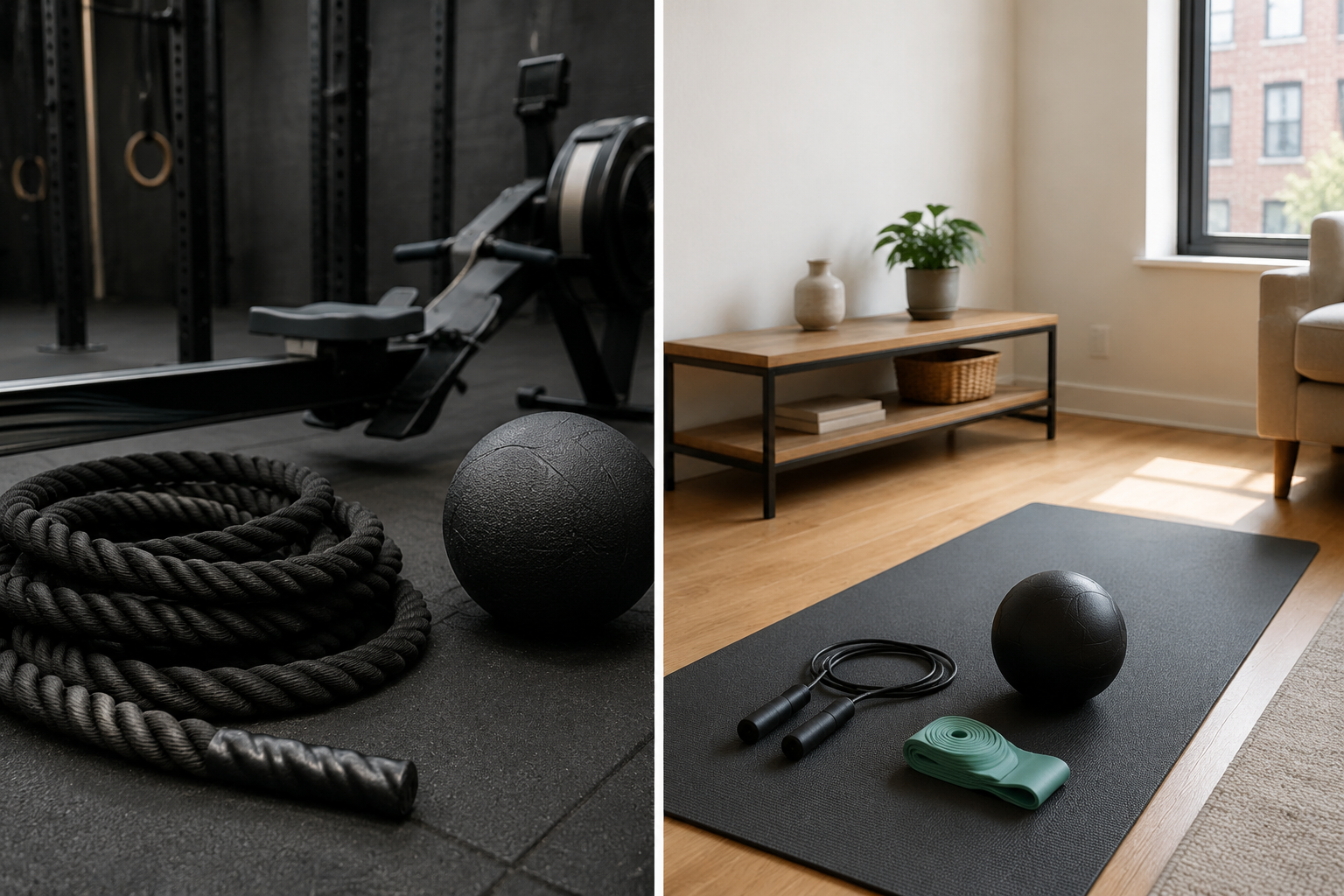
The useful part of Krejcikova's public off-court pattern is not the brand name of the machine. It is the movement mix: battle ropes, medicine-ball throws, rowing, airbike work, functional strength, and regular walking. That points to four load-bearing qualities you can train at home without pretending your apartment is a private performance center: rotational power, full-body conditioning, lower-body explosiveness, and core stability. Her public October training log, as aggregated by CelebWell, also leans more toward strength than conditioning, so a strength-heavy weekly bias makes sense even though the exact calendar is not public.
| Pillar | Home equivalent | Why it belongs |
|---|---|---|
| Rotational power | Medicine-ball twists or controlled rotational throws | Keeps the trunk and hips producing force across the body, which is the home version of the rope-and-throw pattern. |
| Full-body conditioning | Band rows plus jump-rope intervals | Substitutes for rowing or airbike work with something a renter can do in place. |
| Lower-body explosiveness | Band squats, split squats, calf raises, and backpack loading | Builds the leg stiffness and push-off quality that tennis asks for on first step and recovery. |
| Core stability | Plank variations, side planks, dead bugs, towel sliders | Trains the brace that lets the rest of the body move fast without leaking force. |
The Four-Pillar Circuit
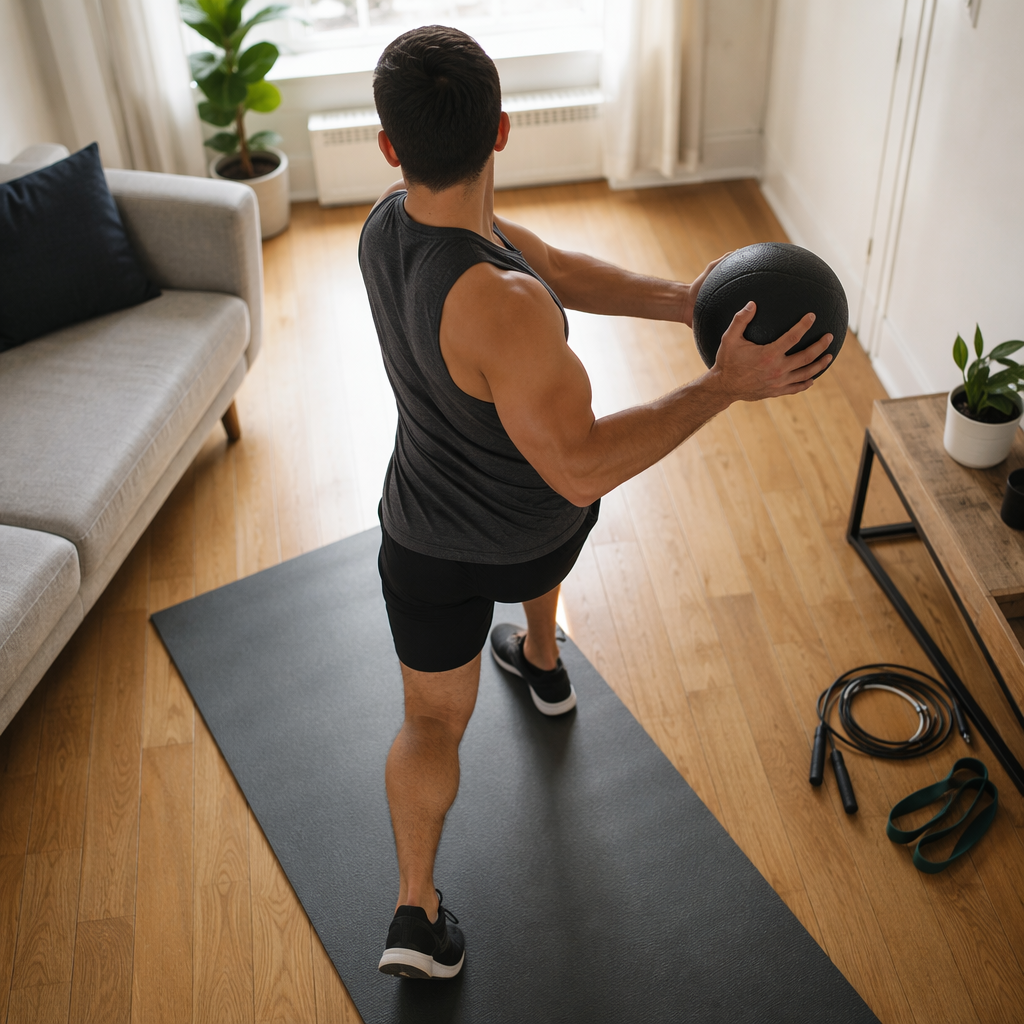
This version is built for one clear floor space, one mat, and quiet transitions. It fits a 3m x 4m corner if you push the coffee table aside. Run 3 rounds. The whole session usually lands in the 20-30 minute range once the setup is sorted, and every piece keeps the same movement intent as the pro version without requiring a rower, an airbike, or a garage.
| Pillar | Exercise | Sets / reps / rest | Space and gear | Progression |
|---|---|---|---|---|
| Rotational power | Medicine-ball rotational toss or twist-to-press | 3 sets of 6-8 reps per side; rest 30-45 seconds | About 2m x 2m; medicine ball, mat, wall only if the room is quiet and safe | Move to a half-kneeling version, then slightly increase the ball weight. |
| Full-body conditioning | Band row followed by jump-rope intervals | 3 rounds of 12-15 rows plus 30 seconds of rope; rest 30 seconds between moves and 60 seconds between rounds | Door anchor or stable post, about 2m x 1m, jump rope | Use single-arm rows, then shorten the rest, then extend rope intervals to 40 seconds. |
| Lower-body explosiveness | Band squat followed by calf raises | 3 rounds of 8-10 squats plus 15-20 calf raises; rest 45 seconds between rounds | About 1.5m x 1.5m; resistance band, backpack optional | Add a filled backpack, then use a 2-second pause at the bottom of the squat. |
| Core stability | Forearm plank, side plank, or dead bug | 3 rounds of 30-45 seconds of plank work plus 20-30 seconds per side; rest 30 seconds | Mat length only; yoga mat, folded towel, towel sliders if useful | Use a long-lever plank or add a reach to make the brace less forgiving. |
- Use a resistance band for anything that would otherwise need a cable machine or row station.
- Use a folded towel as a slider when the floor work asks for more reach.
- Use a filled backpack when you need more load than bodyweight but do not want to buy a vest yet.
- Buy the jump rope first if you want the cheapest conditioning tool, then add the medicine ball if you still have budget left.
If throwing a ball into a wall is too noisy for your building, keep the rotational work as a fast twist-to-press or a pivot-and-press. The point is the transfer of force from the hips through the trunk, not the drama of the throw.
How To Place It In A Week
A public month that leans more toward strength than conditioning supports a weekly split that does the same. Three strength-heavy sessions for every one conditioning-focused session is a reasonable home model, not a claim about her private programming. If you want the broader week built out around your equipment and space, the site's tiered plan is here: Build a Tennis Home Training Routine That Fits Your Equipment and Space.
That leaves room for the part most home tennis plans forget: skill work. If you want to pair this circuit with forehand practice instead of treating fitness as a separate project, use How to Build a Better Tennis Forehand at Home in 15 Minutes.
Don't have the gear this routine assumes? Find the build that covers it.
Wondering how much rest you need after this? Read our ACSM-cited recovery reference.
Questions about form, substitutions, or a correction? Leave it below.
Comments
Join the discussion with an anonymous comment.