
Tennis Volley Drills You Can Do at Home Without a Wall
This article provides a complete toolkit of no-wall, low-noise tennis volley drills designed for apartment living, using foam balls, shadow work, and footwork patterns that build real volley skill without damaging walls or disturbing neighbors.
Before you start
- Equipment required
- foam ball, tennis racquet, mirror
- Assumes build tier
- No specific tier required
- Duration
- 15 minutes
- Difficulty
- beginner
- Noise level
- quiet
Stop Waiting for a Wall
If you live in an apartment, the usual volley advice breaks down fast. A wall is loud, risky, and often not available in the first place. That does not leave you stuck. It just means the useful work happens in a smaller, quieter lane: foam-ball control, mirror shadow volleys, compact footwork, and a little visualization. None of that replaces live-ball practice on a court, but it does let you train the parts of the volley that actually respond to repetition at home: touch, racquet-face control, ready position, and recovery.
The best part is that you do not need a full room to make it work. A racquet, a soft ball, a mirror, and enough floor space to move without clipping furniture are enough for a real tennis volley home workout that stays friendly to neighbors.
The Equipment That Makes Apartment Volley Practice Possible
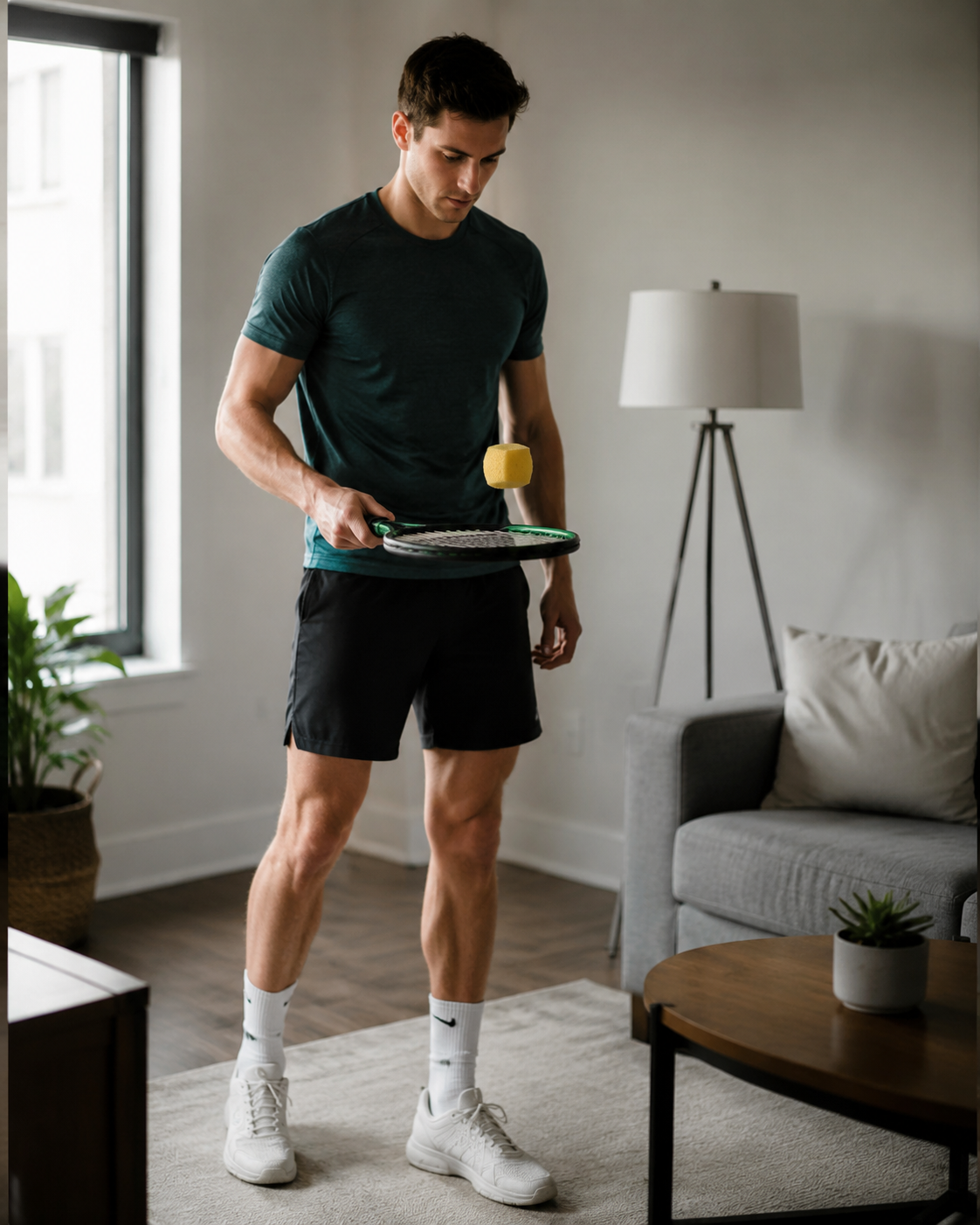
Start with a foam or low-compression ball. That single choice changes the whole drill environment. It cuts noise, reduces the risk of bouncing balls across the room, and makes repeated contact feel manageable in a way a standard tennis ball does not. A full-length mirror is the other high-value tool, because it gives instant feedback on whether the swing is compact or drifting into a backswing that belongs on a baseline groundstroke. If you have space for a small clear patch of floor, that is enough.
You can think of this as a quiet version of tennis-specific home training, not a separate sport. If you already use a broader conditioning plan, the companion piece is something like How to Build a Tennis Fitness Routine at Home Without a Gym, which covers the strength, speed, and stamina side of the game. This article stays with the volley-specific pieces.
The Two Drill Families That Matter Most
1. Foam-ball bounces for hand-eye control
This is the simplest useful drill for apartment volley work, and it earns its place because it trains racquet-ball contact without noise or wall impact. Hold the racquet in front of your body and bounce the foam ball on the strings with short, controlled taps. The goal is not height. The goal is consistency and a calm racquet face.
- Forehand bounces: keep the hitting side in front of you and guide the ball with small, soft contacts.
- Backhand bounces: switch sides and keep the wrist quiet so the racquet does not wobble.
- Alternating bounces: move between forehand and backhand to train quick adjustment and racquet stability.
- Frame-bounce challenge: try to pop the foam ball off the racquet frame to sharpen awareness of where the racquet is in space; treat this as a drill suggestion, not a core requirement.
The first three variations build hand-eye control and clean contact. The frame-bounce version adds a different kind of awareness because you are learning how the racquet sits in your hand and how little movement it takes to keep the ball alive. That is useful for volleying, where too much motion usually costs more than too little.
2. Shadow volleys in a mirror
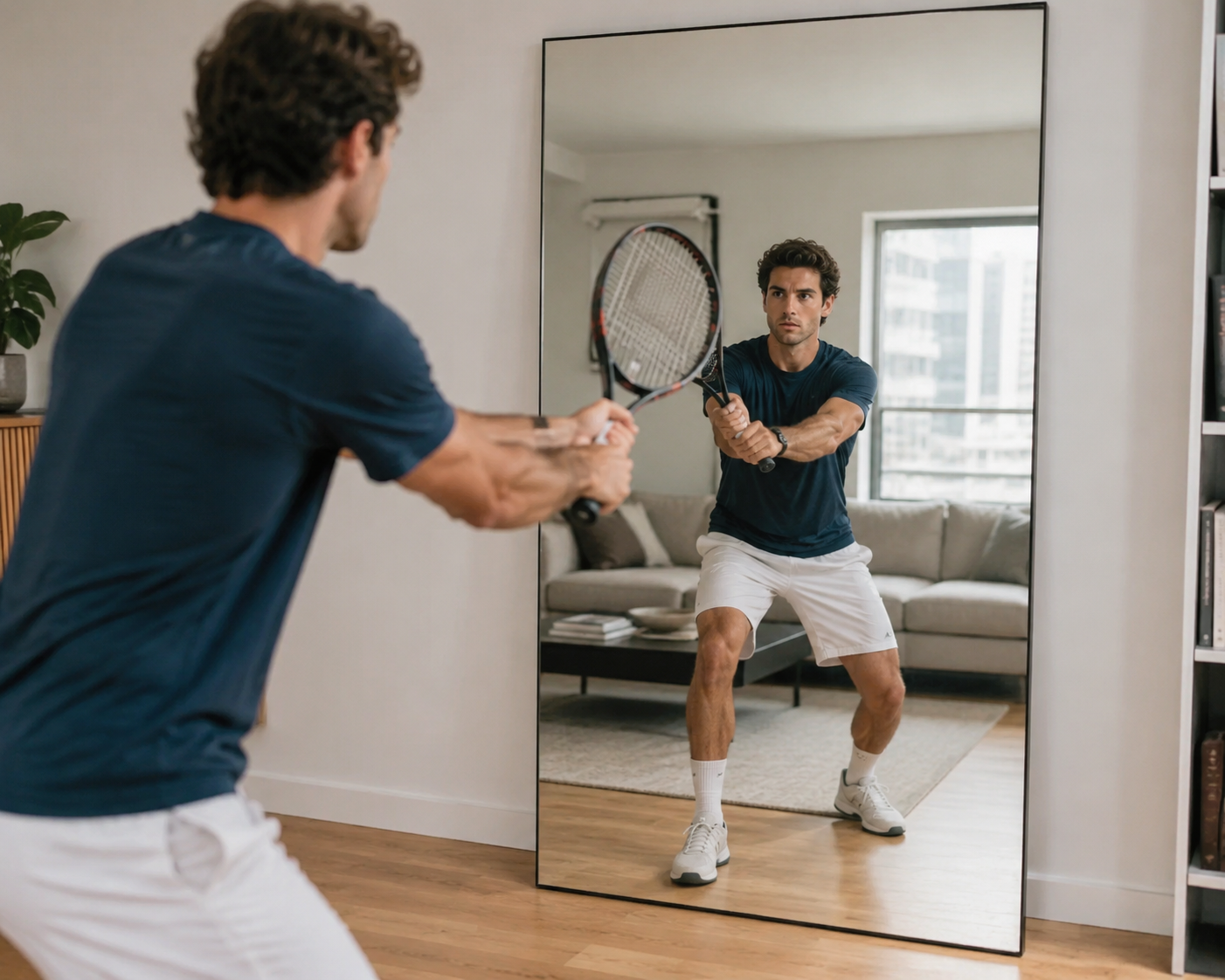
Mirror work is where the volley starts to look like a volley. Stand in front of the mirror and rehearse the motion with no ball at all. Watch for a compact preparation, a quiet racquet face, and no big loop in the backswing. The racquet should stay in front of the body. The elbows should not drift far behind you. The motion should feel short, direct, and repeatable.
- Start from a ready position with the racquet up and the posture stable.
- Take the racquet forward with a compact path instead of drawing it far back.
- Freeze for a moment and check that the racquet face is quiet, not twisting open.
- Recover back to ready position after every shadow volley, because the recovery is part of the skill.
This drill is especially useful because the biggest beginner volley mistake is usually not timing. It is excess swing. The mirror catches that immediately. If the racquet travels too far back or the shoulders over-rotate, you can see it at once and correct it before the habit gets baked in.
Footwork Still Matters in a Small Room
Volleying is not just a hand skill. Even in a tight apartment, you can rehearse the movement that gets you into position. Use a small patch of floor and work three patterns: split steps, lateral shuffles, and forward-approach shadow steps. Keep them quiet. You are training balance, readiness, and the habit of getting set before contact.
- Split steps: land softly and return to a balanced ready position.
- Lateral shuffles: move one or two quick steps each way without crossing your feet unless the movement calls for it.
- Forward-approach shadow steps: take controlled steps toward an imaginary net ball, then recover.
If your apartment gives you only a narrow lane, that is still enough. The point is not court coverage. The point is teaching your body to arrive in a controlled posture instead of lunging late. If you want a broader home tennis conditioning structure to support this, the fitness routine linked earlier is the better place to build it.
Use Visualization to Fill in the Missing Ball
A few quiet mental reps round out the work. Picture a ball coming at different heights and speeds, then rehearse the response: absorb pace, keep the swing compact, place the volley, and recover. The value here is not fantasy. It is patterning. You are giving the body a clear sequence to follow once you get back to the court.
Keep the expectations realistic. Shadow work and foam-ball control can sharpen racquet awareness, preparation, and footwork habits, but they do not reproduce live-ball timing, pace, or the feel of impact. That is why these drills are a bridge, not a substitute. They make the next court session cleaner, not unnecessary.
A Quiet 15-Minute Session
This is a practical way to stack the drills together when you only have a little time and a little space. It is a synthesis of the drill patterns above, not a tested training program.
- 2 minutes: split-step and shuffle warm-up in a small clear area.
- 4 minutes: foam-ball forehand and backhand bounces, staying smooth and quiet.
- 3 minutes: alternating bounces or the frame-bounce challenge if you want extra racquet awareness.
- 4 minutes: mirror shadow volleys with a compact swing and a full recovery to ready position.
- 2 minutes: visualization of approach, contact, and recovery.
If the floor creaks, the racquet taps loudly, or the ball starts skittering toward furniture, reduce the intensity and switch back to shadow work. Apartment training works best when the quiet version is the default, not the compromise.
Keep It Quiet, Keep It Repeatable
A few noise habits make the routine easier to keep up. Use foam or low-compression balls. Practice during reasonable daytime hours. Stay light on your feet instead of stomping through the footwork patterns. If your room has hard flooring, focus on controlled movement rather than speed. The goal is a session you can repeat often without turning it into a neighbor problem.
Apartment volley drills will not give you the same feedback as a live exchange at the net, but they can make you cleaner, quicker, and more controlled before you get there.
Don't have the gear this routine assumes? Find the build that covers it.
Wondering how much rest you need after this? Read our ACSM-cited recovery reference.
Questions about form, substitutions, or a correction? Leave it below.
Comments
Join the discussion with an anonymous comment.