
All-in-One vs. Separate Equipment: Choosing the Right Home Gym Setup for Your Budget and Space
This article compares all-in-one exercise machines against separate equipment builds across three budget tiers, helping you decide which setup delivers better value based on your floor space, upgrade priorities, and total spend.
The floor-space gate
If your garage or basement gives you only a tight rectangle of usable floor, the comparison changes fast. This article really starts once you have about 22–35 square feet to work with; below that, the better next stop is the companion piece on All-in-One Home Gym Types, because the room itself is doing the deciding.
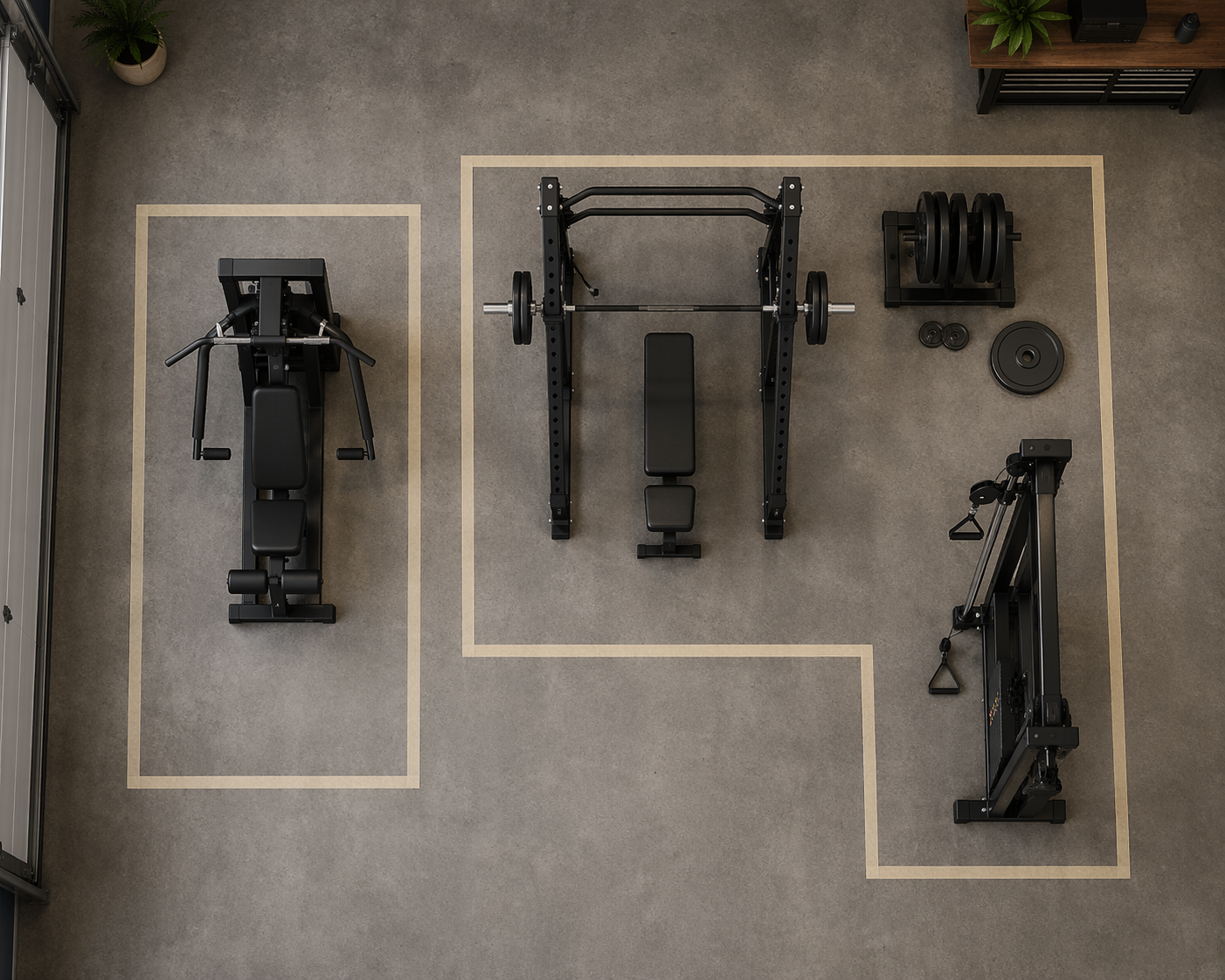
If you do have that space, the choice is not “better machine versus worse machine.” It is whether you are buying one integrated footprint and a cleaner setup, or separate pieces that ask for more room but give you more room to grow.
What the choice really changes
- All-in-ones compress training into one footprint, which matters when every square foot is being negotiated.
- Separate setups spread the same budget across a rack, barbell, plates, and often a cable station, which can mean better strength progression and easier upgrades later.
- The rack-plus-attachment middle path keeps the rack as the anchor and adds cables without forcing a second full machine.
- The real ownership question is how much you value a finished room now versus a setup you can expand later.
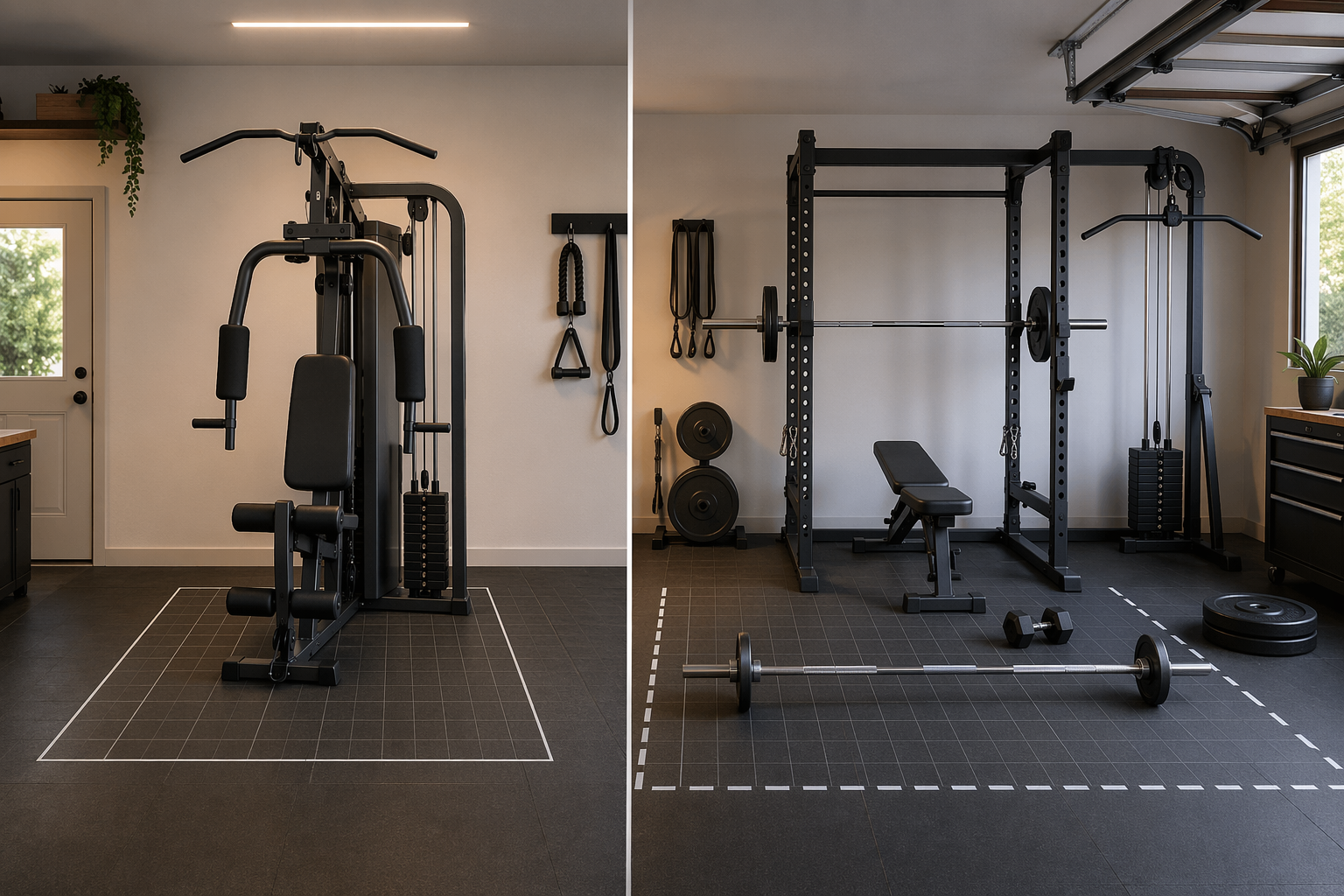
FitnessFactory’s 2026 multi-station recommendations are useful as category context: these systems make sense when you want several training modes in one purchase, but once the machine gets more complex, serviceability and cable feel matter more than the showroom effect. [3]
At $1,500, separates can still win on value
The entry tier is where separate equipment can look strangely competitive. The Bowflex Xtreme 2 SE lands at $1,499, which makes it an easy all-in-one candidate, but a Bells of Steel Cable Tower at $434 still leaves room to build a budget rack, barbell, and plates for roughly the same total. That separate build is less tidy and takes more planning, yet it can give you a more honest path to heavier basic lifting. If you want to stay in the compact multi-gym lane, the Marcy vs. Bowflex vs. Sportsroyals comparison is the more relevant filter; if you are leaning separate, the Cable Machines Under $1,000 guide and the Budget Home Gym Equipment: A Phased Buying Guide from $100 to $1,500 piece fit better.
In the $2,500 to $3,000 middle range, the rack-plus-attachment path gets cleaner
Between $2,500 and $3,000, the comparison gets cleaner. The Bells of Steel All-in-One at $1,900 takes about 22 square feet and keeps the room compact, while the REP PR-4000 with Ares 2.0 comes in at $2,999 and adds cable capability without adding any extra floor footprint to the rack. That makes the trade-off sharper: if the priority is one integrated unit that is ready to use quickly, the Bells machine is the simpler ownership story; if the priority is keeping a true rack at the center of the gym and layering cables onto it, the REP route preserves more upgrade room.
Above $4,000, model quality matters more than price
Once prices move above $4,000, cost stops cleaning up the decision. Major Fitness B17 is $4,199 and Force USA C10 is $4,499, while a high-end separate build can land in the same neighborhood once the rack, bar, plates, and cable work are all counted. Garage Gym Reviews has tested 50+ machines and helped 5,000+ buyers in 2025, which is useful context here because it shows why model-level build quality matters more than sticker price alone; a $1,900 Bells of Steel unit and a $4,199 Major Fitness B17 can both sit at 4.2/5. [1] At this tier, the separate route usually makes the most sense if you want stronger long-term progression and the option to swap pieces independently. The all-in-one only wins if you value a finished footprint more than open-ended expansion.
What ownership looks like after week one
Long-term ownership is where an all-in-one exercise machine stops feeling like a product photo and starts feeling like hardware. RitFit notes that a well-built unit can last more than a decade with maintenance, but cables and pulleys are wear items and eventually need replacement. [2] That does not make the category fragile; it just means the “simple” purchase still has maintenance, and the maintenance is concentrated in the parts you use every session. Separate equipment spreads that burden out: the rack stays the rack, the barbell can be upgraded on its own schedule, and the cable station can improve without forcing a full replacement.
If you already know you want the integrated route, the next layer is the companion guide on All-in-One Home Gym Types, because at that point the subcategory matters more than the broad decision.
The decision rule
If your space is tight but still within roughly 22–35 square feet and you want one integrated purchase, shortlist all-in-ones by model quality, cable feel, and serviceability instead of by how clean the render looks. If you expect to add weight, push harder barbell work, or build around a strength-first setup over time, use the separate path even if it takes more planning. The right answer is the one that still makes sense after the excitement of delivery day fades.
References
- Best Home Gyms — Garage Gym Reviews — garagegymreviews.com/best-home-gyms
- Are All-in-One Home Gym Machines Worth the Investment? — RitFit Sports — ritfitsports.com/blogs/news/are-all-in-one-home-gym-machines-worth-the-investment
- Best All-in-One Home Gym Systems for 2026 — FitnessFactory — fitnessfactory.com/blog/best-all-in-one-home-gym-systems-for-2026
This result comes from one real apartment under the stated conditions — it is a strong signal, not a guarantee your space will measure identically.
Builds this evidence supports
Cable Machine Alternatives That Save Space and Money
Compare the best cable machine alternatives for home gyms – from resistance bands and pulley systems to suspension trainers and compact digital units – and find the right option for your space and budget.
How to Choose a Compact Home Gym That Works for Your Space, Budget, and Noise Tolerance
This article provides a structured decision framework for apartment dwellers and small-space residents to match their specific floor footprint, noise sensitivity, and budget to the most suitable compact home gym strategy — whether that's an all-in-one machine, modular build, smart digital system, or band/bodyweight setup.
The Garage Gym Reality Check: What Equipment Actually Fits in a Single-Car Garage
Most garage gym guides assume a two-car space. This article uses real dimensions, real equipment footprints, and three layout templates to show what fits—and what doesn't—in a single-car garage (10x20 to 12x20 ft).
Spot something off?
If this result didn't match your own space, let us know — floor-damage and noise claims carry real deposit-risk consequences if we get them wrong.