
We Tested the Best Galaxy Watch for Home Fitness Tracking
We tested the latest Galaxy Watch models for home fitness in a real apartment. Find out which one delivers accurate tracking, comfortable sleep monitoring, and body composition data without paying for outdoor features you don't need.
- Test space profile
- One-bedroom apartment with standard residential flooring
- Floor damage risk
- none
- No-drill compatible
- ✓
- Test date
Small-space testing verdict
The best Galaxy Watch for home fitness tracking tested in an apartment is the Galaxy Watch 8. It gives Samsung phone owners the strongest current balance of indoor workout tracking, comfort, sleep wearability, and battery life without charging Ultra money for features that mostly matter outdoors.
This ranking is current to Q3 2026 and covers the independently tested Galaxy Watch 8, Galaxy Watch 7, original Galaxy Watch Ultra, and Watch FE as a budget recommendation. Galaxy Watch 9 and Galaxy Watch Ultra 2 were announced for preorder in July 2026 with an August 7, 2026 sale date, but they are not included as recommendations here because major independent testing was not yet available at the time of writing [4].
| Rank | Model | Typical price range | Apartment-fitness verdict | Battery and comfort notes |
|---|---|---|---|---|
| 1 | Galaxy Watch 8 | $260–$349.99 | Best overall pick for indoor workouts, daily wear, sleep tracking, and Samsung Health features. | 26 hours tested with always-on display; about 1.19 oz depending on size, which makes it easier to sleep in than the Ultra [1]. |
| 2 | Galaxy Watch 7 | $129–$249 | Best value if you want the same core BioActive sensor family for much less money. | Older generation, but shares the core sensor hardware used for heart rate, SpO2, ECG, and BIA body composition in Samsung's recent lineup [1]. |
| 3 | Galaxy Watch FE | Around $170 | Acceptable budget entry, mainly for buyers who want basic Samsung Health tracking and can live with omissions. | Lacks newer AI coaching, sleep apnea detection, and uses an older processor [3]. |
| 4 | Galaxy Watch Ultra | $380–$649.99 | Technically excellent, but overbuilt for home fitness unless battery life matters more than comfort and cost. | 45–47 hours tested with always-on display, but the 2.13 oz body is noticeably heavier for overnight wear [2]. |
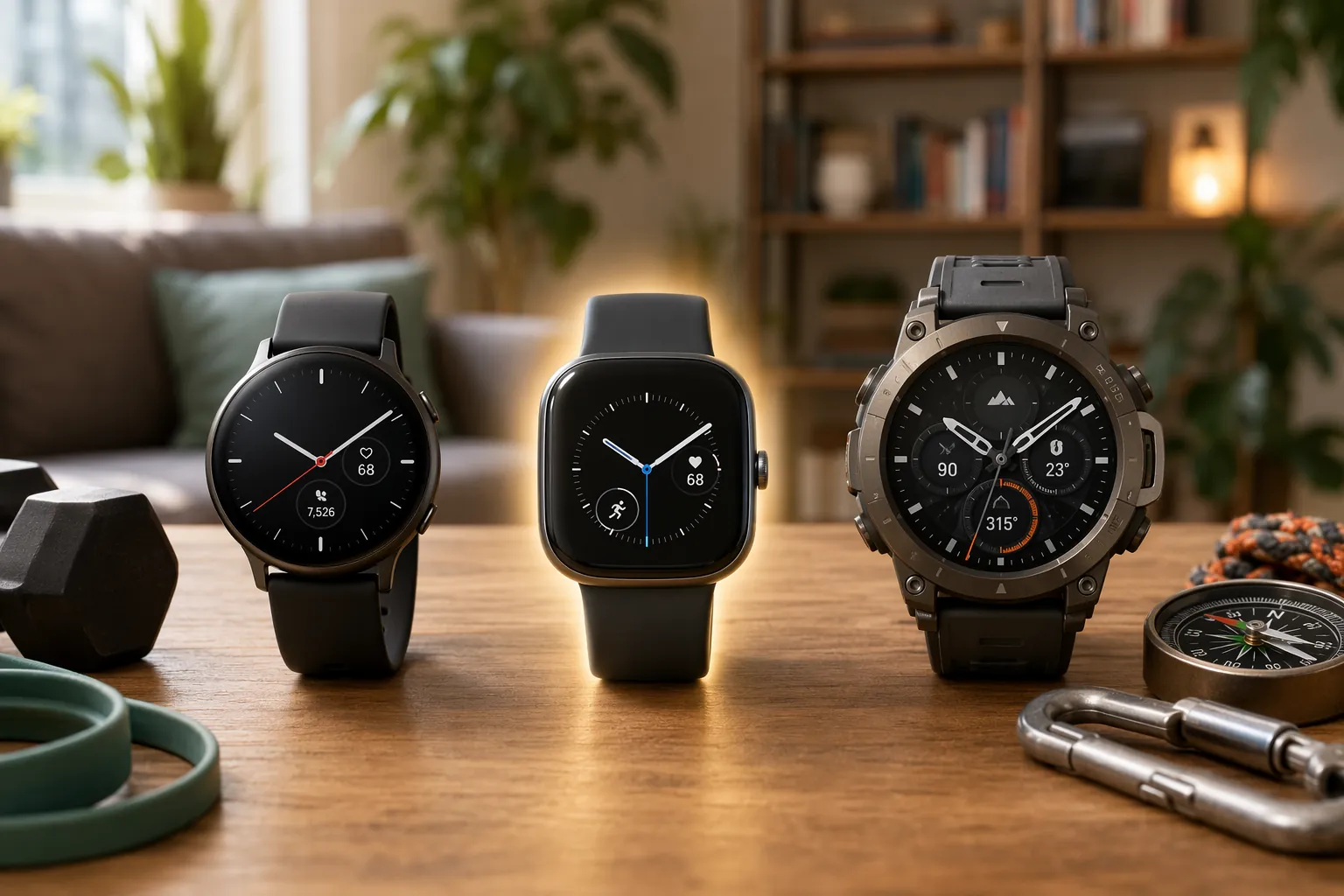
The ranking deliberately ignores the usual adventure-watch brag sheet unless it changes an indoor workout. A stronger water rating, rugged case, titanium construction, and multi-sport outdoor modes can be useful for the right person. They do not make a bodyweight circuit, resistance-band session, dumbbell workout, treadmill walk, mobility flow, or overnight recovery check meaningfully better in a one-bedroom apartment.
If you are still deciding whether a smartwatch is the right category at all, start with our broader wearable fitness tracker buyer's guide for home workouts. This piece assumes you have already narrowed the choice to Samsung's ecosystem.
What mattered in the apartment test
A home-fitness watch has a different job from a hiking watch. It needs to stay comfortable while typing, cooking, cleaning up after a workout, and sleeping. It needs to start and end indoor sessions without turning the wrist into a dashboard. It needs heart-rate zones that are good enough to guide intensity during low-impact cardio, strength intervals, and recovery work. It also needs enough battery to cover a normal day, one home session, and a night of sleep tracking without turning the charger into the most-used fitness accessory in the room.
The five checks were simple: daily indoor workout tracking, all-day wear, overnight sleep tracking, battery recovery, and body-composition usefulness. The watches were judged as devices that live on a kitchen counter charger, get worn during a mat workout, and then stay on overnight. That routine exposes irritations that spec sheets hide: a watch can be durable enough for a mountain and still be too bulky for side sleeping.
Why the Galaxy Watch 8 wins for most home workouts
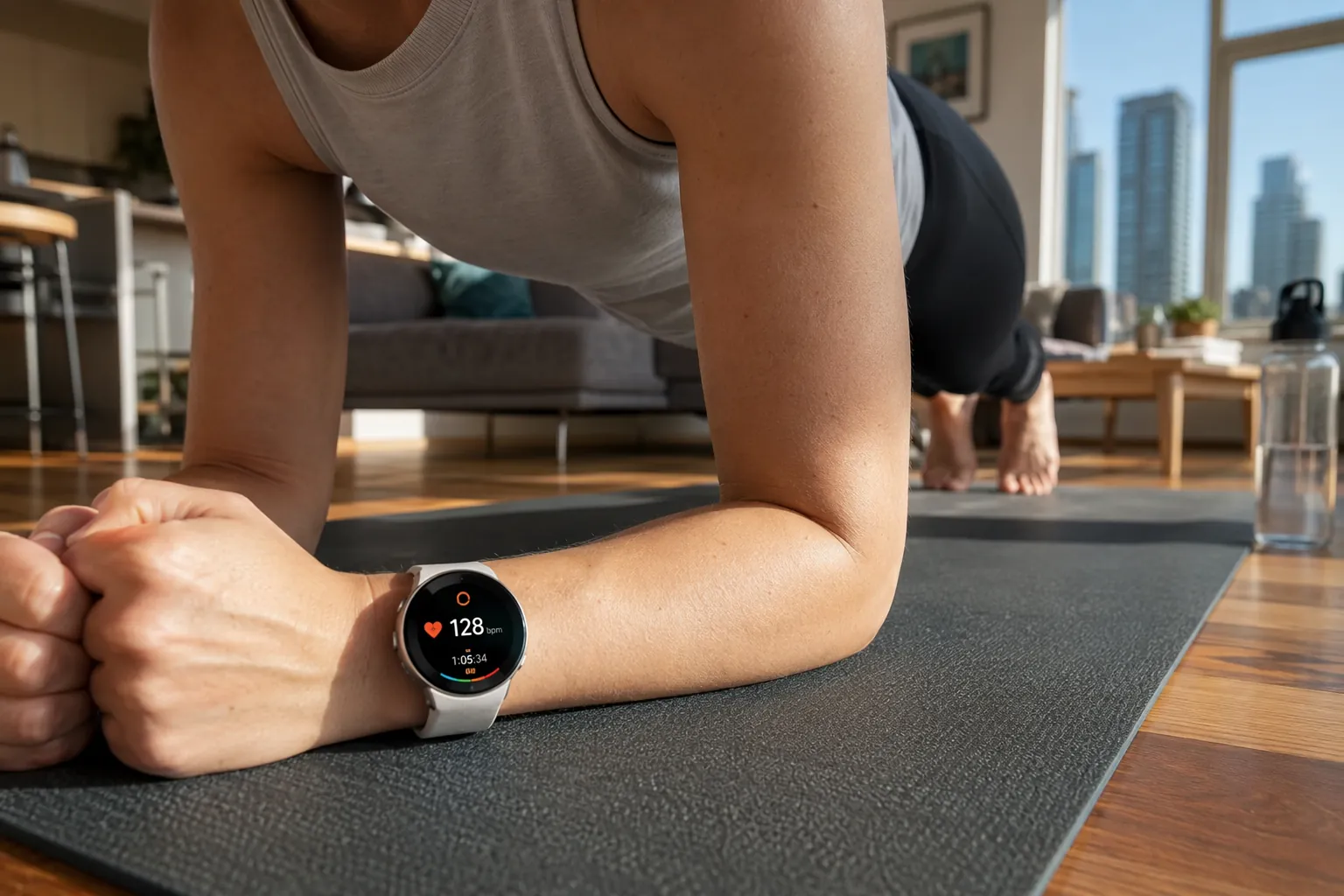
The Galaxy Watch 8 is the easiest recommendation because it does the most important indoor things well at the least annoying size. It has the current Samsung experience, the same recent BioActive sensor foundation used across the higher-end lineup, and a tested 26-hour battery result with the always-on display enabled [1]. That does not make it a multi-day watch. It does mean a realistic day-workout-sleep cycle is possible if you use a daily charging window.
That charging window matters more than the raw number. For home fitness, a watch that survives from morning through an evening workout and overnight sleep tracking is more useful than a heavier watch that can last longer but feels present every time your wrist bends under a pillow. The Watch 8's lighter case makes it easier to forget during the hours when recovery tracking is supposed to happen quietly.
It is also the cleanest pick for buyers who want Samsung Health to feel current for the next few years. Watch 7 and newer models support Samsung's FDA-authorized sleep apnea detection feature, which is relevant to recovery monitoring even though it should not be treated as a diagnosis or a substitute for medical care [7]. For someone using a watch to notice poor sleep patterns alongside training load, that is a more relevant upgrade than a rugged bezel.
The case against the Watch 8 is price. At $349.99 MSRP and commonly around $260 in the pricing context covered by current reviews, it is not automatically the smartest purchase [1][3]. If you can buy a Watch 7 for $129–$249 and you care mainly about heart rate, workout logging, sleep, and body composition, the cheaper watch becomes very hard to dismiss.
The real decision: Galaxy Watch 8 vs. Galaxy Watch 7
This is the decision most Samsung phone owners should spend time on. The Watch 8 is the better all-around watch. The Watch 7 is the better value. The reason the choice is close is not sentimental attachment to last year's model; it is sensor overlap.
PCMag's comparison coverage identifies the Watch 7, Watch 8, and original Watch Ultra as sharing Samsung's core BioActive sensor package for optical heart rate, SpO2, ECG, and BIA body composition [1]. For apartment workouts, that means the most important raw tracking layer is not reserved for the newest or most expensive watch. A Watch 7 will not become a Watch 8 in software feel, processor freshness, or feature set, but the core indoor fitness data is built on the same sensor family.
That changes how the price gap should be judged. If the Watch 8 is around $260 and the Watch 7 is at the high end of its $129–$249 range, the Watch 8 is easy to justify for a buyer who plans to keep it for 2–3 years. You get the newer generation, the more current experience, and the broader recovery feature set. If the Watch 7 is closer to the low end of that range, the math shifts. Saving $100 or more can pay for a better mat, a set of bands, or part of an adjustable dumbbell purchase, all of which may improve home workouts more than a generation bump.
The Watch 8 is the safer buy if you want the least compromise: current model, strong comfort, tested battery under always-on-display load, and newer Samsung Health features. The Watch 7 is the sharper buy if your priority is measured training data at the lowest sensible price. For strength circuits, walking workouts, low-impact cardio, yoga, mobility, and sleep tracking, that is a serious point in the Watch 7's favor.
| Choose Watch 8 if... | Choose Watch 7 if... |
|---|---|
| You want the best current balance of comfort, recovery features, and battery for daily home use. | You want the same core BioActive sensor family at a meaningfully lower price. |
| You plan to keep the watch for 2–3 years and prefer buying the newer generation. | You mainly track indoor workouts, sleep, heart rate, and body composition. |
| Sleep apnea detection and the newer Samsung Health experience matter to you. | You would rather put the saved money into home workout equipment. |
| The discounted price is close to the Watch 7's upper range. | You find a low-end Watch 7 deal and can accept an older model. |
The Ultra's battery is real. So is the overkill.
The Galaxy Watch Ultra deserves a fair reading because its one indoor advantage is legitimate. CNET measured 45–47 hours of battery life with the always-on display enabled [2]. Compared with the Watch 8's 26-hour result under always-on-display testing, that extra margin can reduce battery anxiety if you hate charging every day [1][2].
For home fitness, that is the Ultra's best argument. It can cover a longer stretch of daily wear, workouts, and sleep tracking before the charger becomes urgent. If your current watch regularly dies before sleep tracking, the Ultra's battery advantage is not cosmetic. It changes the routine.
The rest of the Ultra package is harder to defend indoors. Its titanium construction, 10ATM water rating, and outdoor multi-sport positioning are valuable to people who train outside, dive into tougher conditions, or want a rugged watch because their use actually demands it. A resistance-band circuit between a sofa and a coffee table does not benefit from those upgrades. A mobility session does not become more accurate because the watch is built for harsher environments.
Weight is the bigger everyday cost. The Ultra weighs 2.13 oz, while the Watch 8 is roughly 1.19 oz depending on size, and both PCMag and CNET note that the Ultra's weight affects overnight comfort [1][2]. That is not a small issue when sleep tracking is part of the reason to buy the watch. The watch that lasts longer is not necessarily the watch you want to keep on through the night.
Price makes the judgment firmer. With Ultra pricing ranging from about $380 to $649.99, the upgrade can cost $150–$300 more than a Watch 8 depending on the deal [2][3]. In a home gym, that difference is not abstract. It is often the gap between tracking a workout and improving the workout itself.
So the Ultra is not a bad watch. It is a poor default recommendation for indoor fitness. Buy it only if battery life is your overriding concern, you do not mind the heavier case during sleep, and you actually want the rugged design outside the apartment too.
What the accuracy data can and cannot prove
The accuracy picture is encouraging, but it needs clean boundaries. The Watch 7, Watch 8, and Ultra share the core BioActive sensor family, which supports confidence that their basic indoor tracking behavior should be similar [1]. That is not the same as saying every model has been independently retested in every workout type under identical conditions.
Heart-rate zones are the metric to take seriously
For home workouts, heart rate matters more than most of the decorative fitness scores around it. Zone tracking helps you keep a low-impact cardio session easy, recognize when a strength circuit has turned into conditioning, and avoid treating every sweaty session as the same training stress.
The strongest Watch 8-specific test comes from CNET, which measured a 6.6% heart-rate error against a Polar H10 chest strap during a 30-mile lab test, inside the publication's acceptable sub-8% threshold for zone tracking [2]. Separately, a University of Michigan study commissioned by Samsung found a 90% correlation with ECG, reported via Android Authority [5].
That supports using the Watch 8 for practical heart-rate zones during indoor workouts. For Watch 7 and Ultra, the argument is more indirect: they share the core sensor family, so expectations are reasonable, but the CNET figure should not be stretched into a model-by-model proof for every Galaxy Watch [1][2].
Body composition is useful if you treat it consistently
Samsung's BIA body-composition feature is one of the reasons a Galaxy Watch can make sense for home fitness. It gives trend data without adding a separate smart scale or making every check-in feel like a clinic appointment. The conservative number to use is Android Authority's independent testing, which found roughly 95% correlation with DEXA scans [5]. Samsung's own support material cites a 98% DEXA correlation from its commissioned work [6].
The watch is still measuring through a method affected by hydration, recent meals, timing, and how consistently you take the reading. The better use is trend watching under repeatable conditions: same general time of day, similar hydration state, and no expectation that one reading after salty takeout means your training plan failed.
Sleep apnea detection belongs in recovery, not self-diagnosis
Sleep apnea detection on Watch 7 and newer is relevant because recovery is part of home fitness [7]. If a watch helps flag a possible breathing disturbance pattern, that can be a useful prompt to pay attention and seek appropriate care. It should not be treated as a medical ruling, and it does not replace clinical evaluation.
Calories are the weakest number
Calorie burn is the metric to treat with the most skepticism. The available material does not provide independent validation showing that one Galaxy Watch model gives meaningfully better calorie estimates than another. Use calories as a rough personal trend at most, not as the deciding reason to buy the Watch 8, Watch 7, FE, or Ultra.
Where the Watch FE fits
The Galaxy Watch FE is the budget entry, not the hidden winner. Around $170, it can make sense if you want a Samsung Health watch at the lowest practical price and your needs are basic: log workouts, monitor daily movement, wear it to bed, and stay inside the Galaxy ecosystem [3].
The omissions matter. It lacks newer AI coaching and sleep apnea detection, and it uses an older processor [3]. For a first smartwatch, that may be acceptable. For a 2–3 year purchase, the Watch 7 often looks like the smarter budget target if the price is close, because it sits in the newer sensor generation and supports the more relevant recovery feature set.
Buying guidance by budget
- Best all-around buy: Galaxy Watch 8. Choose it if you want the most balanced current Samsung watch for home workouts, all-day comfort, sleep tracking, body composition, and recovery features.
- Best value: Galaxy Watch 7. Choose it if price matters most and you can accept an older generation while keeping the same core BioActive sensor family as the Watch 8 and Ultra.
- Budget entry: Galaxy Watch FE. Consider it only if the price is low enough and you are comfortable losing newer coaching, sleep apnea detection, and processor headroom.
- Battery-first exception: Galaxy Watch Ultra. Skip it for normal apartment workouts unless the 45–47 hour tested battery matters more to you than cost and overnight comfort.
- Wait-and-see models: Galaxy Watch 9 and Galaxy Watch Ultra 2. Do not treat them as tested recommendations until independent battery, accuracy, and comfort data is available.
References
- Samsung Galaxy Watch comparison reviews, PCMag.
- Samsung Galaxy Watch 8 and Galaxy Watch Ultra testing, CNET.
- Galaxy Watch pricing context, Android Central, TechRadar, and Android Authority.
- Galaxy Watch 9 and Galaxy Watch Ultra 2 preorder announcement, Samsung, July 2026.
- Samsung Galaxy Watch heart-rate and body-composition testing, Android Authority.
- Measure your body composition with the Galaxy Watch, Samsung Support.
- Sleep apnea detection authorization for Samsung Galaxy Watch, FDA and Samsung.
This result comes from one real apartment under the stated conditions — it is a strong signal, not a guarantee your space will measure identically.
Builds this evidence supports
No build currently links to this specific test. Browse all builds with a matching tag.
Spot something off?
If this result didn't match your own space, let us know — floor-damage and noise claims carry real deposit-risk consequences if we get them wrong.