
Best Open-Ear Earbuds for Home Workouts, Tested
We tested open-ear earbuds with a home-workout protocol — floor movements, sweat and charging-contact wear, household awareness, and sound leakage — to find which pairs actually hold up for renters and small-space owners in the sub-$100 and $100–300 tiers.
- Test space profile
- Small apartment with shared walls, floor workouts on a yoga mat
- Floor damage risk
- none
- No-drill compatible
- ✓
- Test date
The best open-ear earbuds for home workouts have a different job from the best pair for running. A runner mainly needs a secure fit in an upright stride. In an apartment, the earbuds also have to survive planks, burpees, side-lying exercises, sweat on the charging contacts, and music playing close to a shared wall. You still need to hear a doorbell, a child, or a partner calling from the next room.
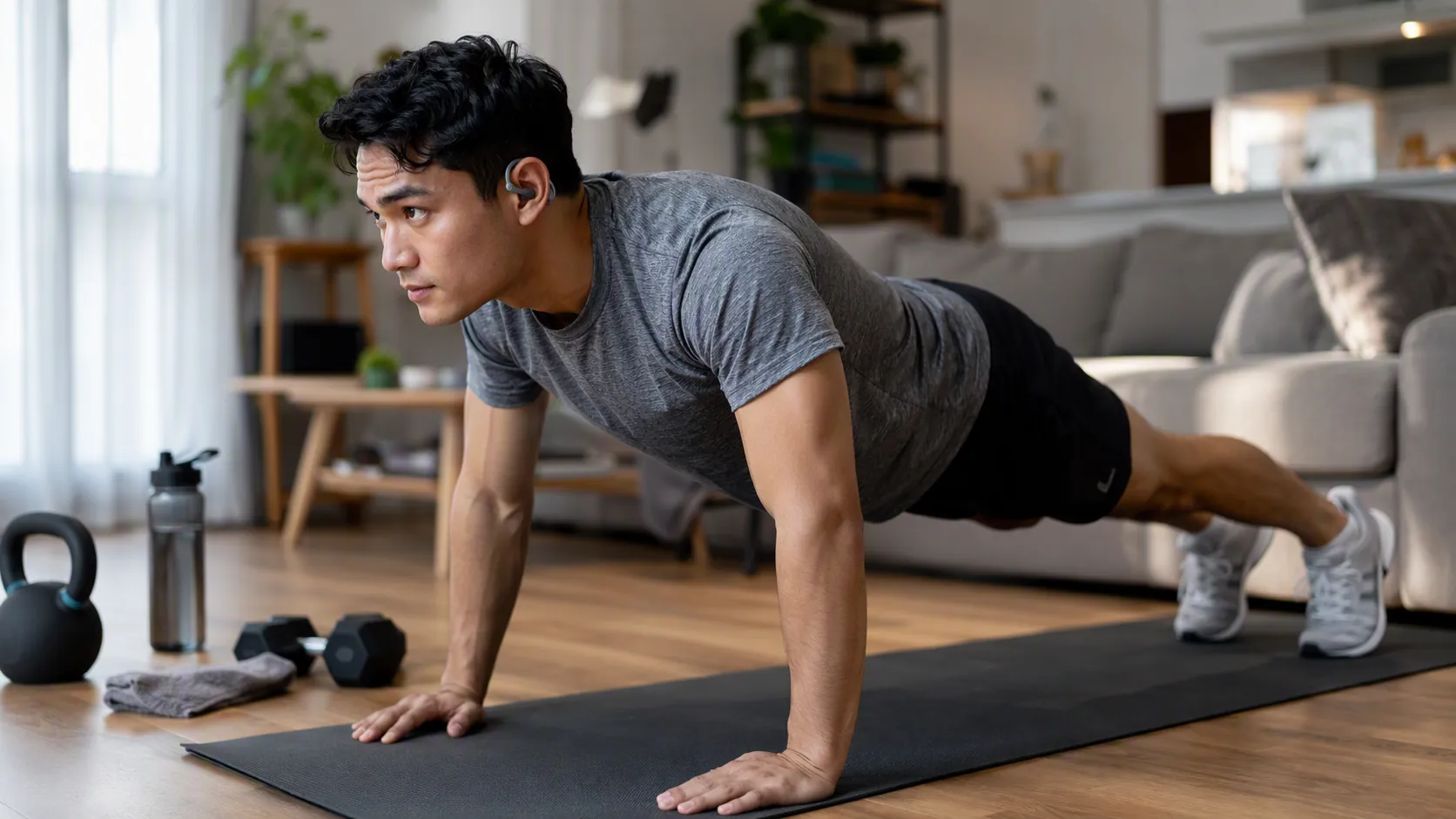
One important qualification comes first: FitAtHome has not published first-party measurements from a completed home-workout test for these models. The cited reviews and manufacturer materials support the product specifications, existing expert opinions, and failure modes discussed here, but they do not support exact claims about floor-movement results, decibel readings, or months of charging-contact wear. The protocol that matters for this category is therefore laid out explicitly, and source-backed evidence is kept separate from measurements that would require completed testing.
Prices below are approximate MSRP or observed prices from an August 2026 review of the cited sources and can change. Battery figures are manufacturer claims unless noted otherwise. This article contains affiliate links.
The Home-Workout Test That Matters
A useful test has to leave the treadmill behind. For an apartment workout, every pair should go through five checks on the same schedule, with the same phone, music playlist, and approximate listening level:
- Impact and floor fit: repeated burpees, jumping movements, planks, push-ups, mountain climbers, and transitions from standing to the floor. The question is whether the earbuds shift, press into the head, or need to be reseated.
- Position changes: side-lying leg work, floor stretching, and bench or mat exercises with the head turned. This catches problems that a normal running test misses, particularly with bands and rigid ear pieces.
- Sweat and charging-contact handling: inspect the earbuds and case after each workout, dry the contact areas, and track whether charging becomes intermittent. An IP rating describes water resistance; it does not by itself prove that a wet earbud will charge reliably for months.
- Household awareness: check whether speech, a doorbell, a timer, or movement elsewhere in the home remains easy to notice while music is playing.
- Leakage and battery: listen at a realistic workout volume from nearby rooms, then record battery use over a normal session. Open designs let outside sound in, but that openness also means sound can travel out.
That last point creates a two-way compromise. Open earbuds generally provide awareness because they do not seal the ear canal, but at high volume they can be audible to people nearby. Without active noise cancellation, they also let in household and neighbor noise, which may tempt the listener to turn them up. Existing open-ear reviews identify both behaviors, but none of the cited sources measures them specifically inside an apartment.[1][2]
The Comparison Frame
| Design or model | Approx. price | Water resistance | Battery claim | Home-workout implication |
|---|---|---|---|---|
| Shokz OpenFit 2+ | $179.95 | IP55 | 11 hours in earbuds; 48 hours with case | Ear-hook benchmark for impact stability; possible glasses conflict |
| Bose Ultra Open | $299 | IPX4 | Not specified in cited sources | Clip-style, glasses-friendly fit; stability depends on ear shape |
| Shokz OpenDots One | $199 | IP54 | Not specified in cited sources | Clip/cuff design with less glasses interference; ear-shape dependent |
| Shokz OpenRun Pro 2 | $179.95 | IP55 | 12 hours | Keeps ears fully open; band can shift during bench work |
| Baseus Bowie MC2 | $59.99 | IP67 | Up to 13 hours in earbuds; 60 hours with case | Strong budget specification set; long-term case and contact behavior still need observation |
| Soundcore C40i | About $100 | IPX4 | Not specified in cited sources | Clip-style budget alternative; fit varies with ear shape |
| SoundPeats Clip 1 | $69.99 | Not specified in cited sources | Not specified in cited sources | Low-cost clip option; verify fit and protection before buying |
| Soundcore V20i | About $30 | IP55 | Not specified in cited sources | Very low-cost open-ear option with basic sweat resistance |
Shokz OpenFit 2+: The Ear-Hook Benchmark
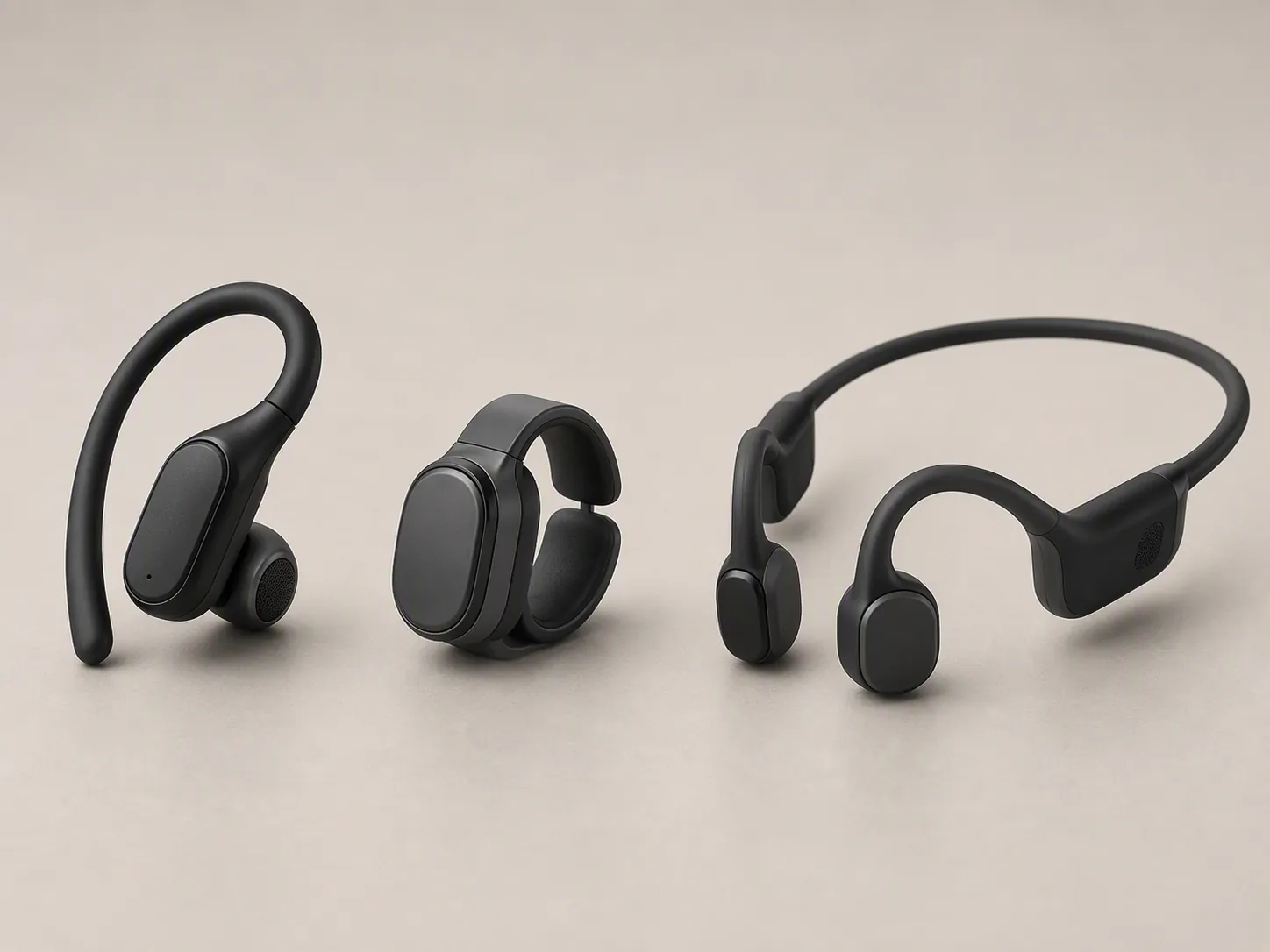
The OpenFit 2+ is the clearest benchmark for this test because its ear hooks address the failure that matters most during high-impact floor work: the earbud moving when the head and body change position. TechRadar describes the design as the most stable open style under impact, while also noting the practical drawback that the over-ear hooks can clash with glasses frames.[2]
Its specification sheet is also sensible for regular workouts: approximately $179.95, IP55 protection, 11 hours of claimed earbud battery life, and up to 48 hours with the case. Those figures make it a strong starting point for the $100-$300 tier, but they are not proof that the case will tolerate repeated wet insertions. The contact routine matters just as much as the rating.
For anyone who wears glasses, the fit question is more complicated. A hook that remains quiet during jumping may press against a frame arm or make the combination uncomfortable over a full session. The OpenFit 2+ should therefore be treated as the stability reference, not an automatic choice for every wearer.
Glasses Change the Fit Decision
Clip and cuff designs move the support point away from the top of the ear. That makes them attractive to people whose glasses already occupy the same area as an ear hook. Bose Ultra Open, at about $299 with an IPX4 rating, and Shokz OpenDots One, at about $199 with IP54 protection, are the main examples in the cited material.[1][2][3]
The compromise is ear shape. A clip can feel almost invisible on one person and insufficiently anchored on another. That distinction is especially important for burpees and side-lying work, where the earbud is being challenged by rotation rather than just vertical impact. A glasses-friendly design is not automatically a floor-work design.
The Bose Ultra Open also deserves a more careful treatment than a single ranking can provide. TechRadar, Runner's World, and Rolling Stone have rated it positively, while Wirecutter lowered its assessment because of microphone quality.[1][2][3][4] That disagreement concerns different priorities, and it does not produce a clean home-workout verdict. For an apartment user, the relevant questions remain whether the clip stays put during floor transitions, whether speech remains understandable, and whether leakage is tolerable at the required volume.
Bone Conduction Keeps the Ear Completely Open
The Shokz OpenRun Pro 2 takes a different route. Its band leaves the ear fully open, and the model is listed at approximately $179.95 with IP55 protection and a claimed 12-hour battery.[5] That can be useful when hearing the household is the first priority.
The band introduces its own floor-work problem. SoundGuys notes that it can shift during bench work, and hats or headbands can nudge it out of position.[5] That is a meaningful distinction from ear-hook stability: the earbuds may stay attached to the head while the listening position changes. A band is a reasonable option for upright strength work and awareness-heavy routines, but it is less convincing when the workout repeatedly puts the back of the head against a bench or mat.
The Sub-$100 Tier Is Now Credible
Budget open-ear models no longer need to be dismissed simply because they cost less. The Baseus Bowie MC2 is listed at about $59.99 with IP67 protection and battery claims of up to 13 hours in the earbuds and 60 hours with the case.[3][6] SoundPeats Clip 1 is listed at $69.99, while the Soundcore V20i is about $30 with IP55 protection.[2][6]
That makes the lower tier genuinely plausible for apartment workouts, especially for someone who wants a dedicated pair rather than risking a more expensive set in daily sweat. The qualification is that a high IP number does not answer every durability question. It says more about the protected device than about how consistently a damp earbud will meet exposed charging contacts in its case.
Soundcore C40i, at about $100 with IPX4 protection, is another clip-style option in this range.[1] Its appeal is the same as other cuffs: fewer glasses conflicts and no band around the back of the head. Its stability still depends on how the clip sits on the individual ear, so this is a category where fit evidence matters more than a small difference in price.
Sweat Can End the Workout Before the Battery Does
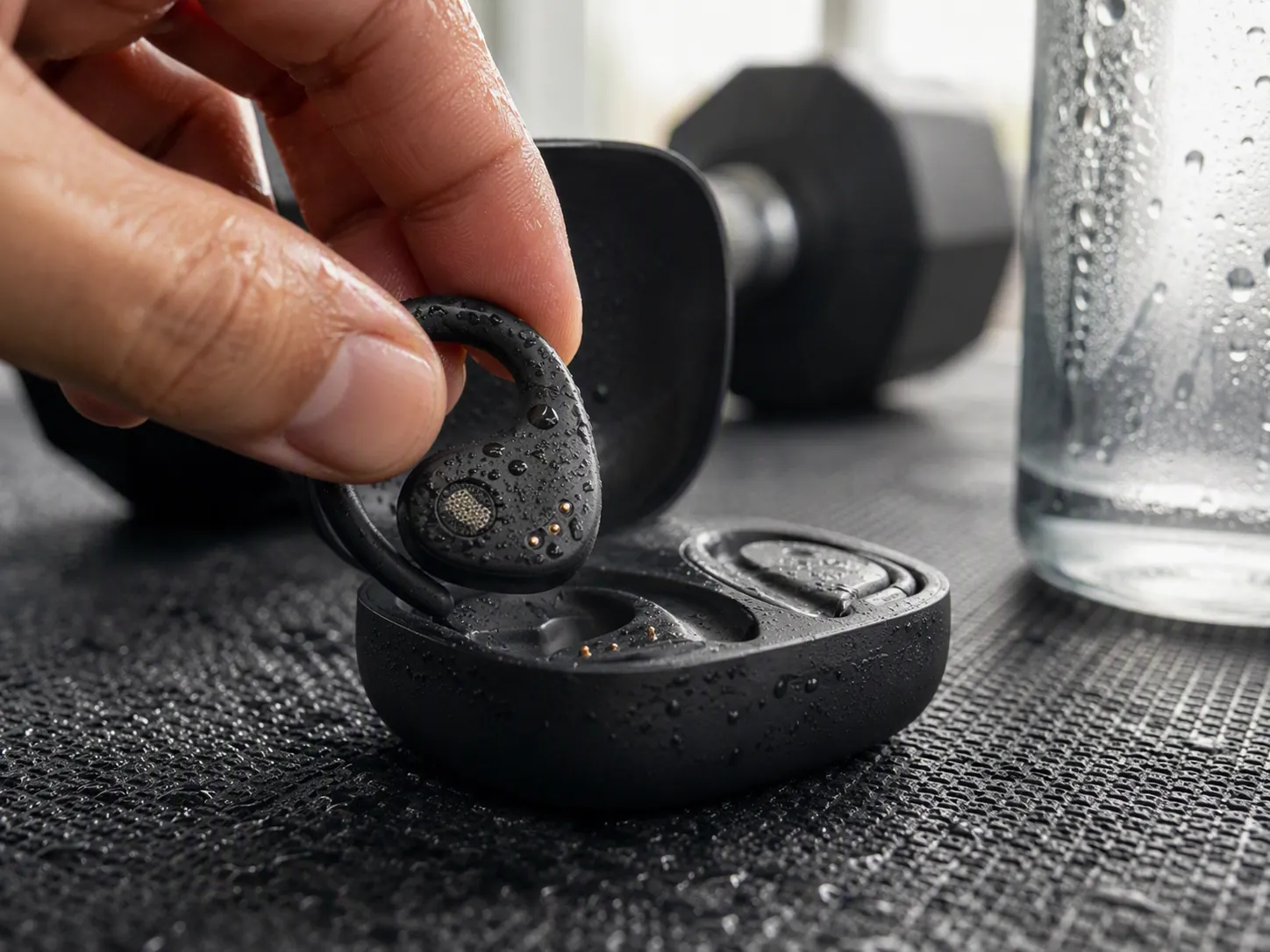
The overlooked failure point is the trip back to the case. Shokz's care guidance says sweat can corrode charging contacts and recommends wiping the earbuds dry before returning them to the case.[7] Treeline Review also calls attention to the OpenFit 2 case being unrated, which reinforces why the IP rating on the earbuds cannot be treated as a rating for the entire charging system.[8]
For a home-gym routine, the practical sequence is simple: finish the workout, wipe the contact areas, let visible moisture clear, and only then close the case. The case should not be the place where sweat is stored against metal contacts for the rest of the day. Wirecutter's use of saltwater as a sweat proxy also illustrates why repeated exposure deserves attention beyond a one-session splash test.[9]
This is also where a budget pair can make sense. A less expensive set used for sweaty sessions may be easier to replace, but only if the owner treats its contacts and case with the same care. No IP67 or IP55 label removes the need for that routine.
How the Picks Sort for an Apartment
For high-impact floor workouts, the OpenFit 2+ is the most defensible benchmark because the ear-hook format directly targets movement. The price is reasonable within the $100-$300 tier, and the tradeoff is clear: check the interaction with your glasses before committing.
For glasses wearers, the Bose Ultra Open and Shokz OpenDots One are the designs to investigate first. Their clips avoid the most obvious hook conflict, but neither should be assumed to have the same impact security on every ear. The choice depends on whether your routine contains more upright work or more jumping, rolling, and side-lying transitions.
For maximum household awareness, the OpenRun Pro 2 has the clearest design rationale. Its rear band may be less comfortable or stable against a bench, however, so it suits users whose workouts do not repeatedly press the back of the head into equipment.
For a dedicated budget workout pair, the Baseus Bowie MC2 has the strongest listed protection and battery combination, while the Soundcore V20i and SoundPeats Clip 1 keep the entry price low.[2][3][6] The sensible expectation is credible everyday use, not immunity from sweat-related charging problems. People building a quiet, compact workout setup can also use the site's guide to home exercise equipment for small spaces for the broader apartment fit and noise constraints.
Keep volume in check as well. The World Health Organization's March 2026 safe-listening guidance gives 80 dB for up to 40 hours per week and 90 dB for up to 4 hours, and recommends keeping personal-device volume below 60% of maximum.[10] Lower volume helps both hearing safety and neighbor relations, although it cannot eliminate leakage from an open design.
The right choice for a renter is therefore determined by the movement that causes the most trouble, not by the most impressive specification. Ear hooks are the stability reference for impact; clips and cuffs are the more glasses-friendly path; bone conduction maximizes openness but has a band-related fit compromise; and the sub-$100 tier is credible when its limits are understood. Whichever design wins on fit, dry the contacts before the earbuds go back into the case. That small habit addresses the durability problem an IP logo cannot.
References
- Best open-ear headphones for running — Runner's World
- The best open-ear headphones — TechRadar
- Best Open-Ear Earbuds and Headphones — Rolling Stone
- Best Bone Conduction Headphones — Wirecutter
- Best Workout Headphones — SoundGuys
- Best Open Wireless Earbuds — CNET
- Tips for Storing and Maintaining Wireless Earbuds — Shokz
- Shokz OpenFit 2 Review — Treeline Review
- Best Workout Headphones — Wirecutter
- Global Standard for Safe Listening Devices and Systems — World Health Organization, March 6, 2026
This result comes from one real apartment under the stated conditions — it is a strong signal, not a guarantee your space will measure identically.
Builds this evidence supports
No build currently links to this specific test. Browse all builds with a matching tag.
Spot something off?
If this result didn't match your own space, let us know — floor-damage and noise claims carry real deposit-risk consequences if we get them wrong.