
Is Celsius a Good Pre-Workout for Home Workouts?
Is Celsius worth it before a home workout? This guide runs the 200 mg caffeine dose against the research-backed 3–6 mg/kg ergogenic range, the 15–60 minute timing window, and the cost per can versus coffee and pre-workout powder — and lands on a clear verdict: fine for some sessions, not as a daily habit.
- Test space profile
- Small apartment home gym
- Floor damage risk
- none
- No-drill compatible
- ✓
- Test date
A 12 fl oz can of Celsius is easy to understand in one way and annoyingly vague in another. The useful facts are on the can: 200 mg caffeine, 0 g sugar, and about 10 calories in a standard Celsius energy drink can.[1] That is enough caffeine to matter before a home workout. The better question is whether it is the right amount for your body, your training time, and your budget.
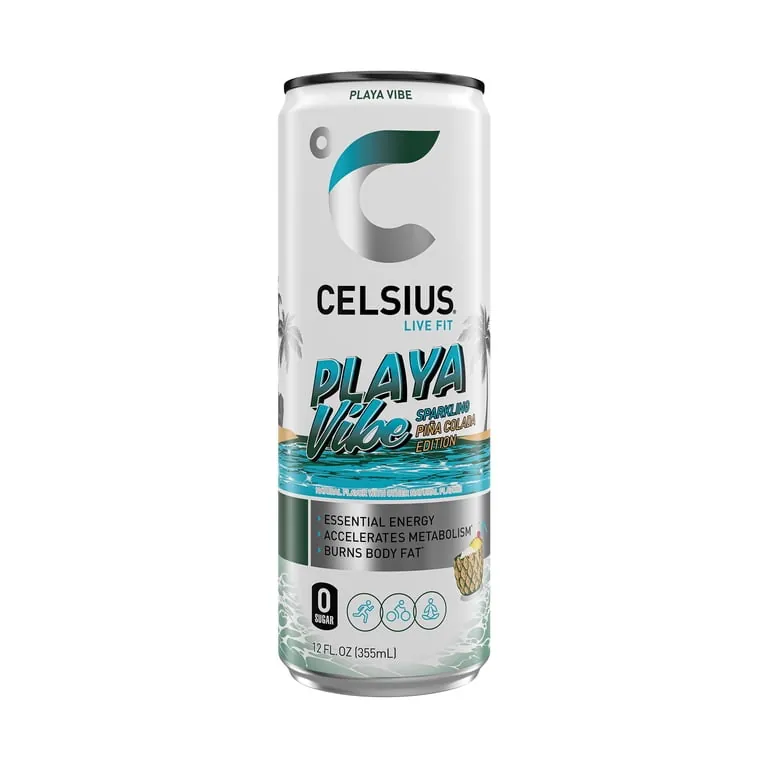
For home workouts, the first filter is not flavor. It is dose. A common research-backed ergogenic caffeine range is 3–6 mg per kilogram of body weight. One can gives a fixed 200 mg. Your body weight decides where that lands.
| Body weight | 3–6 mg/kg caffeine range | Where one 200 mg Celsius lands |
|---|---|---|
| 150 lb / about 68 kg | About 204–408 mg | Just under the low end of the range |
| 200 lb / about 91 kg | About 273–546 mg | Clearly below the low end of the range |
That table is the whole argument in a less marketable form. For a 150 lb home trainer, one can is close to the low end of the caffeine range typically used for performance. For a 200 lb trainer, it is not close; it is a noticeable caffeine dose, but not a full 3 mg/kg dose. If you are smaller, caffeine-sensitive, or training at night, 200 mg may already be plenty. If you are larger and used to caffeine, it may feel more like a nudge than a full pre-workout.
That does not make Celsius fake pre-workout. It makes it a fixed-dose caffeine product. The can does not know whether you weigh 125 lb or 220 lb, whether you had coffee at lunch, or whether your workout is heavy lower-body work or a 25-minute mat session between laundry loads. You have to do that part.
Use the clock before you use the can
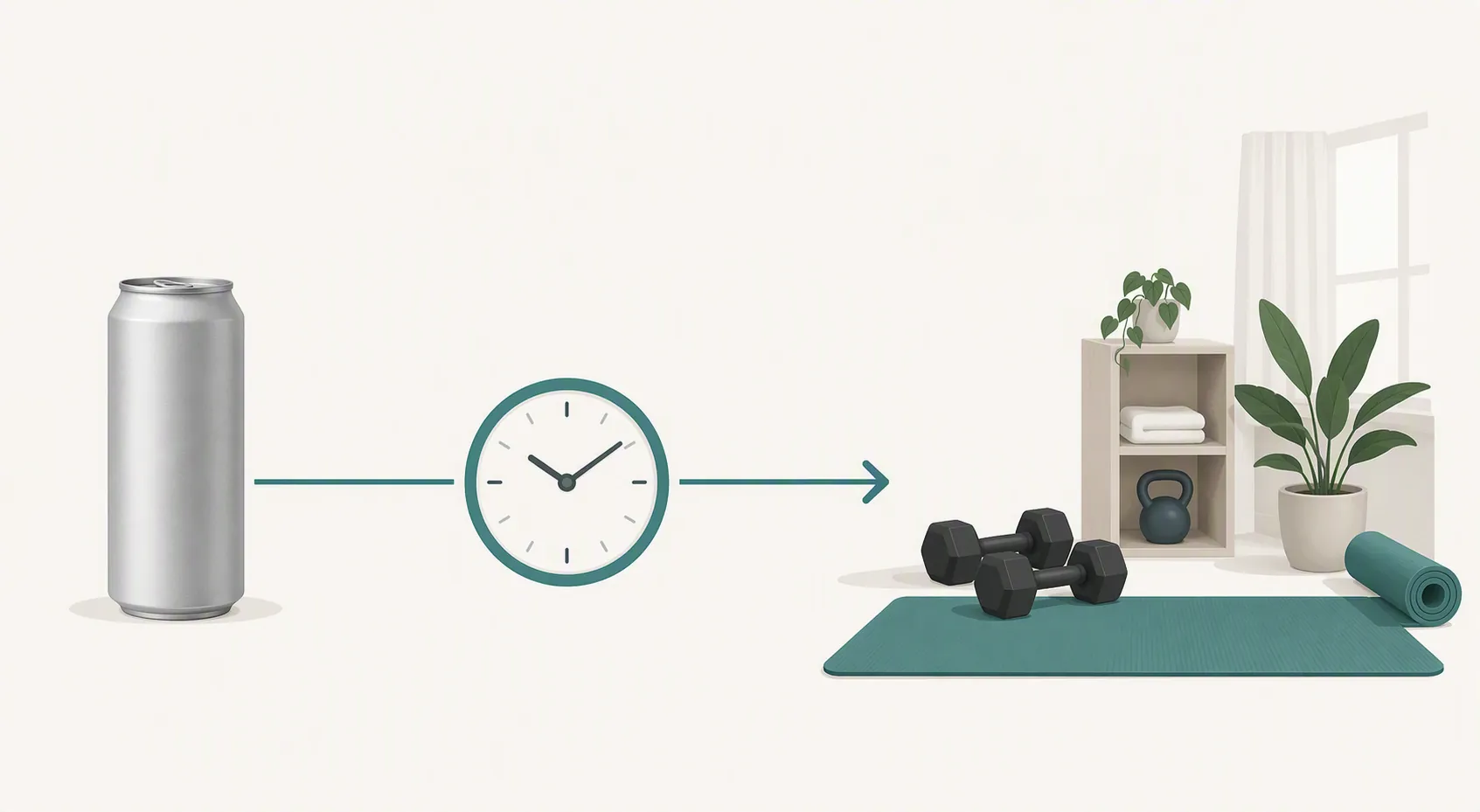
For most home sessions, the practical window is about 15–60 minutes before training, with the useful peak usually around 30–45 minutes. That matters more than the label language. If your workout starts the moment the kids are occupied, the laptop closes, or the neighbor downstairs is unlikely to complain, then timing is not a cute detail. It decides whether the caffeine shows up during the workout or after the part that needed help.
A simple way to use it:
- For a planned strength session: drink it about 30–45 minutes before the first working set.
- For a short conditioning session: start closer to 15–30 minutes before, because the session may be over before a late dose helps much.
- For evening training: be conservative. A useful workout is not a win if the can steals sleep from the next day.
- For caffeine-light people: do not treat 200 mg as casual. It is a real dose.
This is also where home workouts differ from gym workouts. At home, the warmup, setup, and workout may all blur together. There is no commute to absorb the timing mistake. If you crack the can when you start changing shoes, the peak may arrive closer to your shower than your hardest set.
What is actually in the can
The useful purchase facts are plain enough: standard Celsius products list 200 mg of caffeine, 0 g sugar, and about 10 calories per 12 fl oz can.[1] Celsius also publishes guidance connected to the FDA’s 400 mg daily caffeine ceiling: no more than two cans per day, and new users are directed to start with one can per day.[1]
That guidance is worth taking literally. Two cans is 400 mg of caffeine before counting coffee, tea, other energy drinks, or a scoop of pre-workout powder. In a small apartment gym, it is easy to make one more thing automatic: fill water bottle, roll out mat, open can. The habit is where the math gets less friendly.
The zero-sugar part is useful if you do not want a sweet drink adding much energy to the day. The low-calorie part is also straightforward. Neither one proves it is the best pre-workout. They just remove two common reasons someone might reject a canned drink before training.
The cost is a convenience tax

Once the dose and timing make sense, price gets a fair hearing. A can at about $1.40–$2.00 is not outrageous as an occasional pre-workout. It is expensive if it quietly replaces cheap caffeine you already tolerate. Home-brewed coffee at roughly $0.25–$0.50 per serving wins on cost by a lot. Pre-workout powder often wins on cost per serving too, though the exact comparison depends on the tub, scoop size, and what else is in it.
| Option | Best reason to use it | Main catch |
|---|---|---|
| Celsius can | Fixed 200 mg dose, portable, no mixing, no sugar | Higher per-serving cost; dose may be too much or too little depending on body weight and tolerance |
| Home-brewed coffee | Cheap and familiar | Caffeine amount can vary; not everyone wants coffee before training |
| Pre-workout powder | Adjustable serving size and often cheaper per serving | Requires buying a tub, checking ingredients, and tolerating whatever else is included |
That is the cleanest way to price Celsius: not as magic, not as a scam, just as a convenience tax. You are paying for a sealed, cold, fixed-dose can that asks for no measuring and no cleanup. On a Tuesday night before a hard session, that convenience may be worth the extra dollar or so. As a daily caffeine default, it starts to look like an expensive way to avoid making coffee.
When Celsius makes sense before a home workout
It is a reasonable pick when the session is demanding enough to benefit from caffeine and the dose fits you. That usually means you are not already heavily caffeinated, you can drink it early enough for the timing to work, and 200 mg is not going to make the rest of your night worse.
- Good fit: a planned strength workout, interval session, or higher-effort home workout where you want a predictable caffeine dose.
- Questionable fit: a light mobility session, casual walk, or short workout where the can costs more than the session really needs.
- Poor fit: late-night training if caffeine affects your sleep, or any day when you have already had enough caffeine from other sources.
The heavier you are, the more important it is to be honest about expectations. A 200 lb person is not getting the same mg/kg dose as a 150 lb person from the same can. That does not mean the heavier person should automatically add more caffeine. It means the can should not be credited with more precision than it has.
The practical verdict
Celsius can work as a pre-workout for home workouts. One standard can gives a real 200 mg caffeine dose, with no sugar and very few calories.[1] For many people, that is enough to feel useful. Against the 3–6 mg/kg benchmark, though, it is usually a low-end dose and, for larger bodies, below the low end.
Use it when the can lines up with the session: roughly 15–60 minutes before training, ideally closer to the 30–45 minute peak window, and not so late that sleep pays the bill. Buy it when the convenience is actually useful. Skip it when coffee would do the same job for less, or when the workout does not need 200 mg of caffeine in the first place.
So the answer is yes, with limits. Celsius is fine for some home workouts. It does not earn a permanent spot as a daily coffee replacement just because the can is convenient.
References
- Essential Facts - CELSIUS, CELSIUS
This result comes from one real apartment under the stated conditions — it is a strong signal, not a guarantee your space will measure identically.
Builds this evidence supports
No build currently links to this specific test. Browse all builds with a matching tag.
Spot something off?
If this result didn't match your own space, let us know — floor-damage and noise claims carry real deposit-risk consequences if we get them wrong.