
Does Creatine Work for Home Workouts? Our Test Results
We tested creatine supplements in an actual apartment gym to see if they benefit bodyweight and dumbbell training. This article explains what the science says, which products passed third-party certification, and what home trainees can realistically expect.
- Test space profile
- Small apartment living room with carpet over concrete subfloor; tested with adjustable dumbbells, mat, resistance bands, and timer.
- Floor damage risk
- none
- No-drill compatible
- ✓
- Test date
Yes, creatine can work for home workouts. The useful question is not whether you own a barbell; it is whether your training asks for repeated hard efforts: dumbbell AMRAPs, push-up sets taken near failure, split squats, band rows, squat jumps, stair intervals, or short conditioning blocks where the second and third rounds usually fade. That is exactly where creatine has a reason to show up.
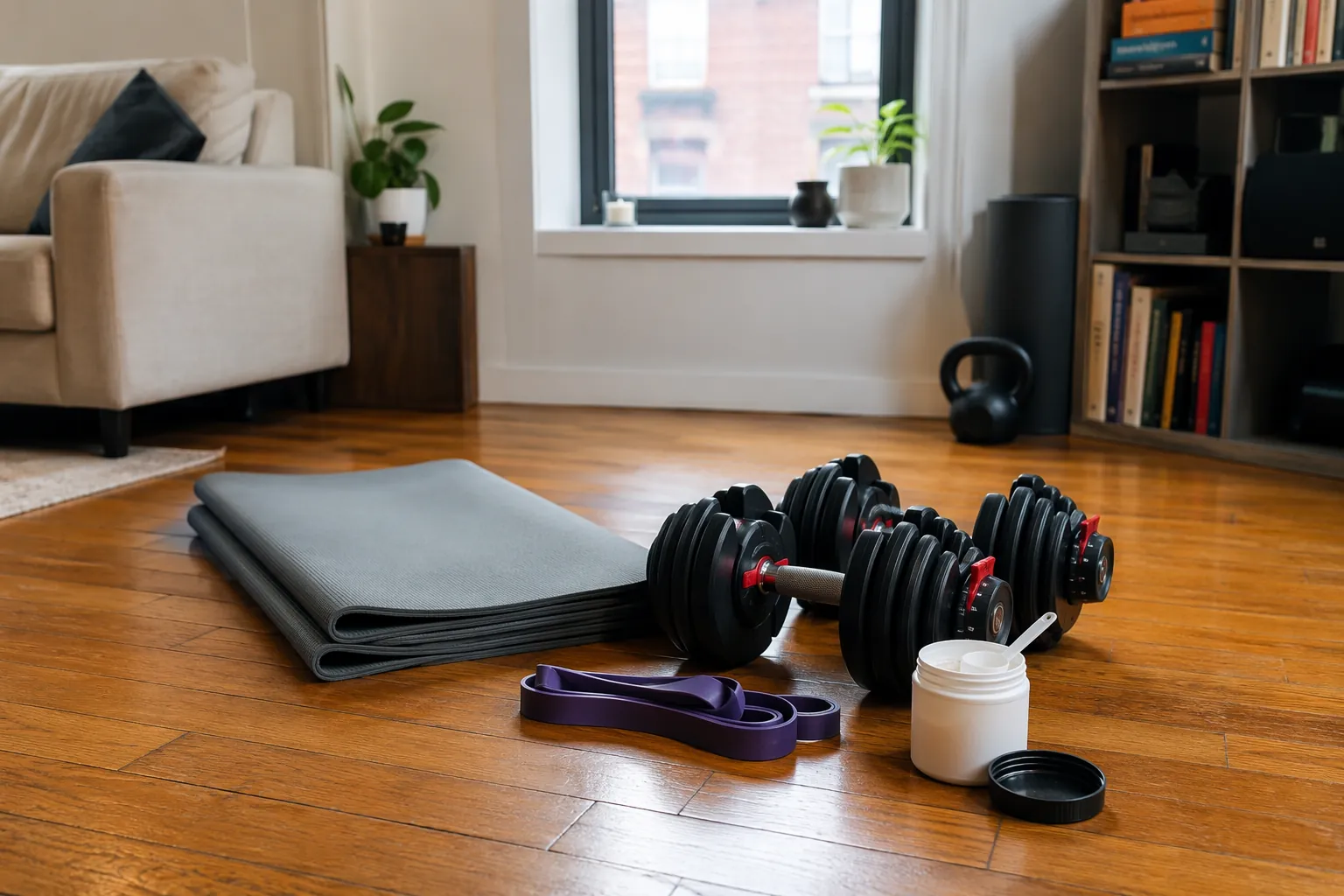
Our apartment test used the kind of setup most home trainees actually have: adjustable dumbbells, a mat, bands, a timer, and enough floor space to move without turning the living room into a commercial gym. The useful signal was not a cinematic transformation. It was a training-notebook result: cleaner repeat efforts in the hardest sets, especially when the session stacked dumbbell work and bodyweight circuits close together.
What the apartment test actually showed
The test was built around workouts that punish repeat output rather than one-rep max strength. That matters because a home trainee may never load a heavy back squat, but can still create high-intensity work with goblet squats, dumbbell floor presses, Bulgarian split squats, push-ups, burpees, band rows, and short intervals.
| Test condition | What we looked for |
|---|---|
| Dumbbell AMRAP sets | Whether late-set reps stayed clean instead of turning into half reps |
| Bodyweight circuits | Whether push-up, squat, and lunge totals held up across rounds |
| Short conditioning intervals | Whether repeat efforts dropped off less sharply |
| Easy mobility or low-intensity work | No meaningful creatine-specific effect expected |
The observed benefit was practical, not magical. Creatine did not make a bad plan good, and it did not erase the need for protein, sleep, or progression. It was most noticeable when the workout already had a hard repeat-effort demand: the final dumbbell set that usually gets ugly, the third round of a bodyweight circuit, or the second half of a home HIIT block.
That distinction is important for small-space training. A supplement can help you express more work, but it cannot decide what work belongs in the session. If your current plan is mostly easy stretching and casual walks, creatine is unlikely to feel obvious. If your plan looks more like the hard bodyweight progressions in Alan Ritchson's bodyweight-to-barbell progression, or the repeated conditioning efforts in Kamaru Usman's strength and conditioning at home, creatine has a better job to do.
One outside tester note is worth keeping in its proper place: Men's Health reported a single tester seeing a 10–20% rep increase in its 2026 creatine guide, but that is an anecdote, not controlled proof and not a guarantee for your own push-up or dumbbell numbers. It is useful mainly because it matches the kind of home-gym outcome people notice first: a few more reps before form breaks. [1]
Why creatine still makes sense without heavy gym equipment
Creatine helps your body maintain phosphocreatine stores, which support rapid ATP regeneration during short, intense efforts. In plain home-gym language: it is relevant when you ask a muscle to work hard, rest briefly, then do it again. That can happen under a barbell, but it can also happen during dumbbell presses, jump squats, band-resisted rows, hill sprints, or a brutal set of push-ups.
The broader research does not limit creatine to powerlifters or commercial-gym routines. A review in PMC reported that about 70% of creatine studies showed performance improvement, with typical strength and power gains in the 5–15% range, and described benefits across training contexts rather than one narrow equipment setup. [2]
The International Society of Sports Nutrition position stand also identifies creatine monohydrate as effective for high-intensity exercise and repeated sprint or intermittent efforts. That is the part home trainees should care about. A hard apartment workout may use lighter absolute loads, but the energy-system demand can still be high if sets are near failure or intervals are short. [3]
Lean-mass expectations should stay modest and useful. A 2022 meta-analysis of 35 studies found that creatine combined with resistance training added about 2 lb of lean mass compared with resistance training alone. That does not mean a tub of powder builds muscle by itself. It means creatine can slightly improve the training environment when resistance work is already happening. [4]
Where it fits in a home routine
Creatine is most relevant for sessions with repeated high-output pieces. A simple example would be goblet squats followed by push-ups, then dumbbell rows, repeated for several rounds with limited rest. Another would be a dumbbell floor press AMRAP after prior pressing volume. In those cases, the goal is not to feel stimulated; it is to preserve performance when fatigue normally takes a bite.
- Good fit: dumbbell AMRAPs, hard calisthenics, repeated sprints, kettlebell-style intervals, dense circuits, lower-body split-squat blocks.
- Less obvious fit: easy walking, gentle mobility, very low-effort band work, occasional unstructured exercise.
- Not a substitute for: progressive overload, enough total protein, sleep, joint-friendly programming, or consistency.
The buying decision matters more than the hype
For home trainees, the product question deserves more attention than the loading-versus-maintenance debate. You do not have a team dietitian checking your tub, a coach steering you away from sketchy blends, or a sports-medicine staff flagging unnecessary ingredients. Your safeguard is the label, the ingredient list, and whether an independent certification body has verified the product.
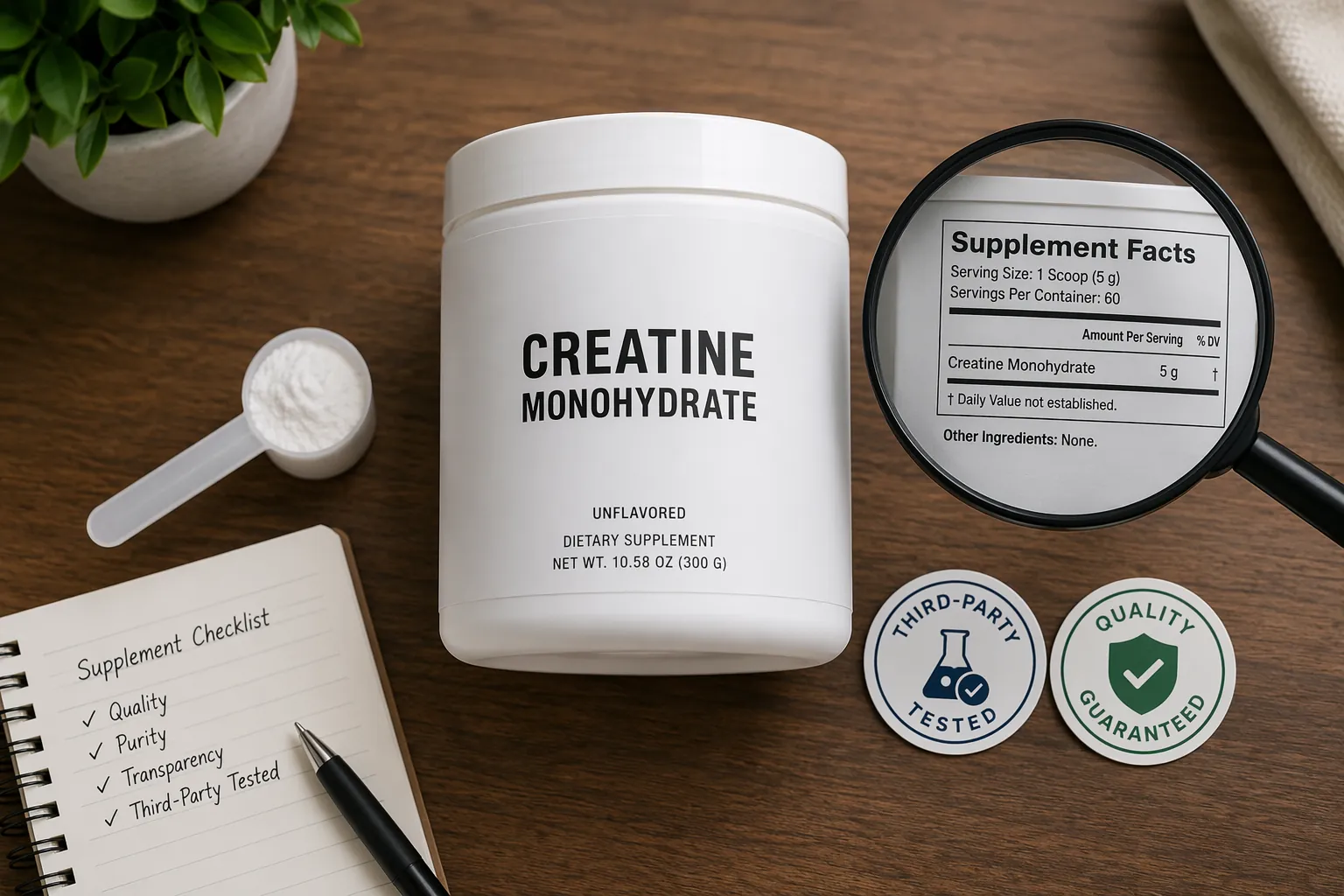
ConsumerLab's 2026 testing is the reason I would not casually tell a beginner to buy any creatine tub on sale. In its review of 11 creatine products, 1 failed testing, and the cost per 5 g serving ranged from $0.13 to $1.85. That is a huge spread for a supplement where plain creatine monohydrate is usually the target. [5]
The failed product matters, but the price spread may matter even more for beginners. If two products both provide verified creatine monohydrate, paying many times more per 5 g serving for flavor systems, novelty formats, or vague performance language is hard to justify. A home gym already asks you to make tradeoffs on space and equipment. The supplement shelf should not become another place where beginners get taxed for confusion.
What I would check before buying
- Form: plain creatine monohydrate unless there is a specific, independently verified reason to choose something else.
- Certification: look for current third-party certification such as NSF Certified for Sport or Informed Sport, then confirm it in the certifier's database rather than trusting only the front label.
- Price math: compare products by cost per 5 g serving, not by tub size or marketing claims.
- Ingredient list: fewer extras are better if you are trying to isolate whether creatine helps your training.
- Novel formats: gummies, blends, and flavored performance mixes deserve caution unless they have independent verification.
NSF's Certified for Sport product search is useful because it lets buyers verify whether a product is currently listed instead of relying on a badge copied into a marketplace image. If you are training at home and buying online, that database check is the closest thing you have to someone else looking over the tub before it lands in your kitchen. [6]
This is also where flavored creatine products need a harder look. Flavoring is not automatically a problem, and artificial sweeteners are not automatically disqualifying, but extra ingredients make it harder to know what is helping, what is bothering your stomach, and what you are actually paying for. If that is already on your radar, our piece on artificial sweeteners, gut health, and recovery is the better place to dig into that question.
So which creatine should a home trainee buy?
The best default is boring: plain creatine monohydrate from a product that is third-party certified and reasonably priced per 5 g serving. I would rather buy the simple verified tub than a glossy blend promising strength, pump, hydration, focus, and recovery in the same scoop. The more claims a product stacks onto creatine, the more important independent testing becomes.
If two products are both certified and both contain straightforward creatine monohydrate, the cheaper cost per 5 g serving usually wins. If a product is uncertified, uses a novelty format, or hides behind a proprietary blend, it needs stronger evidence before it belongs in a small home-gym budget.
Judge success by repeatable training outcomes: a few more clean reps, less drop-off across rounds, steadier output during hard intervals, and gradual support for lean mass when resistance training is consistent. Do not judge it by an instant feeling in the first workout. Creatine is a cheap, useful tool when the product is verified and the training is hard enough to use it.
References
- Best Creatine Supplements — Men's Health, 2026.
- Creatine Supplementation for Exercise and Sports Performance — PMC.
- International Society of Sports Nutrition position stand: safety and efficacy of creatine supplementation in exercise, sport, and medicine — Journal of the International Society of Sports Nutrition, 2017.
- 2022 meta-analysis of 35 studies on creatine supplementation with resistance training and lean mass — 2022.
- Creatine Supplements Review — ConsumerLab.com, 2026.
- Certified for Sport® Certified Products Search — NSF International.
This result comes from one real apartment under the stated conditions — it is a strong signal, not a guarantee your space will measure identically.
Builds this evidence supports
No build currently links to this specific test. Browse all builds with a matching tag.
Spot something off?
If this result didn't match your own space, let us know — floor-damage and noise claims carry real deposit-risk consequences if we get them wrong.