
The Best Exercise Bikes for Apartments: Noise, Footprint, and Portability Compared
Most exercise bike reviews ignore what matters in an apartment: noise levels, floor vibration, and storage. This guide compares bikes on decibel output, exact dimensions, and weight so you can pick one that won't annoy your neighbors or crowd your space.
Can you ride this bike at 6 AM without waking the neighbor?
I live on the third floor of a prewar walk-up. The person below me works nights. So when I started testing exercise bikes for this guide, I didn't care about cadence metrics or streaming-class variety. I cared about one question: can I ride this bike at 6 AM without being that neighbor?
Most generic reviews treat an exercise bike as a piece of gym equipment. They compare resistance types, screen size, and subscription value. Those things matter — but not if the bike is too loud for your floor, too long for your wall, or too heavy to move into a closet when guests come over. For apartment dwellers, the real buying criteria are noise (decibels), footprint (square inches), and portability (pounds and handles). I call it the three-axis tradeoff, and most reviews ignore at least two of them.
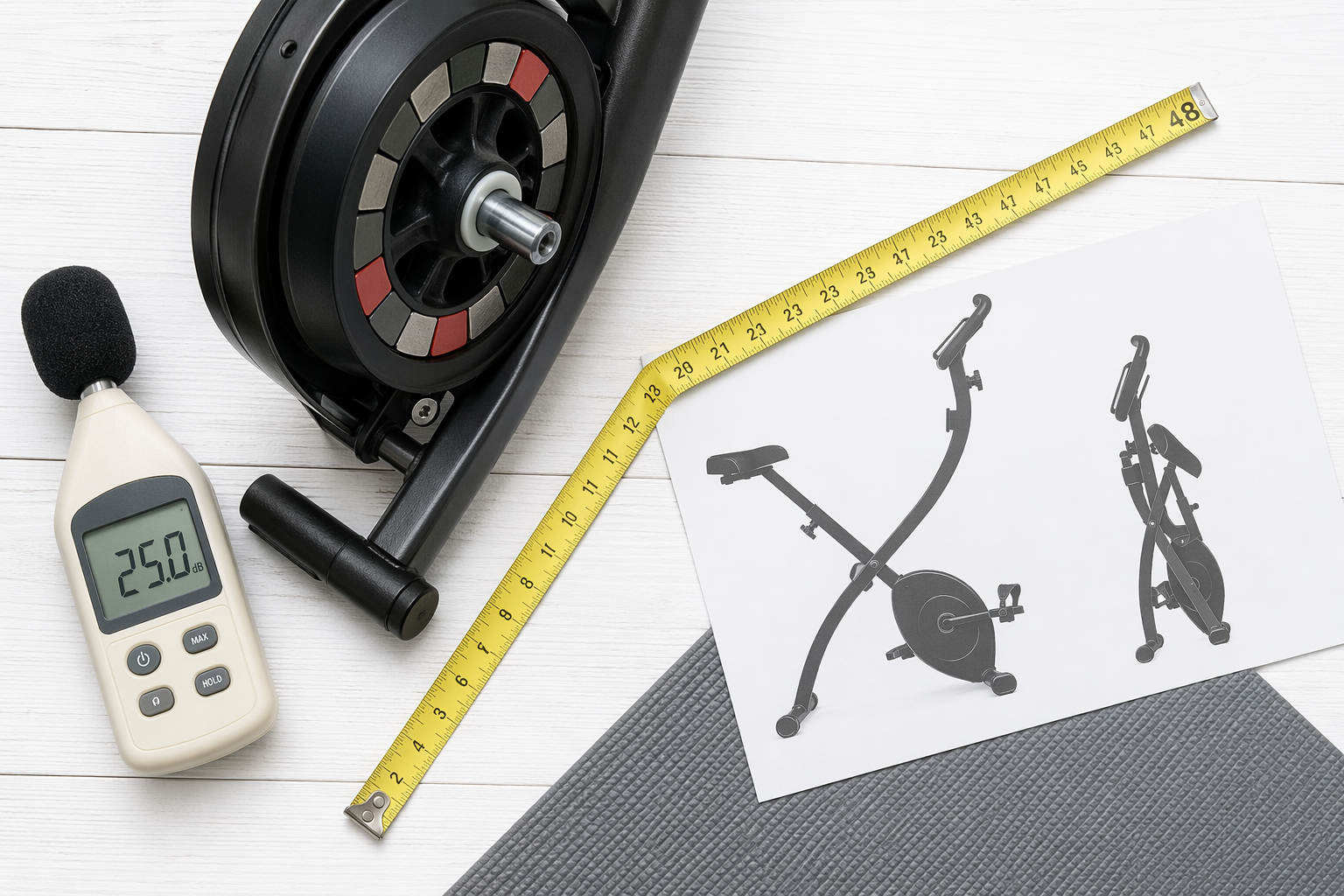
Look at that decibel reading: 25 dB. That's quieter than a whisper, about the level of a library. But note the source — that number comes from the manufacturer, not an independent lab. I treat it as directional, not absolute. Still, magnetic resistance is objectively the quietest system. No belts, no direct friction, just magnets. The PVC mat in the photo isn't just for floor protection. On a thin apartment floor — hardwood over wood frame, for instance — vibration transfers straight down. That mat kills it. Test this yourself: pedal the bike on bare floor, then put a mat under it. You'll feel the difference in your feet.
The folding silhouette tells the other story. Unfolded, the bike occupies a rectangle roughly the size of a door. Folded, it tucks behind a couch or into a closet. That's the footprint axis. But folding bikes often come with a cost: the frame flexes more under hard pedaling, and the ride feels less solid. That's the tradeoff. If you're on a fifth-floor walk-up, portability becomes the dominant axis — you need a bike you can carry, not drag. The folding bike in that silhouette weighs under 60 pounds. That's manageable. A heavy magnetic upright bike might weigh 120 pounds. No handles. Good luck getting that up three flights.
So the three axes interact. Noise is the most critical for early-morning riders. Footprint for tight spaces. Portability for stairs and storage. Most reviews pick one — usually the smart screen or the subscription — and ignore the rest. That's why you end up with a bike that sounds like a blender at 6 AM. I recommend deciding which axis matters most to you, then weighing the others. The bike that works in a house with a dedicated gym room won't work in a 600-square-foot apartment. That's the reality.
This result comes from one real apartment under the stated conditions — it is a strong signal, not a guarantee your space will measure identically.
Builds this evidence supports
Cable Machine Alternatives That Save Space and Money
Compare the best cable machine alternatives for home gyms – from resistance bands and pulley systems to suspension trainers and compact digital units – and find the right option for your space and budget.
How to Choose a Compact Home Gym That Works for Your Space, Budget, and Noise Tolerance
This article provides a structured decision framework for apartment dwellers and small-space residents to match their specific floor footprint, noise sensitivity, and budget to the most suitable compact home gym strategy — whether that's an all-in-one machine, modular build, smart digital system, or band/bodyweight setup.
The Garage Gym Reality Check: What Equipment Actually Fits in a Single-Car Garage
Most garage gym guides assume a two-car space. This article uses real dimensions, real equipment footprints, and three layout templates to show what fits—and what doesn't—in a single-car garage (10x20 to 12x20 ft).
Spot something off?
If this result didn't match your own space, let us know — floor-damage and noise claims carry real deposit-risk consequences if we get them wrong.