
How to Exercise Safely in Extreme Heat Without AC (Tested at Home)
Safely exercising in extreme heat without AC is possible with the right strategies. This guide shares four tested methods—pre-cooling, fan setup, hydration timing, and heat-index-based workout modification—so you can keep training during a heat wave.
- Test space profile
- Small apartment room, no air conditioning, indoor temperature and humidity monitored, fan used, bodyweight exercises on mat
- Floor damage risk
- low
- No-drill compatible
- ✓
- Test date
The first safety decision happens before the mat comes out: look at the heat index outside, then look at the actual temperature and humidity inside the room where you plan to train. Exercising in extreme heat without AC can be made safer at home, but only when the workout is treated as adjustable. A fan, a cold towel, and a water bottle are useful parts of the setup. None of them turns a 95°F apartment into a normal training environment.
The useful home protocol is layered: check the room, pre-cool your body, make the air movement work with sweat instead of against it, drink on a schedule, then downgrade or stop the workout when the heat index or symptoms say so. That sounds less dramatic than “push through,” which is the point. In a small apartment, the margin is often the workout.
| Before or during the workout | Home decision | What changes |
|---|---|---|
| Heat index or room temperature is already high | Use the heat-index thresholds as a conservative guide indoors | Intensity, duration, and exercise choice become negotiable |
| Room is hot but still workable | Pre-cool with ice slurry if practical, or cold towels on neck and forearms | Start with a small temperature buffer, not a guarantee |
| Fan is running | Use it for evaporation and cross-flow, but monitor indoor temperature | Above 90°F, fan advice gets conditional |
| Sweating starts early | Drink before the workout and every 10–20 minutes during it | Hydration becomes timed, not mood-based |
| Symptoms appear | Stop, cool down, and escalate quickly for heat-stroke signs | The workout is over |
Start With The Room, Not The Workout Plan
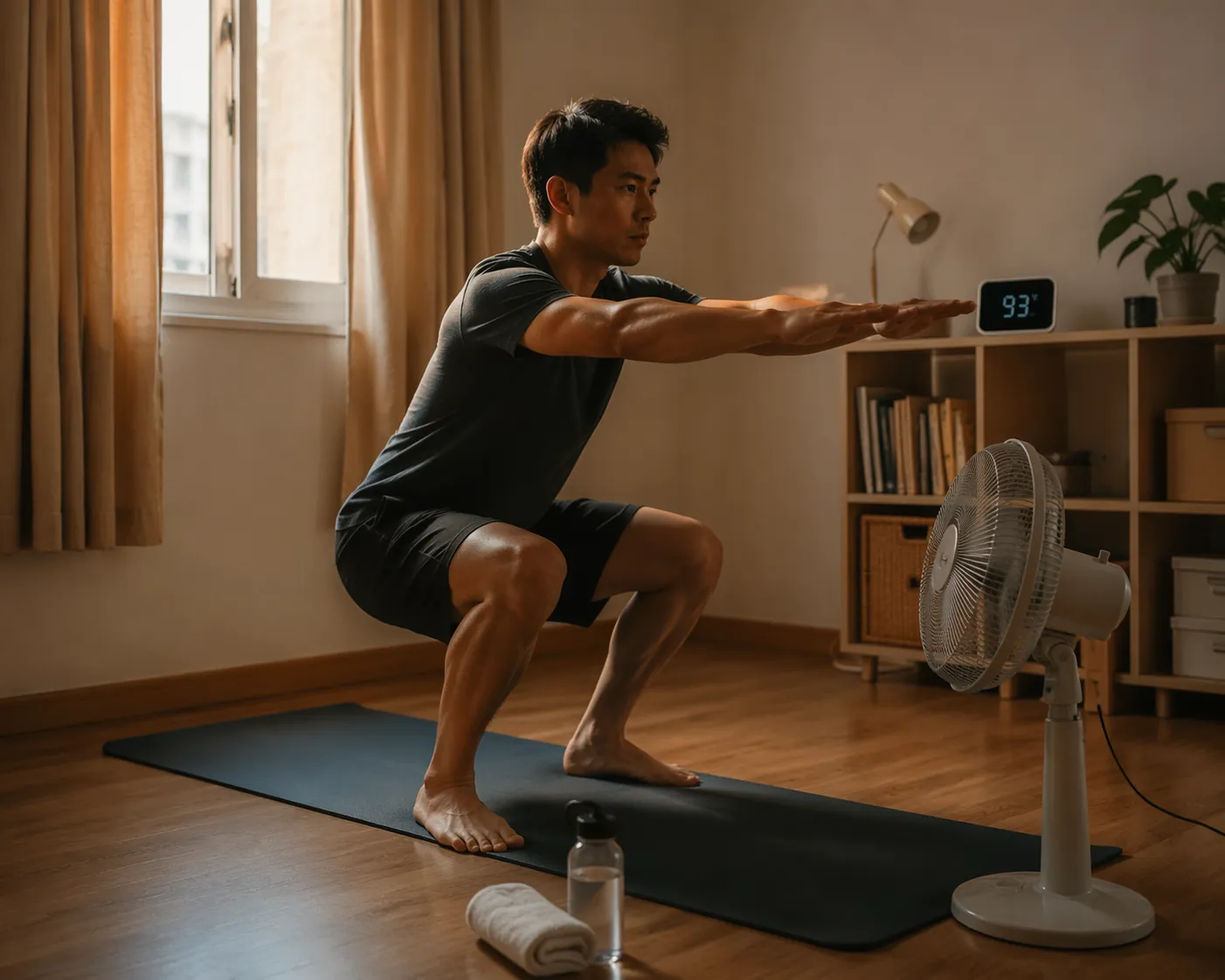
A written workout plan can be too confident for a room that changed by noon. The practical first check is boring: outdoor heat index, indoor thermometer, indoor humidity, window direction, and whether air is actually moving across your skin. National Weather Service-style heat-index categories are commonly used as outdoor shade guidance; Mass General Brigham describes 80–90°F as “caution,” 90–105°F as “extreme caution,” and above 105°F as “danger” for heat-related illness risk during activity [1].
Those numbers are not a perfect apartment model. Indoors, you may avoid direct sun, but you may also have worse airflow, trapped humidity, and heat radiating from appliances or a treadmill motor. For a no-AC room, using the outdoor heat-index categories conservatively is more useful than pretending the room is separate from the heat wave.
If you train near equipment that adds heat or noise, the setup matters more. A treadmill in a small room is not just a cardio machine; it is also a warm motor, a moving belt, and a reason you may close windows to avoid bothering neighbors. If that is your setup, the practical constraints overlap with the same footprint and noise problems covered in a small-apartment treadmill setup.
Pre-Cooling Buys A Buffer, Not Immunity
Pre-cooling is one of the few heat strategies that feels immediately useful in a hot room because it happens before the first set. Research summarized by BBC Future reports that ice slurries can lower core temperature by about 0.3–0.5°C before exercise [2]. That is not a force field. It is a small delay in how quickly the body reaches a risky thermal load.
At home, the exact lab method may be unrealistic. Not everyone has ice ready, a blender available, or the stomach for a large icy drink before jump squats. A practical approximation is to cool high-blood-flow areas before starting: a cold towel on the back of the neck, another around the forearms, and a few minutes sitting still near moving air. The towel will warm up faster than you want it to. That is useful information, not a failure of discipline.
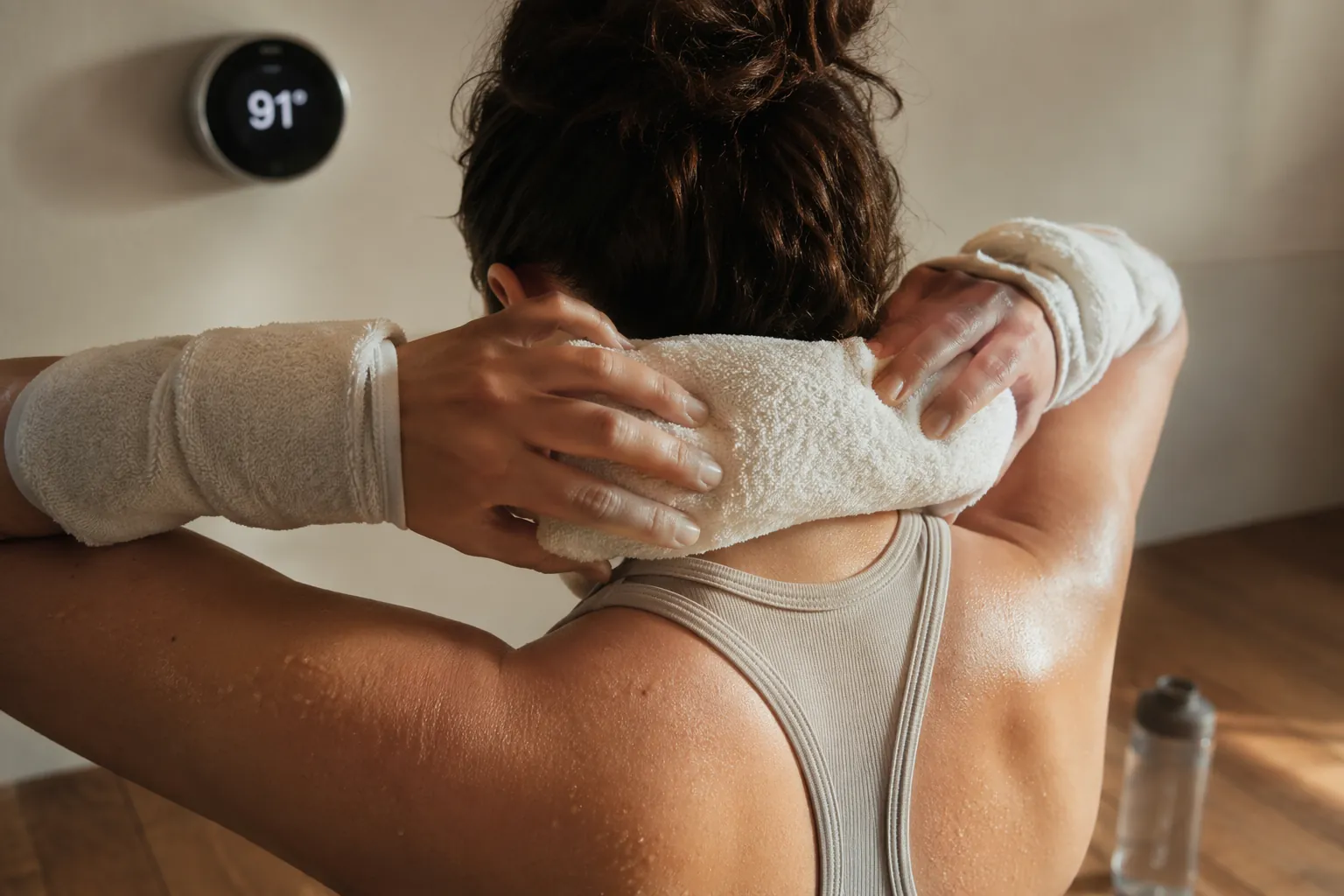
Use pre-cooling when the room is warm but still within a range where you would otherwise train at reduced intensity. Do not use it to justify high-intensity intervals in a room that already feels hostile before the warm-up. If the best part of the workout is the five minutes before you start, the room is telling you something.
The Fan Paradox In A No-AC Apartment
A fan is the most common no-AC fix because it is cheap, portable, and easy to aim. It is also the easiest place to get bad advice. The CDC warns that when indoor temperatures are above 90°F, fan use may not prevent heat-related illness and can increase body temperature in some conditions [3]. That warning is not anti-fan. It is a warning about what a fan is actually doing.
A fan cools you mainly by helping sweat evaporate. If the room air is dry enough and moving across wet skin, evaporation can pull heat away. If the air is very hot, especially near or above skin temperature, the same moving air can add heat by convection. The fan still feels like relief because moving air feels better than stagnant air, but comfort and heat safety are not identical.
Humidity decides how much help the fan can provide. The CDC notes that high humidity reduces the body’s ability to cool itself through sweating [3]. A practical comparison from heat-stress research is stark: sweat-evaporation cooling is 40–60% less effective at 80% relative humidity than at 40% relative humidity. That is why a cheap thermometer-hygrometer can matter more than a louder fan.
How To Aim Fans When The Room Is Still Trainable
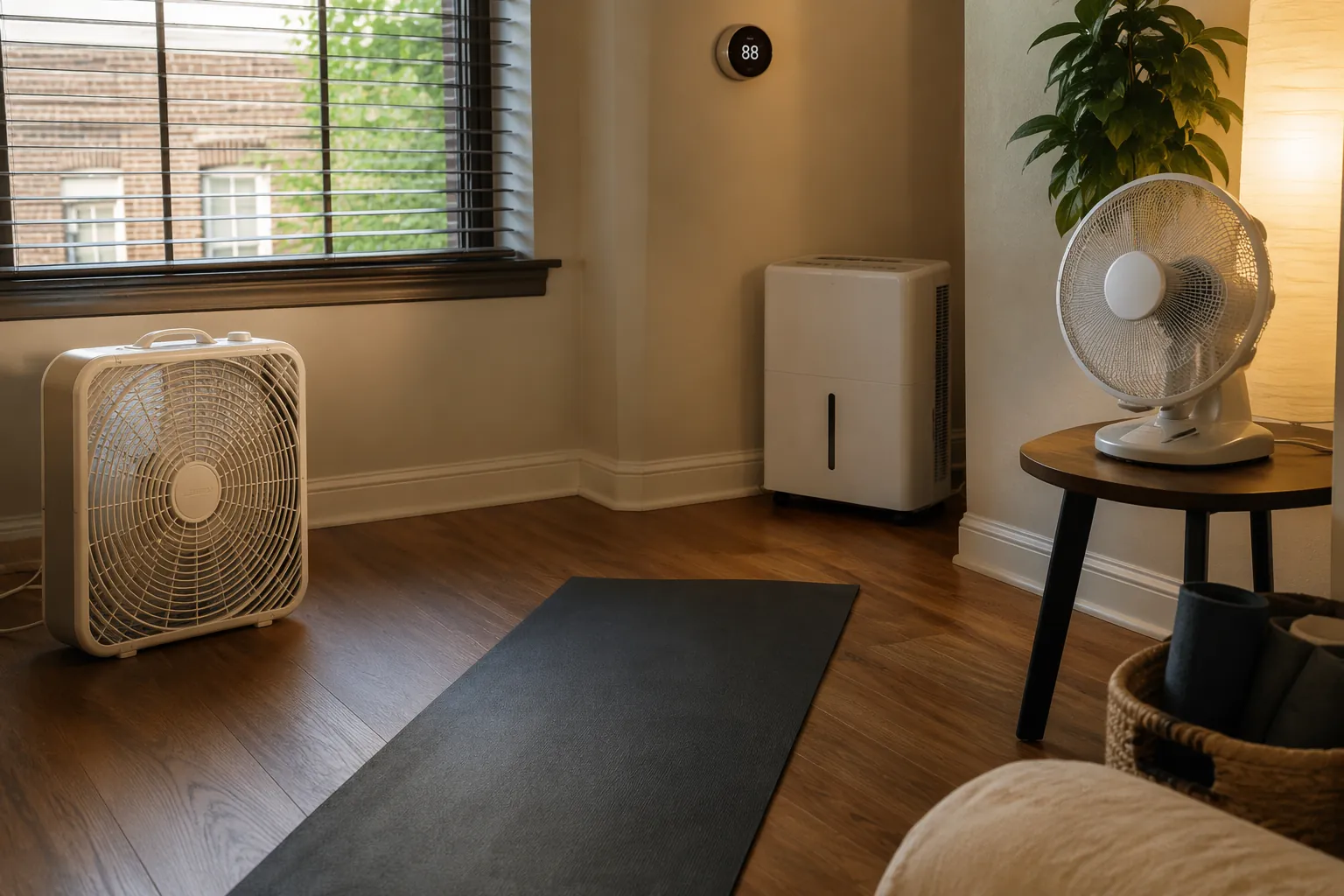
The goal is not simply “more wind.” The goal is to move humid air away from your skin and, if possible, replace it with cooler or drier air. In a small apartment, that usually means one fan creating cross-ventilation at a window when outside air is cooler, and one fan aimed across the training area rather than straight into your face. If the only result is hot air blasting your eyes while the room stays damp, the setup is loud but not smart.
- Put the thermometer where you exercise, not across the room by the window.
- Track humidity; if relative humidity is high, prioritize dehumidifying or shortening the workout.
- Use cross-flow when outdoor air is cooler than indoor air; avoid pulling hotter afternoon air into the room.
- Aim airflow across sweaty skin, but stop treating the fan as protective once the room climbs above 90°F.
- Consider neighbor noise before the workout starts; a fan that gets turned off mid-set because it rattles is not part of the plan.
A dehumidifier can help, but it is not free cooling. It may add some heat while removing moisture, so the tradeoff depends on the room. The practical target is not a perfect climate-controlled gym; it is a room where sweat can evaporate and the temperature is not climbing while you train. For broader apartment gear decisions, a compact home gym equipment guide is more useful than buying the biggest fan that fits in the corner.
Hydration Has To Be Scheduled
In a hot apartment, thirst is late information. National Athletic Trainers’ Association guidance gives a practical starting point: drink 500–600 mL before exercise, then 200–300 mL every 10–20 minutes during exercise. That is deliberately procedural. If you wait until the floor work is over and the bottle is still full, the plan failed quietly.
Sweat loss can move faster than people expect. The Korey Stringer Institute notes that sweat rates during exercise in heat commonly average around 1 liter per hour, and losing more than 2% of body weight through sweat without replacement increases heat-illness risk [4]. A scale is not required for every session, but weighing before and after a few hot workouts can show whether your “normal” bottle is even close.
For sessions longer than a short mobility block, keep the bottle where you can reach it without turning hydration into a break you have to earn. If sweat is pouring, the room is humid, and the workout is still planned at normal intensity, the problem is not only fluid intake. The workload is too ambitious for the conditions.
Modify The Workout Before Symptoms Make The Decision
The modification step is where home heat-safety advice either becomes useful or collapses into vibes. The decision should not be “work out or cancel” until the room is clearly unsafe. Most hot days need a middle option: reduce intensity, shorten the session, switch movement type, or turn the day into recovery.
| Heat signal | Home workout adjustment | What to avoid |
|---|---|---|
| Heat index 80–90°F or warm room with manageable humidity | Train, but trim intensity and add timed water breaks | Starting with all-out intervals |
| Heat index 90–105°F or indoor temperature near/above 90°F | Use low-impact strength, mobility, technique work, or a shorter circuit | Long cardio blocks, high-rep burpees, hard treadmill runs |
| Heat index above 105°F, room keeps getting hotter, or fan is only moving hot humid air | Convert to recovery or stop | Trying to “earn” the session by sweating more |
| Dizziness, confusion, fainting, stopped sweating with hot skin, or worsening symptoms | Stop immediately and seek urgent help when heat stroke is possible | Waiting to see if the next set feels better |
A 20% intensity reduction can be enough to make a session noticeably more tolerable in heat, according to Korey Stringer Institute guidance and a BBC interview with Rebecca Stearns [2][4]. At home, that might mean walking incline instead of running, bodyweight squats instead of jump squats, longer rests between sets, or a 20-minute session instead of the planned 45.
The higher the heat signal, the less useful complicated programming becomes. Heavy compound lifts in a humid room add bracing, blood-pressure load, and cleanup time. Fast floor transitions can hide dizziness until you stand. Treadmill workouts trap you in one warm lane unless you are willing to stop early. On the worst days, an app-guided mobility or low-intensity session from a free home workout app is not a consolation prize; it is the safer version of consistency.
A Practical Downgrade Ladder
- Keep the workout, but cap effort at conversational intensity and add water breaks.
- Cut the hardest block first: intervals, finishers, tempo runs, jump work, or high-rep circuits.
- Shorten the total session before form starts slipping.
- Switch to mobility, stretching, balance, light bands, or technique practice.
- Stop if symptoms appear or the room keeps getting hotter despite the setup.
That ladder matters because heat stress is cumulative. A workout can feel fine for the first circuit and unreasonable by the third. The safer move is to downgrade while you still feel capable of arguing with yourself, not after your body has already settled the argument.
Know The Difference Between Too Hot And Emergency
Heat exhaustion and heat stroke are not just two levels of discomfort. UC Davis Health describes heat exhaustion symptoms as including heavy sweating, weakness, dizziness, nausea, headache, and cool or clammy skin, while heat stroke may involve confusion, loss of consciousness, hot skin, and a body temperature above 104°F [5]. Johns Hopkins Medicine also describes exercise-related heat exhaustion as involving an elevated core temperature, often in the 101–104°F range [6].
For a home exerciser, the stop rule has to be simpler than a medical chart. Stop the workout for dizziness, nausea, chills, unusual weakness, headache that builds, poor coordination, or a heart rate that feels wrong for the effort. Move to a cooler place if one exists, loosen clothing, use cool towels, sip fluids if alert, and do not restart the session.
Treat confusion, fainting, seizure, loss of consciousness, or hot skin with altered mental status as an emergency. Heat stroke is a medical emergency, and the response is not “cool down and reassess after the next set” [5]. Call emergency services and start cooling while help is on the way.
Do Not Overrate Being Used To Heat
Heat acclimatization is real, but it is not the same as having survived yesterday’s workout. The Korey Stringer Institute describes heat acclimatization as a process that typically requires 7–14 days of repeated heat exposure, with adaptations such as increased sweat rate and expanded plasma volume [7]. CDC/NIOSH guidance uses the same broad acclimatization concept for workers exposed to heat [8].
That timeline changes the first hot week. If the heat wave arrived faster than your body adapted, your normal workout is not normal yet. Start with shorter, easier sessions and build only if the room, hydration, sleep, and symptoms cooperate over several days. Acclimatization also fades when exposure stops, so last summer’s tolerance is not a reliable July guarantee.
A Home Test Session That Stays Inside The Limits
A reasonable no-AC heat-wave session starts smaller than pride wants. Check the room temperature and humidity. Pre-cool for a few minutes. Set the fan so air moves across the training area and out of the stagnant corner. Drink before starting. Choose a workout that can be abandoned without wrecking the week.
| Time | Action | Decision point |
|---|---|---|
| 20–30 minutes before | Drink 500–600 mL; set towels in the freezer or cold water | If the room is already above your stop threshold, switch to recovery |
| 5–10 minutes before | Cold towel on neck or forearms; fan and window setup checked | If the fan is only moving hot humid air, downgrade |
| During warm-up | Use easy movement and check how quickly sweat and breathing rise | If warm-up feels like work, cut the main set |
| Every 10–20 minutes | Drink 200–300 mL and reassess symptoms | If symptoms appear, stop |
| After | Cool down, replace fluids, and note body weight change if tracking sweat loss | If weight loss is above 2%, adjust next session |
The best sign that the system is working is not that the workout feels heroic. It is that the choices keep getting less dramatic: the room is measured, the fan setup has a reason, the bottle is not forgotten, and the workout changes before the body has to force a shutdown.
Exercising in extreme heat without AC is possible for some home exercisers under controlled conditions, but the controls have hard limits. Above certain temperatures, with high humidity, poor airflow, or symptoms, the safest tested method is not another cooling trick. It is turning the workout into recovery or ending it while ending it is still a choice.
References
- Exercising in the Heat: How to Stay Safe — Mass General Brigham
- How to exercise safely in hot weather — BBC Future, June 2026
- About Heat and Your Health — CDC
- Heat Stroke — Korey Stringer Institute
- Is it heat exhaustion or heat stroke? Here are the symptoms to watch for — UC Davis Health, July 2024
- Exercise-Related Heat Exhaustion — Johns Hopkins Medicine
- Heat Acclimatization — Korey Stringer Institute
- Heat and People without Air Conditioning — CDC
This result comes from one real apartment under the stated conditions — it is a strong signal, not a guarantee your space will measure identically.
Builds this evidence supports
No build currently links to this specific test. Browse all builds with a matching tag.
Spot something off?
If this result didn't match your own space, let us know — floor-damage and noise claims carry real deposit-risk consequences if we get them wrong.