
Garmin Cirqa vs Whoop Tested for Home Workouts — Our Pick
We tested the Garmin Cirqa and Whoop 5.0 side by side during actual home workouts — dumbbells, HIIT, yoga, and treadmill. This comparison shows which wearable delivers better accuracy, more useful home-workout features, and stronger long-term value for apartment gym owners.
- Test space profile
- Small apartment living room with mat-covered floor, limited space for dumbbells and treadmill.
- Floor damage risk
- none
- No-drill compatible
- ✓
- Test date
The apartment-gym version of Garmin Cirqa vs Whoop starts after a 28-minute session in a living room: did the band catch the effort, did it understand the type of work, and did the bill still make sense three years later?
For most apartment gym owners, the Garmin Cirqa is the better buy. It costs $199 as a one-time purchase, while Whoop’s current tiers run $199, $239, or $359 per year, depending on plan level.[1][2] Over three years, that makes Cirqa a $199 device and Whoop a $597 to $1,077 commitment before you have bought another dumbbell, mat, fan, or flooring tile.
That recommendation has one serious exception: if lifting is the center of your home training, Whoop still has the more useful strength feature. Its Strength Trainer can factor accelerometer-measured muscular load alongside heart rate, which matters because dumbbell and bodyweight work often looks underwhelming when judged by pulse alone.[3] Cirqa is the better default for mixed home workouts; Whoop is the better specialized tool if you will actually log strength sessions carefully.
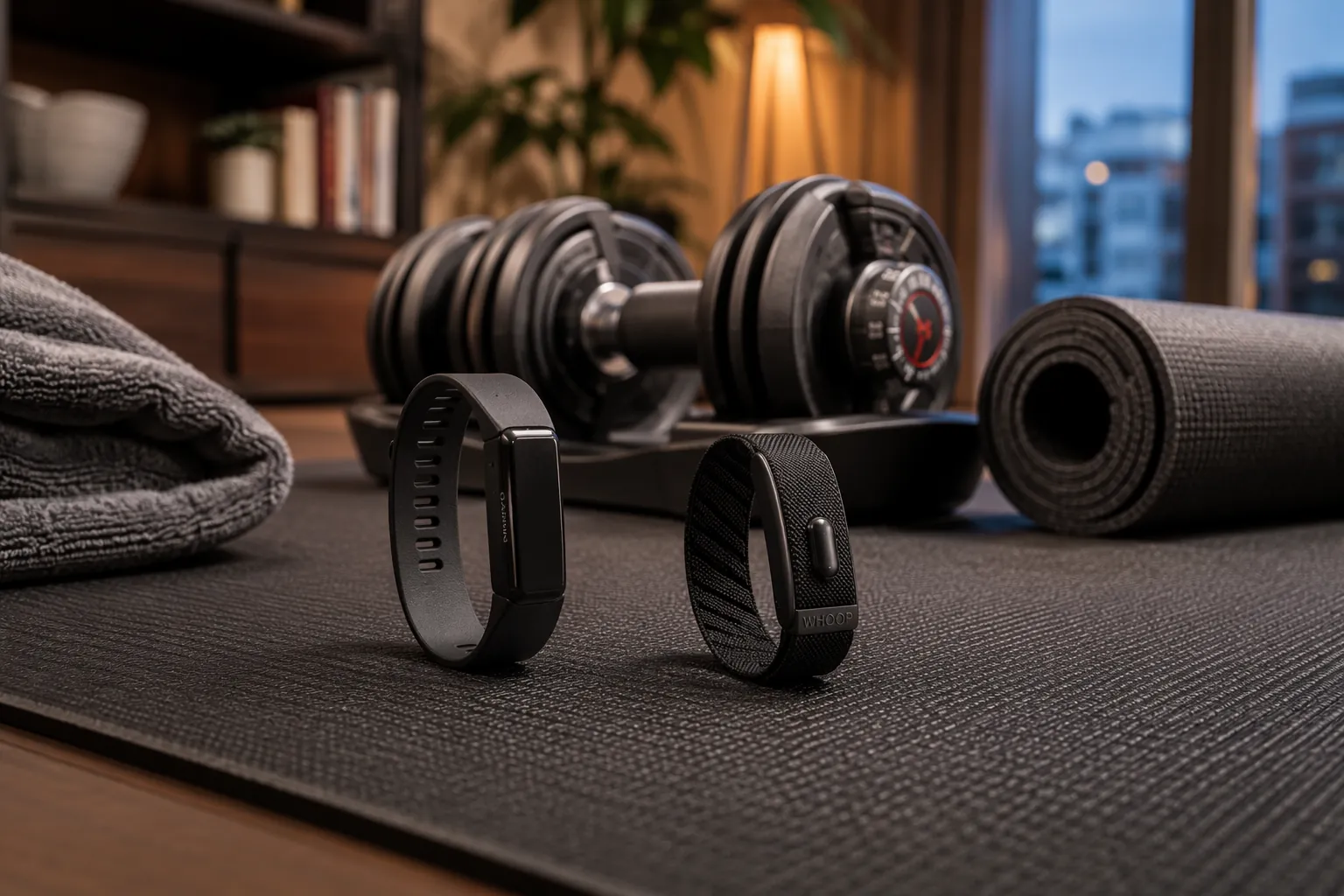
The Apartment Test Is Different
A screenless band has an easier job on a steady outdoor run than it does in a small room where the workout jumps from goblet squats to push-ups to a treadmill incline walk. Home training changes intensity fast, uses awkward wrist angles, and often ends before an auto-detection system has finished deciding what happened.
So the useful comparison is not Garmin’s full ecosystem against Whoop’s full platform. GPS, race predictions, outdoor routing, and smartwatch-style features sit mostly outside the problem. The apartment version of the question is narrower: heart-rate accuracy during cardio, recognition of short workouts, credit for lifting, recovery guidance after mixed sessions, and total cost.
| Home workout need | Garmin Cirqa | Whoop 5.0 |
|---|---|---|
| HIIT and treadmill cardio | Strong early HR result against a Polar H10, but based on one short launch-event test | Established recovery-first band; no specific home HIIT accuracy result in the provided materials |
| Dumbbells and bodyweight strength | Rep counting is built in, but muscular load is less complete | Strength Trainer gives it the clear lifting advantage if manually logged |
| Automatic workout capture | Launch-week auto-detection looked unreliable and slow | Manual logging is still part of the strength-training value |
| Recovery and readiness | Body Battery, Training Readiness, and Acute Load give useful context without a required subscription | Strong recovery platform, but access depends on the annual membership model |
| Three-year cost | $199 without Connect+ | $597 to $1,077 depending on tier |
Cardio: Cirqa Looks Credible, With a Short Evidence Trail
The strongest early point for Cirqa is heart rate during high-intensity work. In TechRadar’s launch-event test, the Cirqa’s Elevate Gen4 sensor averaged 153 bpm during a HIIT session, while a Polar H10 chest strap averaged 155 bpm.[4] For a wrist-worn, screenless band in a sweaty interval session, that is close enough to take seriously.
It is also not a settled accuracy verdict. That result comes from one short HIIT session at a launch event, not months of dumbbell circuits, treadmill intervals, yoga flows, and bad-sleep recovery days. The useful conclusion is narrower: Cirqa has credible early evidence for home-cardio heart rate, especially the kind of HIIT session where many wrist devices can wobble.
For treadmill work, that matters more than GPS. If you are walking uphill on a foldable treadmill beside the couch, the band does not need to map a route. It needs to follow rising effort, falling recovery intervals, and the difference between a casual walk and a session that should affect readiness tomorrow.
Auto-Detection Is Where Cirqa Feels Less Finished
The launch-week problem for Cirqa is not that it lacks sensors. It is that the automation can be late. DC Rainmaker reported that Cirqa took 15 to 20 minutes to auto-detect a run, and that the editing tool failed when trying to trim the activity afterward.[5] For a home workout, that delay is not a small inconvenience. It can be most of the session.
A 45-minute outdoor run can survive a slow start marker. A compact apartment circuit often cannot. If the workout is 8 minutes of mobility, 18 minutes of dumbbell density work, and 5 minutes of cooldown, delayed detection turns the cleanest part of the session into cleanup work in the app.
This may improve. The current evidence is from first-week media units after Cirqa’s July 2026 launch, and firmware can change workout detection. But for now, anyone buying Cirqa for short, frequent home sessions should assume manual starting is safer than trusting automation.
Strength Training Is Whoop’s Best Argument
Dumbbell training exposes the biggest weakness in ordinary wearable scoring. A hard set of split squats, presses, or rows may not keep heart rate high for long enough to look impressive in a cardio-biased model. The session can be productive, and still appear as a mild patch of elevated pulse.
Whoop’s Strength Trainer is built for that gap. Wareable notes that it factors muscular load measured by the accelerometer alongside heart rate, making it unusually relevant for lifters compared with wearables that lean mainly on cardiovascular strain.[3] That is not a cosmetic feature if your home gym is built around adjustable dumbbells and progressive overload.
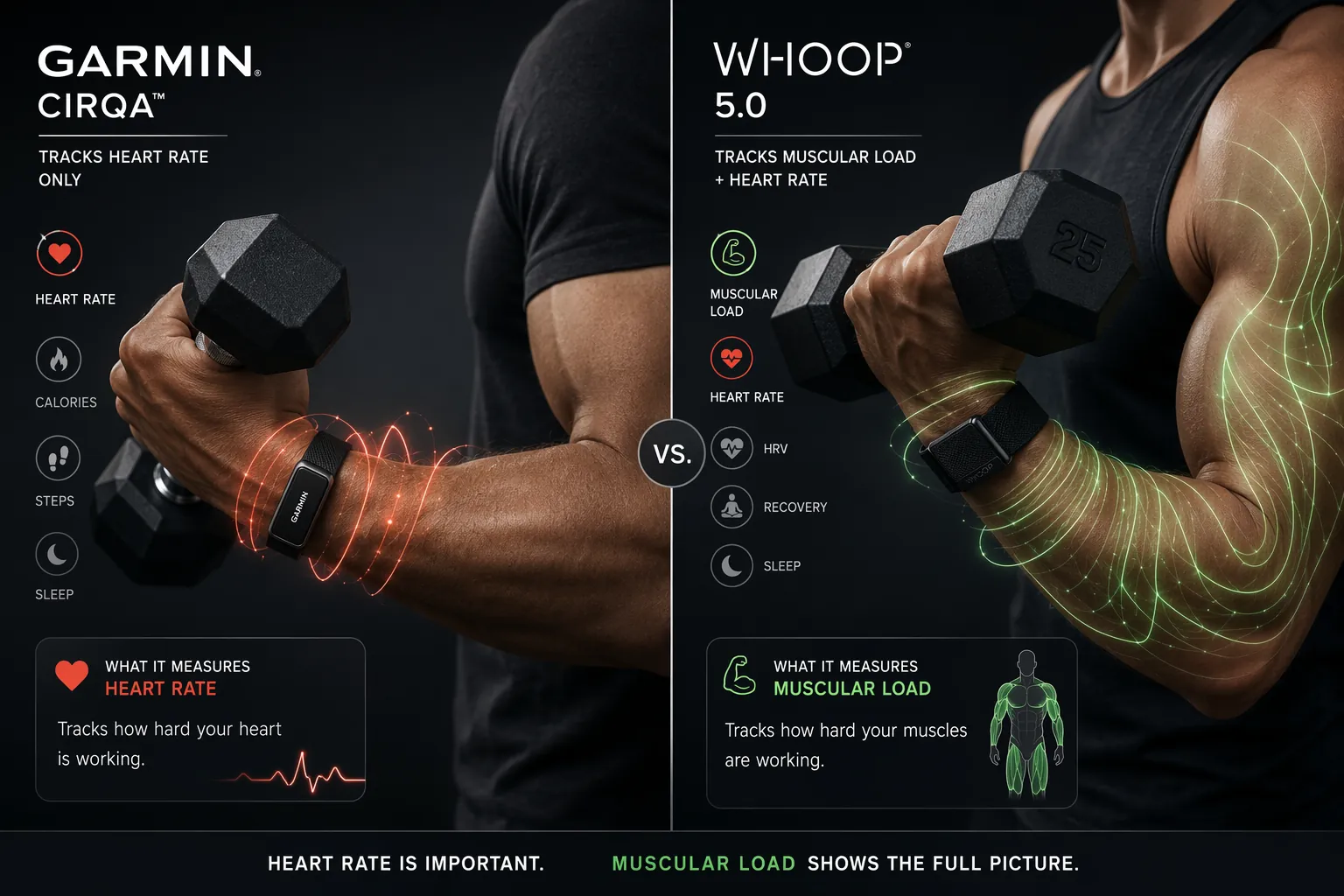
Cirqa is not empty here. Personal Edge Fitness notes that Cirqa includes accelerometer-based rep counting, while Whoop lacks native rep counting and relies on manual Strength Trainer logs.[6] That gives Garmin a convenience point: if you want a band to notice reps without building a detailed lifting diary, Cirqa is easier to live with.
But convenience and training meaning are not the same thing. Rep counting can tell you that movement happened. Muscular-load tracking is trying to give that movement training credit. For serious at-home lifters, Whoop’s advantage is real enough to justify considering the subscription.
The catch is friction. Whoop’s best strength value depends on logging exercises manually. If you enjoy structured lifting and already track sets, that may be acceptable. If your home strength work is a quick circuit squeezed between meetings, the feature may become one more thing you meant to use and gradually stopped opening.
Yoga and Recovery Favor Useful Interpretation Over More Data
Yoga is not where either band wins by counting everything. Wrist movement can be odd, heart rate may stay modest, and the value is often in how the session changes the rest of the day: lower strain, better recovery, or a readiness score that tells you not to turn tomorrow into another max-effort circuit.
This is where Garmin’s no-mandatory-subscription setup matters. Cirqa can feed into Body Battery, Training Readiness, and Acute Load, which are more useful for mixed home training than a raw workout log. A band that says “you did yoga” is fine. A band that helps decide whether today should be dumbbells, treadmill intervals, or mobility is better.
Whoop remains strong as a recovery product, but it is inseparable from its membership model. That is acceptable if recovery coaching is the product you are buying. It is harder to justify if you mainly want a quiet band that records small-space workouts and does not keep billing after the hardware arrives.
The Subscription Math Changes the Pick
The price gap is not a minor spec-line difference. Cirqa is listed at $199 as a one-time purchase.[1] Whoop One is $199 per year, Whoop Peak is $239 per year, and Whoop Life is $359 per year.[2] Over three years, that puts Whoop at $597, $717, or $1,077.
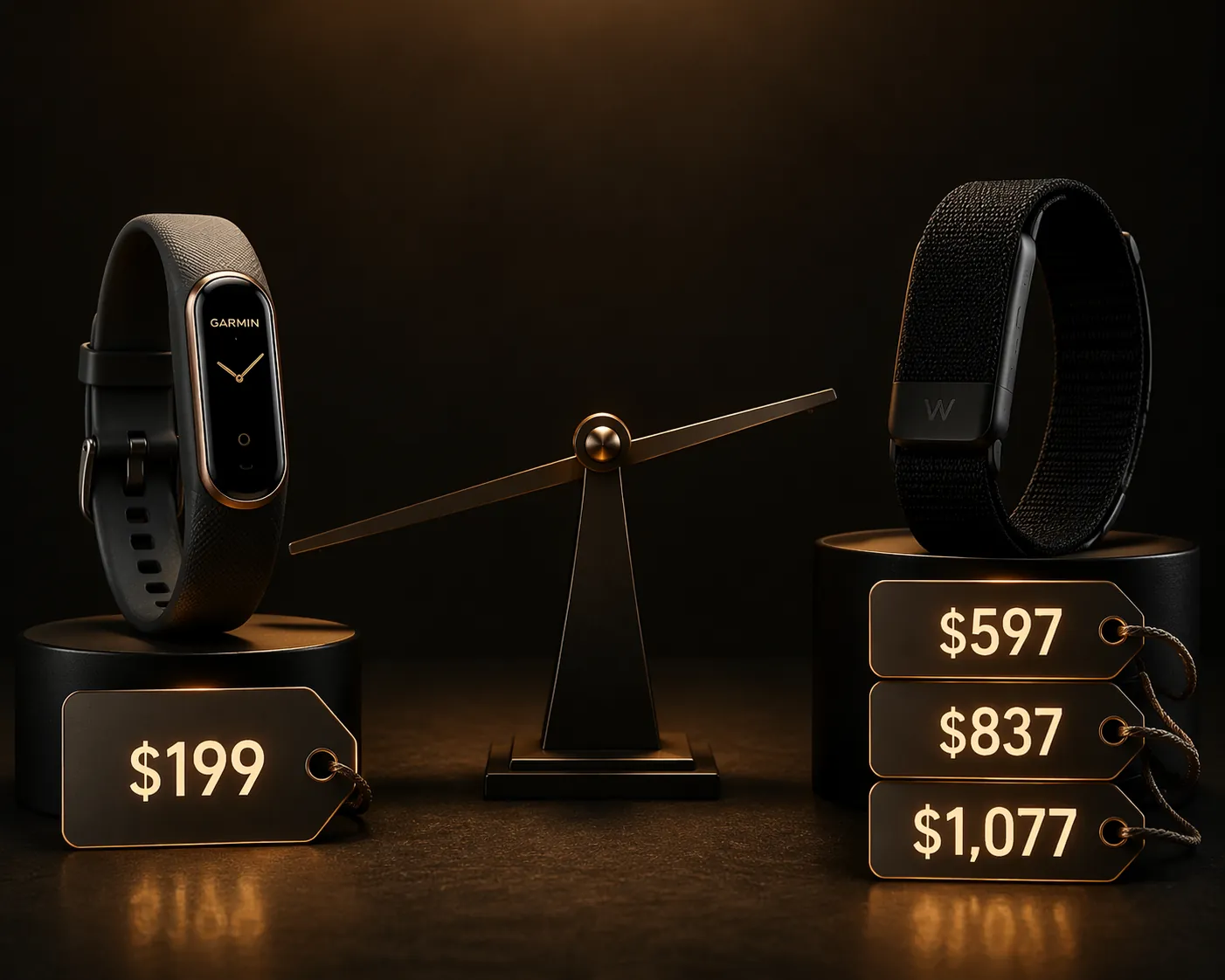
| Device or plan | Year-one cost | Three-year cost | Difference vs. Cirqa over three years |
|---|---|---|---|
| Garmin Cirqa without Connect+ | $199 | $199 | Baseline |
| Garmin Cirqa with Connect+ at $69.99/year | $268.99 | About $409 | About $210 more than Cirqa alone |
| Whoop One | $199/year | $597 | $398 more than Cirqa |
| Whoop Peak | $239/year | $717 | $518 more than Cirqa |
| Whoop Life | $359/year | $1,077 | $878 more than Cirqa |
There is one important Garmin caveat. At launch, DC Rainmaker reported that live heart rate during workouts required Garmin Connect+ at $69.99 per year.[5] Android Authority later reported that Garmin planned to make that paywalled live heart-rate feature free in a future update.[7] Until that change is actually reflected in the product a buyer is using, it is safest to price Cirqa two ways: $199 without Connect+, or about $409 over three years if Connect+ stays necessary for the features you care about.
Even under the paid-Connect+ version, Cirqa still undercuts Whoop One over three years. Without Connect+, the savings are large enough to affect the rest of a small home gym. The $398 to $878 not spent on Whoop can cover meaningful upgrades in the same way a full home gym system cost breakdown changes once recurring fees are included.
That renter’s math is hard to ignore. A subscription may be worth it when it changes training behavior. It is less convincing when the same money could buy better flooring, heavier dumbbell plates, a quieter fan, or the next upgrade in a carefully planned home gym equipment budget.
Bands, Placement, and the Off-Wrist Question
Both devices can benefit from being moved away from the wrist during certain workouts. DC Rainmaker notes that both devices improve heart-rate accuracy 10 to 15% off-wrist, and that Garmin offers a $59 bicep band for Cirqa.[5] For apartment training, that matters during kettlebell-style movements, push-ups, dumbbell presses, and anything where wrist flexion or gripping can interfere with optical readings.
The extra band also complicates the “cheap” answer slightly. A Cirqa plus bicep band is still far below Whoop’s three-year cost, but it is the kind of accessory a serious home user may actually want. If the tracker is going to live through floor work, dumbbells, and HIIT, placement is not a detail; it is part of whether the data is worth trusting.
Who Should Buy Garmin Cirqa
Buy Garmin Cirqa if your home gym is mixed-use: dumbbells some days, treadmill or HIIT on others, yoga or mobility when your joints need a quieter session. Its early heart-rate result is encouraging for home cardio, its readiness tools are more useful than a simple activity count, and its cost stays sane without a required annual membership.
- You want a screenless tracker without committing to a recurring wearable bill.
- You care about readiness and training load across mixed workouts.
- You do HIIT or treadmill sessions at home and want credible heart-rate tracking.
- You lift, but you are unlikely to manually log every exercise in detail.
- You would rather put three-year subscription savings into actual home-gym upgrades.
The only caution is launch software. If automatic detection is central to how you train, Cirqa’s reported 15 to 20 minute detection delay is a real problem until Garmin improves it.[5] Manual workout starts are the safer habit for now.
Who Should Buy Whoop
Buy Whoop if strength training is central enough that muscular-load tracking is worth paying for and maintaining. That means you are not just doing occasional dumbbell circuits; you are progressing lifts, tracking volume, and willing to log sessions because the lifting data changes how you train.
- You lift at home as your primary training mode.
- You will use Strength Trainer consistently instead of relying on passive detection.
- You value muscular load more than rep-count convenience.
- You accept the three-year subscription cost as part of the product.
- You already think in training logs, recovery scores, and structured progression.
For that user, Whoop is not simply the more expensive option. It is the one with the strength-specific feature Cirqa does not fully replace.
Our Pick
Choose Garmin Cirqa for most apartment home gyms. It gives the better balance of cost, readiness data, and mixed-workout usefulness, especially for people who rotate between HIIT, treadmill work, dumbbells, and yoga. The three-year price gap is too large to treat as a footnote, and Cirqa’s best features do not require turning a $199 band into another long-term bill.
Choose Whoop if lifting is the point of the setup and you will manually log Strength Trainer sessions. Its muscular-load approach is the one feature here that can genuinely make Cirqa feel incomplete for serious strength work.
For everyone else, the smarter apartment-gym move is to buy the Cirqa, start workouts manually until detection improves, and put the saved subscription money toward the parts of the room that make training easier to repeat. That is the same logic behind any careful total cost of ownership decision: the best tracker is not the one that wins the feature sheet; it is the one that leaves enough budget to keep the actual gym usable.
References
- Is Garmin's Whoop Challenger What the Fitness World Has Been Waiting For? — Gear Patrol, July 2026
- Which Is Better: Whoop vs. Garmin — Lifehacker, October 2025
- Whoop vs. Garmin: Full comparison and which is right for you — Wareable, July 2026
- Is Garmin Cirqa good? Tested against Polar H10 chest strap — TechRadar, July 2026
- Garmin Cirqa Hands-On: Everything You Need to Know! — DC Rainmaker, July 2026
- Apple Watch vs Garmin vs Whoop Strength Training — Personal Edge Fitness, 2025–2026
- This paywalled Garmin CIRQA feature will soon be free — Android Authority, July 2026
This result comes from one real apartment under the stated conditions — it is a strong signal, not a guarantee your space will measure identically.
Builds this evidence supports
No build currently links to this specific test. Browse all builds with a matching tag.
Spot something off?
If this result didn't match your own space, let us know — floor-damage and noise claims carry real deposit-risk consequences if we get them wrong.