
Which Home Gym Storage Works in a Narrow Apartment? We Tested 6
We tested six storage systems—pegboard, slatwall, wall racks, storage ottomans, door organizers, and under-bed bins—in a 4-foot apartment hallway to find which stores the most gear with the least depth, highest weight capacity, and lowest deposit risk. The result: a layered combination works best, not any single system.
- Test space profile
- 4-foot-wide apartment hallway
- Floor damage risk
- low
- No-drill compatible
- ✓
- Test date
The hallway result: there is no single winner
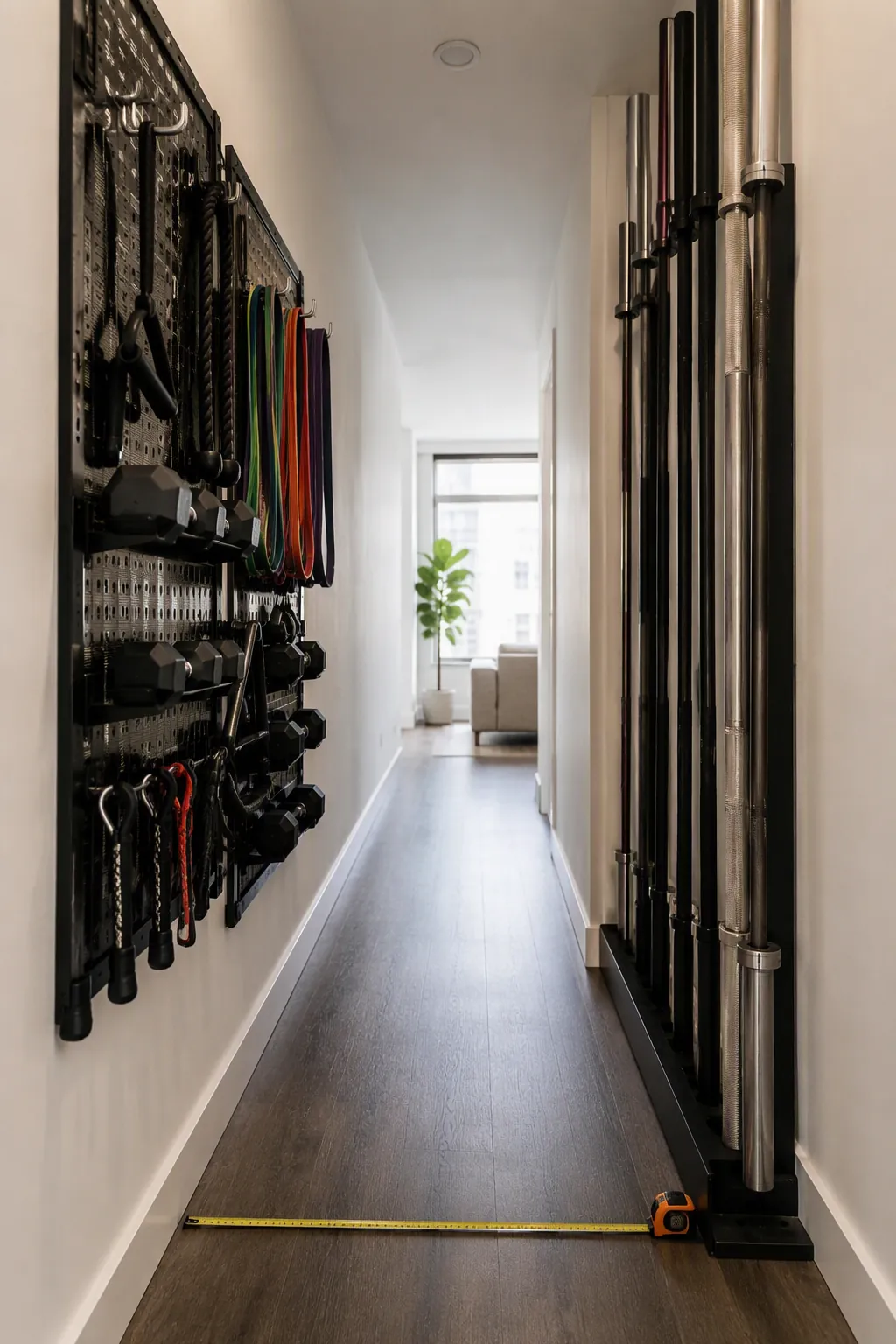
We tested the main home gym storage approaches in a 4-foot-wide apartment hallway because that is where generic storage advice usually collapses. A product can look slim in a catalog and still steal enough shoulder room to make the sock drawer, bedroom door, or laundry basket feel like a daily obstacle. The measurement that mattered most was not panel thickness. It was installed depth from the wall face to the farthest hook, bin, plate, handle, or accessory.
The quick verdict: use a layered setup. Metal pegboard is the best thin wall for small accessories. Under-bed bins are better for soft, flat gear if the bed has clearance. A door organizer can handle light bands and straps. Heavy bars and plates need either a properly stud-mounted rack or a freestanding rack, not wishful thinking on drywall.
| Storage option tested | Best use in a narrow apartment | Depth or clearance that mattered | Load reality | Install and deposit risk |
|---|---|---|---|---|
| Wall Control metal pegboard | Bands, collars, jump rope, handles, light cable attachments, small accessories | 0.875-inch minimum hook reach; 3/4-inch flange depth on the panel | Joe Gray’s long-term 32×16 panel held 150+ lb on 20-gauge steel; we treated that as a conservative real-world ceiling, not a drywall promise [1] | Drilling required; low visual bulk, but holes still need permission and patching |
| PVC slatwall such as StoreWALL or Proslat | Kettlebells, heavier accessories, baskets, mixed gear | 1.5-inch panel depth plus 3–6 inches of hook or basket projection | StoreWALL is rated by the manufacturer at 260 lb/sq ft under proper mounting conditions; apartment drywall alone should not be assumed to deliver that [2] | Higher install burden; usually a stud/stringer conversation, not a casual rental wall project |
| Wall-mounted plate or bar racks | Plates, bars, and other dense gear that otherwise lives on the floor | Largest wall projection in the test; about a foot of side clearance disappears before the stored load is even considered | Useful only when mounted into suitable structure; the rack is not the weak point if the wall is wrong | Highest deposit and permission risk among the wall systems |
| Storage ottoman or furniture bench | Bands, wraps, small accessories, possibly one light adjustable set if weight and dimensions allow | Models wider than 24 inches crowded the 4-foot hallway quickly | Typical useful range was 50–80 lb before the furniture stopped feeling like a storage solution and started feeling like a stressed box [3] | No holes; low deposit risk, but it consumes floor space |
| Over-the-door organizer | Bands, straps, jump rope, gloves, small mobility tools | No wall depth, but the door swing and hinge alignment become the constraint | Up to 15 lb behaved like light-duty storage; heavier loads caused door misalignment in testing [6] | No drilling; watch paint rub, hinge stress, and whether the door can still close cleanly |
| Under-bed bins | Bands, yoga mat, sliders, towels, soft goods, flat accessories | No hallway depth; assumes about 12 inches of bed-frame clearance | Good for awkward light gear, poor for anything you need mid-workout every day | No holes; lowest deposit risk if the bed height works |
| Freestanding vertical bar rack | Bars when drilling is not allowed | Titan’s 9-Bar-style footprint is 19×19 inches, so it needs a real corner, not a walking lane [4][5] | The strongest no-wall-contact option we tested for 45 lb bars | No drilling; floor protection matters more than wall repair |
The thinnest useful wall was metal pegboard
Wall Control was the system that made the hallway feel least punished. The panel itself is thin, but the better number is the 0.875-inch minimum hook reach. That is the difference between a wall that merely holds accessories and a wall that still lets a person pass while carrying laundry.
The strength claim also deserves restraint. Wall Control’s 20-gauge steel pegboard has a strong real-world example in Joe Gray’s 8-year installation, where one 32×16 panel held 150+ lb, with the panel built around a 3/4-inch flange depth [1]. That is the number worth remembering. Higher numbers exist in secondary discussions, but for an apartment reader, 150+ lb from a careful long-term install is already plenty for bands, handles, collars, hooks, and the small objects that otherwise migrate into drawers.
The catch is that metal pegboard is still a wall installation. If the lease says no drilling, this is not renter-safe just because the panel is thin. If drilling is allowed into studs and patching is acceptable, it is the cleanest way we tested to turn a dead wall strip into real gym capacity. If the only available wall is drywall with no stud plan, the rating should be treated as irrelevant.
Slatwall held heavier gear, but the depth penalty showed up immediately
Slatwall earns respect in a garage. In a narrow apartment hallway, it has to earn every inch. StoreWALL-style PVC slatwall is rated at 260 lb/sq ft by the manufacturer, and the kit price in the research set was about $255 for a 4×8 section [2]. Those are attractive numbers if the wall can be mounted correctly. They are not a reason to hang kettlebells from apartment drywall and hope the paint survives.
The physical problem is simple: the panel depth is only part of the intrusion. The panel is 1.5 inches deep, then the useful hooks and baskets add another 3–6 inches. Once a kettlebell handle or basket lip sits out from the wall, the system no longer behaves like a thin surface. In a 4-foot hallway, that extra projection is the difference between a passable wall and a wall everyone learns to sidestep.
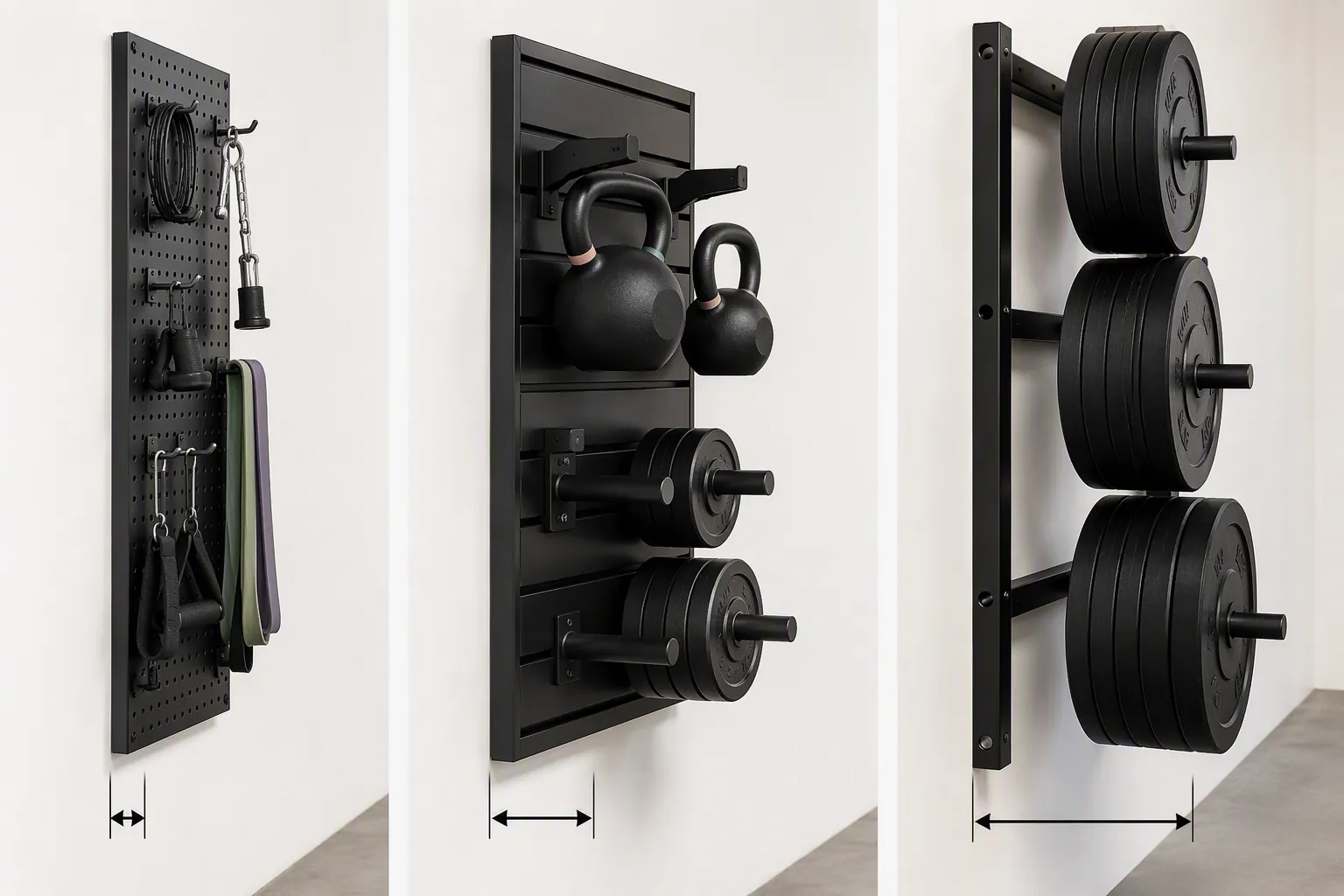
Slatwall made the most sense on a short dead-end wall, inside a closet-width alcove, or anywhere the stored objects would not interrupt walking clearance. It was less convincing along a travel path. It can store heavier and bulkier objects than pegboard, but in this apartment test that advantage came with a visible cost: more projection, more installation work, and more to explain to a landlord.
Wall racks solved floor clutter only when the wall was allowed to become structural
Wall-mounted plate pegs and bar racks are satisfying in the way a proper mechanical solution is satisfying. Plates leave the floor. Bars stop leaning against corners. The wall suddenly looks intentional.
That satisfaction disappears if the rack is being installed under rental uncertainty. A plate rack is not just another hook. It concentrates heavy load at fasteners, and the installation needs studs or suitable structure. In our hallway comparison, these racks also had the largest wall projection. Even before accounting for the stored plates, the rack area behaved like a permanent obstruction rather than a slim organizer.
This is the part where drilling restrictions need more nuance than yes or no. Some renters can make small patchable holes. Some have written permission to mount into studs. Some cannot touch the wall beyond removable hooks. Wall racks belong only in the middle or high-permission version of that spectrum. If the permission is uncertain, the practical answer for heavy bars is a freestanding vertical rack, not a prettier wall rack.
No-drill storage helped, but only when it stayed honest about weight
The no-drill systems were not glamorous. They were also the systems least likely to turn move-out weekend into sanding, patching, repainting, and trying to match landlord-white paint under bad lighting.
Storage ottomans
An ottoman works when it replaces furniture you already needed. It is a poor bargain when it becomes a wide box parked in the only walking lane. In the hallway test, models over 24 inches wide crowded the space fast, even when they technically stored useful gear. The practical load range was 50–80 lb for adjustable dumbbells, bands, and accessories before the furniture started feeling misused [3].
That makes an ottoman a decent living-room compromise for bands, wraps, yoga blocks, light dumbbells, and recovery tools. It is not the place to hide an entire heavy strength setup unless the manufacturer’s weight limit, hinge quality, and floor footprint all agree.
Door organizers
The over-the-door organizer was useful precisely because it did not pretend to be heavy storage. Bands, lifting straps, gloves, a jump rope, and light mobility tools were fine. Around 15 lb was the sensible upper boundary in testing; heavier loads caused door misalignment at the hinges [6].
The other check is door behavior. If the organizer rubs paint, blocks the door from closing, or makes the hinge side sag, the storage is not free. It has just moved the damage from the wall to the door.
Under-bed bins
Under-bed storage was the least annoying solution for soft, flat, and awkward gear. Bands, sliders, a rolled mat, spare handles, towels, and mobility tools disappeared without taking wall depth. The limitation is blunt: it assumes about 12 inches of bed-frame clearance. A platform bed may remove this option entirely.
It is also not ideal for items used every ten minutes during a workout. Under-bed bins are best for gear that comes out once per session, not for collars, handles, and bands that need to be grabbed between sets.
Choose by gear type, not by storage category
The systems did not compete evenly because gym gear is not evenly annoying. A foam roller rolls away. Bands tangle. Plates are dense and unforgiving. A barbell is long even when it is stored perfectly. The cleaner decision is to match the storage to the object.
| Gear | Best tested storage choice | Why |
|---|---|---|
| Resistance bands, collars, handles, jump rope | Metal pegboard | Frequent-use accessories need visibility and fast access; Wall Control gave the most capacity for the least wall projection. |
| Yoga mat, sliders, towels, spare bands | Under-bed bins | These are light and awkward, and they do not need to hang in the hallway. |
| Gloves, straps, very light bands | Door organizer | Useful when kept below light-duty loads and when the door still closes cleanly. |
| Kettlebells | Slatwall only if wall structure and clearance are acceptable | It handles bulk better than pegboard, but the 3–6 inches of hook or basket projection changes the hallway. |
| Plates | Stud-mounted wall rack or freestanding floor storage | The weight is too concentrated for casual wall assumptions. |
| Barbells | Freestanding vertical rack when drilling is not permitted | A 19×19-inch vertical rack stores bars without touching the wall, but it belongs in a corner, not a passage. |
| Adjustable dumbbells | Dedicated stand, sturdy furniture only within rating, or floor position under a bench | They are too dense for decorative storage unless the furniture is genuinely built for the load. |
The freestanding vertical bar rack was the one heavyweight no-drill answer that did not ask the wall for a favor. The Titan 9-Bar-style footprint is 19×19 inches, and similar small-space bar storage guidance treats vertical freestanding storage as a way to consolidate long bars without wall mounting [4][5]. In a 48-inch hallway, though, 19 inches is too much to casually surrender. It belongs in a bedroom corner, closet edge, or spare-wall dead zone.
The narrow-apartment storage map that actually worked
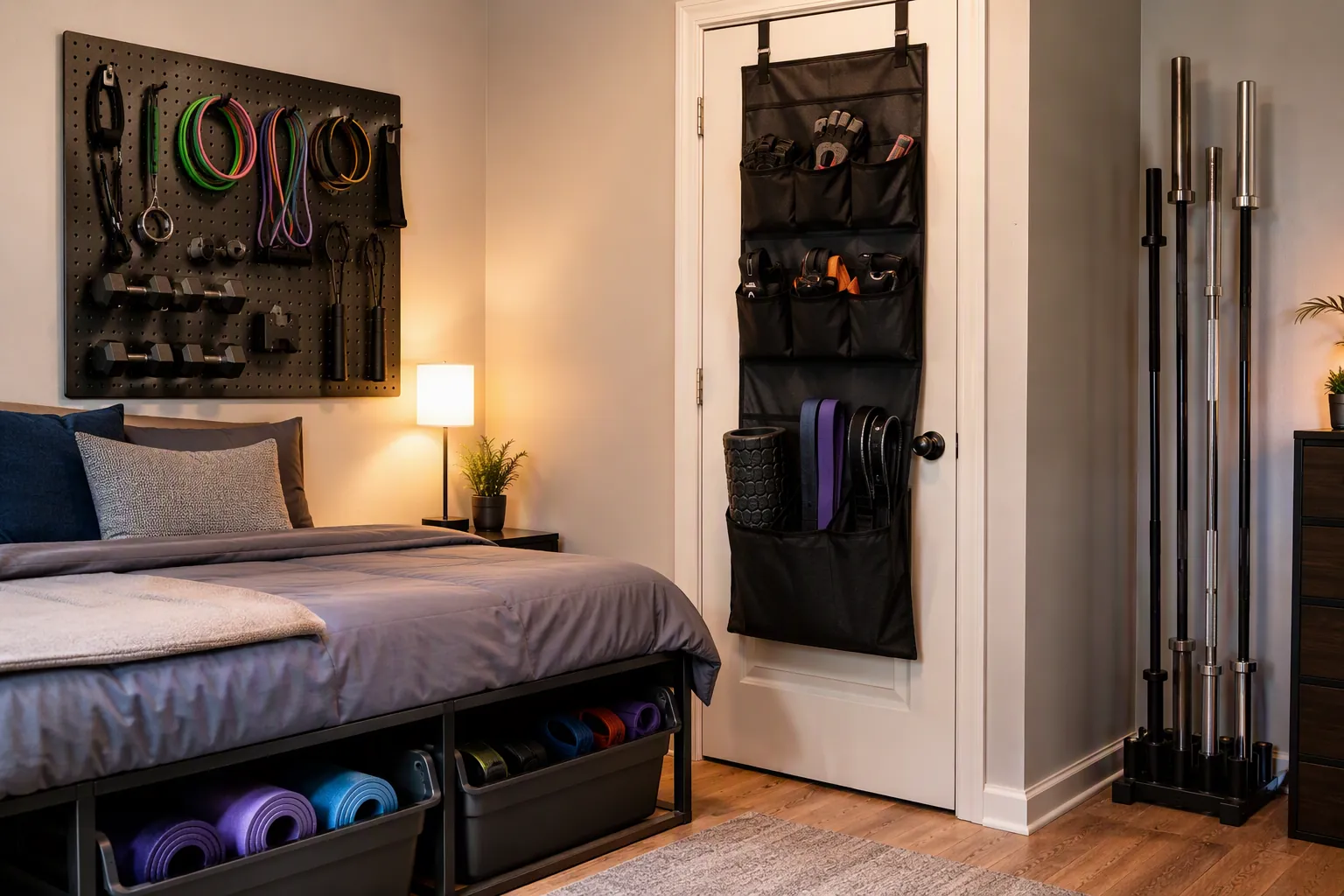
For a full narrow-apartment gym, the best layout was not one hero product. It was a divided system:
- Use metal pegboard on the thinnest useful wall for bands, collars, handles, jump rope, and small accessories.
- Use under-bed bins for mats, sliders, towels, soft goods, and backup bands if the bed has about 12 inches of clearance.
- Use an over-the-door organizer only for light gear, and keep the load low enough that the door still closes without hinge strain.
- Use a freestanding vertical rack for bars when drilling is not permitted, and place it in a true corner rather than a walking lane.
- Use slatwall or wall-mounted racks only when the wall structure, lease permission, and depth loss all make sense.
If drilling is allowed, the strongest version is pegboard for small gear plus properly mounted wall storage for plates or bars where the structure supports it. If drilling is not allowed, the setup changes: pegboard and wall racks leave the plan, under-bed bins and door storage take more of the light gear, and a freestanding rack handles bars. That version is less sleek, but it is much less likely to become a security-deposit argument.
The main caveats are worth checking before buying anything. Confirm whether drilling into studs is allowed. Measure from the wall face to the farthest point of the stored object, not just the panel. Check bed clearance before assuming under-bed bins exist. Treat manufacturer load ratings as mounting-condition ratings, not apartment-wall guarantees.
If the bigger question is which equipment deserves space before it needs storage, start with the small apartment home gym tour at $100, $300, and $800 or the guide to building a home gym in under 50 square feet. For readers trying to avoid several separate storage zones altogether, an all-in-one home gym machine for small spaces may be the cleaner compromise.
References
- Wall Control Comprehensive Guide — Gray Matter Lifting
- Wall Control Metal Pegboard Equipment Organizer Review — Garage Gyms
- Best Home Gym Storage — Garage Gym Lab
- How to Store Workout Equipment in a Small Apartment — Bells of Steel
- How to Build an Amazing Home Gym in a Small Space — REP Fitness
- Gym storage ideas — Real Homes
This result comes from one real apartment under the stated conditions — it is a strong signal, not a guarantee your space will measure identically.
Builds this evidence supports
No build currently links to this specific test. Browse all builds with a matching tag.
Spot something off?
If this result didn't match your own space, let us know — floor-damage and noise claims carry real deposit-risk consequences if we get them wrong.