
Can the Hyperice Hyperslide Replace Your Massage Gun at Home?
Wondering if the $249 Hyperice Hyperslide works for home recovery in a small apartment? We break down its heat-and-vibration performance, noise profile, and space savings — and explain why it's a useful supplement to a massage gun, not a full replacement.
- Test space profile
- Small apartment living area, approx. 10 sq ft, laminate flooring, with yoga mat and coffee table
- Floor damage risk
- low
- No-drill compatible
- ✓
- Test date
The most believable place for the Hyperice Hyperslide is not a product launch stage. It is the ten square feet between a rolled-up yoga mat, a coffee table, and the corner where a massage gun already lives with one charging cable too many. After a run or apartment workout, the choice is usually annoying in small ways: hold a massage gun long enough to matter, stand on a foam roller while hoping the downstairs neighbor is forgiving, or skip recovery because the couch has already won.
That is why any home-use judgment on the Hyperice Hyperslide has to start with a boundary. The Nike Air Zoom Hyperslide is a $249 pre-order product, with Nike saying it will begin shipping September 29, 2026; Forbes also reported the same pre-order and launch timing on July 27, 2026.[1][2] As of July 29, 2026, there are no independent long-term home tests to lean on, so the honest verdict is provisional: this looks like a useful foot-focused recovery supplement for small apartments, not a massage-gun replacement.
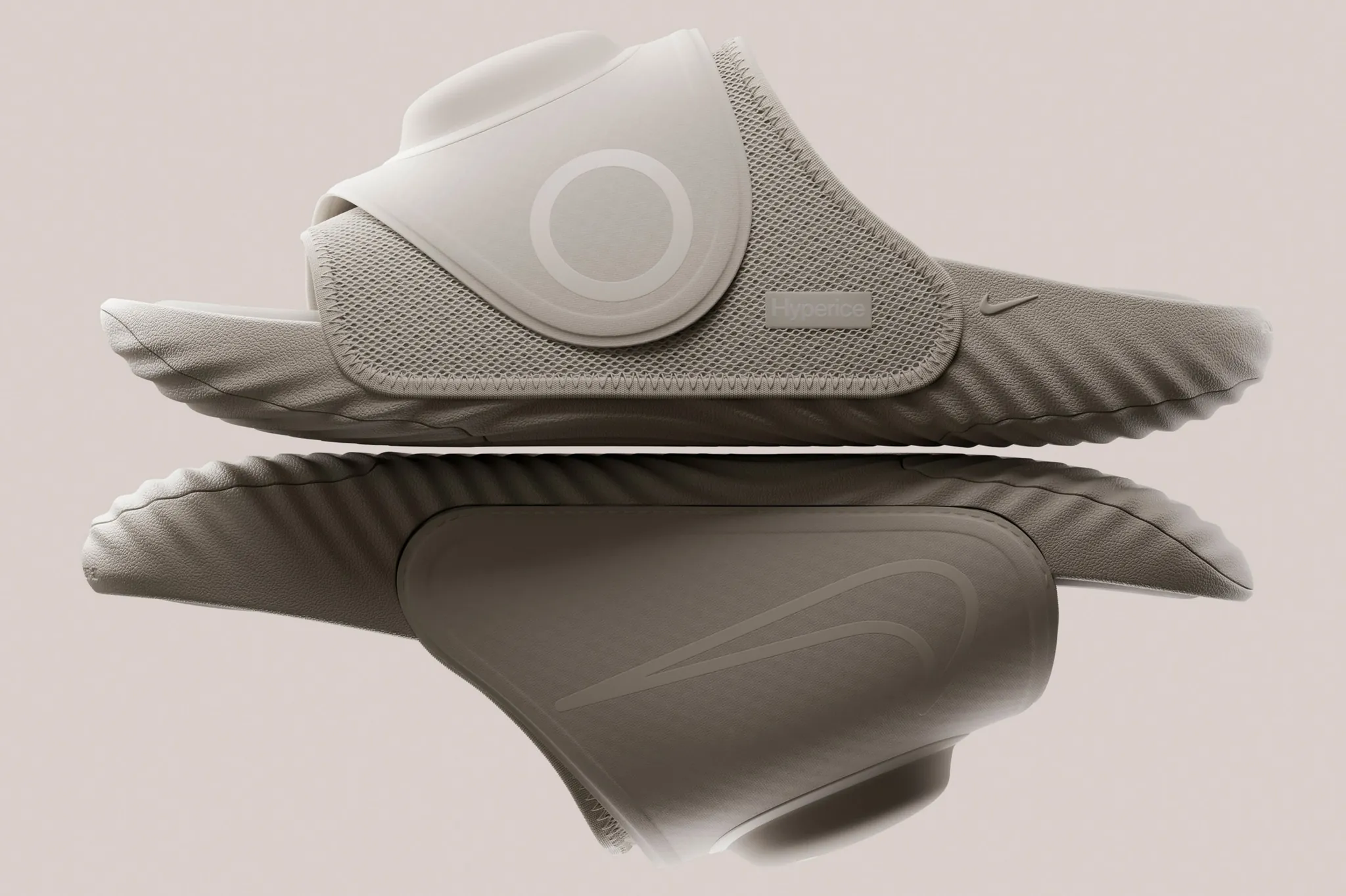
What the Hyperslide Actually Does
The Hyperslide is a recovery slide with a removable magnetic pod on the strap. Nike and Hyperice describe it as delivering heat across the top of the foot and vibration through the slide, with three heat levels from 109 to 117 degrees Fahrenheit and vibration from 50 to 100 Hz.[1] The heat feature is designed to be used with socks, a small but important home-use detail if you were imagining these as barefoot post-shower sandals.[3]
The appeal is obvious if you live in a small space. You do not need to clear floor area, lie down, strap into boots, or hold a tool against your calf until your arm gets tired. You slip into the slides and keep doing low-stakes apartment things: refill a bottle, make dinner, answer a message, sit on the couch without building a recovery station around your legs.
The limit is just as obvious. Heat and vibration on the foot are not the same job as percussion into a quad, pressure through a calf, or compression around the lower leg. Nike calls this part of its broader recovery collaboration with Hyperice, but the Hyperslide is the simplest and most casual piece of that ecosystem, not the deepest one.[1]
| Home recovery question | What the Hyperslide offers | What remains unproven |
|---|---|---|
| Can it save floor space? | Yes, during use it behaves like a pair of slides rather than a mat, roller, or boot setup. | Long-term storage wear and pod durability are not independently tested. |
| Can it replace a massage gun? | Only for easier foot-focused recovery sessions. | It has no percussion and cannot target larger muscle groups the same way. |
| Is it apartment-friendly for noise? | The sealed vibration design should be less aggressive than percussive massage. | No published decibel measurements are available. |
| Can it replace compression boots? | No, it removes hoses and setup friction. | It does not provide compression. |
| Is the battery enough? | Reported runtime is about one hour. | Reported recharge time is about three hours, and real-world aging is unknown. |
The Apartment Test: Space, Noise, Charging, and Wear
For a renter, the strongest case is physical footprint. A foam roller has to live somewhere long and visible. Compression boots need drawer or closet space, plus a hose-and-pump ritual. A massage gun is compact, but it still asks for your hand, attention, and a charged battery. The Hyperslide stores like footwear and uses no floor space while you are wearing it.
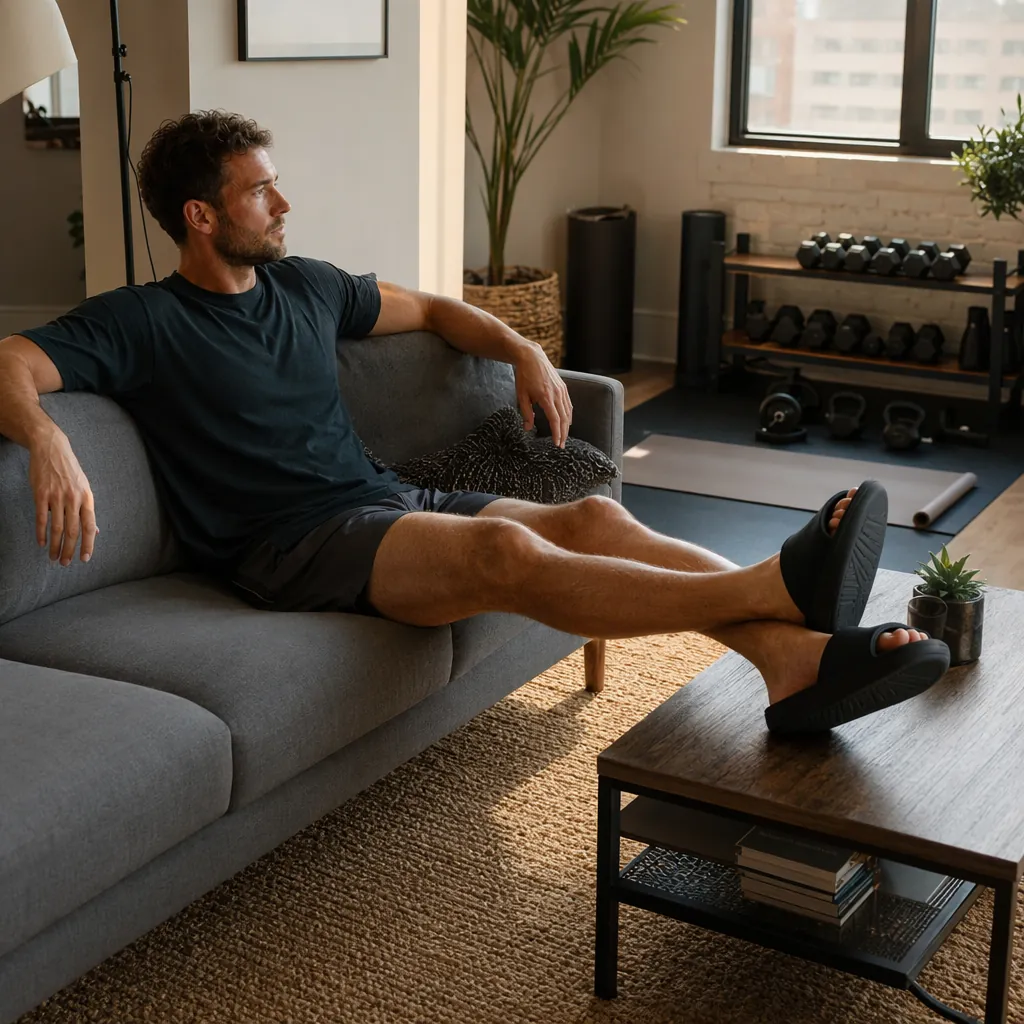
The noise question is more delicate. A sealed vibration motor should be less sharp than the thwack of a percussive massage gun, especially through thin apartment walls. That is a reasonable inference from the mechanism, not a tested result. None of the available launch coverage provides decibel readings, wall-transfer measurements, or neighbor-style testing. Until someone measures it, “quieter” should mean “likely less percussive,” not “safe for midnight recovery in every apartment.”
Battery life is the first practical annoyance. Gear Patrol and The Gadgeteer both report about one hour of runtime and roughly three hours to recharge over USB-C.[3][4] That is fine if you use the slides in short sessions and return the pod to a charging spot afterward. It is less fine if your recovery gear tends to die in drawers, because a three-hour recharge turns “I’ll just slip these on” into “I should have plugged these in yesterday.”
The removable magnetic pod helps. Fast Company and Complex both describe the pod as removable, and the slides can still function as normal footwear when the powered module is depleted or removed.[5][6] That matters in a small apartment because dead electronics usually become clutter. Here, at least, a dead pod does not make the entire object useless on the walk from couch to kitchen.
The unanswered renter questions are durability and water resistance. If these live near the door, beside a shower, or under a bench with other gym gear, they will meet sweat, damp socks, dust, and accidental drops. The available materials do not disclose a water-resistance rating, replacement pod cost, or long-term pod durability. That does not make the Hyperslide fragile; it means no one outside the launch circle has proved it is forgiving.
Massage Gun vs. Hyperslide
The cleanest way to judge the Hyperslide is to separate convenience from depth. A massage gun is an active tool. You choose a muscle, apply pressure, move slowly, change attachments, and decide when to stop. It can work on calves, quads, glutes, hamstrings, shoulders, and feet, but the trade-off is that you have to operate it.
The Hyperslide is passive in the best and worst sense. It asks almost nothing from you after you put it on, but it also does not chase a knot, press into a stubborn calf, or reach anything above the foot and immediate contact area. Its heat range and vibration frequency are real specs, reported by Nike and also repeated in coverage from Engadget and The Gadgeteer, but those numbers do not establish that it produces the same outcome as deep tissue work.[1][4][7]
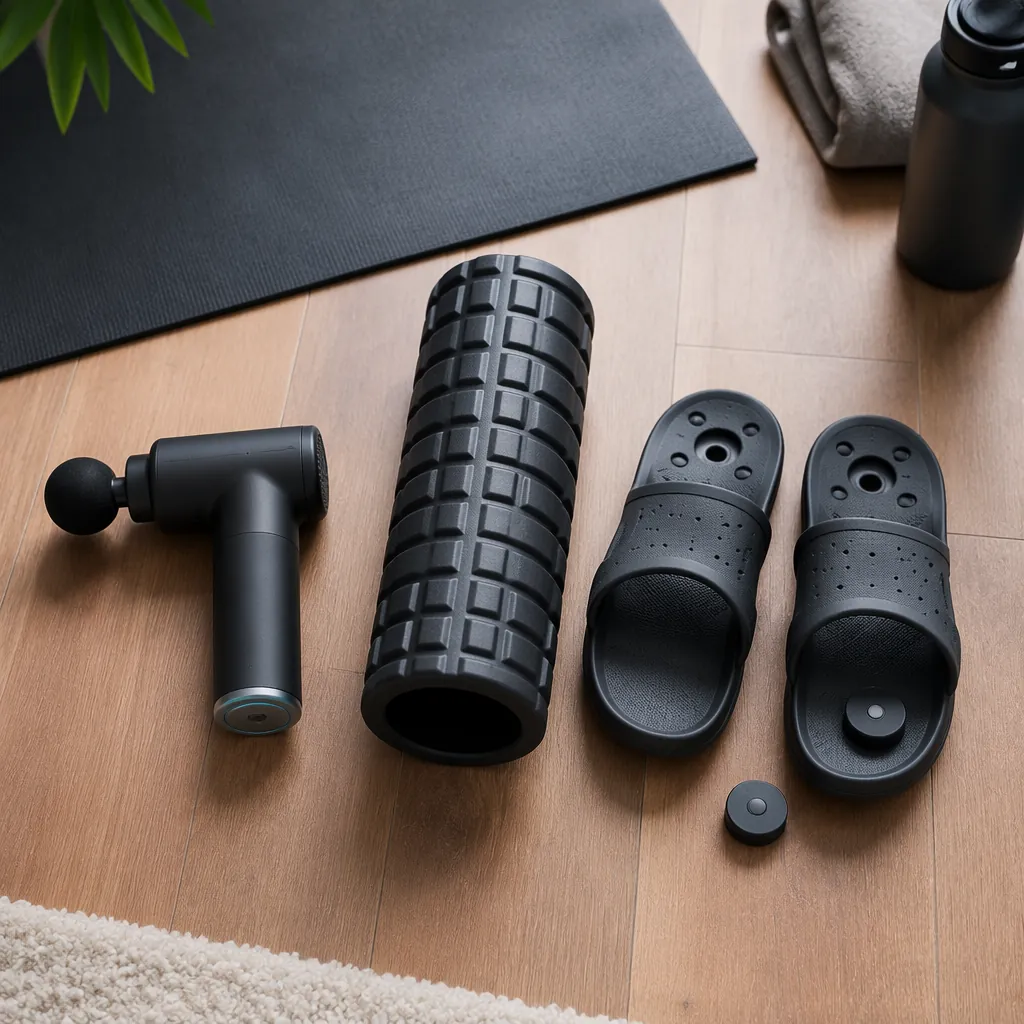
For runners, lifters, and apartment exercisers, that distinction changes the buying logic. If your massage gun mostly gets used on the bottoms of your feet after runs, the Hyperslide may take over that habit because it removes the hand work. If your massage gun is for calves, hip flexors, quads, traps, or general soreness, the Hyperslide cannot replace the range or pressure.
Price makes the comparison uncomfortable. At $249, the Hyperslide sits in the same general buying decision as a capable massage gun, not an impulse accessory.[1] RunToTheFinish’s Hyperice comparison context also places the $899 Hyperboot far above it, which makes the Hyperslide look approachable inside Hyperice’s wearable recovery lineup but not cheap in a normal apartment budget.[8]
Where the Hyperslide wins
- Setup friction: no attachment choice, no mat, no straps, no hose, and no need to hold a device.
- Foot focus: better matched to post-run foot comfort than to whole-body recovery.
- Apartment storage: it occupies shelf or shoe-rack space rather than workout-floor space.
- Casual use: it can be worn while doing light apartment tasks, which may make recovery more likely to happen.
Where the massage gun still wins
- Pressure: percussion gives you a different kind of mechanical input than strap-based vibration.
- Coverage: a massage gun can reach most major muscle groups; the Hyperslide is foot-centered.
- Control: you decide location, angle, duration, and intensity with more precision.
- Replacement value: one massage gun can serve multiple recovery roles, while the Hyperslide is more specialized.
Foam Roller and Compression Boots Are Different Problems
A foam roller is not elegant in an apartment, but it does something the Hyperslide cannot: it uses body weight and position to put pressure through larger tissues. It is awkward, it takes floor space, and it is not hands-free in the relaxed sense. Still, for calves, quads, glutes, and upper back work, the roller belongs to a different recovery category.
Compression-style tools are even farther away from the Hyperslide’s job. Normatec-style systems and the Nike x Hyperice Hyperboot are designed around compression or more substantial lower-leg treatment, while the Hyperslide uses heat and vibration without compression.[8] That makes the slide easier to live with, but it also explains why it should not be treated as a smaller version of recovery boots.
This is the point where the marketing word “ecosystem” can get ahead of the apartment. If you already own a massage gun and a roller, the Hyperslide does not replace both; it competes for the moments when you would otherwise do nothing because the useful tool is across the room, out of battery, too loud, or too involved. That is a real use case. It is just not the same as recovery depth.
Heat and Vibration Without Overpromising
The Hyperslide’s heat spec is easy to understand at home: 109 to 117 degrees Fahrenheit across the top of the foot.[1] That sounds pleasant after a cold-weather run, a standing desk day, or a workout that leaves your feet cranky. It should not be inflated into a medical promise. Available sources describe the feature, not an independent clinical outcome for apartment users.
The 50 to 100 Hz vibration spec is similarly useful but limited.[1] It tells you the slide is using vibration rather than percussion or compression. It does not tell you whether your arch, heel, or forefoot will feel meaningfully better after a specific workout, or whether one setting is optimal for a given type of soreness. Until independent testers measure and compare results, the safest reading is that the Hyperslide may make light foot recovery easier to start and easier to repeat.
That convenience matters more than spec-sheet purity in a home gym. Recovery tools fail in apartments for boring reasons: they are under the bed, the cable is missing, the roller is behind the bike trainer, the gun is loud, or the routine asks for ten focused minutes at exactly the moment dinner is burning. A wearable slide attacks that failure point directly.
Buying Notes That Should Not Decide the Whole Thing
The Hyperslide has a few convenience flags that are worth knowing and easy to overrate. Gear Patrol reports that it charges by USB-C, is TSA-friendly, and is FSA/HSA eligible.[3] Those are helpful if you travel, keep a simple cable drawer, or can use eligible funds. They do not prove the device works better than a tool you already own.
TSA-friendliness is especially useful only if you will actually pack it. A pair of slides is easier than compression boots with hoses and a pump, but it still takes luggage volume. FSA/HSA eligibility can soften the $249 price if it applies to your account, but eligibility is a payment convenience, not a recovery verdict.
The pre-order timing also matters. Early buyers are accepting uncertainty on noise, actual battery behavior, long-term pod life, water exposure, and whether the slide’s comfort holds up outside short demos. None of those questions are exotic. They are exactly the things that decide whether apartment fitness gear gets used or becomes a neat object on a shelf.
Who Should Consider It Now
The strongest pre-order candidate is someone who already knows their recovery problem is consistency, not lack of force. If your feet take the brunt of running, walking, court sports, or long standing days, and you keep skipping recovery because every existing tool feels like a small chore, the Hyperslide fits a real behavioral gap.
- Consider it if your main soreness is foot-centered and you want recovery you can do while sitting or moving lightly.
- Consider it if your apartment has no spare floor space for recovery boots, stretching setups, or a permanent roller area.
- Consider it if you already own a deeper tool and want a lower-friction second option.
- Wait if you need one primary recovery device for calves, quads, hips, back, and shoulders.
- Wait if neighbor noise, battery life, water resistance, or long-term durability would make or break the purchase.
For most home-gym users, the better order is still massage gun or roller first, Hyperslide second. The slide’s best argument is not that it goes deeper. It is that it may be the recovery tool you actually use on the days when deeper tools feel like too much setup.
Conditional Verdict for Small Apartments
The Hyperice Hyperslide makes sense as a small-space convenience play: wearable, shelf-storable, foot-focused, and built around heat plus vibration instead of another bulky recovery station. The $249 price is easier to justify if your current recovery habit fails because tools are loud, awkward, or just enough work to ignore.
It should not be bought as a massage-gun replacement yet. The lack of percussion, lack of compression, roughly one-hour reported runtime, roughly three-hour reported recharge, unknown water resistance, and missing decibel data all keep it in supplement territory.[3][4] If independent home testing confirms quiet operation, durable pods, realistic battery behavior, and a noticeable foot-recovery benefit, it could become one of the more apartment-friendly recovery devices available. Until then, it is a promising second device for foot recovery, not the recovery device to build the whole corner around.
References
- Nike and Hyperice Debut the Nike Air Zoom Hyperslide, an Innovative Recovery Slide for All Athletes, Nike, Inc.
- Nike And Hyperice Grow Collaboration With New Hyperslide Recovery Footwear, Forbes, July 27, 2026
- Nike and Hyperice’s New Recovery Slides Heat and Vibrate Your Feet, Gear Patrol
- This $249 Nike slide doubles as a 15-minute recovery tool, The Gadgeteer, July 27, 2026
- Inside the creation of the brand new Nike Air Zoom Hyperslide, Fast Company
- Everything You Need to Know About the Nike x Hyperice Air Zoom Hyperslide, Complex
- Nike Air Zoom Hyperslide heat and vibrate your feet to help you recover after workouts, Engadget
- Hyperice Honest Reviews: Is it Worth the Money?, RunToTheFinish
This result comes from one real apartment under the stated conditions — it is a strong signal, not a guarantee your space will measure identically.
Builds this evidence supports
No build currently links to this specific test. Browse all builds with a matching tag.
Spot something off?
If this result didn't match your own space, let us know — floor-damage and noise claims carry real deposit-risk consequences if we get them wrong.