
Affordable Marshalls Workout Clothes Tested for Home Gym
We tested the most common Marshalls activewear brands for home gym use, identifying which ones hold up over time and which to skip. Includes a brand-by-brand cheat sheet and an in-store inspection checklist to navigate unpredictable inventory.
- Test space profile
- Apartment home gym with carpeted floor and standard ceiling height
- Floor damage risk
- none
- No-drill compatible
- ✓
- Test date
The Marshalls activewear aisle can look like a win before you touch anything: Nike pants hanging near house-label leggings, sports bras in multipacks, matching sets that cost less than one full-price pair of training tights. For the best affordable workout clothes from Marshalls for home gym use, though, the rack is only half the story. A pair that feels soft on the hanger still has to survive squats, floor work, banded glute bridges, laundry, and being jammed into a drawer beside resistance loops.
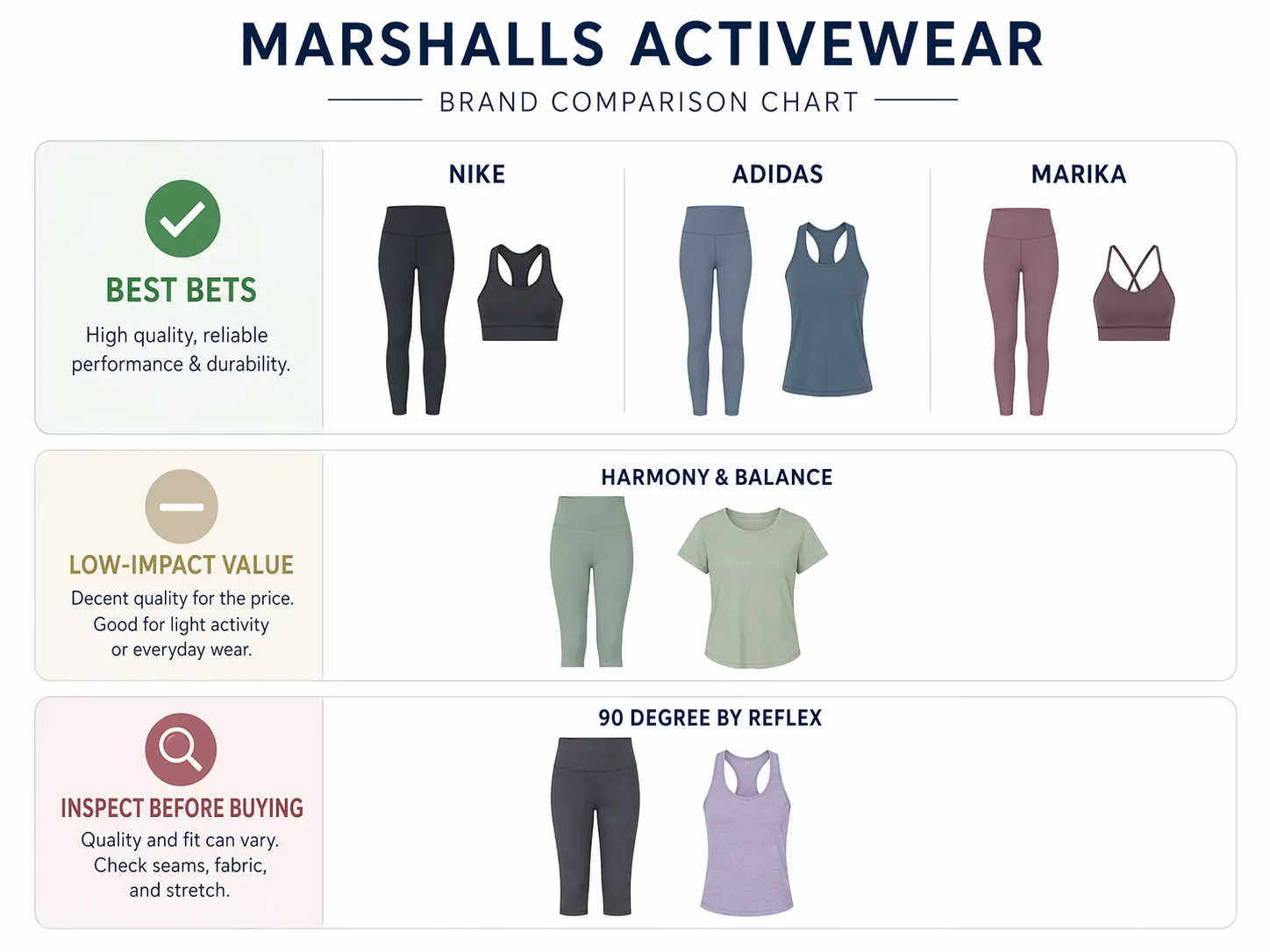
The safest buys are not simply the cheapest ones. Nike, Adidas, and Marika deserve the first look when the size and fabric check out. Harmony & Balance can be a good low-to-medium impact value pick. 90 Degree by Reflex is tempting, especially when the price is low, but it needs more inspection than its popularity suggests.
The Marshalls Activewear Cheat Sheet
| Brand | Best home-gym use | What to check before buying | Verdict |
|---|---|---|---|
| Nike | Strength training, circuits, general home workouts | Waistband fit, fabric weight, whether the cut matches your workout style | Buy when the size and fabric feel right; user reports have shown Marshalls pants around $24.99 versus $60+ retail, but prices vary by store [1] |
| Adidas | Strength days, walking pad sessions, mobility work, everyday training | Rise, inseam, waistband compression, pocket placement if needed | Buy when you find a good fit; the value is strongest when it is clearly mainline Adidas rather than an unfamiliar sub-label |
| Marika | Yoga, mat work, low-to-medium impact strength, squat-heavy sessions | Opacity, waistband recovery, seam smoothness | One of the better Marshalls-specific bets; older detailed review evidence praises thicker, squat-proof fabric that stays put during yoga [2] |
| Harmony & Balance | Stretching, Pilates-style workouts, walking, lighter dumbbell work | Support level, fabric thinness, whether matching sets feel compressive enough | Good value for low-to-medium impact workouts, especially if the set price is strong |
| 90 Degree by Reflex | Only after inspection; best for lower-friction workouts if the exact pair passes checks | Inner seams, colorfastness risk, fabric density, waistband recovery | Conditional buy; Outdoor Gear Lab’s 2020 test found seam tearing on first wear and significant fading after washing on the Squatproof Interlink model [3] |
Nike and Adidas Are Safer Bets When the Garment Is Right
Nike and Adidas at Marshalls are appealing for a simple reason: they are familiar athletic brands showing up at discount-store prices. User price reports have shown pants around $24.99 compared with full retail prices above $60, which is exactly the kind of find that makes the aisle worth checking in the first place [1]. That does not mean every pair belongs in the cart. It means the baseline trust is higher when the label, fabric, and construction all look like the real thing.
For home gyms, the best Nike or Adidas find is usually not the thinnest fashion legging. Look for enough opacity for hinges and squats, a waistband that does not fold when you sit on the floor, and seams that lie flat against the inner thigh. Apartment workouts create a lot of repeated contact: kneeling on mats, sliding into dead bugs, stepping on bands, and sitting between sets. Scratchy seams and rolling waistbands become more annoying when there is no machine changeover to distract you.
The same rule applies to men’s activewear, with one caveat: men’s Marshalls activewear is less documented across the available sources. Nike, Adidas, Under Armour, and Champion often come up as safer buys in community recommendations, but the public evidence is thinner than it is for women’s leggings and sets. For men’s shorts, joggers, and training tops, the inspection matters more than the logo: pull lightly at the crotch seam, check whether the pocket bags distort the fabric, and skip anything that already looks shiny or tired under store lighting.
Marika Is the Marshalls Brand Worth Slowing Down For
Marika is not as exciting as finding Nike buried in the wrong size section, but it may be the better everyday home-gym buy when the rack is picked over. The evidence is not laboratory-grade or recent enough to treat as permanent proof. The strongest detailed review material is older, but it matches the failure points that matter in a small-space workout: thicker fabric, squat-test confidence, and staying in place during yoga [2].
That combination matters because home workouts are full of positions that expose weak leggings. A store mirror might make the front view look fine, then a hip hinge reveals sheerness across the seat. A waistband that feels comfortable standing still may creep down during mountain climbers. A soft brushed fabric may collect lint after one wash and look old before it has earned the drawer space.
Marika’s best role is regular, non-glamorous training: yoga flows, Pilates-style mat work, dumbbell lower-body days, and mobility sessions. If the fabric feels dense without being stiff and the waistband snaps back cleanly after stretching, it is one of the labels most worth trying on. If the exact piece is thin, pale, or loosely stitched, the brand name should not rescue it.
Harmony & Balance Is a Value Pick, Not a Performance Shortcut
Harmony & Balance earns its place when the goal is inexpensive, comfortable clothing for lower-impact home workouts. Reports and reviews have described Marshalls activewear sets around $25, which can be hard to ignore if you need a top-and-bottom outfit for stretching, walking, light dumbbells, or casual movement days [4].
The mistake is treating a low set price as proof that it can handle everything. Matching sets often look better on the hanger than they feel during a sweaty circuit. Before buying, check the sports bra band, cup coverage, and whether the leggings or shorts stay opaque when stretched. For jumping, running intervals, or high-sweat work, this is the category where being picky saves money.
Harmony & Balance makes the most sense as a comfort layer in a home-gym wardrobe: a set for mobility, a soft pair of leggings for floor work, a bra for low-impact days. It is less convincing as the only outfit you expect to handle every workout.
90 Degree by Reflex Needs the Most Inspection
90 Degree by Reflex is one of the most tempting Marshalls finds because the price can be very low, and the brand is commonly recommended in budget activewear discussions. User reports have noted deals such as two-packs of leggings around $19.99, which makes the math feel almost automatic [1]. This is also the brand where the strongest third-party evidence argues for slowing down.
Outdoor Gear Lab’s 2020 review of the 90 Degree by Reflex Squatproof Interlink yoga pants found that the seams tore on first wear for the tester and that the pants showed significant color fading after washing [3]. That is not proof that every current 90 Degree by Reflex item will fail. It is model-specific, dated testing, and product lines can change. But it is still more concrete than most discount activewear chatter, and seam failure on first wear is exactly the kind of problem that turns a bargain into drawer clutter.
If a 90 Degree by Reflex pair passes inspection, it may still be reasonable for yoga, stretching, walking, or moderate strength work. The caution is against buying it blindly because the tag looks familiar or the price is good. Pull at the inner thigh seam. Stretch the seat fabric. Check darker colors for a dusty or uneven finish that may become more obvious after washing. If anything looks weak in the store, it is unlikely to improve after lunges and laundry.
The Three-Minute Inspection Before You Buy
Marshalls inventory changes too much for a permanent shopping list to solve the problem. The better skill is inspecting the exact item in your hand. This is especially useful when the fitting room lighting is unhelpful, the size run is incomplete, or the rack has one pair left in your color.
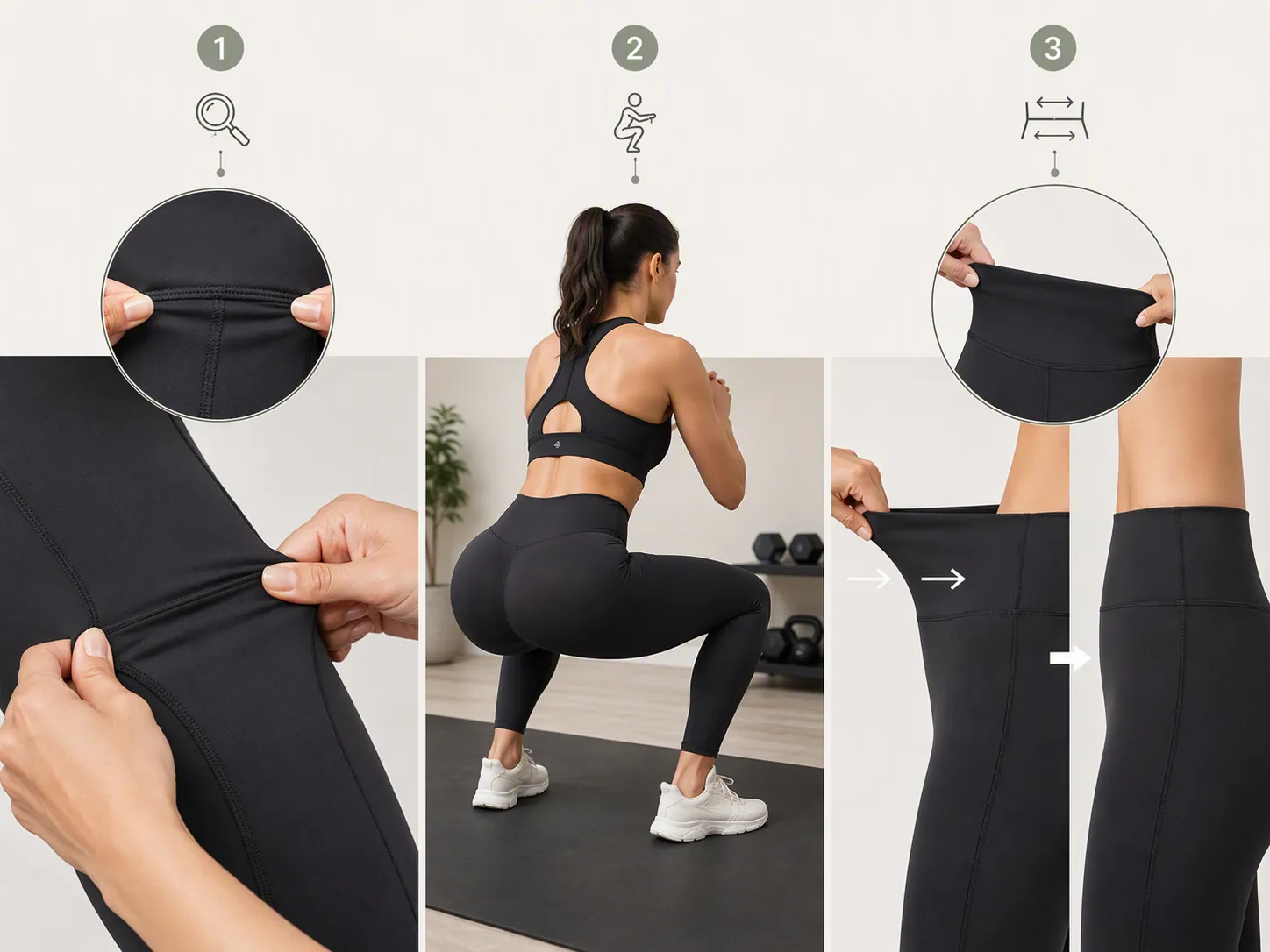
- Check the seams first. Turn the leggings or shorts inside out if you can, then look at the crotch gusset, inner thigh, and waistband attachment. Loose threads, uneven stitching, or puckering are red flags because those areas take the most stress during squats, hinges, and floor transitions.
- Do a fabric opacity test. Stretch the seat or thigh fabric over your hand, or try a squat in the fitting room if possible. Pale colors, heathered fabrics, and very soft thin knits deserve extra suspicion.
- Test waistband recovery. Pull the waistband outward, hold it briefly, then release. It should spring back instead of staying wavy. A waistband that relaxes in the store may roll during dead bugs, glute bridges, or banded walks.
- Look for color and fading risk. Deep black and saturated colors are useful, but uneven dye, dusty-looking fabric, or a rubbed surface can signal that the item may look worn quickly.
- Match the garment to impact level. A low-support bra or soft lounge-style legging can be a good buy for mobility, but it should not be treated as a high-impact training piece just because it came from the activewear rack.
What Counts as a Good Marshalls Price
The price examples that make Marshalls attractive are real enough to use as benchmarks, but not stable enough to treat as promises. User reports have shown Nike and Adidas pants around $24.99 compared with retail prices above $60, three-packs of sports bras around $19.99, and two-packs of 90 Degree by Reflex leggings around $19.99 [1]. Harmony & Balance sets have also been reported around $25 [4].
Those numbers are store observations, not a national price audit. A good deal in one location may never appear in another, and seasonal resets can change what lands on the rack. The practical price test is simpler: if the garment is from a safer brand, passes the inspection, and costs meaningfully less than you would pay elsewhere, it is worth considering. If it fails opacity, seams, or waistband recovery, the discount is just a smaller loss.
A Home-Gym Wardrobe That Actually Makes Sense
For most apartment workouts, a small rotation beats a drawer full of almost-right pieces. Start with one or two reliable bottoms for squats and floor work, one lower-impact pair for stretching or recovery days, and sports bras or tops that match the intensity you actually do at home. Moisture-wicking synthetic fabrics are usually the better bet than cotton for sweaty sessions because they do not stay heavy in the same way, but the aisle decision still comes back to construction and fit.
The strongest Marshalls cart is selective: Nike or Adidas when the price is sharp and the piece feels like real training gear; Marika when the fabric is thick, opaque, and stable; Harmony & Balance for lower-impact value; 90 Degree by Reflex only after the seams, color, and waistband pass inspection. That is how Marshalls becomes useful for a home gym instead of becoming another place to buy leggings that almost work.
Once the clothing is handled, the next budget decision is equipment. A phased plan such as building an apartment home gym on a budget or comparing what $100, $300, and $500 buy in a starter home gym is a better place to spend the next round of attention.
References
- Marshalls Gym Clothes, Lemon8.
- Marika Activewear Review, Polished Habitat.
- 90 Degree by Reflex Squatproof Interlink Review, Outdoor Gear Lab, 2020.
- Review: Working Out With Marshalls Fitness Apparel, Lady and the Blog.
This result comes from one real apartment under the stated conditions — it is a strong signal, not a guarantee your space will measure identically.
Builds this evidence supports
No build currently links to this specific test. Browse all builds with a matching tag.
Spot something off?
If this result didn't match your own space, let us know — floor-damage and noise claims carry real deposit-risk consequences if we get them wrong.