
6-Week Home Strength Training Plan: Two-Phase Program for Beginners and Returning Exercisers
A complete, week-by-week 6-week home strength training program built around compound movements and scaled across three equipment tiers — bodyweight, resistance bands, or dumbbells — so beginners and returning exercisers can follow a clear, progressive path to measurable strength improvement with whatever they have at home.

Why 6 Weeks Is the Right Timeframe for Strength Training
Six weeks is not an arbitrary number. It sits at the intersection of several adaptation timelines that beginners and returning exercisers need to work through in sequence — and it's long enough to produce changes you can actually measure.
The first thing that improves when you start strength training is not your muscles — it's your nervous system. Your brain gets better at recruiting motor units, coordinating muscle fiber activation, and stabilizing joints under load. These neuromuscular adaptations show up within the first two weeks and account for most of the early strength gains beginners notice. Early hypertrophy — actual muscle tissue growth — begins overlapping with these neural gains around weeks 5 and 6, particularly when training effort is sufficient and sleep and nutrition support recovery.
A network meta-analysis of 28 resistance training studies found that studies shorter than 6 weeks were excluded from meaningful hypertrophy analysis — supporting 6 weeks as the minimum intervention window where real, measurable adaptation can be documented. Programs shorter than this capture neural gains but miss the early muscle-building phase.
There is also a habit-formation argument. Around the 6-week mark, consistent training stops feeling like a decision you have to make each day and starts feeling like a normal part of your schedule. The routine becomes psychologically embedded rather than effortful. That shift — from experiment to habit — is one of the most practically useful outcomes of a 6-week program, and it does not happen at 4 weeks for most people.
What to Expect: A Realistic Week-by-Week Adaptation Timeline
Progress in a 6-week program does not arrive all at once. Different systems adapt on different timelines. Here is an honest preview of what you will likely notice — framed in terms of what you can do or feel, not how you look.
- Weeks 1–2 — Coordination and recruitment. Your nervous system is learning to activate the right muscles in the right sequence. Movements will feel awkward at first. You will also experience more muscle soreness than in any later week. This is normal.
- Week 3 — Joint resilience. Connective tissues — tendons, ligaments — begin adapting to the mechanical load. Soreness decreases noticeably. Movements that felt unstable start to feel more controlled.
- Week 4 — Energy system improvements. Your body gets more efficient at fueling the work. You will likely notice that the same session feels less exhausting than it did in week 1, even as the volume begins to increase.
- Week 5 — Smoother movement and quicker recovery between sets. The pattern of each exercise becomes more automatic. Rest periods feel shorter because your cardiovascular recovery between sets has improved.
- Week 6 — Visible strength increases and habit lock-in. For many beginners, early hypertrophy begins showing up here — especially with adequate nutrition and sleep. More importantly, the training routine now feels like a normal part of your week rather than a special effort.
These milestones are not guarantees — individual responses vary depending on sleep, nutrition, stress, and consistency. But this sequence reflects the general adaptation pattern for untrained and returning exercisers following a structured resistance training program.
Choosing Your Equipment Tier
This plan is built around three equipment tiers. Every exercise in both phases includes alternatives for each tier, so you can follow the program with whatever you have at home.
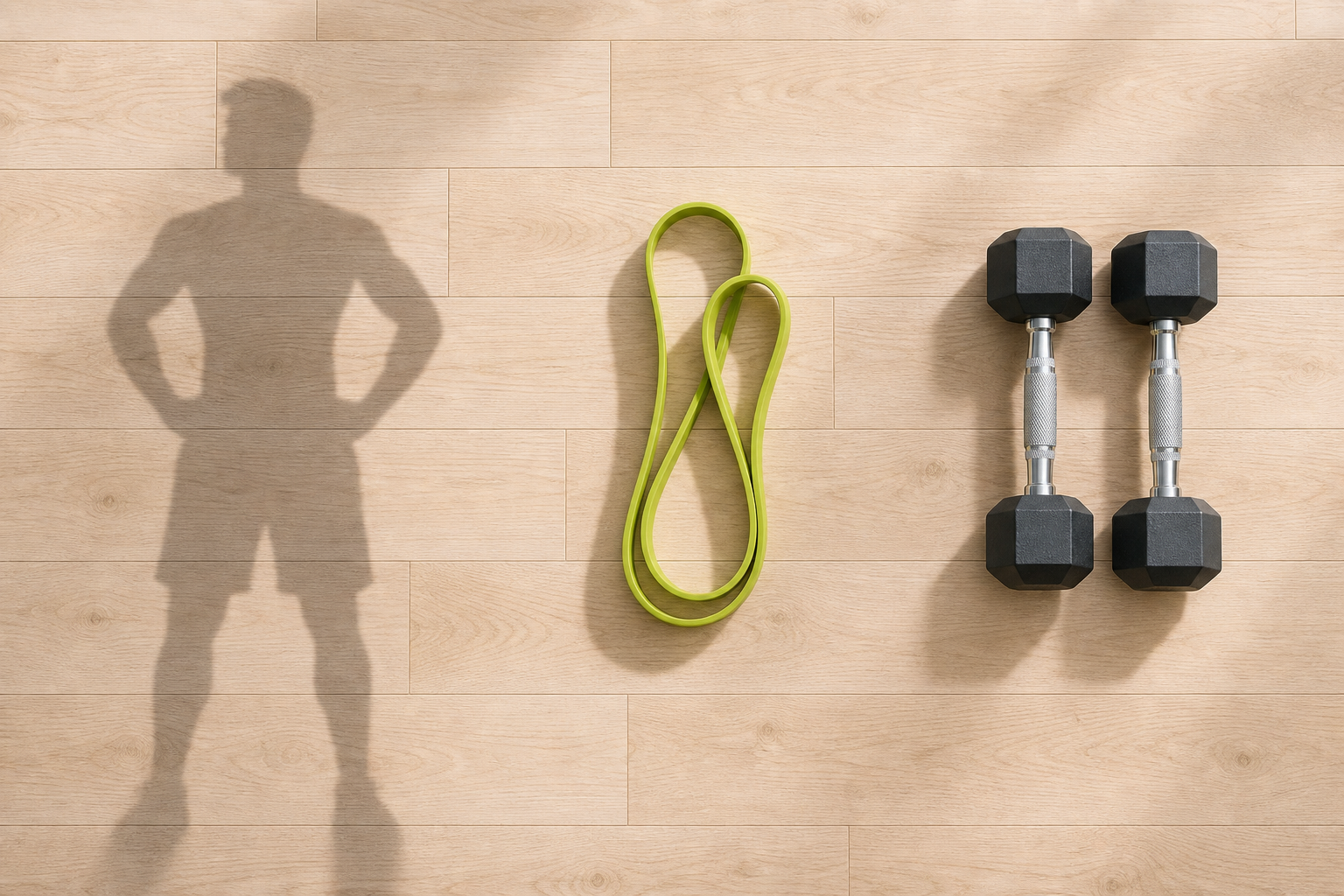
| Tier | Equipment | Strength Gains | Hypertrophy Potential | Best For |
|---|---|---|---|---|
| Tier 1 | Bodyweight only | Meaningful gains for beginners; limited progressive overload over time | Good for upper body; harder to progress lower body | No equipment at home; travel; starting from scratch |
| Tier 2 | Resistance bands | Similar muscle activation to free weights when resistance is matched | Comparable to free weights in untrained individuals | Home training without weights; joint-friendly loading |
| Tier 3 | Dumbbells | Best load-dependent strength gains; easiest to progressively overload | Excellent; load can increase incrementally | Anyone with access to a set of adjustable or fixed dumbbells |
A key finding from research on resistance training load and hypertrophy is that in untrained individuals, low, moderate, and high loads produce similar muscle size improvements — provided sets are taken close to failure. This means Tier 1 and Tier 2 users can expect real hypertrophy gains from this plan, not just cardiovascular conditioning.
Strength gains — the ability to move heavier loads — do favor moderate-to-high resistance, which gives Tier 3 an advantage in that specific dimension. But beginners at every tier will get meaningful strength improvements over 6 weeks. The more important variable is effort and consistency, not which tier you choose.
Research also supports resistance bands as a viable home training alternative to free weights — bands produce similar muscle activation to free weights in matched-resistance exercises, and some studies show comparable strength gains in multi-joint movements as well.
Plan Overview: Structure, Schedule, and Session Length
The plan runs for 6 weeks, divided into two 3-week phases. You train 3 days per week on non-consecutive days. Each session takes approximately 35–45 minutes including warm-up and cool-down.
Three days per week is the right frequency for beginners and returning exercisers for two reasons. First, it provides sufficient mechanical stimulus — enough training sessions per week to drive adaptation. Second, it provides sufficient recovery — 48 hours between sessions allows muscle repair and nervous system recovery, which is where the actual strength gains happen. Trying to train 5 or 6 days per week in the first 6 weeks typically produces more fatigue than adaptation for this population.
| Day | Session | Notes |
|---|---|---|
| Monday | Session A (Full Body) | Phase 1: Foundation / Phase 2: Build |
| Tuesday | Active Rest | Walking, light stretching, or mobility work |
| Wednesday | Session B (Full Body) | Same exercises as Session A |
| Thursday | Active Rest | Walking, light stretching, or mobility work |
| Friday | Session C (Full Body) | Same exercises as Session A |
| Saturday | Rest | Full rest or light activity |
| Sunday | Rest | Full rest or light activity |
All three weekly sessions follow the same exercise sequence in each phase. This repetition is intentional — it accelerates the neuromuscular learning curve by giving your nervous system repeated practice with the same movement patterns. In Phase 2, the exercises evolve slightly, but the structural logic stays the same.
Phase 1 — Weeks 1–3: Foundation
Phase 1 is about learning movement patterns before increasing load. The goal is not to exhaust yourself — it is to build reliable, repeatable technique across the four fundamental movement categories: squat, hip hinge, push, and pull. A core stability exercise is added to complete the session.
The Phase 1 progression rule is simple: add reps before adding load or band tension. If your target range is 8–12 reps and you can only do 8 with good form, stay at 8 until you can do 12 cleanly. Then — and only then — increase resistance and return to 8 reps.
| Exercise | Sets | Reps | Rest | Tier 1 (Bodyweight) | Tier 2 (Band) | Tier 3 (Dumbbell) |
|---|---|---|---|---|---|---|
| Squat pattern | 2–3 | 8–12 | 90 sec | Chair squat or bodyweight squat | Band squat (band under feet, held at shoulders) | Goblet squat |
| Hip hinge pattern | 2–3 | 8–12 | 90 sec | Good morning (hands behind head) | Band Romanian deadlift (band under feet) | Dumbbell Romanian deadlift |
| Push pattern | 2–3 | 8–12 | 90 sec | Incline push-up (hands on chair or counter) | Band chest press (anchored at back) | Dumbbell floor press |
| Pull pattern | 2–3 | 8–12 | 90 sec | Inverted row (under a sturdy table) | Band bent-over row (band under feet) | Dumbbell bent-over row |
| Glute bridge | 2 | 12–15 | 60 sec | Bodyweight glute bridge | Band glute bridge (band across hips) | Dumbbell glute bridge (weight on hips) |
| Dead bug | 2 | 6–8 per side | 60 sec | Bodyweight dead bug | Bodyweight dead bug | Bodyweight dead bug |
Form Cues for Phase 1 Exercises
- Squat pattern: Keep your chest upright and knees tracking over your toes. Sit back and down as if lowering toward a chair. Depth is secondary to a neutral spine — go only as deep as you can without your lower back rounding.
- Hip hinge pattern: Push your hips back — not down. Maintain a flat back throughout the movement. The load (or band tension) should travel close to your legs. Stop when you feel a stretch in your hamstrings, not when your back rounds.
- Push pattern: Keep your elbows at roughly 45 degrees from your torso — not flared out wide. Lower with control, pause briefly at the bottom, then press. Your core stays braced throughout.
- Pull pattern: Initiate the pull by retracting your shoulder blade, not by yanking with your arm. Drive your elbow back and down. Avoid shrugging your shoulder toward your ear.
- Glute bridge: Press through your heels, not your toes. Squeeze your glutes at the top. Avoid hyperextending your lower back — the goal is hip extension, not lumbar extension.
- Dead bug: Press your lower back firmly into the floor throughout. Move only as far as you can while maintaining that contact. Slow and controlled — this is a core stability exercise, not a cardio movement.
Phase 2 — Weeks 4–6: Build
Phase 2 increases volume and intensity systematically. You shift from 2–3 sets per exercise to 3–4 sets, and the exercises evolve to add appropriate challenge to the patterns you established in Phase 1.
The Phase 2 progression rule is: add sets first, then increase load or band tension. Start week 4 at 3 sets. Move to 4 sets in week 5 when the 3-set version feels manageable. In week 6, if 4 sets is comfortable, increase your resistance and return to 3 sets — or continue at 4 sets with the same load and push closer to the top of your rep range.
| Exercise | Sets | Reps | Rest | Tier 1 (Bodyweight) | Tier 2 (Band) | Tier 3 (Dumbbell) |
|---|---|---|---|---|---|---|
| Squat pattern | 3–4 | 8–12 | 90 sec | Bodyweight squat or split squat | Band split squat (band under front foot) | Dumbbell split squat or goblet squat |
| Hip hinge pattern | 3–4 | 8–12 | 90 sec | Single-leg hip hinge (bodyweight) | Band single-leg Romanian deadlift | Dumbbell Romanian deadlift (heavier) or single-leg variant |
| Push pattern | 3–4 | 8–12 | 90 sec | Push-up (full or elevated) | Band chest press (increased tension) | Dumbbell floor press (heavier) |
| Pull pattern | 3–4 | 8–12 | 90 sec | Inverted row with elevated feet | Single-arm band row | Single-arm dumbbell row |
| Glute bridge | 3 | 12–15 | 60 sec | Single-leg glute bridge | Band single-leg glute bridge | Dumbbell glute bridge (heavier) |
| Dead bug | 2–3 | 8–10 per side | 60 sec | Bodyweight dead bug (slower tempo) | Bodyweight dead bug (slower tempo) | Dead bug with light dumbbell held overhead |
The shift to single-leg squat and single-leg hip hinge variations in Phase 2 is deliberate. These unilateral movements increase the stability demand without requiring heavier equipment, making them an effective progression for Tier 1 and Tier 2 users in particular. They also address common asymmetries that develop when bilateral movements dominate a program.
Progressive Overload: How to Keep Getting Stronger at Home
Progressive overload is the single most important variable for continued strength gains. It means consistently giving your body a slightly greater challenge than it faced in the previous session. Without it, your body adapts to the current workload and stops improving.
In a gym setting, the environment provides cues — heavier plates are visible, coaches prompt you to add weight. At home, you have to build this habit deliberately. The four-step progression ladder below gives you a clear sequence to follow for each equipment tier.
- Add reps. If your target is 8–12 reps and you hit 8, aim for 9 next session. Continue until you consistently hit 12 with good form.
- Add sets. Once you can complete all reps across your current sets, add one more set (e.g., 2 sets → 3 sets → 4 sets).
- Increase load or band tension. After reaching the top of your rep range across all sets, increase resistance and return to the lower end of the rep range.
- Slow the tempo. If you cannot add resistance (Tier 1 users especially), slow the lowering phase to 3–4 seconds. This increases time under tension and drives further adaptation without heavier equipment.
| Tier | Week 1 Example | Week 3 Example | Week 6 Example |
|---|---|---|---|
| Tier 1 — Bodyweight | Goblet squat: 2 sets × 8 reps | Bodyweight squat: 3 sets × 12 reps | Split squat: 4 sets × 10 reps, 3-sec lower |
| Tier 2 — Bands | Band squat: 2 sets × 8 reps, light band | Band squat: 3 sets × 12 reps, light band | Band split squat: 3 sets × 10 reps, medium band |
| Tier 3 — Dumbbells | Goblet squat: 2 sets × 8 reps, 15 lb | Goblet squat: 3 sets × 12 reps, 15 lb | Dumbbell split squat: 4 sets × 10 reps, 20 lb |
Recovery, Rest Days, and Managing Soreness
Training is the stimulus. Recovery is where the adaptation actually happens. The 6-week plan is designed to give you 48 hours between sessions — use that time well.
- Sleep 7–9 hours. Muscle repair, hormone regulation, and nervous system recovery all happen primarily during sleep. This is not optional — it is the most impactful recovery tool available to you.
- Move on rest days. Active rest — a 20-minute walk, gentle mobility work, light stretching — promotes blood flow and reduces stiffness without adding training stress. Full sedentary rest is less effective than light movement.
- Stay hydrated. Dehydration impairs both performance and recovery. Drink water consistently throughout the day, not just around sessions.
- Expect soreness in weeks 1–2. Delayed onset muscle soreness (DOMS) — the deep ache that peaks 24–48 hours after a session — is normal and expected, particularly in the first two weeks. It is a sign of muscle adaptation, not injury. It decreases significantly by week 3.
Rest intervals between sets matter too. For beginners, 1–2 minutes of rest between sets is sufficient to allow enough recovery for the next set while keeping sessions within the 35–45 minute window. If you find yourself needing more than 2 minutes to recover, the load may be too high — reduce it slightly and build back up.
Safety, Form, and When to Consult a Healthcare Provider
The most important safety principle in this plan is straightforward: form before load, always. Controlled movement and stable joints take priority over heavier dumbbells, tighter bands, or more reps. A set completed with compromised form does not build strength — it builds injury risk.
- If you cannot maintain a neutral spine in the hip hinge, reduce the range of motion or lighten the load before progressing.
- If your knees collapse inward during squats, slow down and focus on pushing your knees out over your toes. Do not add load until the pattern is stable.
- If any exercise causes joint pain (not muscle soreness), stop that exercise and substitute the lowest-tier alternative, or skip it for that session.
- Warm up before every session — 3–5 minutes of light movement (marching in place, arm circles, hip circles) is sufficient to prepare joints and raise core temperature.
What to Do After Week 6
Week 6 is not a finish line. By the end of this program, you will have established improved neuromuscular efficiency, early hypertrophy (for most beginners), and — most importantly — a consistent training habit. That combination is the foundation for a more demanding program, not the endpoint of your training.
Here are the most natural progressions from this plan, depending on your goals and what you have available:
- Repeat Phase 2 with heavier loads or advanced band tension. If you are still adapting to the Phase 2 exercise variations, running weeks 4–6 again at a higher resistance level is a legitimate and productive next step.
- Move to an upper/lower split. A 4-day upper/lower split increases training volume per muscle group per week, which is the next logical step for strength and hypertrophy progression beyond a 3-day full-body program.
- Add a 4th training day. If your schedule allows and your recovery is solid, adding a 4th full-body session per week increases weekly training volume without requiring a program overhaul.
- Transition to a structured hypertrophy program. If muscle building is your primary goal, a dedicated hypertrophy program with higher volume (more sets per muscle group per week) and periodized intensity will produce better results than continuing a beginner full-body structure.
- Upgrade your equipment tier. If you completed this program at Tier 1 or Tier 2, adding dumbbells or a heavier band set before your next program significantly expands your progressive overload options.
Whatever direction you choose, the 6 weeks you have just completed have done the work that matters most for long-term training: you have established the movement patterns, the recovery habits, and the psychological routine that every more advanced program builds on.
Frequently Asked Questions
- Is 3 days per week enough to get stronger? Yes — for beginners and returning exercisers, 3 full-body sessions per week meets and exceeds the minimum effective dose for strength and hypertrophy gains. The key is that each session hits all major movement patterns and that you are progressively increasing the challenge over time. More frequent training is not more effective if recovery is compromised.
- Can I do this plan with no equipment at all? Yes. Every exercise in this plan has a Tier 1 bodyweight alternative. The main limitation is progressive overload in Phase 2 — bodyweight makes it harder to increase resistance incrementally. You can compensate with slower tempo, more reps, and progression to more challenging movement variations (e.g., split squat from chair squat, single-leg hip hinge from two-leg). If you want to start with a purely bodyweight foundation before this plan, see our 4-week bodyweight beginner program.
- How much weight do I need to start? Start lighter than you think you need to. For most beginners, a single pair of dumbbells in the 10–20 lb range is sufficient for Phase 1. The goal in the first three weeks is learning movement patterns, not lifting heavy. If you can complete all reps with good form and the last two reps feel easy, the weight is too light — but err on the side of lighter until your form is solid.
- What should I do if I miss a session? Do not try to make it up by doubling up sessions. Simply resume the next scheduled session. Missing one session in a week does not meaningfully affect your 6-week adaptation — consistency over the full program matters far more than any single session. If you miss an entire week, repeat that week before moving forward.
- What exactly is progressive overload, and how do I know when to progress? Progressive overload means consistently making the training stimulus slightly harder than your body has already adapted to. The practical signal: when you can complete all sets and all target reps with good form and the last two reps of the last set do not feel challenging, it is time to progress. Follow the four-step ladder — add reps first, then sets, then resistance, then slow the tempo.
What a small equipment investment adds
We don't have a build tagged to this exact tier yet. Browse all builds.
How often should you repeat this?
See our recovery and rest reference for citation-anchored rest-interval guidance.
Spot something off?
Tell us if a movement, tier assumption, or duration didn't match your experience.