
A 4-Week Home Workout Plan to Lower Cholesterol Naturally
This 4-week home workout plan provides a structured progression of aerobic circuits, bodyweight resistance, and HIIT intervals designed to improve cholesterol markers. Learn how to build the routine, what evidence supports it, and when medical management is still needed.
- Equipment tier required
- none
- Duration
- 20 min
- Difficulty
- beginner
- Target area
- full body
- Noise level
- low
If your cholesterol result came back higher than expected, a home workout can be a real first move, not just a comforting one. The useful version is structured: aerobic work to raise weekly energy expenditure, bodyweight resistance to support LDL and triglyceride changes, and short intervals to introduce higher intensity without needing a treadmill.
There is also a boundary worth putting on the floor before the mat comes out. In the 2026 ACC/AHA dyslipidemia guideline, structured exercise interventions were associated with average changes of HDL +2.11 mg/dL, LDL −7.22 mg/dL, and triglycerides −8.01 mg/dL across a meta-analysis of 148 randomized controlled trials; helpful, but not statin-level treatment for high-risk cholesterol patterns. The same guideline treats LDL ≥190 mg/dL or established ASCVD as a situation that still needs medical management, not a four-week experiment in willpower.[1]
For this plan, read “without statins” as “build the lifestyle base seriously, then review the numbers with a clinician,” not “avoid medication under every circumstance.”
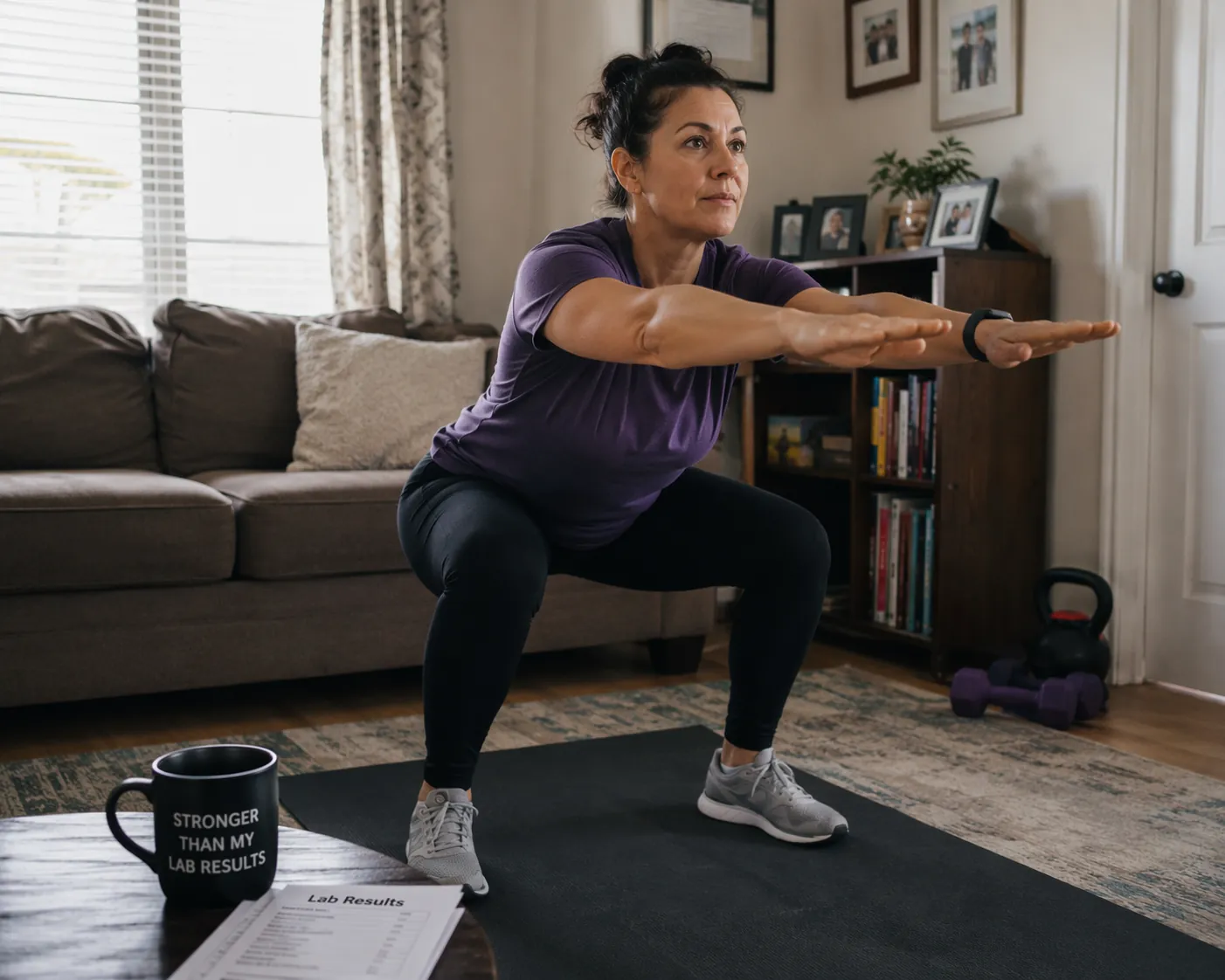
The 4-week home plan
You need enough open space to step, squat, lunge, and get down to the floor. Shoes are optional if your floor is safe and you are not jumping; supportive shoes help for stair work, high knees, jumping jacks, and faster intervals.
| Week | Goal | Schedule | Main work |
|---|---|---|---|
| Week 1 | Build the habit and find moderate effort | 3 days, about 20 minutes each | Low-impact aerobic circuit: march in place, step-touch, bodyweight squats, wall pushups, glute bridges, easy planks |
| Week 2 | Add dedicated resistance work | 4 days, 20–25 minutes each | Two aerobic circuit days, one bodyweight resistance day, one mixed circuit day |
| Week 3 | Introduce intervals without making every day hard | 5 days, 20–30 minutes each | Two moderate aerobic days, two resistance/mixed days, one short HIIT interval day |
| Week 4 | Increase volume and reduce wasted rest | 5 days, 30+ minutes on most days | Longer mixed sessions, one HIIT day, one easier recovery-style aerobic day |
Use a simple effort scale. Moderate means you can speak in short sentences but would rather not hold a long conversation. Hard means you can answer in a few words. Stop if you feel chest pressure, faintness, unusual shortness of breath, or symptoms that feel different from normal exercise effort.
Week 1: three moderate sessions
Do this session on three nonconsecutive days. The point is not to punish the lab result. The point is to finish, recover, and repeat.
- Warm up for 3 minutes: march in place, shoulder rolls, easy step-touch.
- Circuit 1, repeat 2 times: 45 seconds march in place, 10 bodyweight squats, 8 wall or counter pushups, 10 glute bridges, 30 seconds easy plank from knees or countertop.
- Circuit 2, repeat 2 times: 45 seconds step-touch, 8 reverse lunges per side or supported split squats, 10 seated-to-standing chair squats, 30 seconds low-impact high knees.
- Cool down for 3 minutes: slow walking, calf stretch, chest opener, slow breathing.
If jumping jacks are what you picture when you hear “cardio,” they can count, but they are not required. Step-jacks, stair stepping, marching, and brisk walking in a hallway can do the same job at this stage if they keep your heart rate up.
Week 2: four days, with one real strength day
Keep two Week 1-style aerobic circuit days. Add one resistance-focused day and one mixed day. The resistance day is not bodybuilding; it is controlled, repeatable muscle work with short rests.
- Day 1: 20–25 minutes moderate aerobic circuit.
- Day 2: resistance circuit, 3 rounds of 10–12 squats, 8–12 incline pushups, 10 glute bridges, 8 reverse lunges per side, 20–30 seconds plank.
- Day 3: rest or easy walking.
- Day 4: 20–25 minutes moderate aerobic circuit.
- Day 5 or 6: mixed circuit, alternating 1 minute of marching or stair stepping with one bodyweight move for 20–25 minutes.
This is where a light or moderate resistance band can help, especially for rows and presses, but it is not mandatory. Moderate resistance work fits the lipid goal well: low-to-moderate intensity resistive exercise, roughly 50–75% of one-repetition maximum, produced greater triglyceride clearance and HDL increases than high-intensity resistive exercise in Lira et al. 2010.[2]
Week 3: add one interval day
Week 3 adds HIIT, but only once. The rest of the week still carries most of the work through moderate sessions and resistance training.
| Day | Session |
|---|---|
| Day 1 | Moderate aerobic circuit, 25–30 minutes |
| Day 2 | Resistance circuit, 3–4 rounds |
| Day 3 | Easy walking or rest |
| Day 4 | HIIT: 6–8 rounds of 30 seconds hard, 90 seconds easy |
| Day 5 | Mixed circuit, 25–30 minutes |
| Day 6 | Optional easy 20-minute walk or step session |
| Day 7 | Rest |
Choose low-impact intervals first unless you already tolerate jumping. A hard interval can be fast stair stepping, mountain climbers from an elevated surface, squat-to-reach, fast marching with strong arms, or a short burst of step-jacks. Burpees and squat jumps are options, not proof that you are doing the plan correctly.
The intensity has a reason. In O’Donovan et al. 2005, with exercise energy expenditure controlled at 400 kcal per session, significant LDL reductions appeared in the high-intensity group at 80% VO2max, not the moderate-intensity group at 60% VO2max.[3]
Week 4: make the sessions longer before making them flashier
By Week 4, the most useful upgrade is usually time under work. Extend the moderate days to 30 minutes or a little more, keep the resistance days tight, and shorten rest only if your form stays clean.
- Two 30-minute moderate aerobic circuit days.
- Two 30-minute mixed resistance-and-cardio days.
- One HIIT day with 8–10 rounds of 30 seconds hard and 60–90 seconds easy.
- One optional easy walking or mobility day.
- One full rest day.
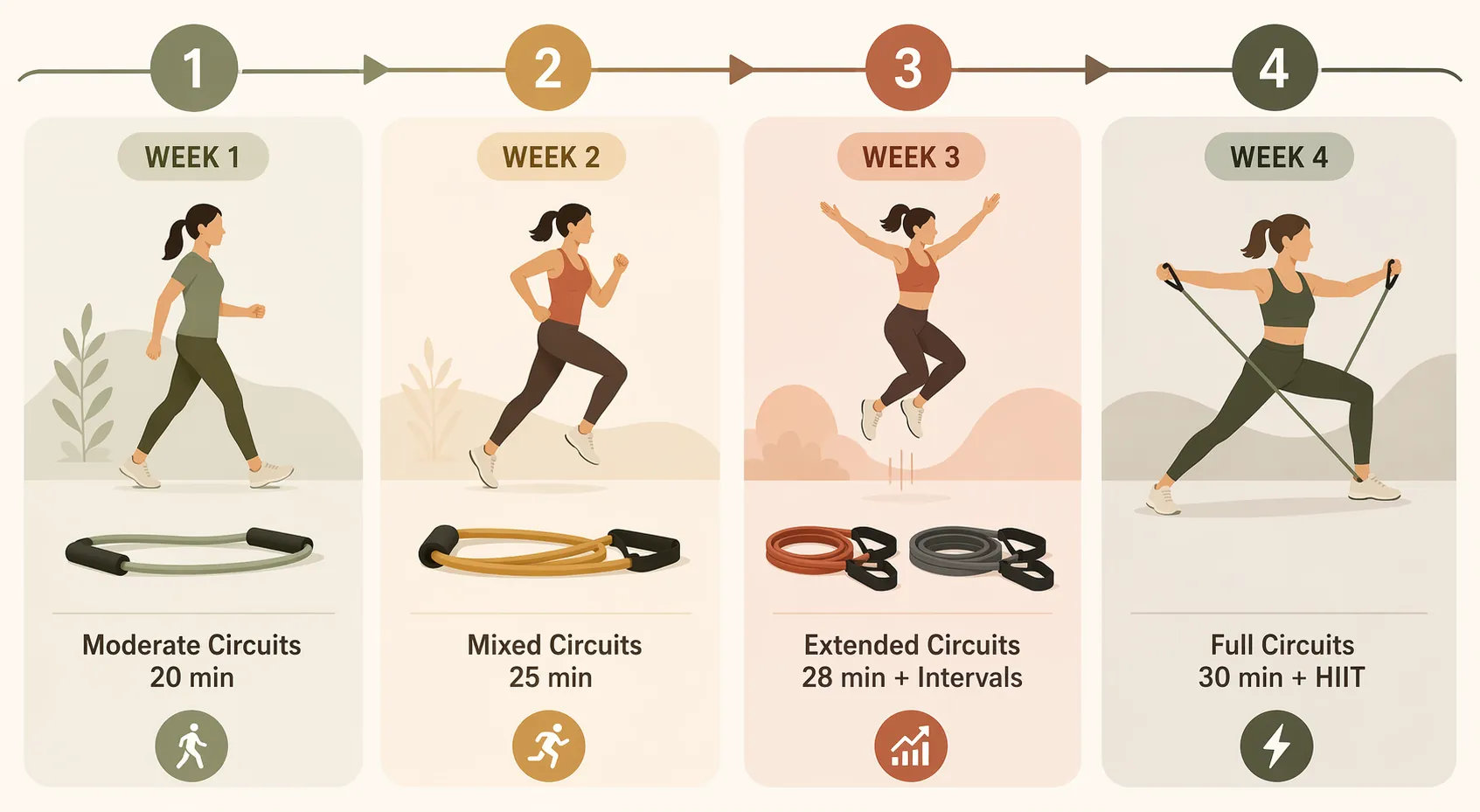
What each type of workout is doing for cholesterol
HDL is often called “good” cholesterol because it is involved in carrying cholesterol away from tissues. LDL is the cholesterol marker clinicians usually focus on lowering because higher levels are tied to atherosclerotic risk. Triglycerides are blood fats that often move with diet, alcohol intake, weight change, insulin resistance, and activity levels. Those definitions are enough for this plan: move often enough to affect energy expenditure, train muscle enough to change how your body handles fat and glucose, and add intensity carefully.
Aerobic work is the weekly-volume engine. It is how a small apartment workout becomes more than a few scattered exercises. The National Lipid Association recommends burning at least 2,000 kcal per week through moderate-to-vigorous physical activity to lower LDL, a threshold that usually requires activity on most days rather than one or two heroic sessions.[4]
Resistance training matters because it gives the plan a second route beyond stepping and sweating. In a 14-week randomized trial, Prabhakaran et al. found that resistance training alone reduced LDL by 0.42 mmol/L, about 16 mg/dL.[5] That does not mean every person doing squats in a spare room will see that exact change, but it does argue against treating strength work as optional decoration.
Intervals are the smallest part of the plan by time and the easiest part to overdo. They belong here because intensity appears to matter independently of exercise volume, but they should not replace the moderate work that lets you accumulate enough weekly activity without burning out.
The 2,000 kcal/week problem
A four-week plan can start cholesterol change, but LDL is usually the stubborn marker. The practical issue is volume. Three 20-minute sessions in Week 1 are good for adherence, confidence, and momentum; they are unlikely to meet the weekly energy expenditure target associated with stronger LDL effects.
That is why the plan does not stay at three short sessions. It grows toward five days, longer sessions, and a mix of moderate and harder work. A watch, treadmill-free fitness app, or exercise calculator can estimate calories, but the exact number will vary by body size, pace, exercise choice, and how much rest you take. Treat the estimate as a steering wheel, not a lab instrument.
| If your week looks like this | What it probably means |
|---|---|
| Three 20-minute moderate sessions | A strong start, but probably below the LDL-focused weekly volume target |
| Four 20–25 minute sessions with resistance work | Better consistency and more muscle work, still likely building toward the target |
| Five sessions, most around 30 minutes, with one HIIT day | A more realistic base for accumulating meaningful weekly activity |
| Daily 30-minute bodyweight circuits or brisk walking, adjusted for recovery | Closer to the NLA-style weekly expenditure goal for LDL lowering |
The STRRIDE trial gives a useful caution about scale. In Kraus et al., high-volume, high-intensity jogging of about 20 miles per week at 65–80% VO2peak improved 10 of 11 lipid variables.[6] Most home exercisers are not going to copy that as jogging mileage, but the lesson carries over: lipid changes respond better when activity accumulates across the week.
How to progress without turning the plan into punishment
Progression has three knobs: duration, density, and intensity. Turn them in that order most of the time.
- Duration: add 5 minutes to a session before adding jumps or harder exercises.
- Density: reduce rest slightly, such as moving from 60 seconds between rounds to 45 seconds.
- Intensity: make one interval day harder, not every workout harder.
- Resistance: move from wall pushups to counter pushups, then lower inclines; move from chair squats to free-standing squats, then split squats.
If your knees dislike jumping, remove jumping. If your wrists dislike floor mountain climbers, put your hands on a counter. If planks make your lower back take over, shorten the hold and use an incline. The cholesterol goal is repeated work over weeks, not proving you can tolerate the most dramatic version of an exercise.
What results are realistic after four weeks
HDL and triglycerides are the markers most likely to make an early move, especially if the workouts replace sitting time and are paired with changes in food and alcohol habits. LDL can improve, but the average exercise-only effect is smaller and less predictable than many “natural cholesterol” articles imply.
The 2026 ACC/AHA exercise meta-analysis is a good realism check: average LDL change was −7.22 mg/dL, while HDL rose by 2.11 mg/dL and triglycerides fell by 8.01 mg/dL.[1] Those averages can matter, especially for borderline elevations, but they do not erase the need for medication when baseline risk is high.
Longer timelines are more informative than a single month. Leon and Sanchez found an average HDL increase of 4.6% in a meta-analysis of interventions lasting at least 12 weeks, while Ferguson et al. found that about 1,100 kcal of energy expenditure per session was required for HDL increases through lipoprotein lipase activity.[7] That does not make very long sessions mandatory for everyone; it does show why short, scattered workouts often disappoint people who expect large lab changes.
Where food, supplements, and statins fit
Exercise is not the whole cholesterol plan. Diet, genetics, baseline fitness, metabolic health, sleep, medications, menopause status, smoking, and alcohol intake can all affect what happens on the next lipid panel. If your clinician gave you dietary instructions, this workout should sit beside them, not compete with them.
Food changes can move LDL more than a short exercise block for some people. The Portfolio Diet research reported an LDL reduction of 26 mg/dL, which is larger than the average LDL shift seen in the structured-exercise meta-analysis cited above.[8] That is a reason to combine approaches, not a reason to keep switching from one promise to another.
Supplements deserve a firmer answer. The 2026 ACC/AHA guideline recommends against dietary supplements for cholesterol lowering, a COR 3 recommendation.[1] If “without statins” turns into red yeast rice, mystery capsules, or a rotating cart of cholesterol gummies, the plan has drifted away from evidence and toward risk.
If your LDL is ≥190 mg/dL, if you have known ASCVD, or if your clinician has already explained that your risk category calls for medication, use this four-week plan as the exercise part of care. Do not use it as a private trial to see whether you can out-squat a high-risk lab result.
After week four
If Week 4 felt manageable, repeat it for another four to eight weeks and work toward activity on most days. Keep one interval day, two resistance or mixed days, and enough moderate aerobic work to move closer to the 2,000 kcal/week target. If bodyweight work becomes too easy, bands are the simplest next step before buying equipment.
If Week 4 felt like too much, repeat Week 2 or Week 3 instead. A sustainable plan that reaches month three is more valuable than a perfect-looking schedule that ends after ten days.
Bring the next lipid panel back to the person managing your care. The useful question is not whether the workout “worked” in some moral sense; it is whether HDL, LDL, triglycerides, and your overall risk picture moved enough to support the next decision.
References
- 2026 ACC/AHA/AACVPR/ABC/ACPM/ADA/AGS/APhA/ASPC/NLA/PCNA Guideline on the Management of Dyslipidemia — Circulation
- Lira et al. 2010 — PMC (NIH)
- O’Donovan et al. 2005
- National Lipid Association physical activity tear sheet — National Lipid Association
- Differential Effects of Aerobic Exercise, Resistance Training and Combined Exercise Modalities on Cholesterol and the Lipid Profile — PMC (NIH)
- Effects of the Amount and Intensity of Exercise on Plasma Lipoproteins — New England Journal of Medicine, 2002
- Leon & Sanchez 2001 meta-analysis and Ferguson et al. 1998
- Portfolio Diet research
What a small equipment investment adds
We don't have a build tagged to this exact tier yet. Browse all builds.
How often should you repeat this?
See our recovery and rest reference for citation-anchored rest-interval guidance.
Spot something off?
Tell us if a movement, tier assumption, or duration didn't match your experience.