
The Complete Guide to 800m Training at Home
Can you train seriously for the 800m without a track? This guide explains how to use time-based intervals, hill sprints, treadmill workouts, and bodyweight strength to build speed and endurance at home, with a practical weekly schedule for competitive runners.
- Equipment tier required
- none
- Duration
- 30 min
- Difficulty
- intermediate
- Target area
- full body
If you cannot get to a track, you are not automatically wasting your 800m season. You are losing a measuring tool, a rhythm teacher, and the clean punishment of lane markings. That matters. But most of the work that makes an 800m runner harder to race — aerobic volume, lactate-tolerant intervals, short speed, hill power, elastic strength, and repeatable recovery — can be built away from a track if the substitute preserves the demand of the original workout.
The reason this works is that the 800m is not a pure sprint wearing distance spikes. Colorado Track Club describes the event as roughly 50% aerobic, 44% anaerobic glycolytic, and 6% alactic, while Freeman’s framing, cited by Everything Track & Field, puts the race closer to 67% anaerobic and 33% aerobic.[1][2] Those estimates do not agree perfectly, and they should not be treated as a lab-printed prescription for every athlete. They do agree on the useful point: the 800m is mixed enough that roads, grass, hills, treadmills, and home strength work can carry a serious share of the load.
There is also a real-world example worth keeping in view, with the right caution label attached. In a LetsRun forum thread, a verified 1:51 800m runner described training with only one track session per week while using undulating grass, hills, and flat road paths for five other sessions.[3] That is forum testimony, not controlled research. Still, it is enough to kill the idea that a competitive 800m runner must touch synthetic surface six days a week.

The home-training rule: replace the job, not the scenery
A track workout is never just a set of distances. It is a contract between pace, duration, recovery, surface, and intent. A 600m rep at 800m pace is not hard merely because it says 600. It is hard because the runner is spending a particular amount of time near race rhythm, accumulating fatigue at a particular rate, and then recovering just enough to repeat the demand without turning the session into jogging survival.
That is the standard for 800m training at home. A replacement workout is useful when it answers four questions:
- What part of the 800m does this session train: aerobic support, race-pace tolerance, fast-but-relaxed speed, finishing power, or general durability?
- How long is the athlete working at the target intensity?
- Is the recovery long enough to preserve mechanics, or short enough to create the intended fatigue?
- Can the workout be repeated next week without guessing whether it was the same stimulus?
If those answers are clear, a road loop can replace a marked oval. If they are not clear, even a track session can become random suffering.
Convert distance reps into time-based reps
The first move is almost always distance-to-time conversion. Do not try to find a perfect 400m stretch of road unless you already have one. Decide what the track repetition was supposed to feel like, estimate the time you would have spent at that effort, and run that duration on a surface that lets you hold form.
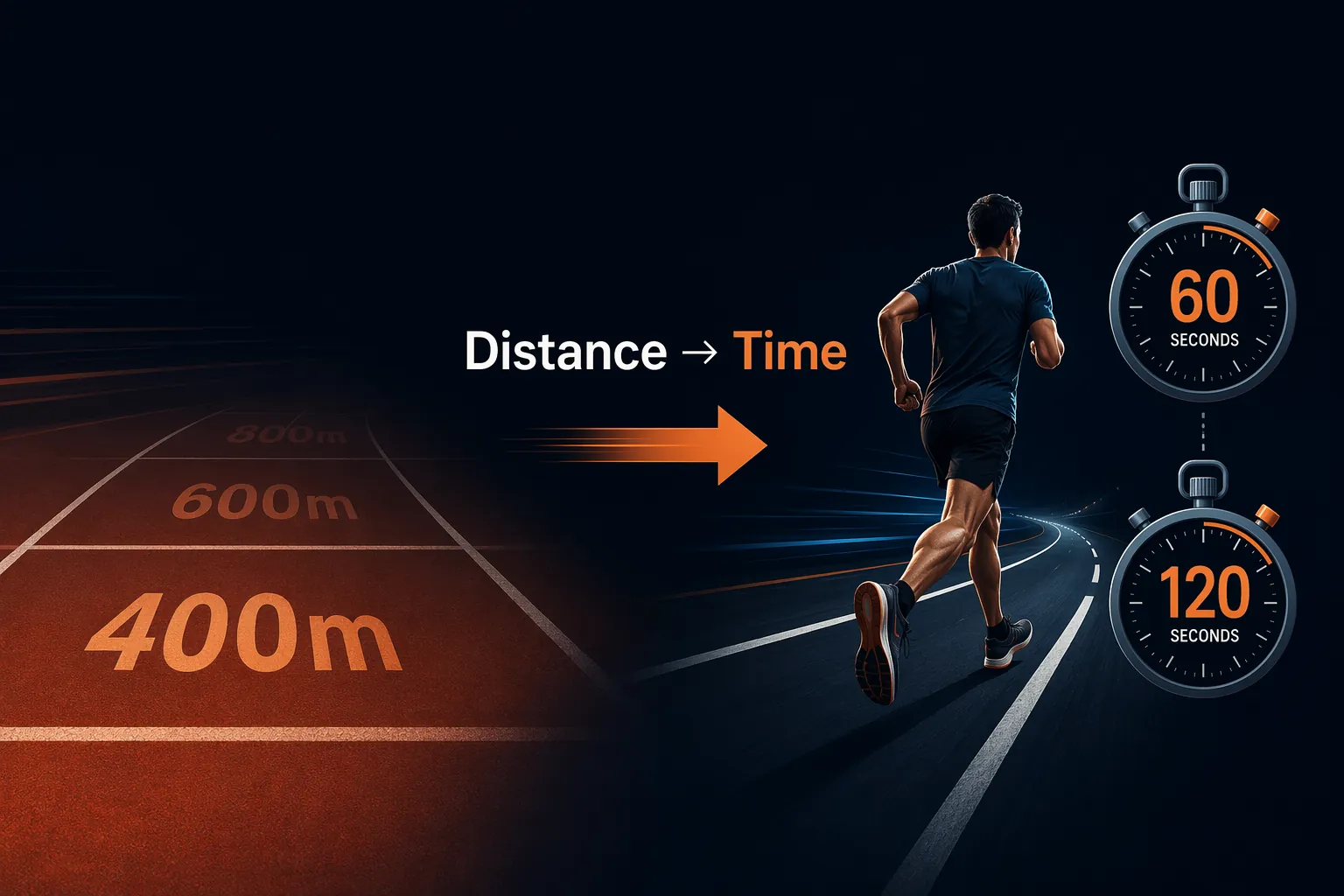
One coach example from the LetsRun discussion is 8 x 60 seconds at 800m effort with 90 seconds of jog recovery as a substitute for a classic 8 x 400m-style track demand.[3] That prescription should not be copied blindly. For a runner whose 400m race-pace split is much slower than 60 seconds, the rep duration should move closer to that athlete’s actual target. The point is not that every 800m runner should worship the one-minute rep. The point is that the rep should preserve the time spent at the intended pressure.
| Track session you cannot do | Home-compatible replacement | What must stay intact |
|---|---|---|
| 8 x 400m at controlled 800m effort, 90 sec recovery | 8 x target 400m split by time on flat road, grass, or treadmill; 90 sec jog or easy walk-jog | Race-specific effort, repeatability, and mechanics under rising fatigue |
| 5–6 x 600m at strong but not all-out effort | 5–6 x the time your 600m rep would usually take, on a flat loop or gentle out-and-back | Longer glycolytic pressure without sprinting the first half |
| 10–12 x 200m fast relaxed | 10–12 x 30–40 sec fast relaxed strides on smooth grass or road, full easy return | Speed rhythm without turning every rep into a max sprint |
| Broken 800m session | Timed segments that add up to the same race-pace exposure, separated by short planned recoveries | Race rhythm, controlled fatigue, and clean posture late in the set |
| Easy mileage and aerobic support work | Road, trail, grass, or treadmill running by time | Conversation-level effort and consistent volume |
The surface matters less than the honesty of the rep. A flat road with light traffic is better than a pretty trail that forces you to brake every twelve seconds. Grass is excellent when it is even enough to run fast without guarding your ankles. A slight rolling route can work for strength-endurance days, but it is a poor place to judge whether you are holding 800m rhythm.
For time-based 800m intervals, use effort bands rather than heroic pace claims. “800m effort” means fast enough that conversation is gone and the last third of each rep demands concentration, but controlled enough that the second half of the session does not collapse. If rep one looks powerful and rep six looks like a different athlete, the workout became a test, not training.
A practical 8 x 60 seconds session
After a normal warm-up and a few relaxed accelerations, run 8 x 60 seconds at current 800m effort with 90 seconds of jog recovery. Choose a flat stretch where you can run the whole rep without stopping, turning sharply, crossing traffic, or staring at your watch every two strides. Start the first two reps under control. Reps three through six should feel like the body has accepted the pace. Reps seven and eight are where posture matters: tall hips, quick ground contact, arms driving backward rather than twisting across the chest.
If you finish feeling as if you could run one more rep well, the session probably landed correctly. If you finish needing five minutes on the curb, the pace was too hot or the recovery too short for the intended workout. The 800m already gives athletes enough chances to discover panic; training should create pressure you can repeat.
Use hills for speed, power, and safer aggression
A good hill is the simplest non-track tool an 800m runner can own. It does not need electricity, it does not care about lane access, and it punishes half-commitment immediately. Short steep hill sprints of 15–25 seconds at 95–100% effort with full walk-back recovery are commonly used as a substitute for flat speed work while building running-specific strength; the approach is supported in coaching discussions around Canova/Ghidini-style middle-distance training and in the LetsRun testimony around low-track-access training.[3][4]

The hill does two useful things at once. It forces force production — the athlete has to push — and it slightly caps reckless overstriding because the ground rises to meet the foot. That does not make hill sprinting risk-free, especially for calves, Achilles tendons, and hamstrings. It does make it a cleaner way for many home-based runners to touch high intensity when they do not have a straightaway.
The recovery is not decorative. Walk back down. Breathe. Let the next sprint be fast. If you jog back quickly and launch again while your legs are still heavy, you have changed the session from alactic power and mechanics into a sloppy conditioning set. There is a place for hard uphill repeats, but the 15–25 second sprint session is not that place.
| Hill session | Best use | How it should feel |
|---|---|---|
| 6–8 x 15 sec steep hill, full walk-back recovery | Early return to speed, conservative first hill-sprint session | Explosive but crisp; no tying up |
| 8–10 x 20 sec steep hill, full walk-back recovery | Main speed-power session for a home-based 800m runner | Very hard on each rep, with form still intact |
| 6 x 25 sec hill, full walk-back recovery | Advanced power-endurance exposure when the athlete already tolerates hills | Heavy by the final reps, but not a stagger |
| Short hill sprints after an easy run | Neuromuscular touch during base training | Fast, brief, and finished before fatigue changes mechanics |
The hill grade should be steep enough that sprinting feels like pushing, not bounding casually, but not so steep that you are climbing more than running. Grass is fine if the footing is predictable. Pavement is fine if your legs tolerate it and the descent is walked carefully. Wet grass, broken asphalt, blind curves, and driveways at the bottom are not badges of toughness; they are ways to turn a good session into a forced week off.
Use the treadmill for control, not borrowed paces
A treadmill can be excellent for 800m training at home when the purpose is control. It is a poor tool when the purpose is copying someone else’s speed setting. The common 1% incline convention helps make treadmill running a more realistic substitute for outdoor running, and 2–4% incline work can be useful for strength-oriented sessions. Those inclines are tools, not commandments.
One treadmill demonstration often passed around is 6 x 0.5 miles at 10–11 mph on a 1% incline with 90 seconds of rest.[5] Treat that as a demonstration-level example, not research and not a universal 800m prescription. For a competitive 800m runner, 10–11 mph may be far slower than race pace. For a developing runner, it may be too aggressive. The useful idea is the structure: repeatable long intervals, controlled belt speed, fixed recovery, and no traffic interruptions.
Set treadmill sessions from your goal and current fitness. If the machine cannot reach your true 800m pace — many home treadmills cannot — do not force the session into a fake race-pace workout. Use the treadmill for tempo intervals, longer aerobic reps, cutdowns, or incline strength runs, and save the fastest work for hills, flat grass strides, or the occasional track day. If you are deciding whether a machine can handle this kind of work, the practical question is not only top speed; it is belt stability, motor durability, deck size, and long-term maintenance cost. That buying side is covered in this guide to the real five-year cost of owning a treadmill for a home gym.
| Treadmill workout | How to scale it | Where it fits |
|---|---|---|
| 6 x 0.5 miles, 90 sec rest, 1% incline | Use a speed that makes the final two reps demanding but controlled; do not assume 10–11 mph is your correct setting | Aerobic-power or strength-endurance day |
| 8 x 60 sec, 90 sec easy | Set speed by current 800m effort if the treadmill can safely handle it; otherwise use a slightly longer controlled interval | Race-effort substitute when outdoor footing is poor |
| Progression run by time | Start comfortable and finish strong without sprinting | Aerobic support during base or pre-competitive training |
| 2–4% incline repeats | Keep speed lower than flat running and focus on posture, cadence, and push-off | Strength-oriented substitute when no hill is available |
The treadmill also removes one kind of cheating. Outdoors, a tired runner can drift off pace and blame wind, GPS lag, or a soft patch of grass. On the belt, if the speed is set correctly, the decision is simpler: keep rhythm or step off. That control is useful. It is also why the first two reps should feel almost too calm. A treadmill session that starts slightly reckless usually ends with a hand on the rail.
Strength and plyometrics should support the event, not replace running
Home strength work for the 800m has a narrow job: help the runner apply force, hold posture under fatigue, tolerate sprinting, and bounce off the ground without turning every landing into a brake. It is not a bodybuilding detour, and it is not punishment for missing a gym.
Brooks Beasts coach Danny Mackey has published a 12-exercise bodyweight circuit for 800m–5000m athletes training indoors, including movements such as power push-ups, pogos, V-ups, burpees, speed skaters, lunge jumps, and lateral planks.[6] Runner’s World also offers a 30-minute no-equipment circuit from Dane Miklaus, C.S.C.S., as a broader home-workout option.[7] For an 800m runner, the most relevant pieces are the ones that train stiffness, single-leg control, lateral stability, hip drive, and trunk control.
Two short sessions per week are enough for most runners when the running is serious. Place them after easier runs or after quality days, not before the most important speed session of the week. The goal is to arrive at hill sprints and race-effort intervals springy, not sore from lunge jumps done to exhaustion the night before.
| Home strength element | 800m reason | Programming note |
|---|---|---|
| Pogos or ankle hops | Elastic lower-leg stiffness for faster ground contact | Keep contacts crisp; stop before the bounce gets heavy |
| Speed skaters or lateral bounds | Hip stability and force control outside straight-line running | Prioritize quiet landings over distance |
| Split squats, reverse lunges, or lunge jumps | Single-leg strength for sprinting and hill work | Use controlled reps first; add jumps only when landings are clean |
| Lateral planks and anti-rotation core work | Posture when fatigue tries to twist the shoulders and hips | Short, high-quality holds beat long sagging holds |
| Power push-ups or burpees in small doses | Upper-body stiffness and whole-body coordination | Do not let conditioning circuits wreck the next running session |
A sensible home circuit might run 20–30 minutes: pogos, split squats, lateral bounds, push-ups, V-ups, lateral planks, and a few controlled lunge jumps if the athlete is already handling impact well. The exact exercise list is less important than the standard: every rep should look like it belongs to a runner who still plans to run fast tomorrow or the day after.
Build the week so the hard days stop colliding
The danger in home-based 800m training is not usually laziness. It is randomness. A runner does hill sprints Monday because the hill is there, a treadmill sufferfest Tuesday because it is raining, plyometrics Wednesday because a video looked useful, and by Friday every session has been “800m specific” in the worst possible way. The week needs separation between stress types.
Use the same basic ingredients across the year, then change the emphasis. Base training gives more room to aerobic volume, hills, and strength. Pre-competitive training brings in more race-effort intervals. Competitive training protects freshness and, if available, adds one track session for rhythm and exact pacing. This follows the periodized logic used in established 800m training plans and coaching frameworks rather than treating every week as a miniature race week.[1][4]
Base phase: build the engine and the chassis
| Day | Session | Purpose |
|---|---|---|
| Monday | Easy run by time + short strength circuit | Aerobic volume and durability |
| Tuesday | Short steep hill sprints, full walk-back recovery | Speed, power, and mechanics without track access |
| Wednesday | Easy run or off, depending on training age | Absorb Tuesday |
| Thursday | Tempo run or controlled aerobic intervals by time | Aerobic support for the 800m |
| Friday | Home plyometrics and single-leg strength | Elasticity and stability |
| Saturday | Long aerobic run on road, trail, grass, or treadmill | General endurance and recovery capacity |
| Sunday | Off or very easy recovery | Let the week consolidate |
In the base phase, the hill sprint day is fast but not draining in the way a long interval session is draining. The tempo or controlled interval day should not feel like a secret race. The long run is not there to turn an 800m runner into a marathoner; it is there to raise the floor so later race-pace work does not arrive on a weak aerobic base.
Pre-competitive phase: make race effort repeatable
| Day | Session | Purpose |
|---|---|---|
| Monday | Easy run + mobility or light trunk work | Recover from the weekend without going flat |
| Tuesday | 8 x 60 sec at 800m effort, 90 sec jog recovery | Timed race-effort exposure off the track |
| Wednesday | Easy run | Aerobic support and recovery |
| Thursday | 8–10 x 15–20 sec hill sprints, full walk-back recovery | Speed-power without excessive volume |
| Friday | Short strength and plyometric session | Maintain stiffness and single-leg strength |
| Saturday | Long run or progression run by time | Endurance support without racing the workout |
| Sunday | Off or very easy | Freshen for the next interval day |
This is where the home runner has to be precise. Tuesday’s timed intervals and Thursday’s hill sprints are both quality, but they are not the same kind of quality. One asks the body to hold 800m pressure repeatedly. The other asks for high force and speed with full recovery. If both days feel like lactate disasters, the week is too hard or the recoveries are too short.
Competitive phase: keep the home work, add rhythm when possible
| Day | Session | Purpose |
|---|---|---|
| Monday | Easy run + light mobility | Recovery and rhythm |
| Tuesday | Track session if available: race-pace reps, broken 800m work, or controlled 300m–600m segments | Exact pacing, curve rhythm, and race-specific confidence |
| Wednesday | Easy run or off | Absorb the race-specific session |
| Thursday | Short hill sprints or relaxed fast strides | Keep speed alive without adding heavy fatigue |
| Friday | Very light strength or plyometric maintenance | Maintain stiffness, avoid soreness |
| Saturday | Race, time trial, or controlled interval session by time if no race | Specific readiness |
| Sunday | Off or easy recovery | Reset |
During the final 6–2 weeks before an important race, one weekly track session becomes more valuable than it was earlier. Not because the body suddenly refuses to adapt elsewhere, but because the 800m punishes poor rhythm. You need to know what the first 200m feels like when it is quick but not suicidal. You need to know how 500m feels when the curve is real and the line is not a mailbox, a tree, or the end of a driveway. You need a few reps where pace is not estimated from GPS lag.
If you can only get one track slot per week, spend it on the session that most needs measurement: race-pace 300s, 400s, 500s, 600s, or broken 800m work. Do not waste the rare track day on an easy run you could have done anywhere. Keep aerobic running, general strength, and many speed touches at home. Use the oval for what only the oval does best.
How to know the substitute is working
Without lane markings, feedback has to come from repeatability. The right signs are simple: your timed reps cover a similar distance at the same effort, your recoveries feel more controlled, hill sprints stay powerful across the set, and easy days actually leave you fresher. The wrong signs are also simple: every interval session becomes a personal challenge, hill sprints turn into bent-over conditioning, and strength work leaves your legs dull for the only fast running of the week.
GPS can help, but it should not be promoted above feel and structure for short reps. Watches are often weak at measuring 30–60 second surges precisely, especially around trees, buildings, or tight turns. Use the watch to record the session, not to negotiate every stride. If you need exact race pace, that is what the occasional track day is for.
Progression should be modest. Add one rep, extend a few reps slightly, reduce recovery a little, or make the pace more consistent. Do not improve all variables at once. A runner who changes duration, recovery, terrain, incline, and effort in the same week has no idea what caused the result. Home training works best when the constraints force discipline instead of improvisation.
No track required does not mean no track useful
You can train seriously for the 800m from home for most of the year. Time-based intervals can replace many distance reps. Hills can carry a large share of speed and power work. A treadmill can control longer intervals and bad-weather sessions. Bodyweight strength and plyometrics can maintain the stiffness, posture, and single-leg control the event demands.
The boundary is sharpening. As racing gets close, the 800m becomes less forgiving of approximation. One weekly track session in the final 6–2 weeks gives you exact rhythm, honest splits, curve running, and the specific discomfort of marked reps. That is not track purism. It is using the tool when the tool finally matters most.
References
- 800 Meter Training Plans, Colorado Track Club
- The 800 Meters – Training Approaches, Everything Track & Field
- LetsRun.com forum thread 12600856, LetsRun.com
- 800m Training, 800mtraining.wordpress.com
- NordicTrack on TikTok, NordicTrack
- Indoor Training Plans for Runners, Brooks Running
- 30-Minute Home Workout, Runner’s World
What a small equipment investment adds
We don't have a build tagged to this exact tier yet. Browse all builds.
How often should you repeat this?
See our recovery and rest reference for citation-anchored rest-interval guidance.
Spot something off?
Tell us if a movement, tier assumption, or duration didn't match your experience.