
Amal Clooney's Home Workout Routine, Built for Small Spaces
Amal Clooney's reported four-part routine — daily walks, short dumbbell sessions, Pilates, and tennis — becomes a week-by-week home workout plan for renters and small spaces. The plan replaces court time with interval cardio, lays out equipment and floor-space needs by budget tier, and keeps rumored details clearly separate from documented ones.
- Equipment tier required
- $100-300
- Duration
- 20 min
- Difficulty
- beginner
- Target area
- full body
- Space footprint needed
- 2-3 square meters
- Noise level
- low
The useful question behind an “Amal Clooney stay in shape home workout routine” is not whether a celebrity can walk, lift, do Pilates, and play tennis. Of course she can. The useful question is what survives when the court disappears, the living room is narrow, and the downstairs neighbor is not part of the program.
The commonly repeated formula is simple: a daily walk, a short weights session, Pilates, and tennis. The shaky part is precision. Women’s Health UK described the 60-minute walk, 20-minute weights, and 30-minute Pilates figures as “rumoured” in 2026, while Popsugar’s earlier post-baby version traced similar details to an unnamed source speaking to Heat magazine.[1][2] That makes the structure worth translating, but not worth treating as Amal Clooney’s verified calendar.
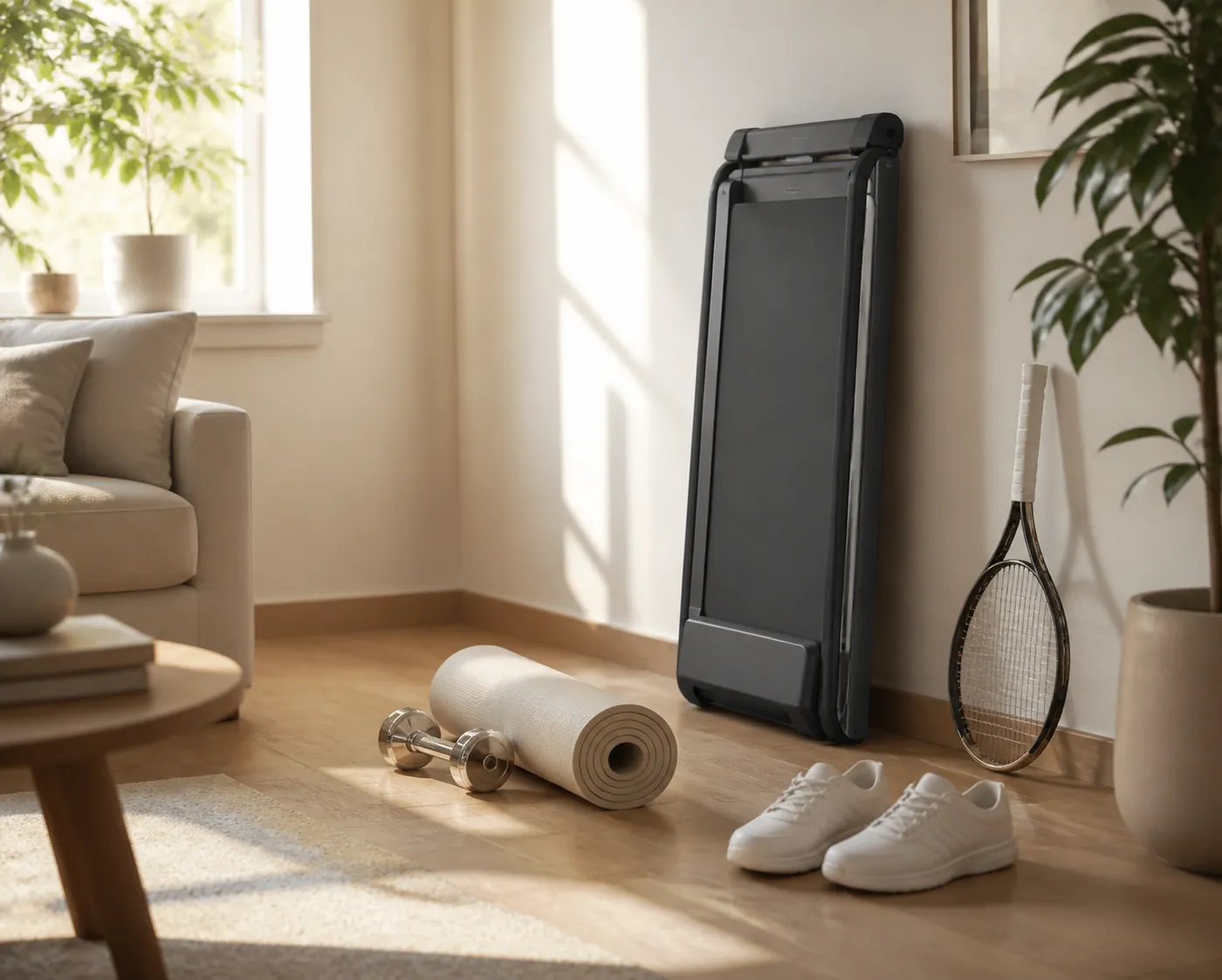
The four-part routine, sorted by how solid it is
For a home version, the first job is separating a usable training pattern from celebrity-reporting fog.
| Block | What the reporting supports | Small-space translation |
|---|---|---|
| Walking | Part of the rumored formula, often repeated as a daily 60-minute walk. | Outdoor walk, commute walk, apartment hallway laps, or walk pad. |
| Light strength | Part of the rumored formula, often framed as a short weights session. | Two or three quiet dumbbell circuits per week. |
| Pilates | Part of the rumored formula, usually described as a 30-minute Pilates block. | Mat Pilates in roughly 2–3 square meters: no reformer required. |
| Tennis | The strongest public thread. Vogue covered Amal and George Clooney playing tennis at Lake Como in 2018.[3] | Court-free interval cardio that keeps the bursts, direction changes, and coordination. |
That last row is where the routine stops being a celebrity list and starts becoming an apartment plan. Walking, dumbbells, and mat Pilates are easy to shrink. Tennis is not. It needs a court, a partner or ball machine, clearance, footwear, weather cooperation, and time. A renter can fake neither a baseline nor a landlord’s patience.
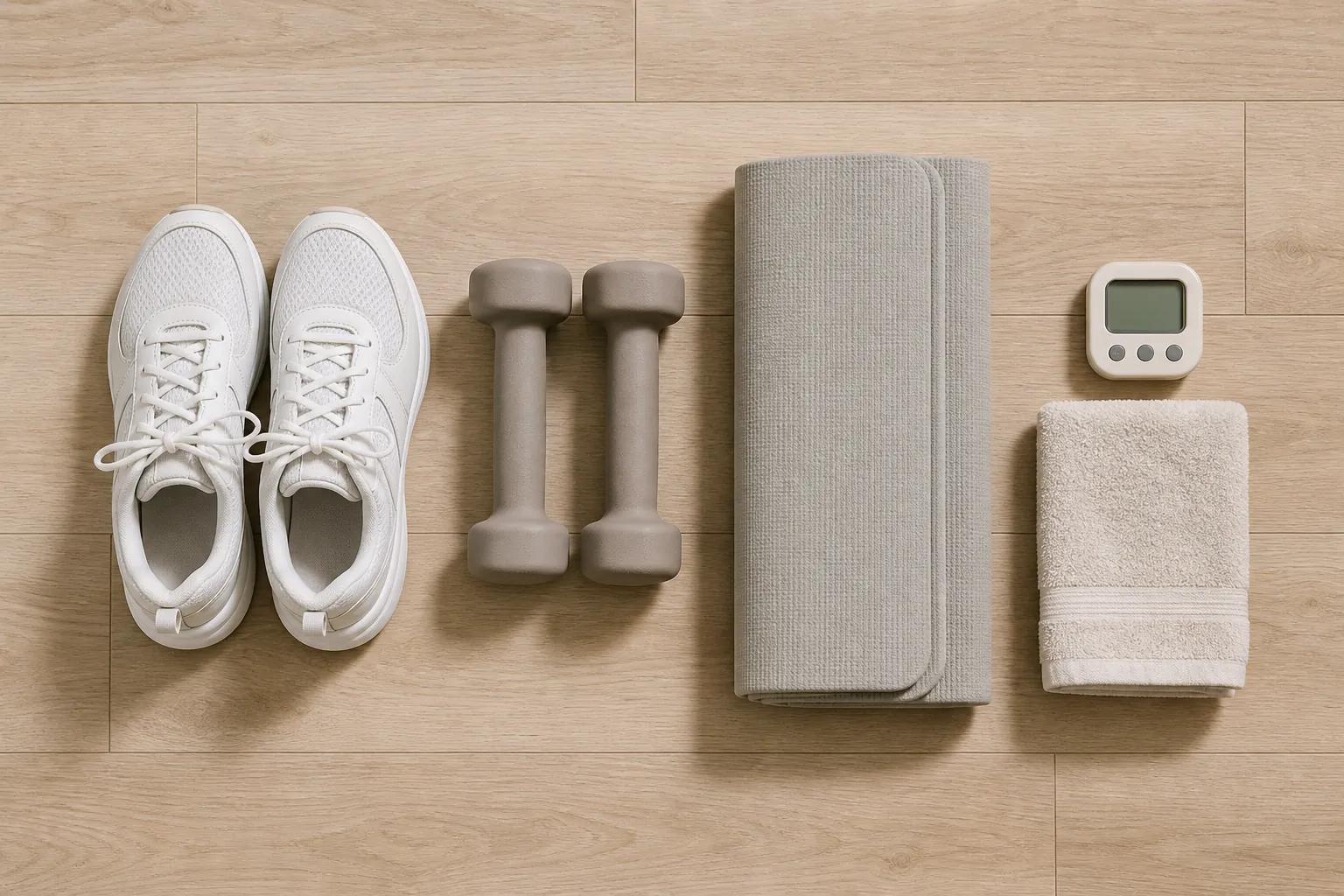
Why the tennis block deserves the most careful replacement
Tennis is not just “cardio with a racket.” It mixes short accelerations, decelerations, lateral steps, rotation, hand-eye timing, and enough stop-start unpredictability to keep attention switched on. A treadmill walk does not reproduce that. A random set of jumping jacks does not either, and in an apartment it may also reproduce a ceiling complaint.
The reason to preserve the tennis flavor is stronger than the usual “it tones everything” filler. In the Copenhagen City Heart Study analysis published in Mayo Clinic Proceedings, tennis showed the largest multivariable-adjusted life-expectancy association among the activities studied: 9.7 years compared with 3.2 years for jogging, among 8,577 participants followed for up to 25 years.[4] The authors also stated that causality remains uncertain, and social interaction may be part of the explanation.[4]
A British Journal of Sports Medicine cohort study of 80,306 adults found that racquet sports were associated with 47% lower all-cause mortality risk and 56% lower cardiovascular-disease mortality risk in the abstract’s reported hazard ratios.[5] Again, this is observational. It does not prove that a tennis-style interval in your living room causes a longer life. It does make racket-sport-type effort a more defensible model than simply swapping tennis for any sweaty thing.
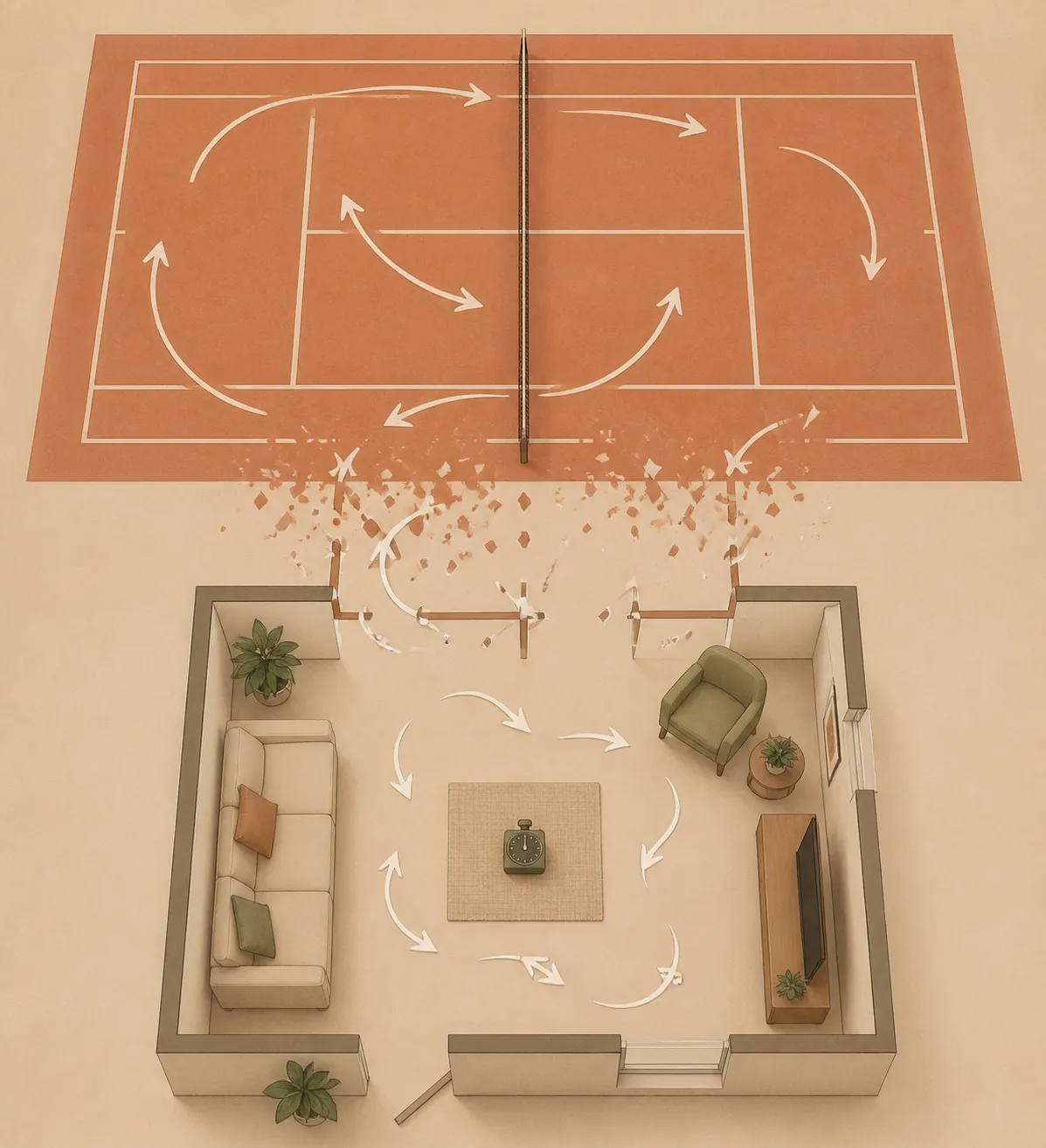
So the home replacement should keep four pieces: bursts, side-to-side movement, controlled pivots, and coordination. It should drop the pieces that do not belong in a rental: sprinting into furniture, hard jumping, and pretending a hallway is a clay court.
A small-space weekly version
This is a FitAtHome synthesis of the reported structure, not Amal Clooney’s verified schedule. It keeps the four blocks, gives tennis the most honest court-free translation, and leaves room for workdays that do not politely end at 5 p.m.
| Day | Main work | Small-space notes |
|---|---|---|
| Monday | Walk + 20-minute dumbbell strength | Use a mat under weights. No dropping dumbbells, even the small ones. |
| Tuesday | Walk + mat Pilates | Best day for floor work if legs feel heavy from Monday. |
| Wednesday | Walk + tennis-style intervals | Low-impact lateral steps, shadow swings, timer-based bursts. |
| Thursday | Walk only or mobility | Keep this intentionally boring if sleep or work stress is high. |
| Friday | Walk + 20-minute dumbbell strength | Repeat Monday or slightly change the moves, not the whole plan. |
| Saturday | Longer walk + Pilates or intervals | Choose Pilates if joints feel cranky; intervals if energy is good. |
| Sunday | Easy walk + recovery | No need to “make up” missed sessions with a punishment workout. |
If you already train hard, this may look light. If you are starting from inconsistent home workouts, it is enough structure to matter. The better adjustment is not adding another celebrity-adjacent block; it is controlling weekly load so the plan survives more than one motivated week. For that, use a simple load-and-rest framework like FitAtHome’s weekly workout recovery system instead of turning every missed day into a debt.
The walk: keep it daily, but do not worship the 60-minute number
The rumored version often says 60 minutes. At home, the cleaner rule is daily walking exposure: outside if you can, a walk pad if you have one, or split walks if the morning is cramped. A renter-friendly version might be 20 minutes before work and 20 minutes later, or a single longer walk on days with fewer obligations.
A walk pad is optional, not a moral upgrade. If you use one, the two things that matter are shoe comfort and vibration control. Put the machine on a protective mat, avoid early-morning speed experiments, and use shoes that do not make your feet hate the whole idea by Thursday. FitAtHome’s home walking footwear guide is a better next stop than buying another gadget.
The weights: short, quiet, and repeatable
The reported routine’s weights block is brief, which is exactly why it translates well. Twenty minutes is enough time for a full-body dumbbell circuit if the exercises are chosen for control rather than drama.
- Goblet squat to a chair or box
- Dumbbell Romanian deadlift
- One-arm dumbbell row with a hand on a chair
- Floor press or incline push-up
- Suitcase carry march in place, slow enough that nothing rattles
Run those as a circuit for 2–3 rounds. The living-room test is simple: if you have to hop, drop, slam, or drag equipment, it is not the right version for this routine. Set the dumbbells down like there is a security deposit attached to them, because there is.
If setup friction is what kills your consistency, keep the dumbbells visible but not in the walkway. A basket beside the mat beats a perfect equipment closet you never open. The same idea sits behind FitAtHome’s friction-free home workout setup: the room should make the first rep easier, not more ceremonial.
The Pilates: mat space, not studio fantasy
A mat Pilates block needs roughly 2–3 square meters: enough room to lie down, extend the arms, roll to one side, and move the legs without kicking a table leg. That is not a reformer studio. It is the patch of floor you can claim after sliding the coffee table a foot and negotiating with the dog.
For this plan, choose quiet Pilates staples: dead bug variations, glute bridge, side-lying leg work, swimming prep, roll-downs if your spine tolerates them, and plank variations on knees or toes. The goal is trunk control, hip strength, and mobility that support the walking, lifting, and tennis-style movement. Third-party trainer commentary around Clooney’s reported mix has made the same broad point: the appeal is the combination of cardiovascular endurance, strength, and flexibility, not one magical move.[6]
The tennis replacement: intervals without impact theater
The court-free version should feel a little like rally practice and a little like footwork training. It should not feel like a bootcamp instructor moved into your apartment.
| Tennis quality | Apartment replacement | Noise control |
|---|---|---|
| Short bursts | 20–30 seconds of fast but controlled work | Use soft knees and keep feet close to the floor. |
| Lateral movement | Side steps, shuffle-to-reach, skater steps without the jump | Step, do not bound. |
| Rotation | Shadow forehand and backhand patterns with light footwork | Rotate through the hips; do not twist aggressively on sticky flooring. |
| Coordination | Timer cues, towel targets, or alternating hand reaches | Use visual targets instead of equipment that bounces. |
| Sustained engagement | Intervals repeated for 12–18 minutes | Stop before form gets loud. |
One simple session: set a timer for 30 seconds of work and 30 seconds easy. Rotate through lateral step-and-reach, shadow forehand, shadow backhand, low step-back lunge, and quick-feet march. Repeat the circuit two or three times. Keep a towel on the floor as your “center mark” so you return to the same spot instead of migrating into a lamp.
A quieter session: use 20 seconds work, 40 seconds easy. Do side steps, standing cross-body reaches, split-step practice without leaving the floor, slow mountain climbers with hands on a bench, and shadow swings. This is better for early mornings, older buildings, and floors that make every heel strike sound like construction.
If the tennis angle makes you curious but your elbow or shoulder has a history, do not use shadow swings as a rehabilitation plan. Start with dedicated work such as FitAtHome’s tennis elbow rehab exercises or a broader tennis injury recovery routine before adding speed.
Equipment tiers for the Amal-inspired apartment version
There is no public reporting that Amal Clooney uses a particular home gym setup, so the equipment list should not pretend to imitate one. This is the smallest kit that makes the four-block structure practical.
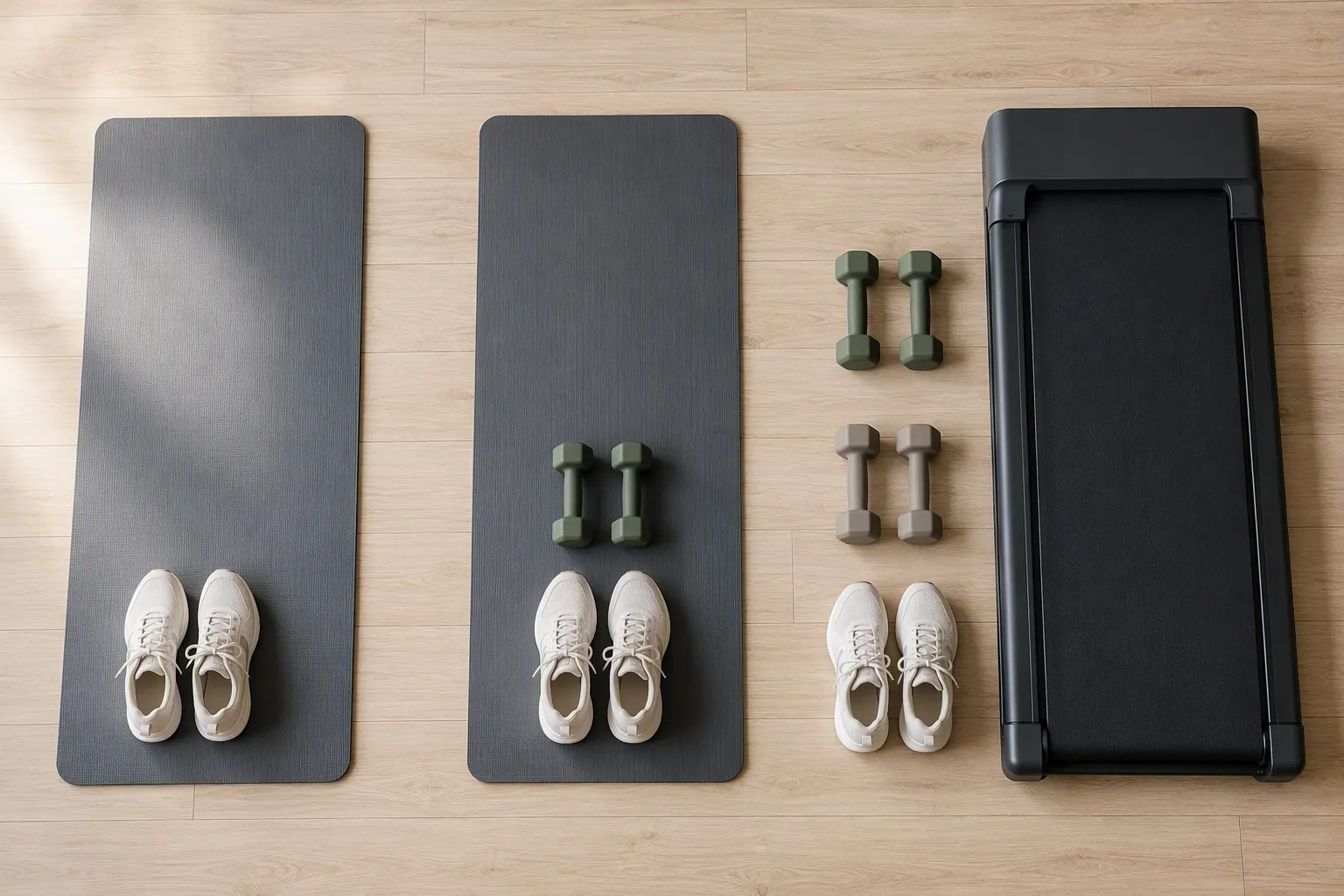
| Budget tier | What to use | What it unlocks | What to watch |
|---|---|---|---|
| $0–$100 | Sneakers, mat or thick towel, timer, optional resistance band | Walking, Pilates, tennis-style intervals, bodyweight strength | Use a rug or mat to reduce slipping and floor noise. |
| $100–$300 | Mat, one or two pairs of dumbbells, mini band, floor protector | A stronger 20-minute weights block and more exercise variety | Choose weights you can set down quietly; avoid adjustable plates that rattle. |
| $300–$800 | Compact walk pad, better mat, two dumbbell pairs, storage basket | More reliable daily walking when weather or schedule gets in the way | Measure storage depth, outlet access, and vibration before buying. |
For a budget comparison in the same small-apartment spirit, FitAtHome’s $100–$300 Tom Segura home workout plan is a useful neighbor. If your main concern is floor protection and noise, the goal-setting framework in the Harada Method home workout guide is more practical than buying heavier equipment.
Where the routine breaks, and how to bend it
The walk breaks when time breaks. Split it. The weights break when setup is annoying. Leave the mat and dumbbells where you can reach them. Pilates breaks when the floor is too hard or the room is too crowded. Use a thicker mat and remove one obstacle instead of waiting for a better apartment.
The tennis block breaks for the most honest reason: tennis is tennis. A living room can borrow its movement qualities, not its full environment. If you have court access, play. If you do not, use intervals that preserve the bursts and directional changes without smashing your feet into the floor.
If soreness starts stacking up, trim the interval day before trimming the walking day. If the hips feel tight after lateral work, use an easy recovery session from FitAtHome’s post-workout tightness relief guide. If motivation is coming mainly from celebrity curiosity, borrow the format from other translated routines, such as the Christie Brinkley at-home workout or Jade Carey gymnastics-inspired home routine: keep the appealing structure, then resize it until it fits your floor.
That is the honest version of the Amal Clooney home workout routine: a reported four-part structure, strongest where it follows the well-documented tennis thread and weakest where celebrity fitness coverage leans on unnamed sources. At home, it becomes walking, short dumbbell strength, mat Pilates, and tennis-style interval cardio — not a verified imitation, but a version a renter can actually do.
References
- Amal Clooney workout, Women’s Health UK, 2026
- Amal Clooney Diet and Exercise, Popsugar, 2018
- Amal Clooney and George Clooney’s Lake Como Tennis Athleisure, Vogue
- Various Leisure-Time Physical Activities Associated With Widely Divergent Life Expectancies: The Copenhagen City Heart Study, Mayo Clinic Proceedings, 2018
- Associations of specific types of sports and exercise with all-cause and cardiovascular-disease mortality: a cohort study of 80 306 British adults, British Journal of Sports Medicine, 2017
- Amal Clooney's fitness regime after twins, Hello!, October 2023
What a small equipment investment adds
We don't have a build tagged to this exact tier yet. Browse all builds.
How often should you repeat this?
See our recovery and rest reference for citation-anchored rest-interval guidance.
Spot something off?
Tell us if a movement, tier assumption, or duration didn't match your experience.