
Quiet At-Home Football Conditioning Drills for Small Apartments
Learn how to run football-specific conditioning drills in a small apartment without disturbing neighbors, using a noise-level drill system and bodyweight exercises that build acceleration, foot speed, and anaerobic endurance in a tight space.
- Equipment tier required
- none
- Duration
- 20 min
- Difficulty
- beginner
- Target area
- full body
- Space footprint needed
- 6x6 feet
- Noise level
- Low
American football conditioning gets awkward fast when the training space is an upstairs apartment. The sport wants acceleration, violent foot strike, recovery between snaps, and enough repeated effort to still move well late in a drive. The room gives you a 6x6-foot patch of floor, maybe a yoga mat, maybe painter’s tape, and someone downstairs who did not sign up to hear your offseason.
That does not make at home football conditioning drills useless. It just means they have to be chosen differently. The goal is not to turn a living room into a field. It is to keep the work close to American football: short bursts, clean body positions, quick feet, and enough rest that each rep still looks like a rep you would trust on grass.
Strength coach Joe DeFranco timed one NFL game from broadcast film and reported an average play length of about 5.5 seconds with about 32 seconds between plays. That is not a peer-reviewed dataset, and it should not be treated like one. But as coaching evidence, it explains why a serious football conditioning block can be built from sharp 5-to-8-second efforts instead of long, sloppy apartment cardio.[1]
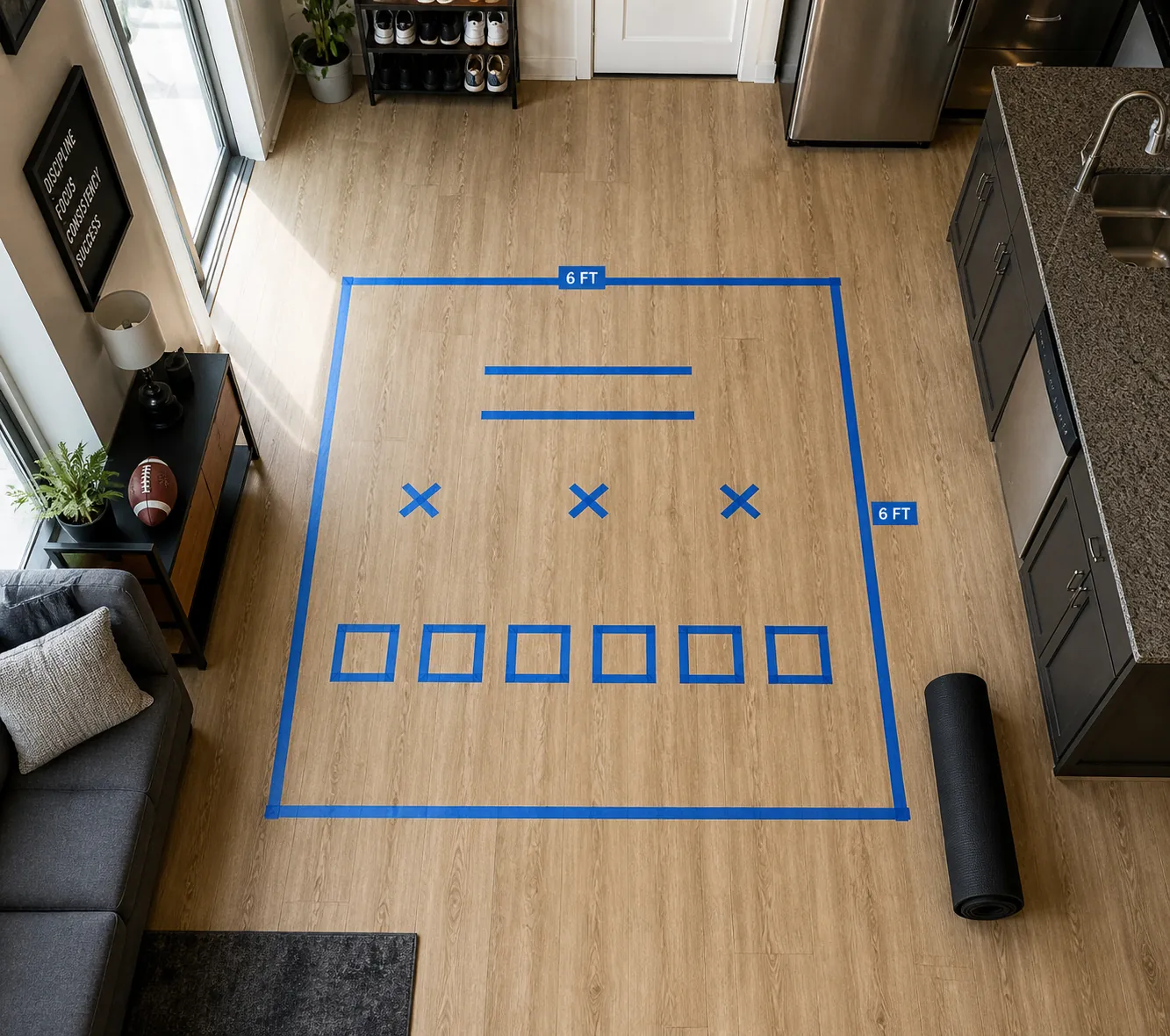
Set Up the 6x6-Foot Zone Before You Pick Drills
Next Level Athletics USA describes speed and agility training that can be done in a 6x6-foot area, using wall drive holds, quick-step line drills, and mini ladder patterns that do not require open forward running space.[2] That is trainer-tested small-space guidance, not a medical or performance standard. Still, it is the right size of claim for an apartment: small enough to tape off on the floor, large enough to train positions and foot rhythm without pretending the hallway is a turf lane.
Tape the square first. Put one strip down the middle for line steps. Add two short parallel lines for quick feet. Add four small X marks for shuffle or reset positions. If you have a yoga mat, keep it under wall drills and low-impact positions, not under fast lateral footwork where it can bunch up.
The floor matters as much as the exercise. A ground-floor unit, garage, basement, or thick concrete slab gives you more options. A second-floor bedroom over a neighbor’s ceiling gives you fewer. If your setup problem is bigger than this routine, the same noise-and-footprint logic applies when choosing a compact home gym for a tight apartment. Football drills are just less forgiving because bad choices announce themselves through the floor.
The Noise Key: Green, Yellow, Red
Most apartment football routines fail because they sort drills by muscle group instead of sound. For this setup, noise comes first. A drill that trains the right quality but shakes the room belongs outside.
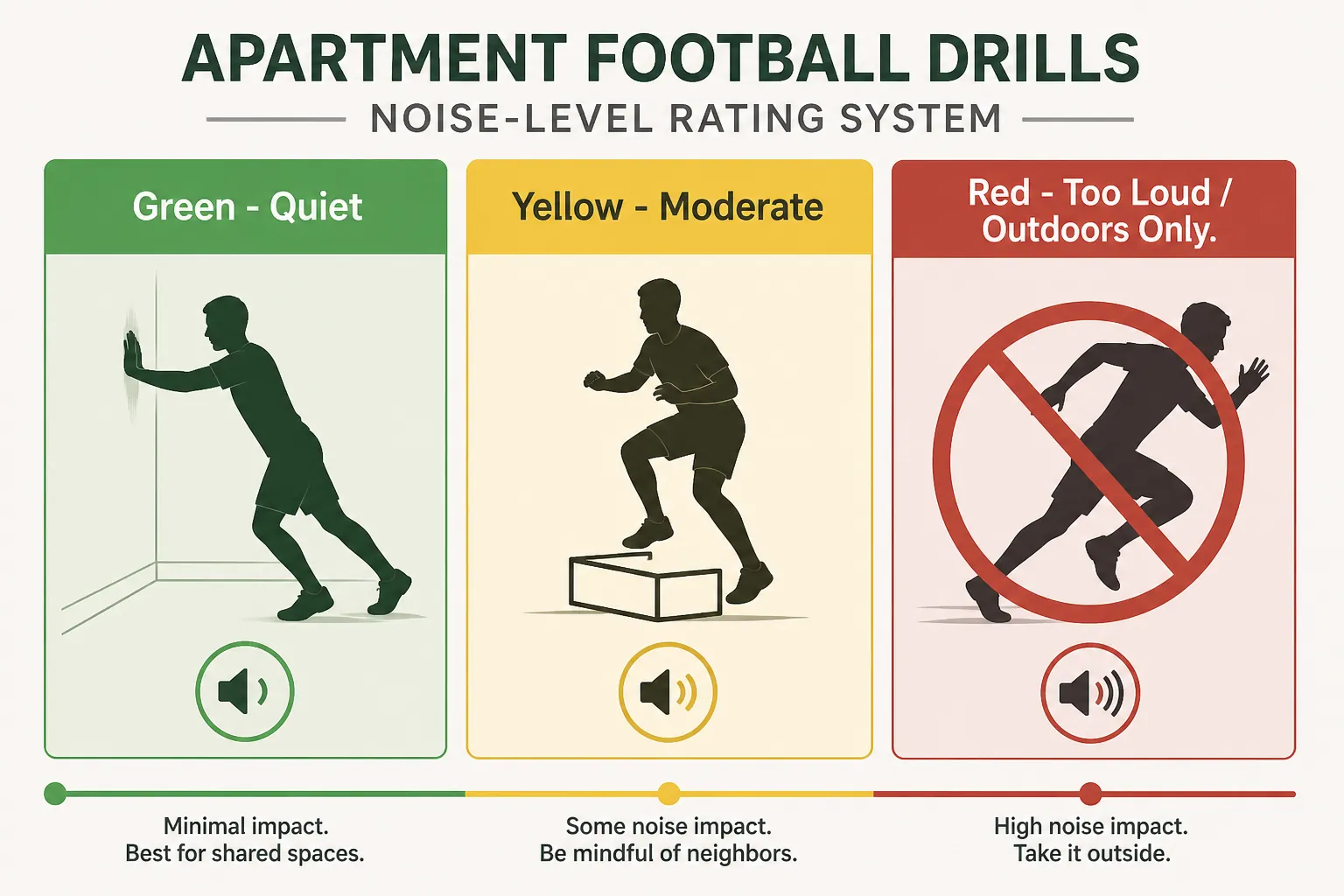
| Rating | Use it when | Typical drills | Apartment rule |
|---|---|---|---|
| Green | You need the quietest option | Wall drive holds, acceleration position switches, floor-tape line steps, mini ladder patterns | Safe starting point for upstairs units |
| Yellow | Your floor, mat, and neighbors can tolerate controlled impact | Low pogo contacts, snap-downs to stick, low skater step-and-stick, controlled split-squat switches | Test at low volume before adding conditioning sets |
| Red | You have a garage, yard, driveway, field, or padded training space | Jump squats, broad jumps, burpees with hard foot contact, sprint starts, cone shuttles | Do not force these into an upstairs apartment |
The test is simple: if the floor thumps, the drill changes. Not after the set. Right then. Quiet training is not about being delicate; it is about preserving the lease, the knees, and the next training day.
Green Drills: Quiet Work That Still Looks Like Football
Green drills are the base of the apartment program. They train posture, stiffness, foot replacement, and repeated short efforts without needing a runway. They will not replace sprinting. They will keep an athlete from losing the feel of acceleration mechanics while the field is not available.
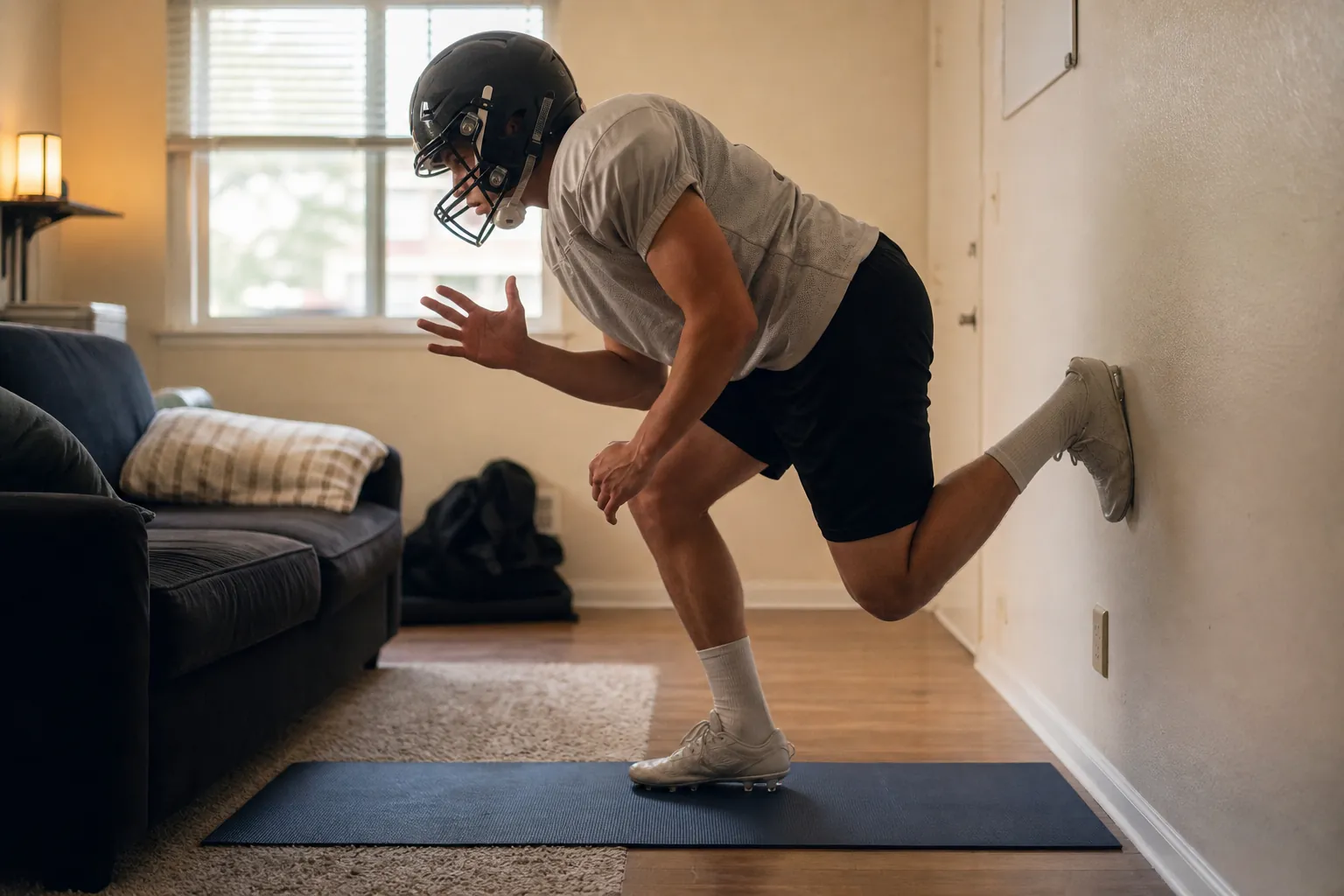
Wall Drive Hold
Place both hands on a wall, step back until the body leans forward, and lock into a straight line from shoulder to heel. Drive one knee up, keep the toe pulled up, and hold. The standing foot presses through the floor without bouncing.
- Work: 5 to 8 seconds per side
- Rest: 25 to 35 seconds
- Best use: acceleration posture, hip flexor stiffness, quiet warm-up into harder drills
- Stop if: the low back arches or the support foot starts bouncing
Wall Drive Switch
Use the same wall angle. Start with one knee up, then switch legs once, twice, or three times. The switch should be fast, but the foot contact should be placed, not stomped. If the mat slaps or the wall shakes, slow the switch down.
- Beginner: single switch, reset, repeat
- Intermediate: double switch, reset, repeat
- Conditioning use: 6-second bursts with full control
Floor-Tape Line Steps
Stand over a taped line. Move the feet in-out, forward-back, or right-left across the line while keeping the hips quiet. The drill should sound like socks brushing the floor, not cleats hitting turf.
| Pattern | How to do it | Football carryover |
|---|---|---|
| In-in, out-out | Both feet step inside the line, then both feet step outside | Linebacker and defensive back foot rhythm |
| Forward-back | Both feet cross the line forward, then retreat behind it | Short reset steps after a read |
| Right-left taps | Tap each foot across the line without jumping | Low-noise lateral quickness |
Mini Ladder Without a Ladder
Tape four to six small boxes inside the 6x6-foot zone. Move through them with short steps: one foot in each box, two feet in each box, or lateral in-in-out-out. Next Level Athletics includes mini ladder patterns among its small-space speed and agility options.[2]
Do not chase social-media ladder speed. If the feet get loud, wide, or tangled, the drill stopped being useful. A clean 6-second round is better than a 20-second scramble that trains panic feet.
Low Shuffle and Stick
Put two tape marks about two steps apart. Shuffle from one mark to the other and freeze for one count. Keep the knees bent, chest over the thighs, and feet under the body. The freeze is not decoration; it keeps the drill from turning into a slippery apartment skate.
- Work: 5 seconds
- Rest: about 30 seconds
- Best use: defensive back mirror work, linebacker read-step control, general lateral conditioning
Yellow Drills: Only If the Floor Passes the Test
Yellow drills add bounce, quicker deceleration, or more plyometric demand. They can be useful. They are also where apartment articles start lying to people. A jump squat is not quiet because someone writes “land softly.” If the landing sends vibration through the floor, it is not an upstairs-apartment drill.
Snap-Down to Stick
Rise tall on the toes, then drop into an athletic stance and freeze. The feet should land under the hips, not slam wide. Use this to train braking position without turning it into a jump.
- Use: 3 to 5 reps, then rest
- Keep it yellow only if: the landing is quiet on your floor
- Move it outside if: the feet slap or the floor shakes
Low Pogo Contacts
Keep the knees nearly straight and make tiny ankle bounces in place. The goal is elastic ankle contact, not height. This belongs on a mat or forgiving floor, and it should be cut immediately if it becomes a thump drill.
Skater Step and Stick
Step laterally to one side, load the outside leg, and stick the position. This is not a full skater jump. Keep one foot close to the floor and use it for controlled lateral loading. For many upstairs apartments, even this is too much. That is fine. Stay green.
Split-Squat Switch, Controlled
Start in a split stance, dip slightly, and switch feet with the smallest possible air time. If it becomes a jumping lunge, it leaves the apartment category. Use short sets and judge it by sound before effort.
Red Drills Belong Somewhere Else
Red drills may be good football drills. They are just not good upstairs-apartment drills. Sprint starts, broad jumps, burpees, box jumps, hard jump squats, cone shuttles, and aggressive backpedal-to-break work need a garage, driveway, yard, court, or field. If you have access to one of those spaces, use it. If you do not, do not wreck the room trying to prove a point.
The same goes for long hallway shuttles. A hallway can look tempting until a foot slips, a door opens, or a turn gets cut short because the wall arrives too fast. Tight-space conditioning should respect the space instead of pretending the space is not there.
Build the Conditioning Around Snaps, Not Cardio
The easiest mistake is making every drill last 30 to 45 seconds because that feels like conditioning. Football usually punishes the player who cannot repeat high-quality bursts. Once the feet slow down and the torso pops up, the drill is training survival more than football.
Use the 5.5-second play and 32-second rest numbers as a practical template, not a law. For apartment work, 5 to 8 seconds of effort and 25 to 35 seconds of rest keeps the session pointed toward repeated football bursts.[1]
| Block type | Work | Rest | Rounds | Best drills |
|---|---|---|---|---|
| Snap repeat block | 5 to 6 seconds | 30 to 35 seconds | 8 to 12 | Wall drive switches, line steps, low shuffle and stick |
| Drive series | 6 to 8 seconds | 25 to 35 seconds | 6 to 10 | Wall drive hold, wall drive switch, acceleration position reset |
| Foot-speed block | 5 seconds | 25 to 30 seconds | 8 to 10 | Mini ladder, in-in-out-out, forward-back line steps |
| Controlled work-capacity circuit | 10 to 20 seconds | 40 to 60 seconds | 3 to 5 | Bodyweight strength moves mixed with green footwork |
EliteFTS published an at-home offseason football training program in 2020 during the COVID-19 closure period, using bodyweight training and a four-day structure to keep football athletes training without normal facilities.[3] Athletes Acceleration also supports bodyweight circuits as a way to build strength-endurance and work capacity without equipment when the circuit is organized with purpose.[4] For an apartment, that support is useful as long as the circuit does not become random sweating.
Three Apartment-Safe Football Conditioning Sessions
These sessions assume a 6x6-foot zone, painter’s tape, and no equipment beyond a mat. If a yellow drill is too loud, replace it with the green option listed nearby. Do not add reps to punish yourself for being quiet; add precision.
Session A: Acceleration Mechanics and Repeated Bursts
| Order | Drill | Work | Rest | Rounds |
|---|---|---|---|---|
| 1 | Wall drive hold, right leg | 6 seconds | 30 seconds | 4 |
| 2 | Wall drive hold, left leg | 6 seconds | 30 seconds | 4 |
| 3 | Wall drive single switch | 5 seconds | 30 seconds | 6 |
| 4 | Floor-tape forward-back steps | 6 seconds | 30 seconds | 6 |
| 5 | Low shuffle and stick | 5 seconds | 35 seconds | 6 |
This is the best starting session for most apartments because every drill can stay green. The wall work gives the athlete a forward body angle. The tape work adds foot speed without pretending it is a sprint. If form stays sharp, the conditioning comes from repeating quality efforts.
Session B: Quiet Feet and Defensive Recovery
| Order | Drill | Work | Rest | Rounds |
|---|---|---|---|---|
| 1 | Mini ladder one foot in each box | 5 seconds | 25 seconds | 6 |
| 2 | Mini ladder two feet in each box | 5 seconds | 30 seconds | 6 |
| 3 | Right-left line taps | 5 seconds | 30 seconds | 6 |
| 4 | Low shuffle and stick | 6 seconds | 35 seconds | 6 |
| 5 | Wall drive hold | 6 seconds per side | 30 seconds | 3 per side |
This session fits defensive backs, linebackers, receivers, and any player who needs cleaner feet in a small area. It is also a good dorm-room option because the athlete can keep the whole workout inside the taped square.
Session C: Green Base With Optional Yellow Contacts
| Order | Drill | Work | Rest | Rounds |
|---|---|---|---|---|
| 1 | Wall drive switch | 5 seconds | 30 seconds | 6 |
| 2 | Snap-down to stick or wall drive hold | 3 to 5 controlled reps | 35 seconds | 5 |
| 3 | Low pogo contacts or forward-back line steps | 5 seconds | 35 seconds | 5 |
| 4 | Skater step and stick or low shuffle and stick | 5 seconds | 35 seconds | 5 |
| 5 | Mini ladder pattern of choice | 5 seconds | 30 seconds | 6 |
Run this only after Session A and Session B feel controlled. The yellow options are not upgrades for everyone. They are options for floors that can handle them. In a loud building, the green substitutions are the correct version.
Where Bodyweight Strength Fits
Bodyweight strength can support the conditioning, especially for athletes who have no weight room access. Keep it separate enough that the football-speed reps stay clean. A player doing wall drive switches with tired, collapsing hips is not getting extra credit.
| Exercise | Apartment noise | Use |
|---|---|---|
| Split squat | Green | Leg strength and position control |
| Push-up | Green | Upper-body strength-endurance |
| Bear plank shoulder tap | Green | Trunk control without floor impact |
| Reverse lunge | Green to yellow | Single-leg strength if the step stays quiet |
| Mountain climber | Yellow | Conditioning only if feet do not drum on the floor |
One clean circuit is enough after a football drill block: split squats, push-ups, bear plank shoulder taps, and a quiet line-step finisher. Work for 15 to 20 seconds, rest long enough to keep the next round controlled, and stop before the room turns into a percussion section.
A Simple Weekly Layout
For a youth or high school player training at home, two to four apartment sessions per week is a practical range when field work, practice, lifting, and school schedule are also in the picture. The quieter sessions can sit on days when a hard outdoor sprint session is not available.
| Day | Apartment focus | Notes |
|---|---|---|
| Day 1 | Session A | Acceleration mechanics and repeated bursts |
| Day 2 | Rest, walk, mobility, or team practice | Do not turn every day into conditioning |
| Day 3 | Session B | Quiet feet and defensive recovery |
| Day 4 | Rest or strength work | Keep impact low if neighbors are below |
| Day 5 | Session C or outdoor sprint work | Use yellow drills only if the floor passes |
If the athlete has access to a field that week, field sprinting gets priority for true speed. The apartment session then becomes mechanics, rhythm, and repeat-effort support. That is not a downgrade. It is the right job for the room.
Warm-Up and Recovery Without Making the Workout Bigger Than the Room
Warm up with low-noise movement: ankle rocks, hip switches, bodyweight squats to a comfortable depth, dead bugs, and slow wall drive holds. Five minutes is plenty for most short apartment sessions. The first few drill rounds can also build intensity gradually.
Cool down the same way: walk around the room, breathe, stretch the calves and hip flexors, and get off the floor before adding junk volume. If recovery tools need to stay quiet and compact, a space-saving option like the Hyperice Hyperslide at home fits the same apartment problem better than loud or bulky gear.
FitAtHome has tested other sport-specific apartment setups, including a FightCamp apartment workout and structured at-home training inspired by Adrien Broner’s 45-day transformation. The useful pattern is the same here: the space is not an excuse, but it is a rule.
The Selection Rule
A small apartment cannot replace field sprinting, contact practice, full-speed route running, tackling work, or true change-of-direction training. It can keep an American football player sharper than generic jogging, better prepared for repeated short bursts, and more connected to football positions when the field is not available.
Start with green drills. Add yellow only if the floor, mat, and neighbors can tolerate it. Save red drills for outside. Build the main work around 5-to-8-second efforts with football-like rest, and cut any drill the moment it becomes loud, sloppy, or too big for the room.
References
- Football Conditioning: The RIGHT Way!, DeFranco’s Training, https://www.defrancostraining.com/football-conditioning-the-right-way/
- Speed and Agility Training in Small Spaces, Next Level Athletics USA, 2025, https://nextlevelathleticsusa.com/uncategorized/speed-agility-training-small-spaces/
- At-Home Offseason Football Training Program, EliteFTS, 2020, https://elitefts.com/blogs/training/at-home-offseason-football-training-program
- Body Weight Circuits, Athletes Acceleration, https://athletesacceleration.com/body-weight-circuits/
What a small equipment investment adds
We don't have a build tagged to this exact tier yet. Browse all builds.
How often should you repeat this?
See our recovery and rest reference for citation-anchored rest-interval guidance.
Spot something off?
Tell us if a movement, tier assumption, or duration didn't match your experience.