
Apartment-Friendly Golf Drills That Work Without a Net
Improve your golf game from your apartment with no equipment, no net, and no noise complaints — using household items and drills designed for low ceilings and tight spaces.
- Equipment tier required
- none
- Duration
- 20 min
- Difficulty
- beginner
- Target area
- full body
- Noise level
- low
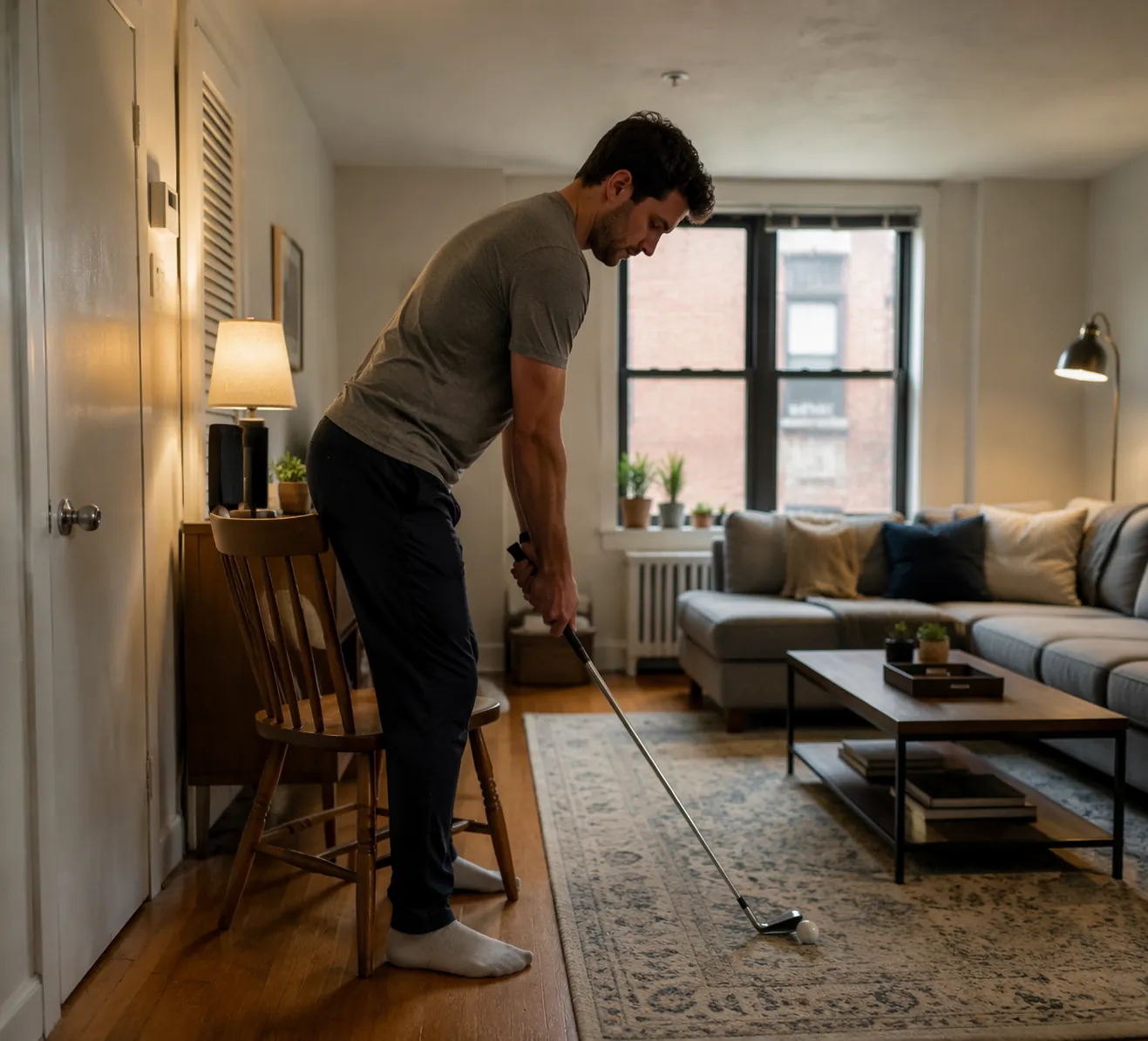
The apartment test for golf at home training drills is not whether the drill looks good in a garage. It is whether it works under a low ceiling, stays quiet enough for neighbors, avoids real-ball impact into a wall, and disappears before the room has to become a room again.
That rules out more than most golf advice admits. A full-speed driver swing is not a safe apartment drill if the ceiling is under 9 feet. Real golf balls into drywall are not “feedback”; they are a repair bill. Rehearsals that thump through the floor are not more serious because they are louder. Small-apartment golf guidance commonly puts full swings in the 9–10 ft clearance range, while several useful movement drills can still fit in 7–8 ft spaces when they are done slowly and without a ball [1].
The useful menu is narrower, but not empty. In an apartment, the best work tends to be slow-motion sequencing, posture control, contact awareness, tempo, and short putting. Those are not consolation prizes. They are the parts of practice where a wall, chair, strip of tape, towel, book, or coin can make a mistake visible without a launch monitor.
Start With the Limits, Then Pick the Drill
Before choosing a drill, check the room the way a renter actually uses it: ceiling first, neighbors second, cleanup third. If any drill fails one of those checks, it belongs outside, at the range, or in a larger practice space.
| Apartment constraint | Skip | Use instead |
|---|---|---|
| Ceiling under 9 ft | Full-speed driver or long-club swings | Slow-motion hip turns, wall-plane checks, chair posture drills, putting |
| Thin floors or downstairs neighbors | Hard impact, stomping weight shifts, repeated ball strikes into walls | No-ball rehearsals, towel drills, putting on a rug, foam-ball chips only if quiet |
| No net or mat | Real-ball full shots | Masking-tape face checks, shadow swings, contact rehearsals into a pillow or towel |
| Two-minute cleanup | Permanent practice station | Chair, books, coin, tape strip, towel, floor line |
Foam balls and mats can reduce risk and noise, but retail advice around them often comes from companies that sell practice gear. The practical parts are still useful: avoid real-ball impact indoors, dampen sound with a rug or yoga mat, and practice during reasonable hours rather than making the apartment below you absorb your ambition [1]. The no-purchase version is even simpler: if a drill makes a thump, remove the ball, slow it down, or change the surface.
Low-Ceiling Swing Drills That Still Teach the Body
Low ceilings are annoying, but they are also honest. They force the club out of the drill unless the club is really needed. For apartment swing work, that is usually a good trade. The aim is not to rehearse a heroic finish under a ceiling fan. The aim is to make the body learn where it should be before the speed comes back at the range.
Chair-Behind-the-Hips Drill for Early Extension
Early extension is the move where the hips drift toward the ball and the golfer stands up through the downswing. Golf.com published an instructor’s estimate that about 70% of amateur golfers do it, but that figure should be treated as a teaching observation, not a formal population statistic [2]. The important apartment point is that the fix does not need a ball, net, mat, or full swing.
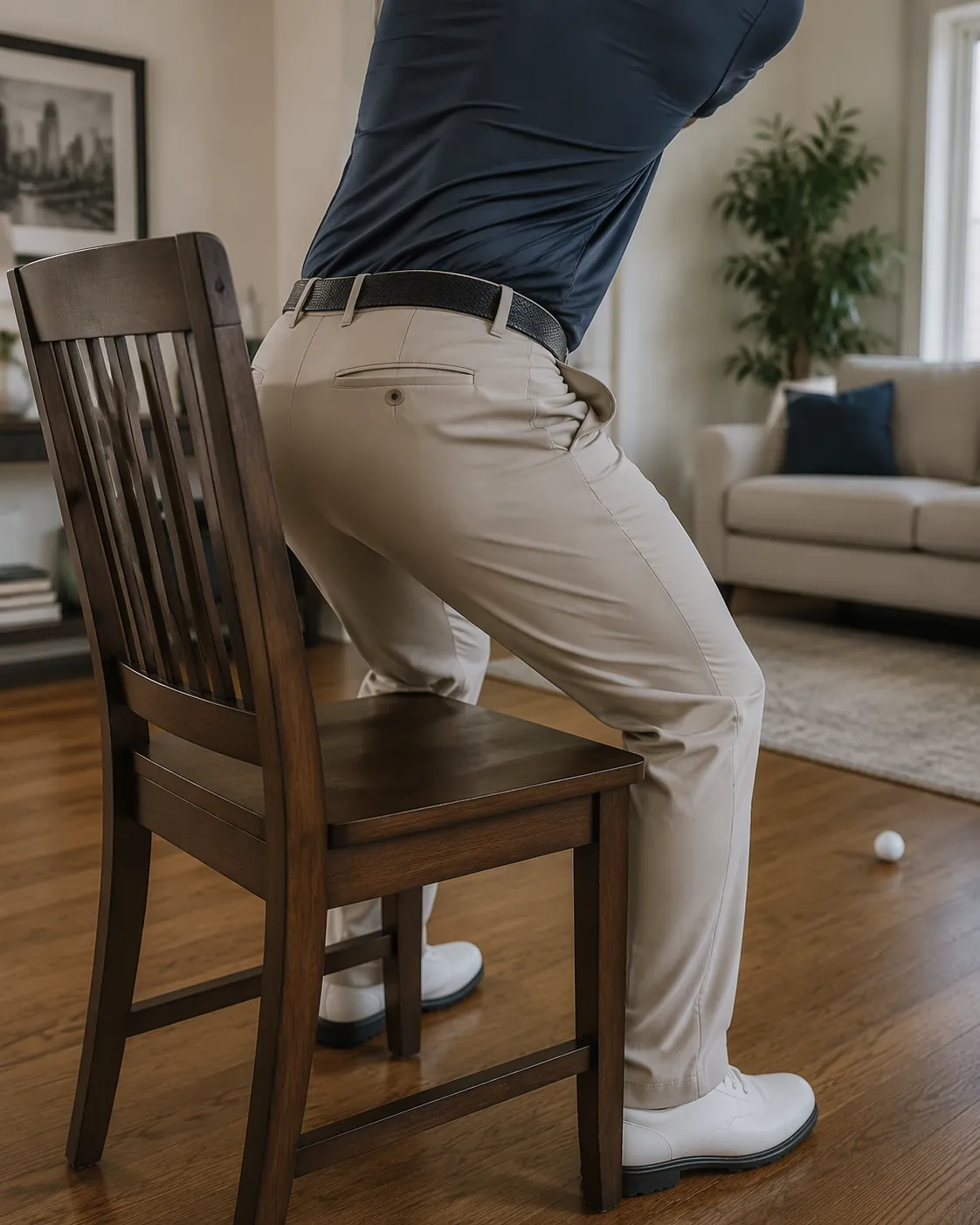
Place a dining chair behind you so the front edge of the seat or backrest is lightly touching, or nearly touching, your backside at address. Use a short iron if the ceiling allows it; otherwise hold the club across your chest. Set up over an imaginary ball. Turn slowly to the top, then start down while keeping your trail hip close to the chair. Through the impact zone, the feeling is that the hips rotate against the constraint rather than lunging away from it.
The chair gives immediate feedback. If your hips leave it early, you stood up or moved toward the ball. If you shove the chair backward, you are pushing into the prop instead of turning. The quiet version is to put the chair on a rug or folded towel and use only slow rehearsals. Nothing about this drill improves because the chair scrapes across hardwood.
- Do 6–8 slow reps with the club across your chest.
- Do 6–8 reps with a short club only if the ceiling is safe.
- Pause at the imagined impact position and check whether the hips are still near the chair.
- Stop the set if the chair moves, the floor thumps, or the club feels close to the ceiling.
Wall-Plane Drill for an Over-the-Top Move
Stand far enough from a wall that you can make a slow backswing with a short club or with your hands clasped. The wall is behind you, roughly where an outside-the-line downswing would crash. Make a slow backswing, pause, then rehearse the downswing without letting your hands or clubhead move out into the wall.
This is not a speed drill. It is a path-awareness drill. If the wall keeps getting involved, the takeaway or transition is throwing the club outside too early. No-equipment drill libraries commonly use walls and slow rehearsals for swing path and body-position feedback because the surface turns an invisible movement error into something obvious [3]. In an apartment, use that feedback gently: near the wall, not into it.
Head-on-Wall Sway Check
Set up in golf posture with the top or side of your head lightly near a wall. Cross your arms over your chest or hold a towel across your shoulders. Make a slow backswing. If your head slides into the wall or pulls dramatically away from it, you are adding sway instead of turning.
The wall should not pin you in place. A golf swing has pressure shift and rotation. The apartment version simply gives you a boundary so the upper body does not wander a foot sideways while you call it a turn. Keep the reps slow enough that there is no bumping sound through the wall.
Towel-Under-Arms Connection Drill
Place a small towel lightly under both armpits and make waist-high rehearsals. If the towel drops immediately, the arms and torso are separating. If you have to squeeze your arms so hard that the shoulders freeze, you have turned the drill into a wrestling match.
This drill fits low ceilings because the motion can stay waist-to-waist. It also stays quiet because there is no ball. Use it for half-swings, pitch-motion rehearsals, or tempo work before putting. It is especially useful on nights when even a foam-ball chip feels like asking for a note under the door.
Shadow Swings for Sequencing
A shadow swing is just the golf swing stripped of impact. Face a window at night or use a lamp against a blank wall. Rehearse the order: turn, shift, unwind, finish balanced. Keep the club out of it if the ceiling is questionable. If you need something in your hands, hold a towel or a short object instead of a long club.
The value is tempo, not imitation speed. Slow-motion sequenced reps remove the two apartment problems that usually ruin indoor swing practice: ceiling risk and impact noise.
Contact Feedback Without Ball Flight
Contact practice indoors gets dangerous when it pretends ball flight does not matter. If there is no net and no safe strike zone, do not hit real shots. Instead, separate strike-location feedback from ball flight. You can learn whether the face is finding the center without sending a ball across the room.
Masking-Tape Clubface Drill
Put a strip of masking tape across the clubface. Make tiny, controlled chips into a pillow, folded towel, or soft cushion only if the surface is stable and the sound is acceptable. The mark on the tape shows where the ball met the face. Strike-location drills using face spray or tape are widely used because they reveal contact without needing to guess from ball flight; MyGolfSpy includes no-simulator home practice guidance that points golfers toward simple feedback methods rather than full simulator setups [4].
The apartment-safe version can also be done without a ball. Sole the club behind an imaginary ball, rehearse a short motion, and brush the tape gently against a folded towel positioned where the ball would be. You will not get the same mark a real strike gives, but you can check whether the face is returning to the same place and whether the low point is drifting.
- Use a wedge or short iron, not a long club.
- Aim into something soft and low, never at a wall, window, door, television, or cabinet.
- Hit only the smallest possible chips, or skip the ball entirely.
- Quit the drill if the strike makes a sharp sound through the floor.
Towel Low-Point Brush
Lay a small towel flat on the floor and place a strip of masking tape just in front of it as your imaginary ball line. Make slow chip motions and try to brush the floor on the target side of the line. If the club hits the towel first, your low point is behind the ball. If you miss the floor entirely, you are probably lifting through impact.
This is one of the better renter drills because the towel protects the floor, the motion stays short, and the mistake is visible. It is not a substitute for seeing divots or ball flight outside, but it can make sloppy indoor rehearsals much less vague.
Putting Inside 10 Feet Is Worth the Floor Space
Putting is where the apartment stops feeling like a compromise. A straight section of floor, a rug, or a hallway can give enough room for high-value work. Practical-Golf’s at-home practice guide emphasizes putting inside 10 feet because amateurs have their highest make probability in that range, and it points to PGA Tour putting statistics to show why short-putt practice deserves attention [5].
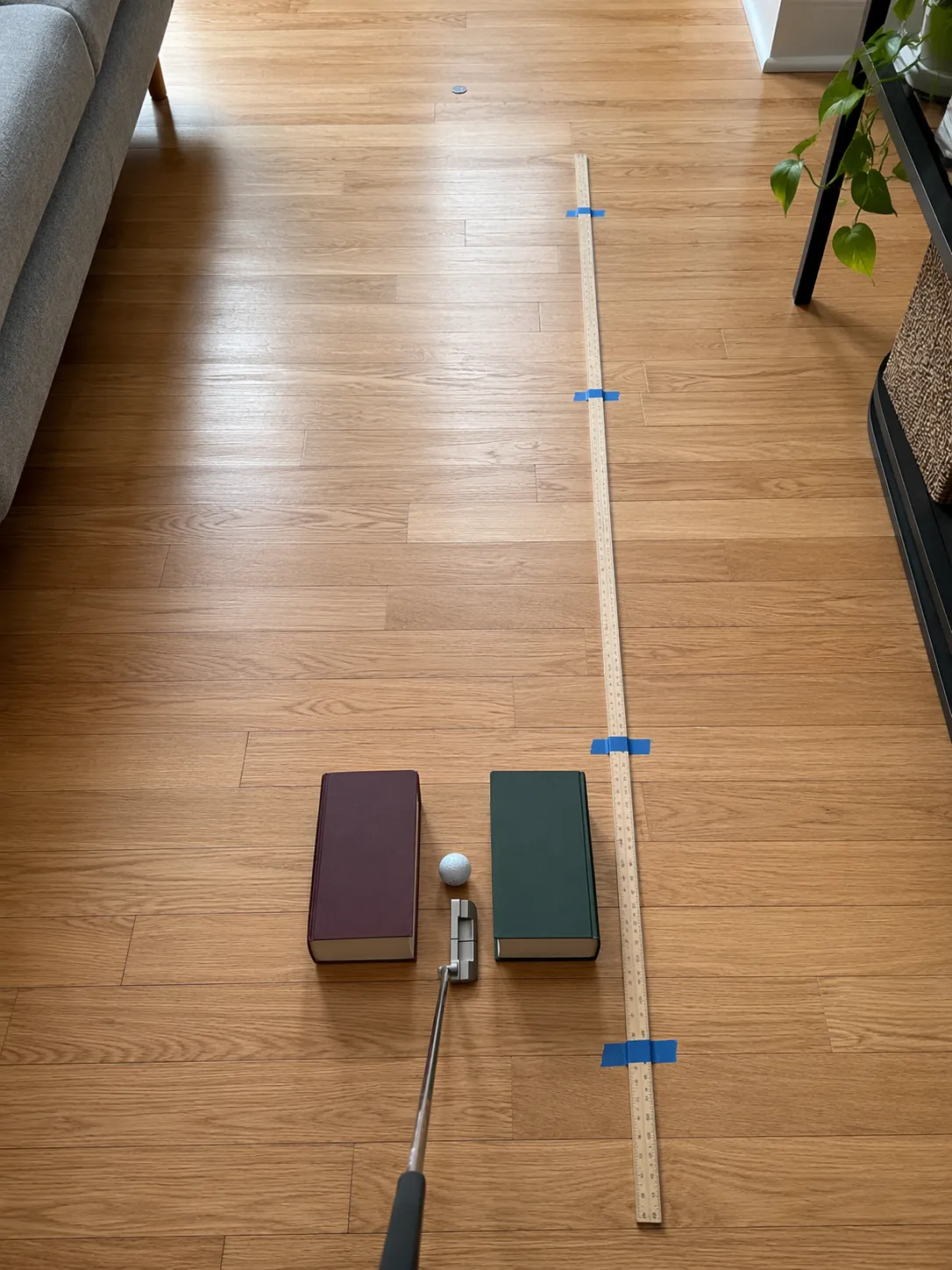
The surface will not roll like a green. That is fine. Indoors, the work is start line, face control, stroke path, and distance discipline. Those skills do not require a cup cut into the carpet.
Yardstick Start-Line Drill
Place a yardstick or a straight strip of tape on the floor. Set the ball at one end and roll it along the line. If the ball falls off early, the face or path is sending it offline. Keep the stroke small and the target close enough that you can retrieve the ball without turning the room into a fetch drill.
On hardwood, use painter’s tape only if it is safe for the finish, and remove it after practice. On carpet or a rug, a yardstick is cleaner. The point is the same either way: the ball has to start where the face says it should start.
Book-Channel Stroke Drill
Place two hardcover books on the floor, parallel to the target line, just wide enough for the putter head to travel between them. Hit short putts without touching either book. If the putter clips the inside book, the path is moving one way; if it clips the outside book, it is moving the other.
This drill is excellent in a small room because the boundaries are real. You do not have to wonder whether the stroke wandered. The books tell you. Start with generous spacing, then narrow the channel only when the stroke stays quiet and centered.
Quarter-Target Drill
Place a quarter, poker chip, or small piece of tape 3–8 feet away. Putt toward it and try to finish the ball on or just past the target. A cup-sized target is easier to flatter yourself with indoors. A coin makes the start line and speed demand obvious.
If the floor has a strong slope or the carpet grabs the ball, do not overread the result as green-reading practice. Use the drill for repeatable roll, face control, and speed to a small target. The apartment floor is a training constraint, not a putting green.
Gate Without a Gate
Set two coins or small pieces of tape just wider than a ball, about a foot in front of the starting position. Roll putts through the gap. This adds a start-line check without buying a putting gate. If the ball clips the left or right marker, the face is not starting the ball cleanly enough.
A Quiet 20-Minute Apartment Session
A good apartment session should not require moving half the furniture. If the setup takes longer than the practice, it will not survive a normal week. For broader weekly planning, pair this drill library with How to Schedule Your Home Golf Practice for Real Improvement; use this article for the drills and that one for distributing them across the week.
| Time | Drill | Setup |
|---|---|---|
| 3 minutes | Shadow swings | No club or towel in hands |
| 5 minutes | Chair-behind-the-hips drill | Dining chair on rug or folded towel |
| 4 minutes | Towel-under-arms connection | Small towel, waist-high motion |
| 3 minutes | Masking-tape or towel low-point check | Tape, towel, no ball or tiny soft-contact reps |
| 5 minutes | Yardstick, book-channel, or quarter putting | One straight floor line and a small target |
The session can be shorter. On a low-energy night, do the chair drill and one putting drill. On a noise-sensitive night, skip every impact drill and keep only shadow swings, wall checks, and putting on a rug. The drill library is meant to narrow choices, not create another obligation that needs its own storage bin.
What These Drills Can and Cannot Replace
Apartment drills can improve mechanics, posture awareness, contact consistency, tempo, and short-putt accuracy. They can make the body feel a better constraint before speed and ball flight enter the picture. They can also keep practice alive during weeks when a range trip is not happening.
They do not replace occasional range sessions. You still need to see the ball fly, learn whether a face pattern becomes a shot pattern, and test whether slow rehearsals hold up when speed returns. Indoor contact marks and wall checks are feedback, not proof that the whole swing is fixed.
That is a reasonable bargain for an apartment. A chair, towel, tape strip, books, wall, pillow, coin, or floor line can set up quickly, stay quiet, and disappear before anyone has to explain why there is a practice station in the living room.
References
- Perfect Home Golf Practice Space (Even in Small Apartments), Chiputt Golf
- 10 indoor golf drills you can do while you're stuck at home, Golf.com, 2020
- Essential No Equipment Golf Drills, V1 Sports
- 5 Golf Drills You Can Do at Home (No Simulator Required), MyGolfSpy
- How to Practice Golf at Home [Complete Guide], Practical-Golf.com
What a small equipment investment adds
We don't have a build tagged to this exact tier yet. Browse all builds.
How often should you repeat this?
See our recovery and rest reference for citation-anchored rest-interval guidance.
Spot something off?
Tell us if a movement, tier assumption, or duration didn't match your experience.