
Apartment-Safe BJJ Drills for No-Equipment Home Workouts
Not all BJJ solo drills are safe for apartment living. This article ranks common movements into noise-impact and floor-damage tiers so you know which to drill at home and which to save for the gym.
- Equipment tier required
- none
- Duration
- 19 min
- Difficulty
- beginner
- Target area
- full body
- Space footprint needed
- 6 x 6 feet
- Noise level
- quiet-friendly
A jiu jitsu home workout with no equipment can be apartment-floor safe, but only if the drill list gets filtered before you start moving. The problem is not whether shrimping, bridges, rolls, sprawls, and technical stand-ups are “real BJJ.” They are. The problem is that they do not hit the floor the same way, they do not need the same space, and they do not create the same conversation with the person living below you.
Most solo-drill lists are written as if the floor is neutral. In an apartment, the floor is part of the drill. A slow hip escape across a yoga mat is one thing. A late-night sprawl into a wood-joist floor is another.
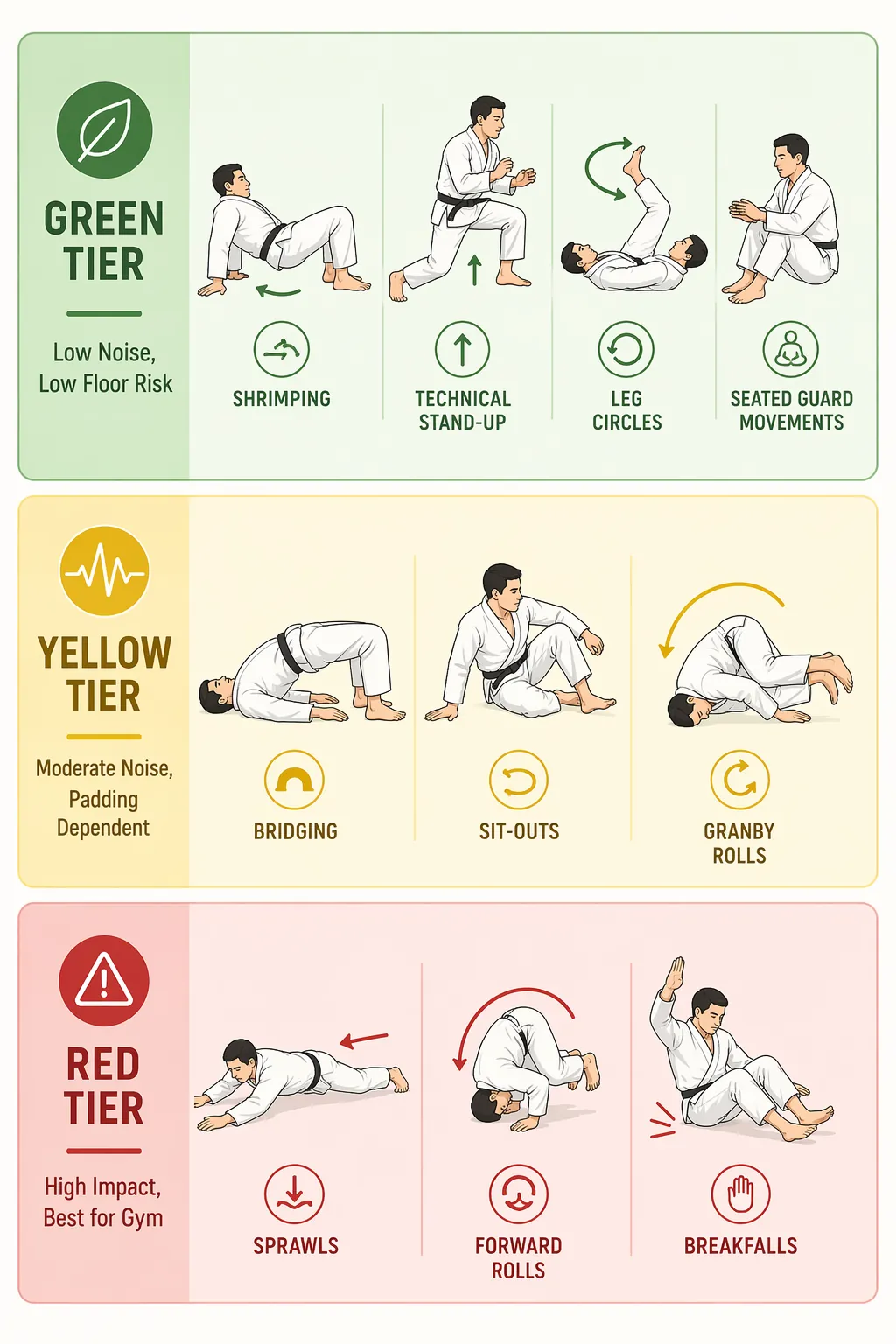
The Apartment-Safety Tier Map
This ranking is a practical synthesis, not a lab-measured decibel study of BJJ movements. The sources behind it list common solo drills and home-training formats; the tiering comes from the mechanics of each movement: whether your weight stays controlled, whether a limb slaps the floor, whether your hips drop, and whether the drill needs enough room that you are likely to crash into furniture.
| Tier | Best fit | Drills | Padding and floor risk |
|---|---|---|---|
| Green | Most apartment-friendly | Shrimping, technical stand-ups, leg circles, hip heists, seated guard movements, shadow grappling, seated or kneeling hip-mobility flows | Usually reasonable on hardwood with a yoga mat or thin exercise mat if performed slowly and kept low-impact |
| Yellow | Useful, but building-dependent | Bridges, sit-outs, Granby rolls, butterfly lifts | Prefer 0.5–1 inch padding; risk rises on wood-joist floors, at night, or when speed turns into impact |
| Red | Save for the academy unless your setup is closer to a real mat space | Sprawls, forward rolls, backward rolls, breakfalls, takedown entries | Need dedicated 1.5 inch or thicker mats and a tolerant space; even then, impact can transmit through the building |
JiuJitsu.com’s solo-drill list includes movements such as shrimping, bridging, technical stand-ups, Granby rolls, and sprawls, and it recommends at least an 8-by-8-foot area for solo drilling.[1] RollBliss gives a more compact limited-space benchmark of about 6 by 6 feet.[2] That range matters. A drill that behaves well in an 8-by-8 spare room can become noisy and clumsy when it is squeezed between a coffee table and a radiator.
Green-Tier Drills: The Home Menu You Can Actually Repeat
Green-tier drills keep your center of mass under control. They may be tiring, technical, and useful, but they do not require you to throw your body into the floor. That is the difference between a home drill and a home complaint.
Shrimping belongs here when it is done as a slide, not a stomp. The heel can still thump if you kick the floor hard, so the apartment version should be slower than the warm-up-line version. Think of pushing the hip away and pulling the elbow-knee frame back underneath you, not launching yourself across the room. JiuJitsu.com and Kingz both include shrimping among core solo movements, which makes sense; it is one of the rare drills that is both fundamental and easy to scale down for a living room.[1][3]
Technical stand-ups are also green if you treat the posted hand and foot as quiet contact points. The apartment mistake is letting the back foot slap down after the hip lifts. Keep the base narrow enough that you do not need a running start, stand only as high as your ceiling and furniture allow, then reverse the motion with control. If your floor squeaks under the posting hand, put the hand on the mat rather than half-on, half-off the edge.
Leg circles, hip heists, seated guard pummeling, and shadow grappling are the quiet workhorses. They let you rehearse hip angles, frames, inside position, and guard-retention habits without pretending your apartment is a mat room. They also expose the boring truth of solo practice: if you cannot move smoothly at half speed on a quiet floor, adding speed usually just hides the problem.
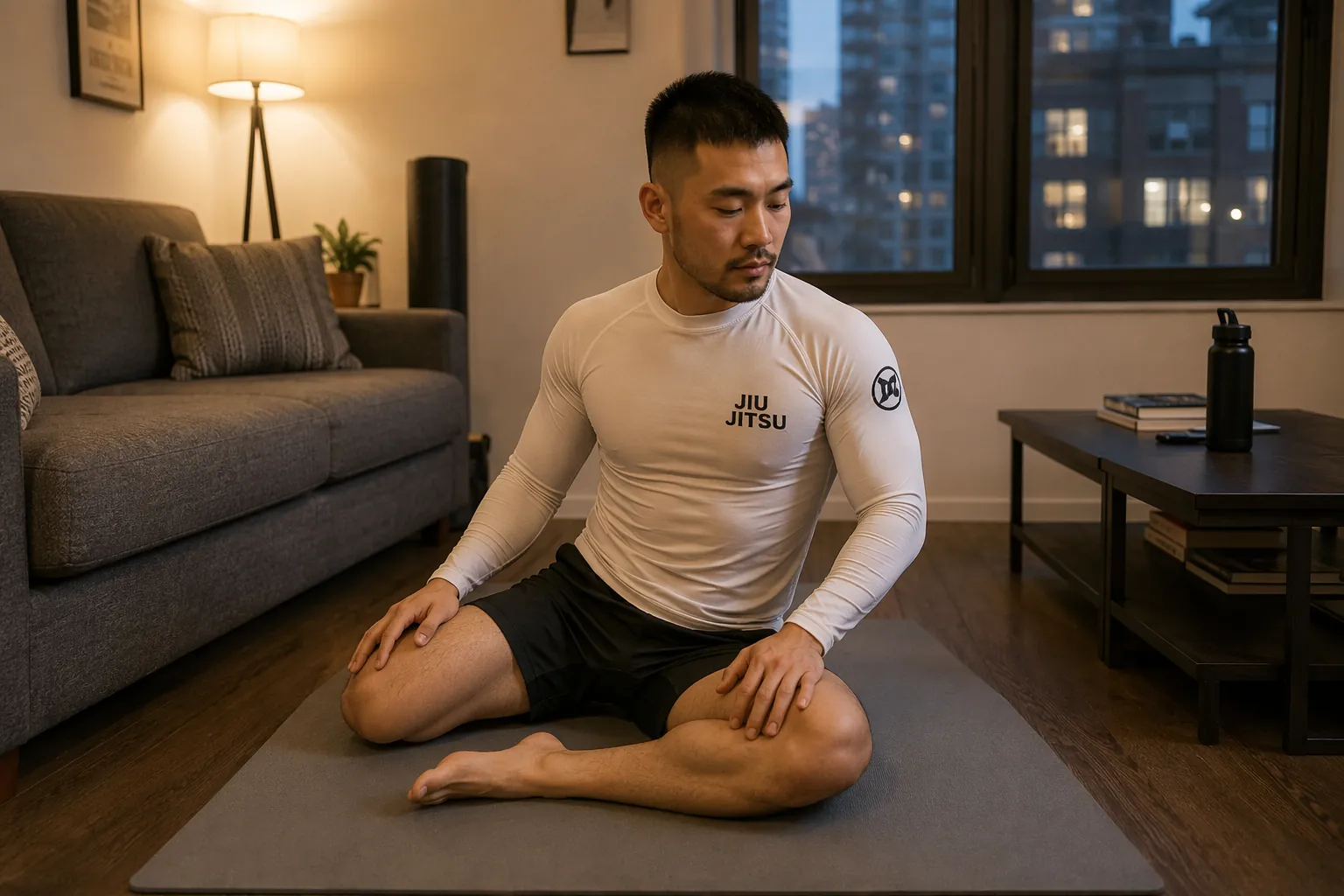
The most apartment-friendly sequence here is not even a classic BJJ warm-up line. Ryan Hurst’s GMB Fitness sequence uses a 90/90 switch, kneeling lunge, and twisting bear, all performed from seated, kneeling, or low hand-supported positions.[4] That is exactly the kind of movement a compact-apartment grappler should steal without apology. It trains hip rotation, transitions, and active range without asking the floor to absorb a landing.
- Quietest green choices: 90/90 switches, seated guard pummeling, leg circles, slow hip heists.
- Best BJJ-specific green choices: shrimping, technical stand-ups, shadow grappling, seated guard movements.
- Main apartment rule: if the heel, knee, elbow, or hip makes a sharp sound, slow the drill down before adding more padding.
Yellow-Tier Drills: Good Movements, Conditional Floors
Yellow-tier drills are not unsafe by nature. They become questionable because small changes in speed, fatigue, floor structure, or padding change how much impact reaches the building. This is where “I bought mats” stops being a complete answer.
Bridging is the easiest drill to underestimate. A controlled bridge can be quiet: shoulder blades stay planted, feet press through the floor, hips rise, hips return. A tired bridge often becomes heel-driving and hip-dropping. That is still useful on academy mats. In an apartment, especially on a springy wood floor, it can sound like someone tapping the ceiling from above.
Sit-outs sit in the same middle zone. Done low and smooth, they are mostly hand-and-foot transitions. Done fast, they turn into a series of palm slaps, knee bumps, and hip drops. If you have only a yoga mat over hardwood, keep them slow or reduce the range. If you have 0.5–1 inch padding and a floor that does not resonate, they become much more reasonable.
Granby rolls deserve more caution than they usually get in drill lists. JiuJitsu.com includes Granby rolls among solo movements, and they are valuable for inversion awareness and guard recovery.[1] The apartment issue is not the technique’s value; it is the combination of shoulder loading, spine rolling, and momentum. In a cramped room, the roll can drift. On thin padding, the shoulder and hip contact can be louder than expected. Near furniture, the risk is no longer just noise.
Butterfly lifts are yellow because the lifting leg can be quiet, but the return often is not. If the imaginary opponent is a pillow or no opponent at all, keep the lift technical and the landing silent. If the drill makes you kick the mat, it belongs in a better-padded session.
Red-Tier Drills: Useful BJJ, Bad Apartment Choices
Red-tier drills are not bad drills. They are bad default choices for a rental living room. Sprawls, rolls, breakfalls, and takedown entries all involve sudden weight transfer, travel, or landing mechanics. That is exactly what apartment floors punish.
Sprawls are the clearest example. They show up in common home-drill catalogs because they build shot-defense timing and conditioning.[1][3] They also put a lot of body mass into the floor quickly. Even if your chest never fully crashes, the feet shoot back, the hips drop, and the hands usually hit hard enough to announce the rep. A sprawl that is quiet enough for an apartment is often so modified that it stops training the quality people wanted from the drill in the first place.
Forward and backward rolls have a different problem: they move. In an academy, the mat gives you runway and forgiveness. In a 6-by-6-foot corner, the wall arrives quickly. A clean roll can still be controlled, but a slightly crooked roll near a coffee table is not worth the home-training points.
Breakfalls are the easiest red-tier call. Their purpose is to teach impact management. That does not make them apartment-friendly; it makes them impact drills. Unless you have dedicated matting, enough clear space, and a building situation where impact noise is not a problem, save them for the gym.
Takedown entries vary, but the apartment-safe version is usually just footwork and level changes. Once the drill includes penetration steps that stamp, sprawled finishes, shot recoveries, or wall-to-wall movement, it has left the quiet category. Practice posture, stance switches, grip-shadowing, and level changes if you want the pattern. Do the real entry work on mats.
Space Changes the Tier Faster Than People Admit
The difference between 6 by 6 feet and 8 by 8 feet sounds small until you are halfway through a technical stand-up and your rear foot is under the sofa. RollBliss frames limited-space home training around roughly 6 by 6 feet, while JiuJitsu.com recommends at least 8 by 8 feet for solo drilling.[1][2] Treat that as a range, not a contradiction.
| Usable clear space | What it supports best | What to avoid |
|---|---|---|
| About 6 by 6 feet | Seated guard work, 90/90 switches, leg circles, slow hip heists, compact technical stand-ups | Rolling drills, fast sit-outs, sprawls, traveling shadow sequences |
| Closer to 8 by 8 feet | Shrimping in short lanes, technical stand-up chains, controlled bridging, low-intensity shadow grappling | Breakfalls, hard sprawls, takedown entries with momentum |
| More than 8 by 8 feet with real mats | Some yellow-tier work becomes easier to justify | Red-tier impact still depends on mat thickness, subfloor, neighbors, and time of day |
Clear space means more than visible floor. It means no table corner at head height during a Granby, no lamp where your hand posts during a stand-up, and no mat edge that catches your heel during a sit-out. A drill that requires you to aim around furniture is already too big for the room.
Padding Helps, but It Does Not Rewrite Physics
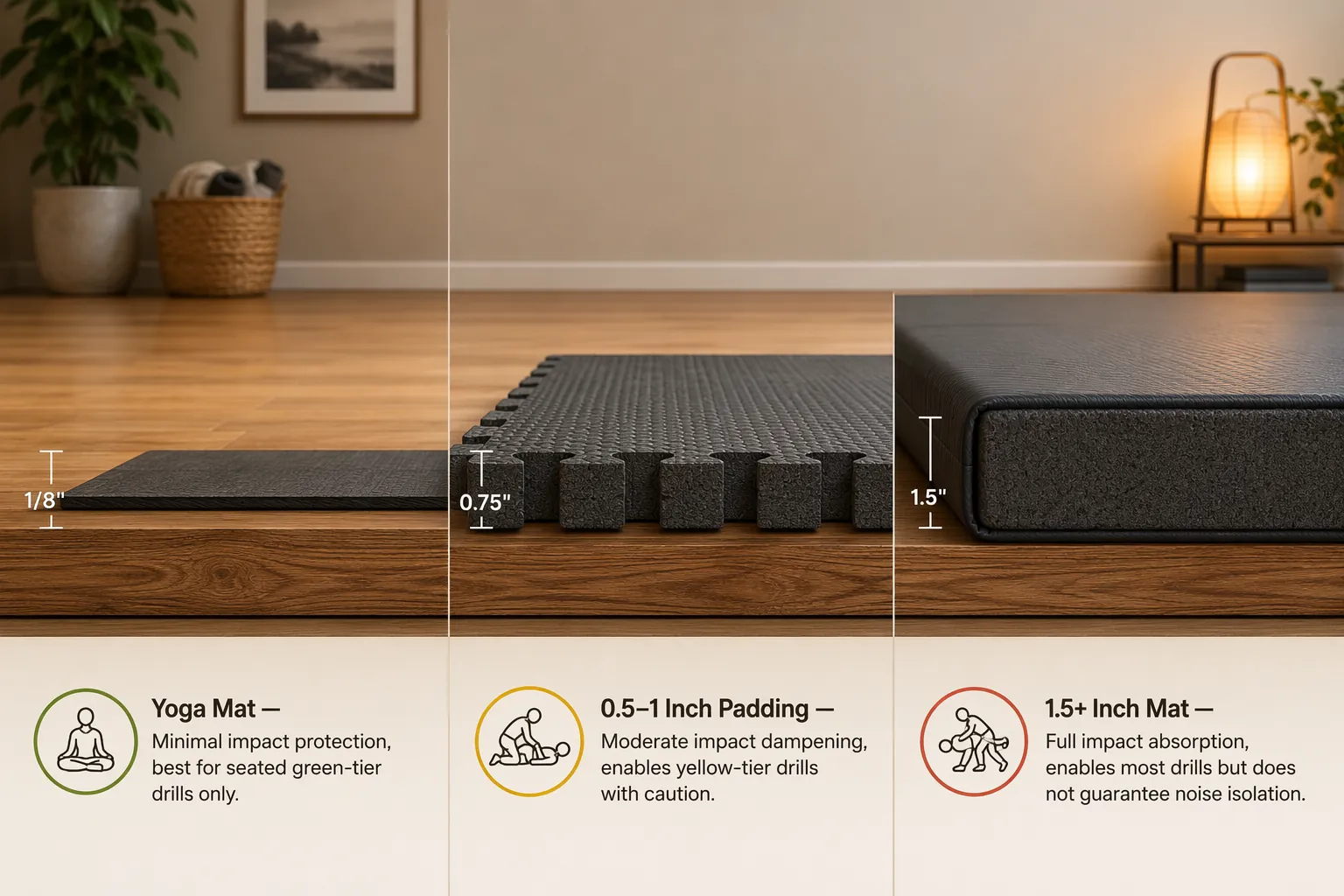
Padding has two jobs that people mix together: protecting your body from the floor and reducing what the building receives. Those overlap, but they are not identical. A mat can make your shoulder feel better during a roll and still transmit a dull thud through a wood-joist floor.
A yoga mat is enough for many green-tier drills because those drills are mostly about friction, comfort, and controlled contact. It gives your knees, elbows, and hips a cleaner surface and a little cushion. It should not be treated as impact protection for breakfalls, hard bridges, or sprawls.
The middle category, roughly 0.5–1 inch padding, is where yellow-tier drills become more plausible. Interlocking foam or rubber-style flooring can reduce sharp contact and spread load better than a yoga mat. Norsk Store reports manufacturer-tested impact-noise reductions of 65–75% for 0.47-inch rubber tiles and about 50% for double-layer foam mats, but those figures should be read as directional, not a promise for every apartment.[5]
The reason for caution is the building underneath. Impact Insulation Class performance varies with the assembly below the mat, including whether the floor is a concrete slab or wood-joist structure.[5] A concrete building may tolerate moderate movement better. A light wood floor can behave like a drum. Your neighbor does not hear your mat spec; they hear the completed system.
Dedicated jiu jitsu mats are a different category. Greatmats’ jiu jitsu mat comparison discusses thicker martial-arts mat options, including 1.5-inch products, as part of the category used for grappling-style training.[6] That kind of thickness is much more appropriate for red-tier movement than a yoga mat, but it still does not guarantee silence, prevent every floor issue, or make a cramped room safe for rolling.
| Surface | Reasonable use | Poor use |
|---|---|---|
| Bare hardwood or carpet | Very slow seated mobility if the surface is clean and stable | Any drill with sliding friction, knee pressure, rolling, or impact |
| Yoga mat or thin exercise mat | Green-tier drills: shrimping, technical stand-ups, seated guard work, 90/90 switches | Sprawls, breakfalls, fast bridges, Granby rolls at speed |
| 0.5–1 inch padding | Green tier plus cautious yellow-tier work if noise is acceptable | Assuming downstairs impact is solved |
| Dedicated 1.5 inch or thicker grappling mats | Best home option for higher-impact BJJ movement if space and building allow | Treating a small apartment as a full academy mat room |
A Quiet No-Equipment BJJ Circuit for an Apartment
Infighting’s at-home workout structure uses 4-minute rounds with 1-minute rest, a useful format because it feels like grappling time without requiring explosive movement.[7] For an apartment, keep the clock and change the drill selection. The point is not to win the round against your floor.
| Round | Drill focus | Apartment cue |
|---|---|---|
| Round 1: 4 minutes | 90/90 switches, kneeling lunge transitions, twisting bear | No thuds; hands and knees place, not drop |
| Rest: 1 minute | Check mat position and noise | If the mat has crept, reset before continuing |
| Round 2: 4 minutes | Shrimping and reverse shrimping in short lanes | Slide the hip; do not kick the heel into the floor |
| Rest: 1 minute | Breathe and slow down | Fatigue usually makes quiet drills loud |
| Round 3: 4 minutes | Technical stand-up to seated guard return | Control the posting hand and the returning foot |
| Rest: 1 minute | Clear the space again | Furniture drift is real in small rooms |
| Round 4: 4 minutes | Seated guard pummeling, leg circles, hip heists, shadow frames | Stay smooth enough that you could repeat the session tomorrow |
If you have 0.5–1 inch padding and a quiet building, you can swap one green round for a cautious yellow round: controlled bridges, slow sit-outs, or low-amplitude butterfly lifts. Do not add all of them at once. Change one variable, listen to the floor, and see how your body feels the next day.
If you only have a thin mat, the better upgrade may be discipline rather than equipment. Use the same 4-minute structure, but make every contact point quiet. That gives you useful feedback: loose frames slap, rushed hips bump, lazy feet stomp. The apartment turns volume into a coach, which is annoying but not useless.
What to Save for the Gym
Save the movements that need commitment: hard sprawls, real breakfalls, rolling sequences, takedown entries with penetration and recovery, and any drill where you have to tell yourself “I’ll just be careful.” That sentence usually means the room is wrong for the drill.
There is still plenty to do at home. Build a green-tier base, add yellow-tier work only when your padding and building can handle it, and let the academy absorb the impacts it was built for.
References
- 7 BJJ Solo Drills, JiuJitsu.com
- How to Train Jiu-Jitsu with Limited Space at Home, RollBliss
- 10 BJJ Solo Drills You Can Train at Home, Kingz
- BJJ Solo Drills: Train Your Movement Off The Mats, GMB Fitness
- Best Apartment Gym Flooring, Norsk Store
- Jiu Jitsu Mat Comparison, Greatmats
- 4 Week BJJ At Home Workout Plan, Infighting
What a small equipment investment adds
We don't have a build tagged to this exact tier yet. Browse all builds.
How often should you repeat this?
See our recovery and rest reference for citation-anchored rest-interval guidance.
Spot something off?
Tell us if a movement, tier assumption, or duration didn't match your experience.