
Badwater 135 Training Tips for Home Runners Without a Sauna
Discover how to prepare for Badwater 135 from your own apartment using a bathtub, treadmill, and strategic overdressing — no sauna required. Backed by peer-reviewed research showing post-exercise hot water immersion can produce heat acclimation as effective as exercising in the heat.
- Equipment tier required
- none
- Duration
- 75 min
- Difficulty
- intermediate
- Target area
- full body
- Noise level
- —
The most useful Badwater 135 training tips for home runners start after an ordinary run, not in Death Valley. You finish 40 minutes in normal weather, come upstairs, stop dripping on the hallway floor, and face the problem that actually matters: no sauna, no desert road, no garage treadmill cave, no spare gym membership. The heat work still has to happen.
That is where the bathtub earns its place. In the Zurawlew hot-water immersion protocol, runners completed six consecutive days of 40-minute easy running in temperate conditions, then immediately sat in a 104°F bath up to the neck for 30 to 40 minutes. After the six days, their end-exercise core temperature was 0.42°C lower, and perceived exertion during heat testing dropped from “fairly hard” to “fairly light.” [1]
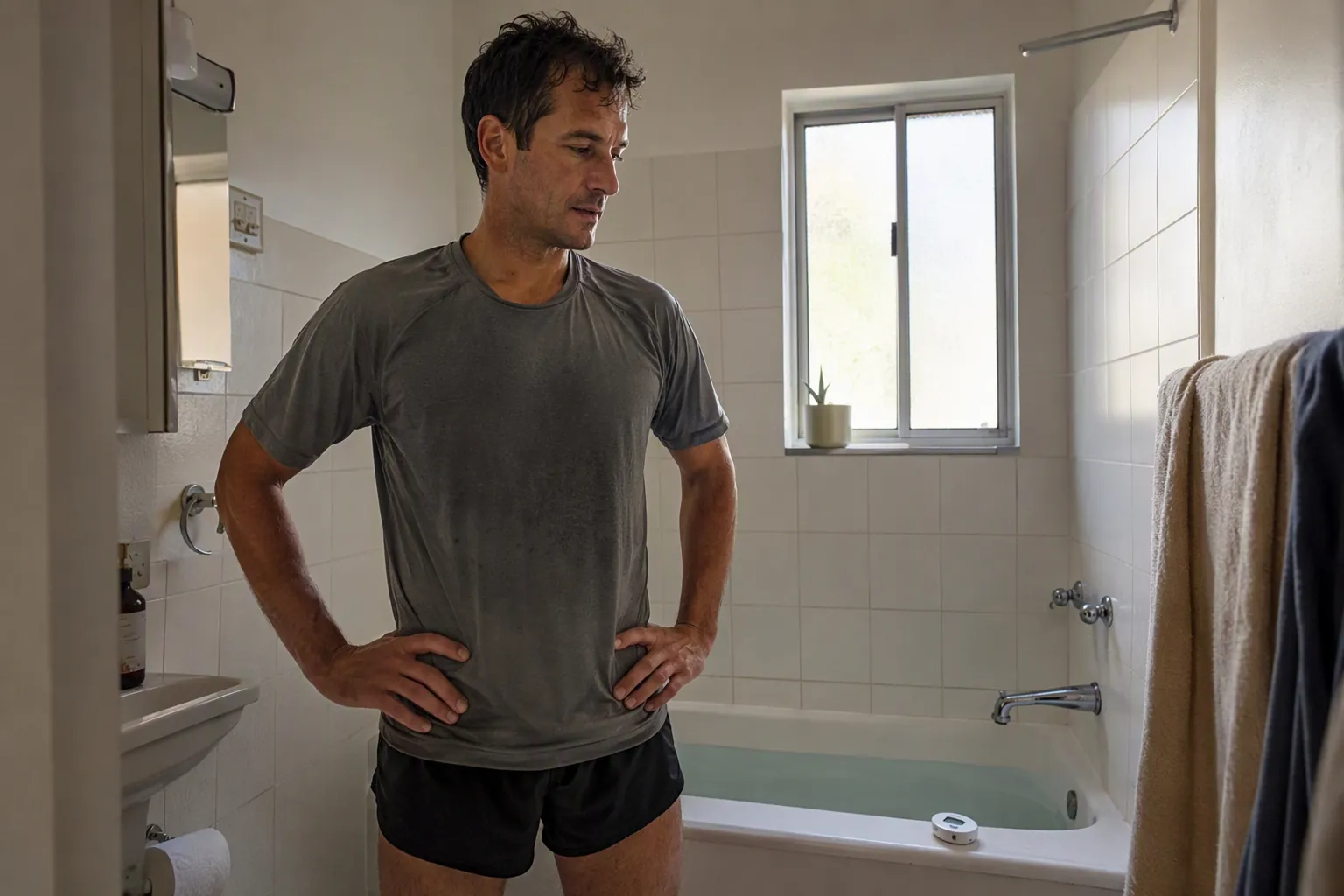
For a runner living in the wrong climate and the wrong building, that finding changes the question. The bathtub method is not a consolation prize for people who cannot do “real” heat training. It is a specific heat stimulus that can be repeated in a normal apartment bathroom, quietly, with no equipment beyond a thermometer and enough discipline to keep the session boring.
The Bathtub Protocol That Actually Has Research Behind It
The basic session is simple enough to fit on a sticky note:
- Run 40 minutes at easy effort in temperate conditions.
- Get into the bath immediately after the run.
- Set the water at 104°F.
- Immerse up to the neck if tolerated.
- Stay in for 30 to 40 minutes, then get out and cool down normally.
- Repeat for six consecutive days for the original Zurawlew structure.
The order matters. The run comes first because the bath is stacked on top of an already elevated body temperature. The runner does not need to hammer the run. In fact, making the run heroic is a good way to arrive at the bathtub dehydrated, overheated, and less able to judge warning signs. The useful version is controlled: easy running, quick transition, measured bath, no improvising with “a little hotter” because the day felt too comfortable.
The McIntyre comparison is the reason this deserves more than a shrug. In a 12-day comparison of post-exercise hot-water immersion against exercising in the heat, passive immersion produced what the researchers described as more complete heat acclimation.[2] That does not settle every debate about heat training. It was one study with specific protocols, and it should not be stretched into a rule that baths beat every possible heat-training setup. But it does give the home runner a stronger position than “better than nothing.”
Badwater preparation still includes the usual unglamorous work: long-run durability, downhill tolerance, walking efficiency, foot care, fueling practice, and the ability to keep moving when pacing gets ugly. If the broader running base is the weak link, an apartment-based plan such as Your Apartment-Friendly SF Marathon Training Plan is the kind of boring support work that belongs underneath the heat block. Heat acclimation is not a replacement for fitness. It is a layer added to fitness.
How To Run The Session In A Real Bathroom
A lab bath holds temperature more obediently than a second-floor apartment tub. Home water cools, fixtures vary, and some bathtubs are too shallow to cover the shoulders without turning the bathroom into a minor insurance event. The goal is not to recreate a laboratory. The goal is to keep the main exposure close enough to the studied protocol without making the session dangerous.
| Part of session | Home-runner version | What to avoid |
|---|---|---|
| Run | 40 minutes easy in normal conditions | Turning the run into a workout before a heat stressor |
| Transition | Start the bath immediately after finishing | Waiting long enough to fully cool down |
| Temperature | Use a thermometer and hold near 104°F | Guessing by feel or pushing hotter |
| Immersion | Up to the neck if tolerated; lower if needed | Forcing full immersion when symptoms appear |
| Duration | 30 to 40 minutes maximum | Adding time because the session feels manageable |
| Exit | Stand up slowly and cool down calmly | Jumping out fast while lightheaded |
Use a real thermometer. Hand feel is useless after a run, especially when your skin is already warm and your judgment is softened by fatigue. Fill the tub, check the temperature, and keep 104°F as the ceiling, not the opening bid. If the water drops, add hot water carefully and stir it before settling back in. Do not let hot water run directly against your skin.
If your tub loses heat quickly, accept a slightly imperfect session before chasing precision with risk. A bath that begins at 104°F and drifts lower is still a meaningful heat exposure. A bath that keeps getting topped up carelessly can create localized burns, especially around feet and calves. The runner who will succeed at Badwater is not the one who makes the bathtub more dramatic. It is the one who can repeat the exposure tomorrow.
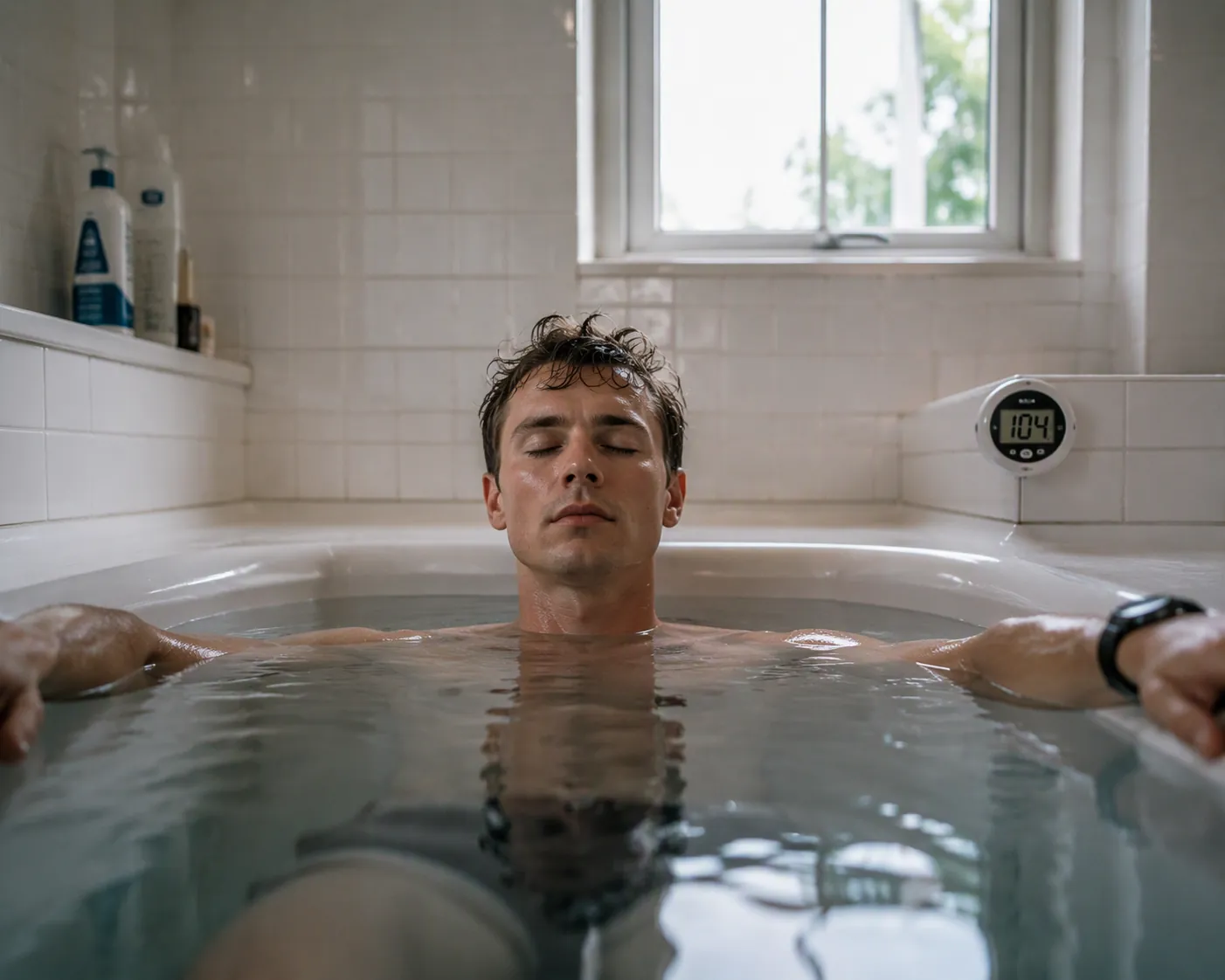
The exit signs are not negotiable. Stop the session if you feel dizzy, faint, confused, unusually nauseated, chilled in a strange way, unable to focus, or unsteady when you shift position. Stop if your skin hurts from the water. Stop if you cannot keep your breathing calm. A heat protocol that teaches you to ignore early trouble is not training; it is rehearsal for a medical problem.
Hydration belongs around the session, but it should not become theater. Start the run normally hydrated. Do not deliberately restrict fluids to “make it hotter.” After the bath, drink, eat, and cool down without rushing into another stressor. If you are doing this block during a heavy training week, the bath is part of the load. Count it that way.
A Six-Day Starter Block
The cleanest home version begins with six consecutive days, because that is the structure tied to the Zurawlew results.[1] Keep the run easy each day. Do not add intervals, hill repeats, or fast-finish long runs inside the block just because the bath looks passive on paper. The passive part is still heat stress.
| Day | Run | Bath | Adjustment |
|---|---|---|---|
| 1 | 40 minutes easy | 30 minutes at 104°F | Learn how your body responds |
| 2 | 40 minutes easy | 30 to 35 minutes at 104°F | Only extend if day 1 was controlled |
| 3 | 40 minutes easy | 35 to 40 minutes at 104°F | Keep the run deliberately boring |
| 4 | 40 minutes easy | 35 to 40 minutes at 104°F | Watch cumulative fatigue |
| 5 | 40 minutes easy | 35 to 40 minutes at 104°F | Do not chase discomfort |
| 6 | 40 minutes easy | 35 to 40 minutes at 104°F | Finish with margin, not bravado |
The first day is a test, not a proving ground. If 30 minutes feels like enough, stop there. If you feel fine but become wrecked later in the day, that also counts as feedback. Home heat training is attractive because it is repeatable. The price of that repeatability is admitting when the session took more out of you than expected.
Where This Fits On The Badwater Calendar
Badwater does not reward last-minute panic heat work. CTS guidance for ultrarunners points to 7 to 10 consecutive days of heat exposure for full adaptation, with a critical core-temperature window of 38 to 38.5°C, or 100.4 to 101.3°F.[3] Most home runners will not be measuring core temperature. That makes conservative structure more important, not less.
A practical race build can use the bathtub block in three passes. First, test the method well before the race so you know whether hot-water immersion is tolerable. Second, place the main block close enough to race day to matter but far enough away that it does not damage the taper. Third, maintain the adaptation with occasional exposure rather than trying to rebuild it from scratch during race week.
| Time before race | Heat work | Purpose |
|---|---|---|
| 8 to 12 weeks out | Try 1 to 2 conservative bath sessions | Confirm tolerance and bathroom logistics |
| 3 to 5 weeks out | Complete a 6-day bath block or longer heat-acclimation block | Build the main adaptation |
| After main block | Use maintenance exposure every 3 to 4 days | Prevent avoidable decay |
| 3 to 7 days before race | End intentional heat exposure | Arrive fresh rather than heat-stressed |
The timing is helped by two pieces of evidence and one practical coaching rule. Zurawlew follow-up work found adaptations persisted for at least two weeks after the final session.[4] CTS recommends ending intentional heat exposure at least three days before Badwater.[5] The same CTS heat-acclimation guidance notes that adaptation can decay after missed exposure, with maintenance often handled by another heat session every 3 to 4 days.[3]
That argues against the classic mistake of squeezing the hardest heat work into the final days because the race suddenly feels real. The last week should not be where you discover that hot baths leave you flat, that your sleep suffers afterward, or that you misjudge hydration after evening sessions. The useful heat block has already done its job before then.
If You Cannot Use A Bathtub
Some runners cannot make immersion work. The tub is too small, the plumbing is unreliable, the bath triggers nausea, or the household schedule makes 40 minutes of bathroom occupation unrealistic. That does not end the project, but it does change the tool.
Overdressing is the simplest branch. Trail Runner’s heat-training framework describes an entry-level approach using dark layers above 80°F and two layers below 80°F.[6] This is accessible and cheap, but it is less controlled than a measured bath. Clothing traps heat unevenly, sweat rate rises quickly, and perceived toughness can lure runners into running harder than intended. Keep overdressed runs short and easy at first, and avoid stacking them on demanding workouts.
Sauna suits are another fallback, not an upgrade. A cheap PVC suit can create a strong heat load in a small space, but it also hides how much sweat you are losing and can make treadmill running clumsy. If you use one, start with walking or very easy running, keep the exposure short, and treat it as heat practice rather than fitness work.
A small-room treadmill setup is the branch for runners who already own equipment or truly need indoor control. CTS has described Badwater runners improvising heat environments with setups such as dryer vents and greenhouse-style spaces.[5] That should be read as proof of problem-solving, not as a shopping list. If you are deciding whether a treadmill or compact setup fits your apartment, use a constraint-first guide like Compact Home Gym Equipment Guide for Apartments before buying anything that will rattle a floor, block a doorway, or become a clothes rack by August.
The hierarchy stays clear: if you can tolerate and safely control hot-water immersion, use the bath as the primary tool. Use overdressing, sauna suits, or a warm treadmill room for maintenance, travel weeks, or cases where immersion is not available.
What Not To Copy From Elite Badwater Stories
Arthur Webb’s heat-training notes deserve respect because they come from a 15-time Badwater finisher, and because he treated heat as central rather than ornamental. He wrote that heat training is “equal to, and possibly greater than race pacing, food, and fluid intake,” and he described sauna work progressing from 15 to 45 minutes at 170°F over four weeks.[7]
That is useful as a seriousness check. It is not a command to copy an elite routine. Webb’s broader training volume is an elite data point, not a minimum requirement hidden between the lines. The lesson for a home runner is narrower and more useful: heat exposure belongs in the plan early enough to adapt, often enough to maintain, and calmly enough that it does not wreck the running.
There is also a difference between a finisher’s personal account and controlled research. Webb’s claim that acclimated runners lose “fifty per cent less sweat and sodium” is part of his heat-training framework.[7] It should motivate attention to heat work, not replace individualized hydration and sodium practice during long runs.
Badwater’s finish rate also argues for preparation over mystique. CTS has reported an 85 to 90 percent finish rate at the race, a number that makes more sense when you remember how selective the field is and how seriously entrants prepare.[5] The race is brutal, but the useful conclusion for a home runner is not that suffering is magic. It is that repeatable preparation works.
A Home Heat Block That Does Not Break The Rest Of Training
The safest way to place bathtub heat work is to protect key running sessions from it. Do not put the first bath session after your hardest long run. Do not introduce it during a week when mileage, climbing, strength work, and life stress are all already high. If the heat block is important, make room for it.
| Training problem | Better choice |
|---|---|
| You have never tried hot-water immersion | Test one conservative session on an easy day |
| You are in peak mileage | Keep the bath block easy or move it away from the biggest week |
| You sleep poorly after evening heat | Schedule sessions earlier when possible |
| Your tub cannot hold 104°F | Start at the target temperature and accept some cooling |
| You feel dizzy or nauseated | End the session immediately |
| Race week has started | Stop intentional heat exposure 3 to 7 days before the race |
On the running side, keep the heat block attached to easy mileage unless a coach has a specific reason to do otherwise. The bath supplies the heat stress. The run supplies the warm starting point. Trying to make both components hard is the kind of arithmetic that looks committed in a training log and feels stupid by day four.
On the apartment side, remove friction before the first session. Put the thermometer where you can see it. Keep a towel within reach. Set a timer. Make sure you can add water without standing up repeatedly. If the bathroom gets slippery, solve that before you are tired and hot. None of this is inspiring. That is the point.
Recovery afterward can stay small and quiet: food, fluids, dry clothes, legs up, light mobility, and sleep. If your post-run routine already happens in a tight apartment, a renter-friendly recovery setup such as Injury Recovery Exercises for Renters in Small Spaces fits the same constraint: do the useful thing without turning the home into a gym showroom.
The Plain Judgment
For home runners preparing for Badwater 135 without a sauna, the bathtub is the strongest first option. The best-supported version is not complicated: easy temperate run, immediate 104°F bath, 30 to 40 minutes, repeated across consecutive days, then maintained and tapered intelligently.
It is not a gimmick, and it is not a consolation prize. Used carefully, post-exercise hot-water immersion is the most viable no-sauna heat acclimation tool for a runner training out of an apartment. Its power depends on the least glamorous parts: measured temperature, conservative time caps, honest exit signs, and stopping heat work early enough to arrive at the start line adapted rather than cooked.
References
- Post-exercise hot water immersion induces heat acclimation and improves endurance exercise performance in the heat, Frontiers in Physiology, 2018.
- Comparison of heat acclimation adaptations after 12 days of exercise heat stress and post-exercise hot water immersion, Precision Hydration.
- Ultrarunners Heat Acclimation Cheat Sheet, CTS.
- The Decay and Re-Induction of Heat Acclimation in Trained Males, Frontiers in Physiology, 2019.
- Badwater Lessons: Preparation, CTS.
- 3 Heat Training Strategies, Trail Runner Magazine.
- Heat Training in the Sauna, Badwater.
What a small equipment investment adds
We don't have a build tagged to this exact tier yet. Browse all builds.
How often should you repeat this?
See our recovery and rest reference for citation-anchored rest-interval guidance.
Spot something off?
Tell us if a movement, tier assumption, or duration didn't match your experience.