
Do a Barry's Bootcamp-Style Workout at Home With No Equipment
A 25-minute, no-equipment at-home session that mirrors Barry's Run/Lift format with RPE-driven intervals and an all-out finisher — plus an honest take on what a bodyweight homage can and can't do.
- Equipment tier required
- none
- Duration
- 25 min
- Difficulty
- intermediate
- Target area
- full body
- Space footprint needed
- Yoga mat plus one stride in each direction
- Noise level
- Low (quiet swaps; jumping optional)
This is a Barry’s Bootcamp-style home workout with no equipment, not a pretend Red Room. The point is to borrow the class architecture that makes Barry’s feel like it is going somewhere: cardio blocks, strength blocks, escalating effort, timed recovery, and a hard finish. Barry’s describes its workout as splitting time between floor weights, or Lift, and treadmill work, or Run, in the Red Room; the treadmill work can include walking, jogging, running, hills, and speed pushes across levels.[1] At home, without a treadmill or dumbbells, RPE has to do the job that speed, incline, and load usually do.
Set a 25-minute timer. Clear a space about the size of a yoga mat plus one stride in each direction. If you have downstairs neighbors, choose the quiet swaps. If you have a hallway, use it for the “Run” blocks. If you only have the patch between the couch and coffee table, that works too.
| Spec | What to do |
|---|---|
| Duration | 25 minutes total, including warm-up and finisher |
| Equipment | None. Mat optional. |
| Format | Alternating Run/Lift blocks: cardio, strength, cardio, strength, sprint finisher |
| Intensity | RPE 5–10, with most hard work at RPE 7–9 and only brief touches of RPE 10 |
| Space | Mat-sized floor space; hallway optional for shuttles |
| Noise | Jumping is optional. Quiet swaps are built in. |
| Best for | Intermediate exercisers, or beginners who use the lower-impact options and cap effort before all-out |
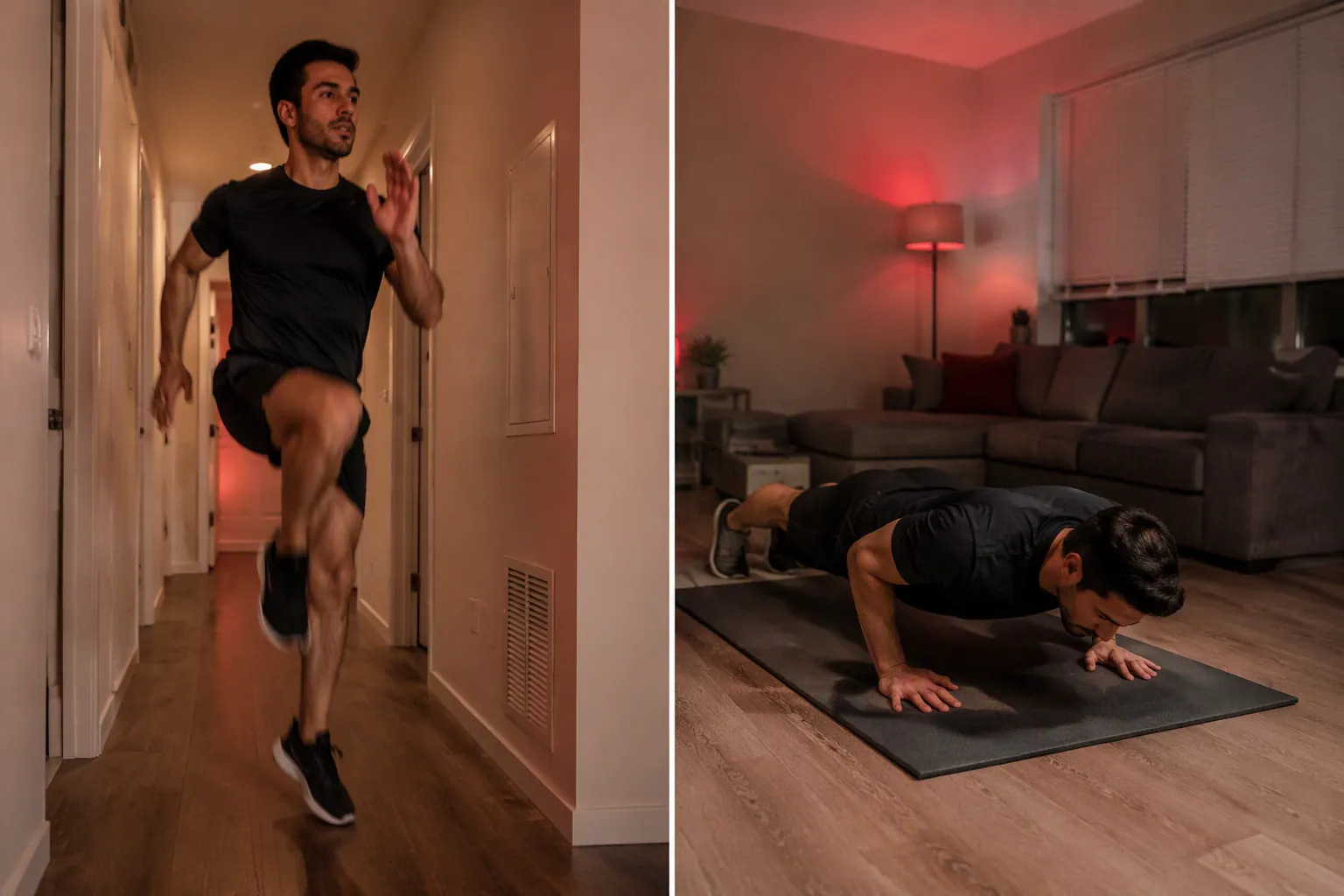
The RPE scale for this workout
RPE means rating of perceived exertion. It is subjective, but for a no-equipment session it is more honest than inventing treadmill speeds you do not have.
| RPE | How it should feel | Home-workout cue |
|---|---|---|
| 5–6 | Warm but controlled | You can speak in short sentences |
| 7–8 | Hard and focused | You can say a few words, but you are working |
| 9 | Very hard | You are counting down the seconds |
| 10 | All-out for the day | Only safe for short bursts; form cannot fall apart |
Beginners should treat RPE 8 as the ceiling for the first run-through. The workout still works if you finish with control instead of theatrics.
25-minute no-equipment Barry’s-style workout
The flow below uses “Run” to mean treadmill-free cardio and “Lift” to mean bodyweight strength. The Run blocks are not random jumping; they have pace changes. The Lift blocks are not filler; they give your legs, chest, core, and trunk the floor-work feeling without dumbbells.
| Time | Block | Work | Target effort |
|---|---|---|---|
| 0:00–3:00 | Warm-up | Mobility, marching, squats, walkouts | RPE 4–6 |
| 3:00–8:00 | Run 1 | Treadmill-free cardio intervals | RPE 5–9 |
| 8:00–13:00 | Lift 1 | Lower body + push strength | RPE 7–8 |
| 13:00–18:00 | Run 2 | Escalating cardio intervals | RPE 6–9 |
| 18:00–23:00 | Lift 2 | Core + total-body strength | RPE 7–9 |
| 23:00–25:00 | Finisher | 30-second sprint repeats with short rests | RPE 9–10 |
0:00–3:00 — Warm-up
- 0:00–0:45: March in place or step-touch, gradually swinging the arms.
- 0:45–1:30: Bodyweight squats. Sit back, stand tall, squeeze glutes at the top.
- 1:30–2:15: Alternating reverse lunges, or step-back taps if lunges bother your knees.
- 2:15–3:00: Walkouts to plank, then walk hands back and stand. Skip the push-up.
You are not trying to win the warm-up. You are checking your floor, your knees, your wrists, and whether the lamp is about to become part of the workout.
3:00–8:00 — Run 1: build the engine
Pick one Run style and keep it for the whole block: hallway shuttles, running in place, high-knee marches, low-impact skater steps, or fast step-backs. If impact feels fine, you can use high knees and skaters. If noise matters, keep one foot on the floor and move your arms aggressively.
| Time | Do this | RPE | Quiet option |
|---|---|---|---|
| 3:00–4:00 | Easy jog in place or hallway shuttle | 5–6 | Fast march with strong arm drive |
| 4:00–5:00 | Fast run in place or quicker shuttles | 7–8 | Low-impact high-knee march |
| 5:00–5:30 | Sprint | 9 | Fast step-back runs |
| 5:30–6:00 | Recover | 4–5 | Walk in place |
| 6:00–7:00 | Fast run | 7–8 | Fast march or lateral step |
| 7:00–7:30 | Sprint | 9 | Low-impact skater steps |
| 7:30–8:00 | Recover and set up for floor | 4–5 | Walk, breathe, get to mat |
This is where the no-treadmill adaptation either works or collapses. Do not make every interval a burpee. The treadmill feeling comes from gear changes: controlled, fast, faster, recover.
8:00–13:00 — Lift 1: legs and push
Work for 45 seconds, transition for 15 seconds. Move with enough control that the last 10 seconds are ugly in effort, not in form.
| Time | Move | How to do it | Scale down |
|---|---|---|---|
| 8:00–9:00 | Squat to calf raise | Squat, stand, rise onto toes, lower with control | Regular squats |
| 9:00–10:00 | Push-ups | Hands under shoulders; chest lowers as one unit | Incline push-ups on couch or hands-elevated surface |
| 10:00–11:00 | Reverse lunge to knee drive | Alternate legs; step back, drive knee up, switch | Reverse lunge without knee drive |
| 11:00–12:00 | Plank shoulder taps | Feet wide, tap opposite shoulder without rocking hips | High plank hold or elevated plank |
| 12:00–13:00 | Squat pulse to stand | Two small pulses at the bottom, then stand tall | Sit-to-stand from couch edge |
13:00–18:00 — Run 2: make the room smaller
The second Run block should feel more coached than chaotic. You are going to climb effort by time, not by adding new exercises.
| Time | Do this | RPE | Quiet option |
|---|---|---|---|
| 13:00–13:45 | Jog or fast march | 6 | March with arm drive |
| 13:45–14:30 | High knees or hallway shuttle | 7 | Low-impact high knees |
| 14:30–15:00 | Sprint | 9 | Fast step-back runs |
| 15:00–15:30 | Recover | 4–5 | Walk in place |
| 15:30–16:15 | Fast skaters or lateral shuffles | 7–8 | Step skaters |
| 16:15–16:45 | Sprint | 9 | Fast march, arms pumping |
| 16:45–17:15 | Recover | 4–5 | Walk in place |
| 17:15–17:45 | Best controlled sprint | 9 | Fastest quiet option |
| 17:45–18:00 | Reset to floor | 5 | Breathe and set up |
If you track heart rate, this is the block where it may lag behind how hard you feel. RPE still leads. For more heart-rate-driven pacing at home, the Apple Watch home fitness hub guide is useful, but you do not need a device to run this session.
18:00–23:00 — Lift 2: core, trunk, total body
This is the block that keeps the workout from becoming cardio in costume. Stay deliberate. Strength work without dumbbells has to use tempo, range, leverage, and fatigue.
| Time | Move | How to do it | Scale down |
|---|---|---|---|
| 18:00–19:00 | Walkout to push-up | Walk hands to plank, do 1 push-up, walk back | Walkout only, or push-up from knees |
| 19:00–20:00 | Alternating lateral lunge | Step side, sit into hip, push back to center | Side step squat |
| 20:00–21:00 | Forearm plank hip dips | Rotate hips side to side under control | Forearm plank hold |
| 21:00–22:00 | Modified burpee | Hands down, step or jump to plank, return, stand | Step-back burpee with no jump |
| 22:00–23:00 | Dead bug or hollow hold | Keep ribs down; move slowly | Heel taps |
23:00–25:00 — Finisher: 30 on, 10 off
This finisher is a deliberate homage design choice: three 30-second sprints with 10 seconds between them. It is not an official Barry’s timing claim. The 30-second all-out close is anchored to Sandy Macaskill’s published Barry’s-style workout, which ends its treadmill section with a 30-second all-out sprint.[2]
| Time | Do this | RPE |
|---|---|---|
| 23:00–23:30 | Sprint option of choice: high knees, hallway shuttle, fast skaters, or quiet step-back runs | 9 |
| 23:30–23:40 | Rest | 3–4 |
| 23:40–24:10 | Sprint again, matching or slightly beating the first effort | 9–10 |
| 24:10–24:20 | Rest | 3–4 |
| 24:20–24:50 | Final all-out for the day | 9–10 |
| 24:50–25:00 | Stand tall, walk, breathe | 3 |
If “all-out” makes your form get loose, your wrists collapse, or your feet slap the floor like you are trying to notify the building, pull it back to RPE 8–9. The win is finishing the block hard and clean.
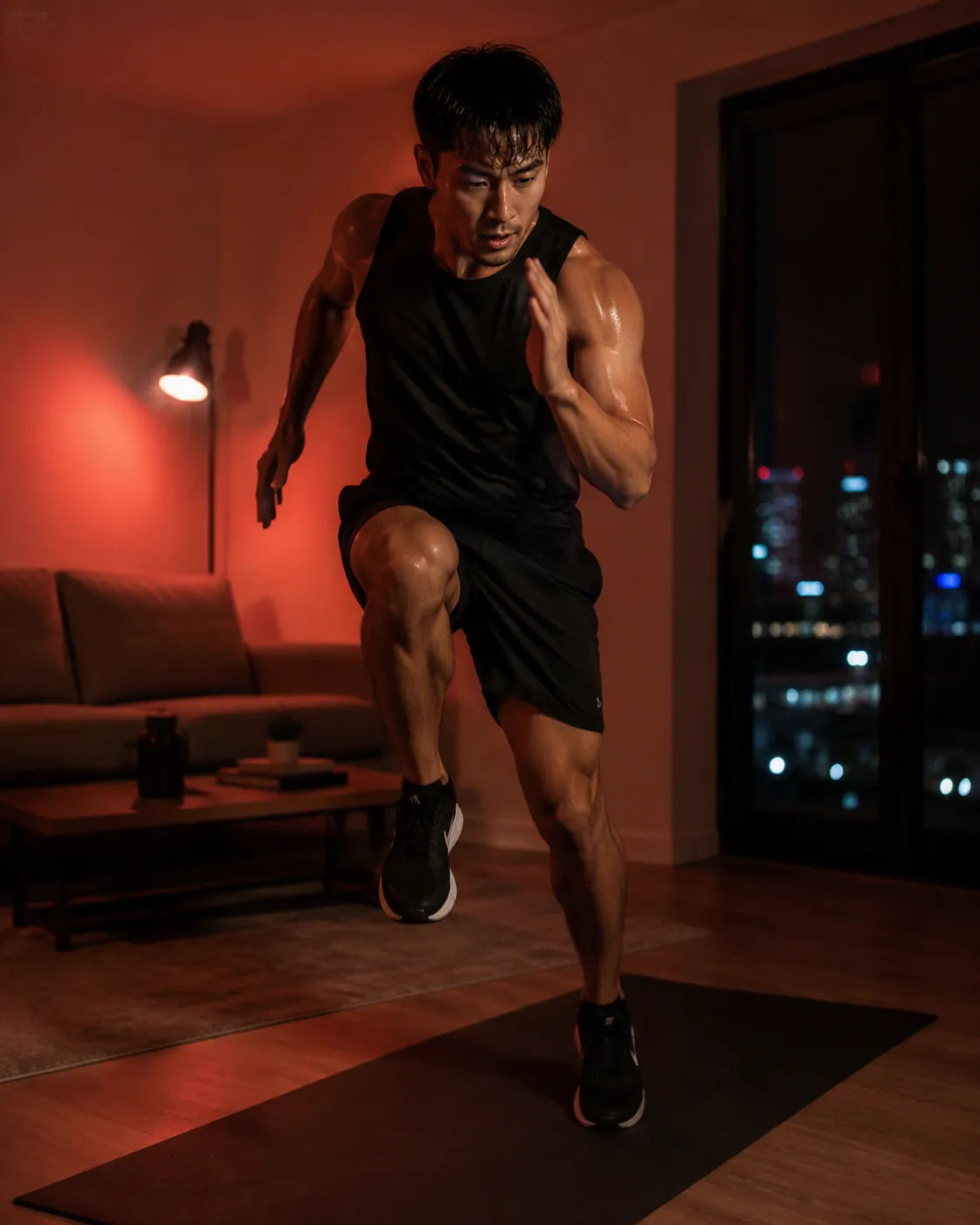
Why this feels closer than a random bodyweight circuit
The thing worth copying is the alternation. Barry’s public description gives the basic spine: time split between treadmill Run work and floor Lift work.[1] Macaskill’s published 30-minute Barry’s-style workout also alternates a tiered treadmill interval section with a floor block using 60-second and 30-second intervals, and he calls the combination “the secret sauce at Barry’s.”[2] That matters more than trying to mimic the room with a red bulb and a playlist you forgot to update.
The home translation has precedent, too. Sarah Fit published a Barry’s Bootcamp-style travel workout that uses RPE-based “run” circuits — including a 1-minute jog at RPE 5–6, 1-minute fast run at RPE 7–8, 1-minute sprint at RPE 9–10, and 1-minute recovery, repeated 3 times — plus bodyweight strength circuits including plank, push-ups, and reverse-lunge split jumps.[3] That is the practical bridge: not a treadmill, but the same idea of changing gears.
Bodyweight-only work is not alien to Barry’s-adjacent programming language. POPSUGAR published a five-move bodyweight workout from a Barry’s San Francisco trainer using 60-second blocks such as squat jacks, spider-plank push-ups, push-up to side plank with hip dips, forearm plank hip dips, and modified burpees.[4] Wellhub also quotes Barry’s Chief Curriculum Lead Tommy Stracke saying bodyweight requires no equipment and can be “incredibly effective at getting the metabolic furnace burning,” while listing household items as optional load.[5] Optional is the important word for this workout. You can add load later; you do not need it to start.
What the workout can honestly do
A 25-minute no-equipment session can deliver a real interval stimulus. HIIT is generally described as repeated near-maximal efforts separated by recovery periods, and a 2021 review describes low-volume HIIT as involving less than 15 minutes of active high-intensity exercise while still being discussed as a time-efficient cardiometabolic strategy.[6] This workout has short, hard bouts, recoveries, and less than 15 minutes of truly high-intensity work, depending on how honestly you hit the RPE targets.
Bodyweight training also deserves more respect than it gets in equipment-obsessed programming. Harvard Health summarized a 10-week study in which participants doing bodyweight exercise improved aerobic capacity by 33% and improved 7 of 9 fitness parameters measured.[7] That does not prove this exact 25-minute workout will produce the same result. It does support the narrower, useful point: bodyweight training can improve fitness when it is structured and progressed.
An ACSM journal feature summarized by Nike also reported that bodyweight-only high-intensity training improved body fat, VO2max, and muscular endurance comparably to weight training.[8] Again, do not turn that into a studio-calorie fantasy. It means the no-equipment version is not automatically soft just because there is no treadmill humming under you.
What it cannot reproduce
It cannot reproduce Woodway treadmill mechanics, incline changes, treadmill speed coaching, dumbbell loading, instructor-specific programming, or the particular social pressure of not wanting to be the person who quits while the room is still moving. Barry’s official description is explicitly built around treadmill Run work and weighted floor Lift work.[1] A quiet apartment version has to give those jobs to pace, range of motion, tempo, and RPE.
It also should not promise a Barry’s calorie burn. The sources here support the format, the bodyweight stimulus, and the interval logic. They do not support a precise calorie number for your living room, your body, your floor, your sleep-deprived Tuesday, or your decision to use the low-impact swaps.
And no, the 30-on/10-off finisher is not being presented as a documented Barry’s class spec. It is a compact home-programming choice that creates a 3:1 sprint-to-rest feel and borrows the spirit of Macaskill’s published 30-second all-out sprint finish.[2] That distinction matters because “inspired by” is useful; fake canon is annoying.
Apartment-friendly swaps that still feel hard
| If the workout says | Use this quiet swap | How to keep intensity |
|---|---|---|
| High knees | Low-impact high-knee march | Drive arms hard and lift knees quickly |
| Sprint in place | Fast step-back runs | Stay low and move feet fast without hopping |
| Skaters | Step skaters | Reach farther side to side and load the hip |
| Burpees | Step-back modified burpees | Remove the jump; speed up the plank step-back |
| Jump squats | Squat to calf raise | Use full depth and a sharp stand |
If noise is the limiting factor, do not treat quiet as easy. The apartment-safe indoor drills are useful for building a bigger menu of low-impact substitutions, and the site’s apartment workout testing notes are worth reading if your main problem is floor noise rather than motivation.
How often to do it
Do this workout 1–3 times per week, depending on training history and recovery. If you are new to HIIT, start with once weekly and keep the sprints at RPE 8. If you already train regularly, twice weekly is a reasonable place to live. Three times weekly is only sensible if your joints feel good, your sleep is decent, and you are not turning every other workout into another max-effort session.
On non-HIIT days, use easier strength, walking, mobility, or a shorter no-equipment session. If you want a sibling routine with the same apartment logic but less boutique-class cosplay, try this storm-day indoor workout.
If you want to progress the session without buying equipment, change only one thing at a time: make the Run blocks cleaner at the same RPE, add range to the strength moves, reduce sloppy transitions, or repeat the workout with better control. If you eventually add household load, keep it optional and modest; the no-equipment version already has a job.
What you did here is not Barry’s at home. It is a Barry’s-inspired interval session that uses the Run/Lift architecture, RPE pacing, bodyweight strength, and a short all-out finish to make a real workout fit inside an apartment.
References
- The Workout — Barry’s.
- Try The Barry’s Bootcamp Experience With This 30-Minute Full-Body Workout — Coach.
- Summer Vacay Barry’s Bootcamp Style Workout — Sarah Fit.
- 5-Minute Bodyweight Workout From Barry’s Bootcamp — POPSUGAR.
- Barry’s Bootcamp Home Workouts — Wellhub.
- Evidence-Based Effects of High-Intensity Interval Training on Exercise Capacity and Health: A Review with Historical Perspective — Atakan et al., 2021.
- The advantages of body-weight exercise — Harvard Health.
- How Fit Can You Get From Bodyweight Exercises Alone? — Nike.
What a small equipment investment adds
We don't have a build tagged to this exact tier yet. Browse all builds.
How often should you repeat this?
See our recovery and rest reference for citation-anchored rest-interval guidance.
Spot something off?
Tell us if a movement, tier assumption, or duration didn't match your experience.