
Basketball Drills You Can Do at Home Without a Hoop
Train every basketball skill except live play at home without a hoop: ball handling, shooting form, wall passing, footwork, conditioning, and vertical jump, each with concrete sets, reps, and space-fit notes. Includes progression rules and 15/30/45-minute sample sessions so the drills turn into a usable workout in a small space.
- Equipment tier required
- none
- Duration
- 30 min
- Difficulty
- beginner
- Target area
- full body
- Space footprint needed
- 4 x 6 feet
- Noise level
- includes jumping
The useful answer to “what basketball training drills you can do at home?” is not “dribble more.” It is a session you can actually run in a hallway, living room, basement, driveway, or garage: pick a few drills that fit the floor, give them enough reps to matter, and stop advancing the drill before your handle, balance, or landing mechanics fall apart.
Without a hoop, you lose live finishing, real rebounding, and the full rhythm of catching, reading, and shooting against defense. You do not lose ball handling, shooting form, wall passing, footwork, conditioning, or vertical jump work. The home version just needs tighter rules because there is no coach, rebounder, or court line forcing the drill to stay honest.
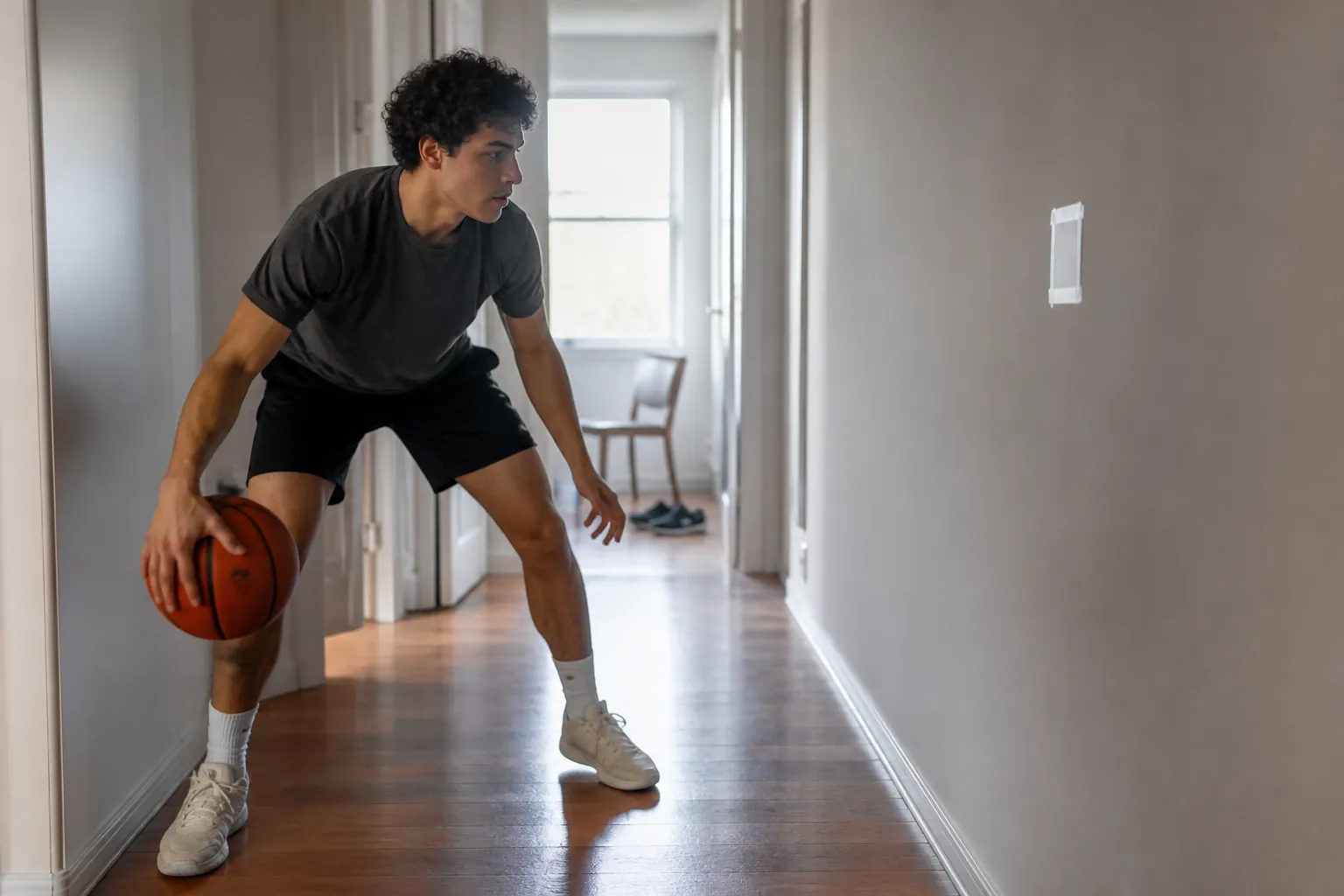
What you can train at home without a hoop
| Skill | Minimum setup | Small-space fit | What the home drill should measure |
|---|---|---|---|
| Ball handling | One basketball; optional chair or cones | Best fit: 4 x 6 feet is enough for stationary work | Control, weak-hand quality, dribble height, change of speed |
| Shooting form | Ball, wall or open space, tape line | Good fit: needs enough room to extend upward safely | Set point, wrist finish, balance, repeatable foot placement |
| Passing | Wall, tape target, ball | Good fit: 8-10 feet from the wall is ideal for basic wall passing | Accuracy, snap, catch readiness, left/right symmetry |
| Footwork | Tape line, chair, socks or shoes depending on floor | Excellent fit: most drills need 6-8 clear feet | Balance, pivot discipline, slide width, stop control |
| Conditioning | Timer; optional ball | Depends on noise and impact | Work quality under fatigue, repeatable bursts, recovery control |
| Vertical jump | Mat or safe surface; optional box | Usable, but floor choice matters | Landing quality, stiffness, power, controlled volume |
Ball handling gets the biggest share because it gives the most return for the least space. Basketball for Coaches’ stationary dribbling library alone lists 50 dribbling drills, which is a useful reminder that one ball and a small patch of floor can carry a real workout if the drill has a prescription instead of just a name [1].
Set up the room before you pick drills
A home basketball session gets worse fast when you keep stopping to move furniture, chase the ball under a couch, or wonder whether the downstairs neighbor can hear every pound dribble. Do the boring setup once.
- Clear a rectangle first. For stationary handling, 4 x 6 feet works. For passing, leave 8-10 feet from the wall. For lateral footwork, try to get 6-8 clear feet side to side. For plyometrics, prioritize surface and ceiling clearance over drill variety.
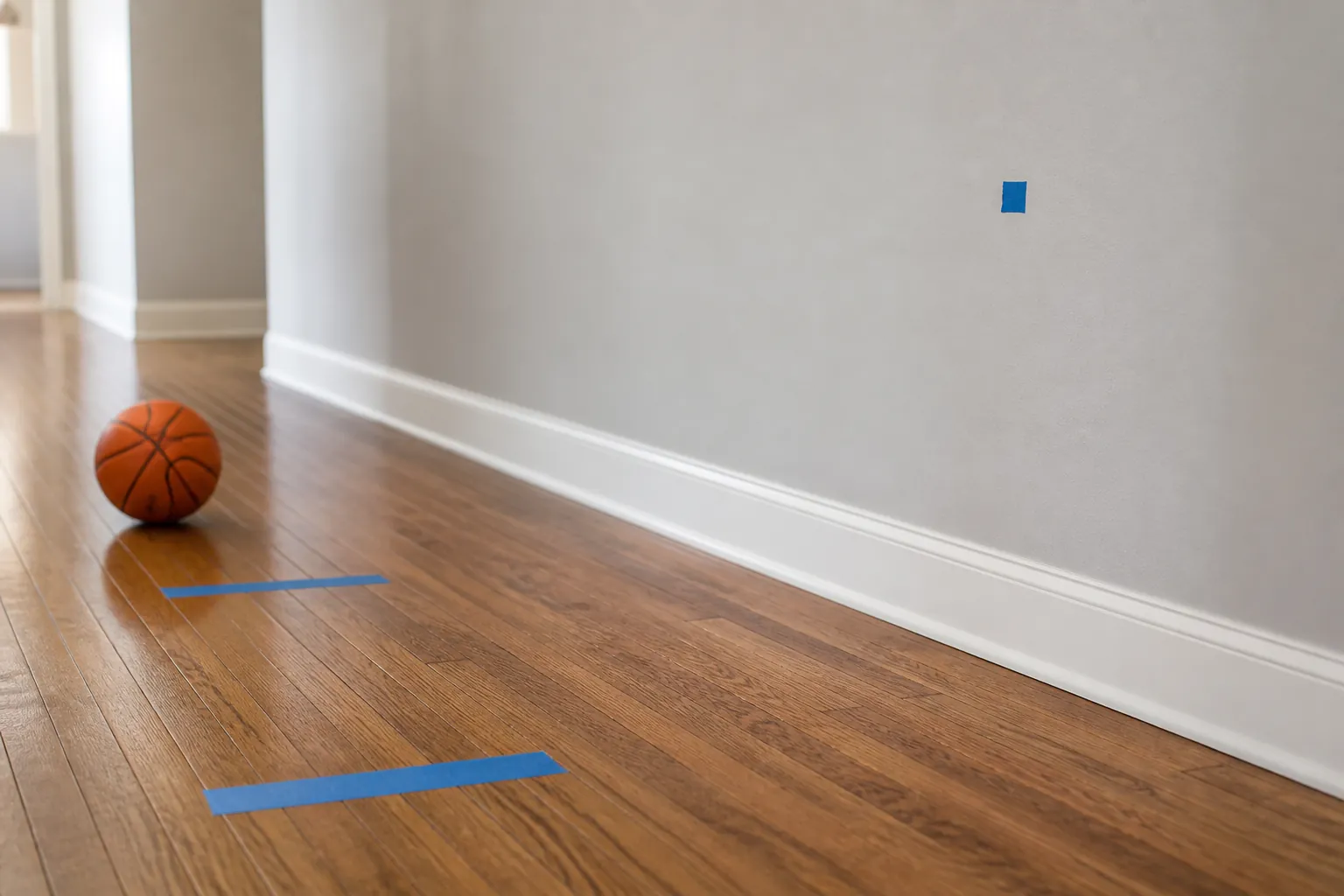
- Mark the floor. A strip of painter’s tape can become a shooting line, pivot line, passing distance mark, or footwork lane. If tape could damage the floor, use socks, paper cups, or a towel edge.
- Mark the wall only if it is safe. A tape square at chest height is enough for passing. For wall shooting, use a soft touch and choose a wall that can handle repeated contact.
- Use budget tiers honestly: $0 means tape, socks, a chair, and a ball you already own; $0-100 means a basic ball, mat, cones, or floor tape; $100-300 can include specialty quiet-practice tools if they fit your space; $300-800 is mini-hoop or more built-out home setup territory.
Noise matters, but it can take over the whole conversation. If your main problem is apartment sound, use the dedicated quiet basketball practice guide and then come back to this drill menu. If your main problem is floor protection for dribble-heavy work or jumps, the home gym flooring mistakes guide is the better rabbit hole.
Ball-handling drills: the highest-return home category
For handling, the goal is not to survive a random two-minute dribble montage. The goal is to build control at specific heights, speeds, and body positions. Most players should start with 8-12 total minutes here in a short session and 15-20 minutes in a longer one.
| Drill | How to do it | Prescription | Space and budget tag | Progression rule |
|---|---|---|---|---|
| Low pound dribbles | Athletic stance, ball below knee height, pound the ball with one hand without letting your shoulders rise. | 3 sets per hand: 20 seconds work, 20 seconds rest. | 4 x 4 feet; $0 if you own a ball. | Move up when you can keep the ball below the knee for all sets without looking down. |
| High-low pounds | Start with 5 hard dribbles at hip height, then 5 low dribbles below the knee. Stay in one spot. | 4 rounds per hand; each round is 10 dribbles high and 10 dribbles low. | 4 x 4 feet; $0. | Add speed only when the low dribbles stay tight and the high dribbles do not slap away from your body. |
| Front V-dribble | Push the ball side to side in front of one foot with the same hand, like drawing a V on the floor. | 3 sets per hand: 30 seconds work, 20 seconds rest. | 4 x 4 feet; $0. | Progress by widening the V, then by lowering your hips, not by standing taller. |
| Side V-dribble | Keep the ball beside your hip and push it forward and backward with one hand. | 3 sets per hand: 25 seconds work, 20 seconds rest. | 4 x 5 feet; $0. | Move up when the ball stays outside your foot and does not drift into your stance. |
| Stationary crossover | Pound the ball from right to left in front of your body. Catch it outside the opposite knee, not under your chest. | 5 sets of 20 clean crossovers; rest 20-30 seconds. | 5 x 5 feet; $0. | Count only crossovers that arrive outside the knee and stay below the waist. |
| Between-the-legs exchange | Stagger your feet, dribble between the legs, then switch stance after each rep or after a fixed count. | 4 sets of 12 each direction. | 5 x 5 feet; $0. | Progress from one exchange and reset to continuous exchanges. |
| Behind-the-back exchange | Keep your chest forward and wrap the ball behind your hips to the other hand. | 4 sets of 10 each direction. | 5 x 5 feet; $0. | Do not speed up until the ball lands outside the opposite hip instead of floating behind your heels. |
| Figure-eight low dribble | Dribble the ball in a figure-eight path around both legs while staying low. | 3 sets of 30 seconds; rest 30 seconds. | 4 x 5 feet; $0. | Progress by reducing eye contact with the ball, then by increasing speed. |
| Chair retreat and attack | Place a chair 3-4 feet in front of you. Take two retreat dribbles, then attack past the chair with one hard change of direction. | 5 reps right, 5 reps left, 3 total rounds. | 6 x 8 feet; $0-100 depending on ball and floor setup. | Add a second move only after the first step past the chair is sharp and balanced. |
| Weak-hand only minute | Use only your weaker hand. Mix pounds, V-dribbles, and stationary escapes without switching hands. | 5 rounds: 45 seconds work, 15 seconds rest. | 4 x 6 feet; $0. | When you lose the ball, restart immediately; do not turn the minute into a walking chase drill. |
A simple ball-handling progression
Use this order before you invent harder drills: clean stationary control, lower stance, weaker hand, wider angles, then movement. A lot of home workouts jump straight to combo moves because they look more like basketball. In a small room, sloppy combos mostly train you to recover loose balls.
- Beginner: low pounds, high-low pounds, front V-dribbles, stationary crossover.
- Early intermediate: side V-dribbles, between-the-legs, behind-the-back, figure-eight.
- Intermediate: chair retreat and attack, weak-hand minute, timed combo rounds.
Shooting form drills when there is no rim
No-hoop shooting work is form work. You are training the parts of the shot you can control indoors: feet, balance, hand placement, set point, release path, and follow-through. Ultimate Hoops’ no-hoop shooting drills include wall shooting at a 15-18 foot spot, self-shooting in 1-minute sets repeated 5 times, 180-degree shooting, line shooting, and chair shooting [2].
| Drill | How to do it | Prescription | Space and budget tag | Progression rule |
|---|---|---|---|---|
| Wall form shooting | Stand facing a blank wall. Pick a safe spot on the wall; if the room allows, use the 15-18 foot wall-shooting setup from Ultimate Hoops. Shoot softly toward the spot and let the ball return or drop safely. | 5 sets of 10 releases; rest 20 seconds. | Needs wall and safe ceiling height; $0. | Advance when 8 of 10 releases in a set leave your hand with the same arc and wrist finish. |
| Self-shooting | Start in shooting stance, toss the ball lightly to yourself, catch, load, and shoot straight up or toward a safe wall target. | 5 rounds of 1 minute; rest 30 seconds between rounds. | 5 x 5 feet; $0. | Count clean catch-to-release reps, not speed. Add pace only when your feet land the same way. |
| Line shooting | Put toes on a tape line. Shoot straight up or toward a wall while checking that your feet, knees, elbow, and follow-through stay aligned. | 4 sets of 12 reps. | 4 x 5 feet; $0. | Move from stationary to hop-in footwork only after your landing does not drift off the line. |
| 180-degree form turns | Start facing away or sideways, turn into shooting stance, square up, and release. | 3 sets of 8 turns each direction. | 5 x 5 feet; $0. | Progress by catching a self-toss before the turn, not by spinning faster. |
| Chair shooting footwork | Use a chair as a pretend defender or screen. Step around it, square your feet, and perform a form release. | 4 rounds: 6 reps going right, 6 reps going left. | 6 x 8 feet; $0. | Advance when you can stop without drifting into the chair or fading sideways. |
The mistake with no-rim shooting is pretending you can measure makes. You cannot. Measure repeatability instead: same base, same release pocket, same wrist finish, same landing. If the ball bangs off the wall at a different angle every time, that is feedback.
Wall passing drills that do not need a partner
A wall is not a teammate, but it is honest about bad aim. Rockline and Little Boomers both use the basic home setup: stand about 8-10 feet from a wall and pass to a taped target with chest passes, bounce passes, and one-handed push passes [3][4].
| Drill | How to do it | Prescription | Space and budget tag | Progression rule |
|---|---|---|---|---|
| Chest pass to tape square | Stand 8-10 feet from the wall. Hit a chest-height tape square, catch in ready position, and pass again. | 5 sets of 20 passes; rest 30 seconds. | Wall plus 8-10 feet; $0-100. | Advance when at least 16 of 20 passes hit or graze the target without forcing you to reach on the catch. |
| Bounce pass to wall target | Aim for a floor spot that makes the ball rise into the wall target or return to your hands at waist height. | 4 sets of 15 passes. | Wall plus 8-10 feet; $0. | Move the floor target farther or lower only when the return stays catchable. |
| One-hand push pass | Start with the ball outside one hip. Push it to the wall target with one hand, catch with two hands, reset. | 3 sets of 12 per hand. | Wall plus 8-10 feet; $0. | Progress from reset reps to alternating right-left passes. |
| Pass-catch-foot reset | Pass to the wall, catch, jump stop or split stop, then pass again from a balanced base. | 4 rounds of 45 seconds; rest 30 seconds. | Wall plus 8-10 feet; $0. | Add speed only if your feet stop before the pass leaves your hands. |
| Wall passing under fatigue | After 20 seconds of defensive slides or quick feet, step to the line and complete accurate chest passes. | 5 rounds: 20 seconds footwork, 10 passes, 30 seconds rest. | 8-10 feet plus a small lane; $0. | Keep the target standard the same. Fatigue is not an excuse to turn this into wall throws. |
Footwork drills for a hallway, living room, or garage
Footwork is where home training either becomes useful or turns into furniture dodging. Keep the drill small, define the stop, and decide before you start whether the surface is for socks, shoes, or a mat. On slick floors, pivot work may be fine in socks; on jump or slide drills, shoes and a safer surface usually make more sense.
| Drill | How to do it | Prescription | Space and budget tag | Progression rule |
|---|---|---|---|---|
| Jump stop to pivot | Toss the ball to yourself, catch, land on two feet, front pivot once, reverse pivot once, reset. | 4 sets of 8 catches. | 5 x 5 feet; $0. | Advance when neither pivot foot slides and your eyes stay up after the catch. |
| Jab-step series | Start in triple-threat position. Jab right, reset, jab left, reset, then rip through without traveling. | 3 rounds of 10 jabs each side and 10 rip-throughs each side. | 4 x 5 feet; $0. | Progress by adding a single dribble after the rip-through. |
| Defensive slide line | Use two tape marks 6-8 feet apart. Slide from mark to mark without clicking your feet together. | 6 rounds of 20 seconds; rest 20 seconds. | 6-8 feet side to side; $0. | Move up when your hips stay low for the full 20 seconds. |
| Closeout to wall | Start 6-8 feet from a wall. Sprint or quick-step forward, chop your feet, hands up, stop short of the wall, backpedal to start. | 5 sets of 5 closeouts. | 6-8 feet toward a wall; $0. | Advance by adding a slide left or right after the closeout. |
| Chair curl footwork | Place a chair as a screen. Curl around it, catch a self-toss, square up, and hold the shot pocket. | 4 sets of 6 curls each direction. | 6 x 8 feet; $0. | Progress by adding a form release after the catch. |
| Drop-step wall touch | Stand with your back to a wall or imaginary defender. Drop step, bring the ball to a protected finish position, then reset. | 3 sets of 8 each side. | 5 x 5 feet; $0. | Advance only if the pivot is clean and the ball stays tight to your body. |
Conditioning that still looks like basketball
Conditioning at home should not swallow the skill workout. Use enough to make your handle, passing, and footwork hold up under fatigue. Ultimate Hoops cites NYU Langone exercise physiologists for practical at-home basketball conditioning prescriptions: HIIT-style work at 3-4 rounds of 30 seconds work and 30 seconds rest, cardiac-output work around 30 minutes at 130-150 bpm, power-endurance bursts of 10-12 sets of 6-8 seconds with 90 seconds rest, and adding 1-2 sets weekly as a progression [5].
| Conditioning block | Home version | Prescription | Space and budget tag | Progression rule |
|---|---|---|---|---|
| HIIT handle block | Alternate hard stationary pounds, quick crossovers, or defensive slides with equal rest. | 3-4 rounds: 30 seconds work, 30 seconds rest. | 4 x 6 feet for handling; 6-8 feet for slides; $0. | Add speed after the ball or footwork stays controlled for every round. |
| Cardiac-output base | Low-impact continuous work: brisk walking, step-ups, easy bike, shadow footwork, or light ball-handling movement if noise allows. | About 30 minutes at roughly 130-150 bpm. | Variable; $0 if walking or shadow work, more if using equipment. | Extend duration or frequency before making it harder. |
| Power-endurance burst | Short explosive efforts such as quick first-step attacks, hard slide bursts, or low-volume jump efforts. | 10-12 sets of 6-8 seconds; rest 90 seconds. | 6-8 feet minimum; $0-100 depending on floor protection. | Add 1-2 sets weekly only if power does not drop off early. |
| Skill-fatigue finisher | Complete a passing or dribbling target after a short conditioning burst. | 5 rounds: 20 seconds work, then 10 accurate passes or 20 controlled dribbles. | 8-10 feet if passing; $0. | Keep the skill target strict. If accuracy collapses, reduce the conditioning piece. |
Those numbers are training guidance, not a medical plan. If you are coming back from injury, managing a condition, or training a child who is new to structured exercise, the safer move is to lower the volume and keep the drill quality visible.
Vertical jump work: useful, but pick the floor first
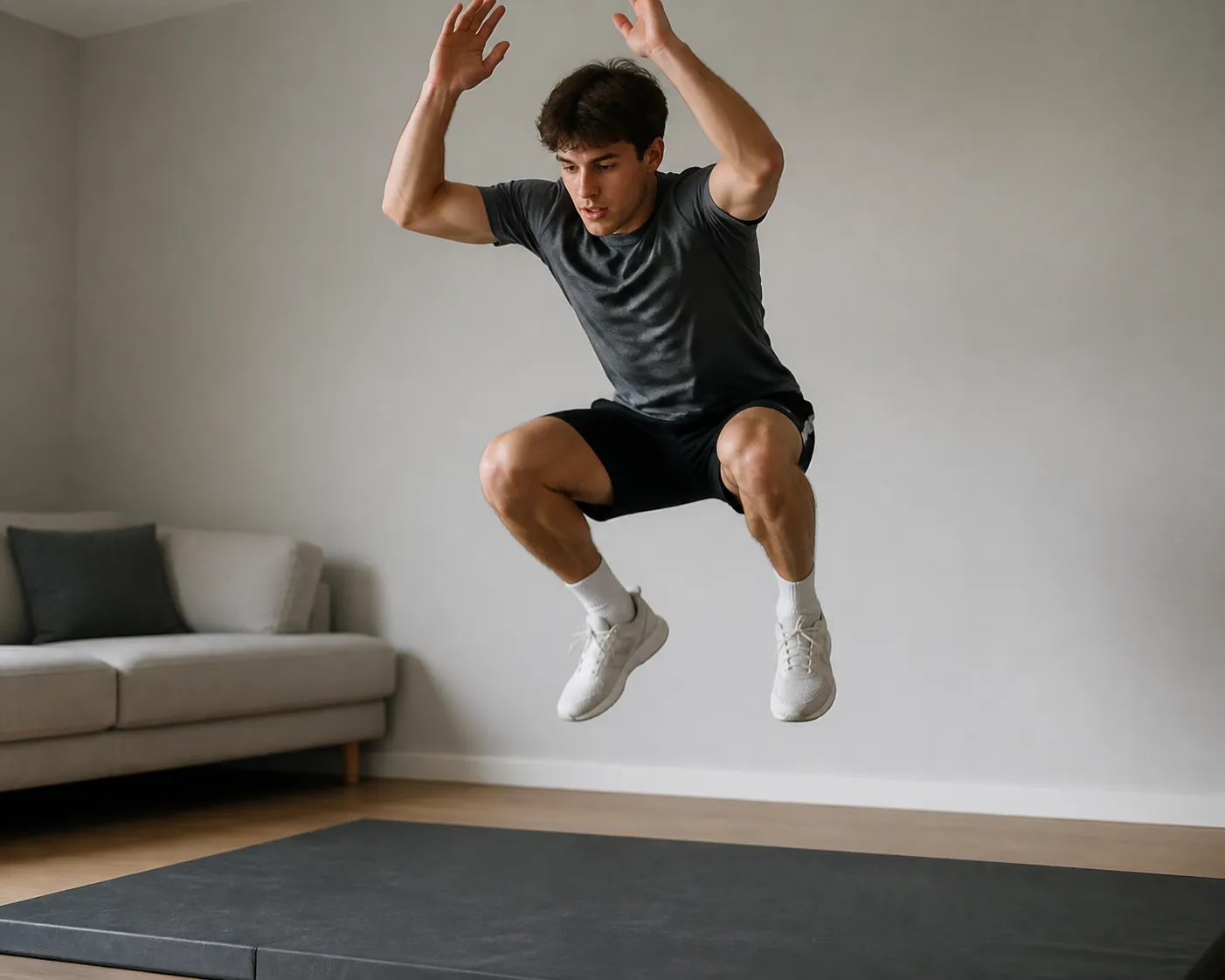
Vertical training belongs in a home basketball plan only when the surface is right. A thick exercise mat, garage floor with proper protection, or outdoor flat surface changes the decision. A thin rug over a slick floor does not. Overtime Athletes’ at-home vertical jump workout includes bodyweight movements such as pogo jumps, squat jumps, lunge jumps, box jumps, and tempo squats [6].
| Drill | How to do it | Prescription | Space and budget tag | Progression rule |
|---|---|---|---|---|
| Pogo jumps | Small, quick ankle jumps with knees slightly bent and contacts light. | 4 sets of 15-20 seconds; rest 45-60 seconds. | 4 x 4 feet; $0-100 depending on mat and floor. | Progress by making contacts cleaner and quieter before adding time. |
| Squat jumps | Sink into a controlled quarter-to-half squat, jump straight up, land softly, reset. | 4 sets of 5 reps; rest 60-90 seconds. | 5 x 5 feet plus ceiling clearance; $0-100. | Add reps only if every landing is quiet and balanced. |
| Lunge jumps | Start in a split stance, jump and switch legs, or jump and land back in the same split stance if switching is too chaotic. | 3 sets of 4-6 reps per side. | 5 x 6 feet; $0-100. | Use non-switching reps first if knee control or balance is shaky. |
| Box jumps | Jump to a stable box or step, land tall, step down instead of jumping down. | 4 sets of 3-5 reps. | Needs stable box, safe clearance, and enough landing room; $0-300. | Raise height only when every landing is quiet and the box does not move. |
| Tempo squats | Lower for 3 seconds, pause for 1 second, stand up strong without jumping. | 3 sets of 8 reps. | 4 x 4 feet; $0. | Add a backpack load only after the tempo stays consistent. |
For renters or upstairs rooms, pogo jumps and squat jumps may be too loud even when they are technically low-equipment. In that case, keep the vertical block to tempo squats, split squats, calf raises, and low-impact strength work, or move the jumps outside.
Choose drills by space before you choose them by difficulty
The best drill on paper is useless if it needs a driveway you do not have. Pick from the room you actually have tonight.
| Your space | Best drill choices | Use caution with | Session note |
|---|---|---|---|
| 4 x 4 feet, no wall | Low pounds, high-low pounds, V-dribbles, line shooting, tempo squats | Crossovers if furniture is close; any jumping with low ceiling | Make this a control and form session. |
| 4 x 6 feet, no wall | Full stationary handling menu, self-shooting, jab steps, jump stops | Chair attack drills if there is no safe forward space | Good for 15-30 minute skill sessions. |
| 8-10 feet with a safe wall | Wall passing, wall form shooting, pass-catch-foot reset, closeouts | Hard wall passes on fragile walls or shared apartment walls | This is the best no-hoop passing setup. |
| 6-8 feet lateral lane | Defensive slides, closeout-slide combos, chair curls | Plyos if the lane is narrow or slippery | Use tape marks to keep the drill honest. |
| Garage, basement, driveway, or outdoor flat space | Chair retreat attacks, conditioning bursts, vertical jump work, longer combo sessions | Box jumps on unstable objects; high-volume jumping on hard surfaces | Best for 30-45 minute sessions with conditioning. |
If you are building the setup gradually, match the equipment to the space instead of buying around a fantasy version of the room. The compact home gym build plan and beginner equipment framework are better places to think through tiers, mats, and add-ons. Any quiet-ball or mini-hoop purchase should be treated as an equipment experiment until it has been tested in your actual room.
Turn the drill library into 15-, 30-, and 45-minute sessions
A good full practice does not need 18 drills. Basketball for Coaches gives a useful session-volume benchmark of roughly 4-6 drills per session and 8-12 minutes per drill [7]. Jr. NBA starter practice plans also support the idea that skill work should dominate a youth or beginner session, with roughly 60% of the practice time spent on skill development [8]. At home, that means the short session has to be selective, and the longer session should not become a random tour of every drill you know.
15-minute no-hoop session: one skill plus one finisher
| Time | Block | Drills |
|---|---|---|
| 2 minutes | Warm-up | Bodyweight squats, arm circles, ankle bounces, light stationary dribble |
| 8 minutes | Main skill: handling | Low pounds 2 sets per hand; front V-dribble 2 sets per hand; stationary crossover 3 sets of 20 |
| 3 minutes | Form or passing | Line shooting 2 sets of 12, or chest pass to target 3 sets of 15 if you have a wall |
| 2 minutes | Control finisher | Weak-hand only: 4 rounds of 20 seconds work, 10 seconds rest |
This is the before-dinner version. Do not cram in vertical work, five passing drills, and a fake conditioning circuit. Fifteen minutes is enough for one clean emphasis.
30-minute no-hoop session: skill, wall work, footwork
| Time | Block | Drills |
|---|---|---|
| 4 minutes | Warm-up | Light dribble, hip hinges, lunges, quick feet in place |
| 10 minutes | Ball handling | High-low pounds 3 rounds per hand; side V-dribble 3 sets per hand; between-the-legs 4 sets of 12 each direction |
| 8 minutes | Wall passing or shooting form | Chest pass 3 sets of 20; one-hand push pass 2 sets of 12 per hand; or wall form shooting 5 sets of 10 |
| 6 minutes | Footwork | Jump stop to pivot 3 sets of 8; defensive slide line 4 rounds of 20 seconds |
| 2 minutes | Finish | Free throws without a rim: 20 slow form releases, same routine every rep |
45-minute no-hoop session: full small-space workout
| Time | Block | Drills |
|---|---|---|
| 5 minutes | Warm-up | Mobility, light dribble, defensive stance holds, easy skips or marches |
| 12 minutes | Ball handling | Low pounds 2 sets per hand; front and side V-dribbles 2 sets per hand each; chair retreat and attack 3 rounds of 5 each side |
| 8 minutes | Shooting form | Self-shooting 5 rounds of 1 minute; line shooting 3 sets of 12 |
| 8 minutes | Wall passing | Chest pass 3 sets of 20; bounce pass 3 sets of 15; pass-catch-foot reset 3 rounds of 45 seconds |
| 6 minutes | Footwork | Closeout to wall 4 sets of 5; jab-step series 2 rounds each side |
| 6 minutes | Conditioning or vertical | Conditioning option: 3-4 rounds of 30 seconds work, 30 seconds rest. Vertical option: pogo jumps 3 sets and squat jumps 3 sets of 5 on a safe surface. |
For parents running this with a 6- to 12-year-old, keep the same structure but cut the work sets before attention breaks. A child does not need a cartoon version of the workout; they need fewer reps, visible targets, and one correction at a time.
Progression rules that keep home drills from getting sloppy
At home, progression has to be earned because there is no scoreboard telling you the drill broke down. Use these rules across the whole menu.
- For ball handling, progress when you can complete every set without looking down for more than a quick check and without standing up out of your stance.
- For shooting form, progress when the release, follow-through, and landing repeat. No rim means no make percentage, so do not pretend otherwise.
- For passing, progress when the target standard holds. A harder pass that misses the tape square is not a better rep.
- For footwork, progress when the stop is clean. If the pivot foot slides, the drill is too fast.
- For conditioning, progress by adding 1-2 sets weekly only when the skill portion stays sharp.
- For vertical work, progress through cleaner landings before higher jumps, more reps, or harder surfaces.
No hoop does not mean no basketball training. It means the plan has to be honest about what is missing and precise about what can still be trained. Choose drills that fit the room, do enough volume to matter, and move up only when control, form, or output justifies it.
References
- 50 Basketball Dribbling Drills — Basketball for Coaches
- Five Basketball Shooting Drills Without a Hoop — Ultimate Hoops
- Basketball Drills Kids Can Do at Home — Rockline Basketball
- Home Basketball Drills No Hoop — Little Boomers Basketball
- Effective At-Home Workouts to Get Into Basketball Shape — Ultimate Hoops
- Vertical Jump Training At Home Workout — Overtime Athletes
- 73 Basketball Drills for Players and Coaches — Basketball for Coaches
- Basketball Practice Plans: Starter — Jr. NBA
What a small equipment investment adds
We don't have a build tagged to this exact tier yet. Browse all builds.
How often should you repeat this?
See our recovery and rest reference for citation-anchored rest-interval guidance.
Spot something off?
Tell us if a movement, tier assumption, or duration didn't match your experience.