
Do Basketball Shooting Drills at Home With No Noise Complaints
Practical basketball shooting drills you can do in a small apartment using foam balls and no-drill hoops — no noise complaints, no deposit risk, and room for real skill improvement.
- Equipment tier required
- none
- Duration
- 15 min
- Difficulty
- beginner
- Target area
- upper body
- Space footprint needed
- 3x3 ft
- Noise level
- quiet
A useful basketball shooting drill at home has to clear a lower bar than most online advice admits: it must fit in a few feet of floor, avoid drilling into a wall, and keep the downstairs neighbor from hearing a hard ball slap the floor every few seconds. In an apartment, the practical setup is usually a foam silent ball, an adhesive-mounted mini hoop if your wall and lease allow it, and a set of no-bounce form drills that keep the shot pattern alive without pretending your living room is a court.
That last part matters. Quiet apartment shooting can train alignment, release, wrist finish, arc awareness, and repeatable rhythm. It cannot fully replace judging depth on a regulation rim, reading game-speed closeouts, or feeling a real ball come off your fingers from the free-throw line. The point is to make the small-space work legitimate enough that you keep practicing instead of waiting for a driveway, gym slot, or merciful weather.
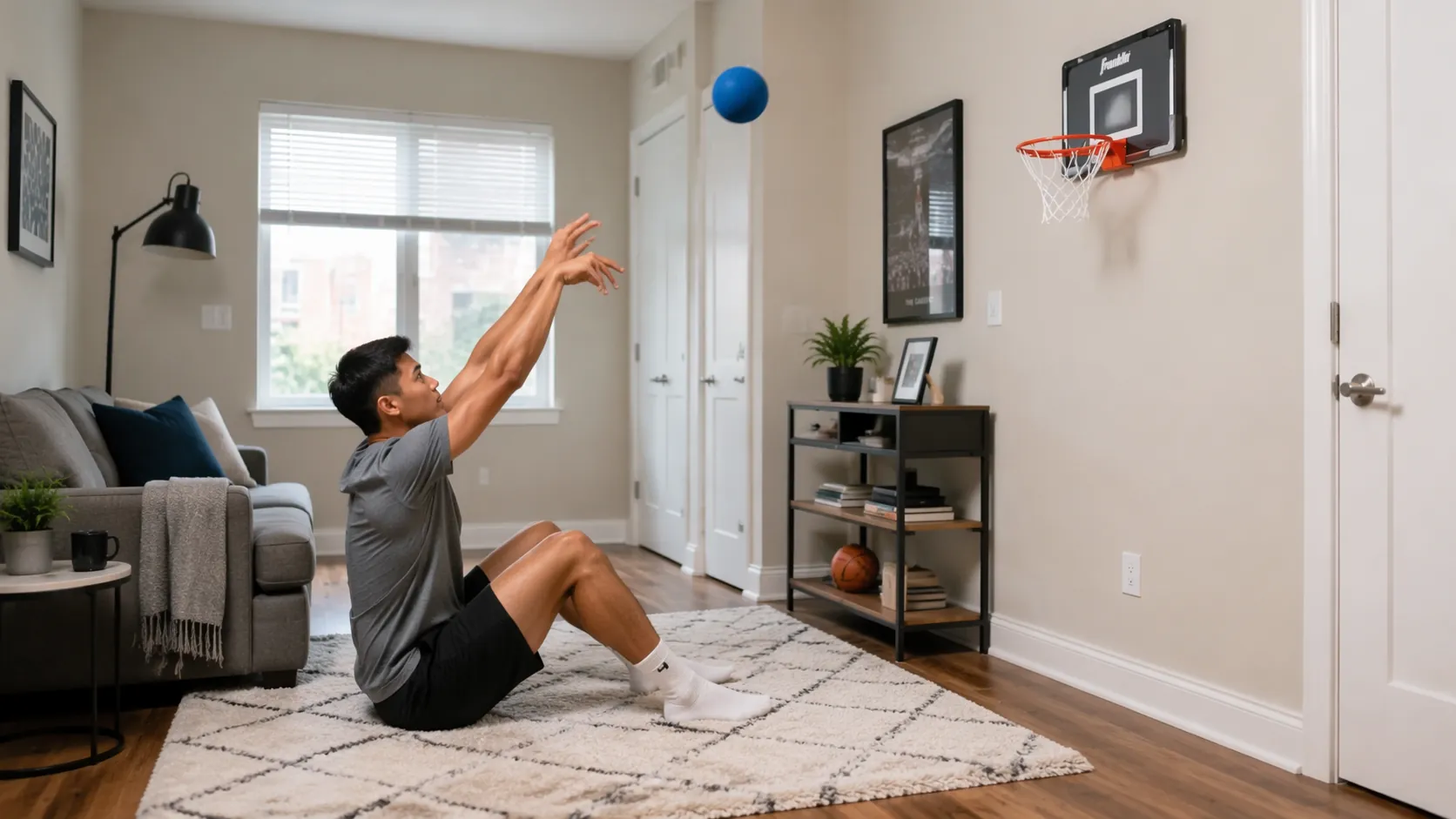
First solve the two apartment killers: impact noise and damage
A regulation basketball is the wrong default indoors because the problem is not only volume in the air. It is impact through the floor. SilentBasketball.net reports that a traditional basketball can create roughly 80–90 dB on apartment floors, while its foam ball is designed to cut the thud and still retain about 85% of a real basketball’s bounce height [1]. That decibel figure is useful because it gives shape to why neighbors complain, but it should be treated as a manufacturer-reported claim, not an independent acoustic study.
For shooting work, you do not need much bounce anyway. A foam ball earns its place because it lets you catch, lift, release, and retrieve without turning every miss into a floor hit. If the ball drops onto a rug or mat, the sound profile changes from a sharp report to a dull landing. That is the difference between a repeatable 10 p.m. routine and an apology text.
Wall and floor damage deserve the same seriousness. A no-drill mini hoop is only apartment-safe if the adhesive is appropriate for the surface, the backboard is light, and the target area is away from framed art, mirrors, thin plaster, and shared walls. If you are unsure whether the adhesive will remove cleanly, skip the hoop at first and use wall form shooting, self-shooting on your back, and line feedback on the floor. A security deposit is too expensive to gamble on a plastic rim.
What to buy, and when buying nothing is fine
The cheapest useful version of this setup is not a mini hoop. It is clear floor, a soft landing surface, and a ball you can release without fear. The hoop becomes valuable when you want a visible target and a little more satisfaction per rep, but it is not required for the first layer of form work.
| Budget tier | What it usually includes | Best use | What to watch |
|---|---|---|---|
| $0–30 | Rolled towel or tape line, rug or mat, existing soft ball or low-cost foam ball | Release work, alignment checks, lying-on-back form shooting, seated shooting | No real rim feedback; avoid tape that lifts paint or floor finish |
| $30–80 | Foam silent basketball plus removable floor line or small target marker | Daily quiet reps with better hand feel and safer misses | Foam feel is different from a regulation ball, so real-hoop sessions still matter |
| $80–150 | Foam ball, adhesive-mounted mini hoop, mat or rug, simple floor markers | Most complete apartment shooting station without drilling | Adhesive risk, wall suitability, and neighbor-facing shared walls |
A foam ball alone is enough if your goal is to clean up hand placement, elbow path, release timing, and follow-through. Add the adhesive mini hoop only when the wall can handle it and you want a target that encourages arc and finishing line. If you are renting a place with delicate paint or old plaster, the more mature choice is often the less exciting one: no hoop, no drilling, no argument with the landlord.
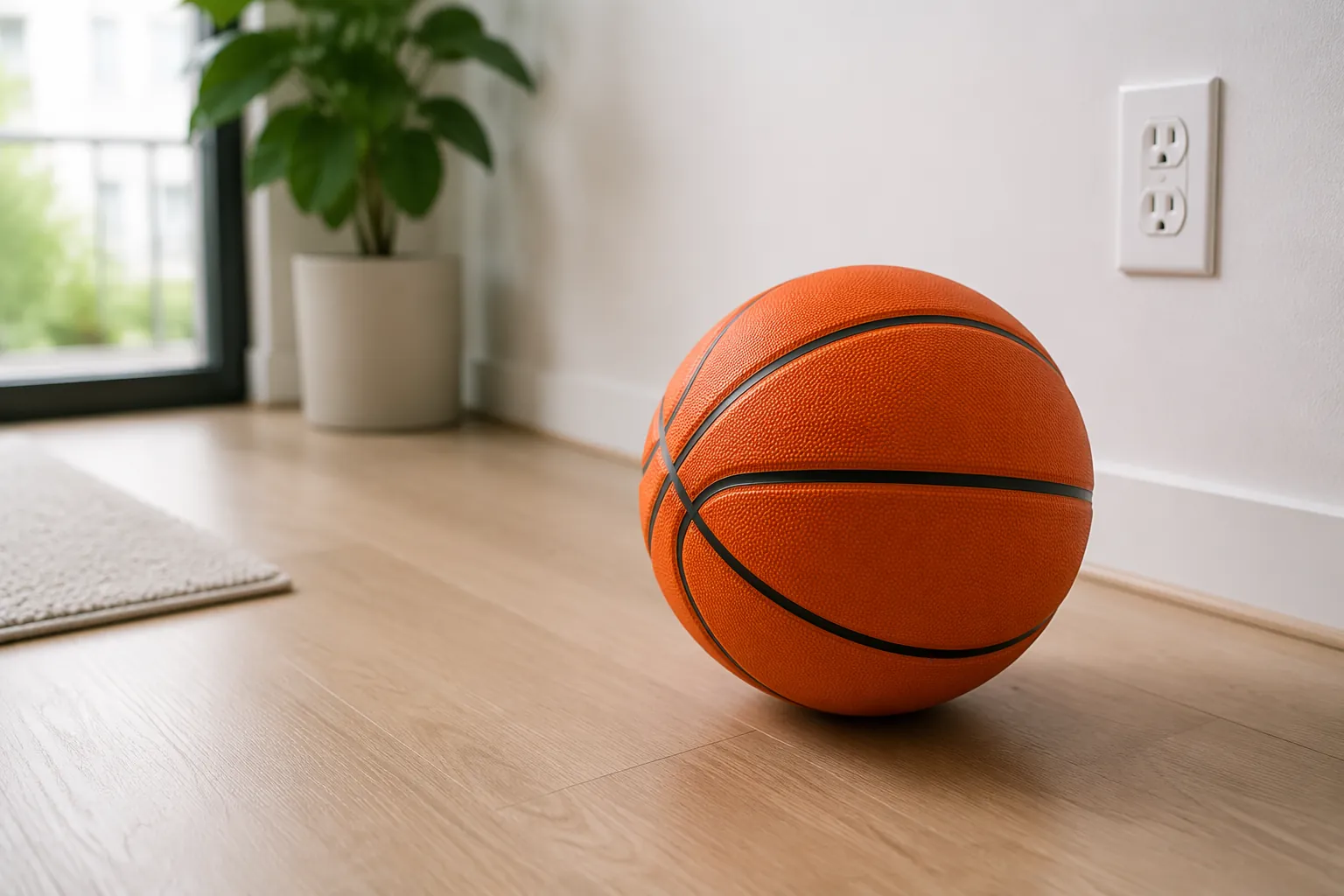
Mark a tiny practice area before you start shooting
The smallest useful shooting station is about control, not square footage. Lying-on-back form shooting and seated chair shooting can be done in less than 3×3 feet, while basic footwork such as a 1-2 step, hop, or pivot needs closer to a 4×4-foot patch if you want to move without clipping furniture [3][4][6].
Clear the area as if you expect one awkward miss. Move the coffee table, shift the chair legs out of the landing zone, and put a rug or mat where the ball will most often fall. If you are using a wall target or mini hoop, stand close enough that the ball travels softly and returns low. This is apartment shooting, not a contest to see whether the adhesive strip trusts you.
For a floor line, use something removable: a yoga strap, a shoelace, painter’s tape only if the surface tolerates it, or the seam of a rug. The line is not decoration. It gives you a reference for whether the ball leaves your hand straight or drifts left and right.
A 15-minute apartment shooting progression
Run the session in the same order most days: close form first, release feedback second, footwork last if space allows. The order keeps the noisy and risky parts out of the center of the workout, and it prevents tired feet from smearing the exact mechanics you came inside to practice.
| Time | Drill | Space | Main feedback |
|---|---|---|---|
| 2–3 minutes | Wall form shooting | Standing close to a blank wall or safe target | Straight wrist, soft touch, no side spin |
| 3–4 minutes | Lying-on-back self-shooting | Less than 3×3 feet | Vertical release, balanced guide hand, clean catch |
| 3–4 minutes | Seated chair shooting | Less than 3×3 feet | Upper-body alignment without jumping or drifting |
| 3 minutes | Ball-and-line deviation drill | Small floor strip | Whether the ball returns left, right, or straight |
| 2–3 minutes | Limited 1-2 step, hop, or pivot into form hold | About 4×4 feet | Feet set before the release; quiet landings |
Wall form shooting: close enough that misses are harmless
Stand close to a blank wall, soft target, or adhesive mini hoop and shoot with one hand first. ProSkillsBasketball uses wall form shooting as a way to isolate mechanics without needing a basket [2]. In an apartment, the useful version is gentle: ball under control, wrist finishing through the center, guide hand coming off without twisting the ball.
Do not chase power here. If the ball rebounds hard, you are too far away or throwing instead of shooting. A good rep makes a soft contact, drops safely, and tells you whether your wrist finished straight. Ten clean releases are more valuable than fifty noisy ones that train you to fling the ball at drywall.
Lying-on-back self-shooting: the quietest way to expose a crooked release
Lie on your back with knees bent, hold the ball above your shooting shoulder, and shoot it straight up so it comes back to your hand path. US Sports Camps includes this kind of self-shooting form work as a small-space way to practice release mechanics [3]. The floor does one useful coaching job: it removes your legs, so any left-right drift is coming from your upper body.
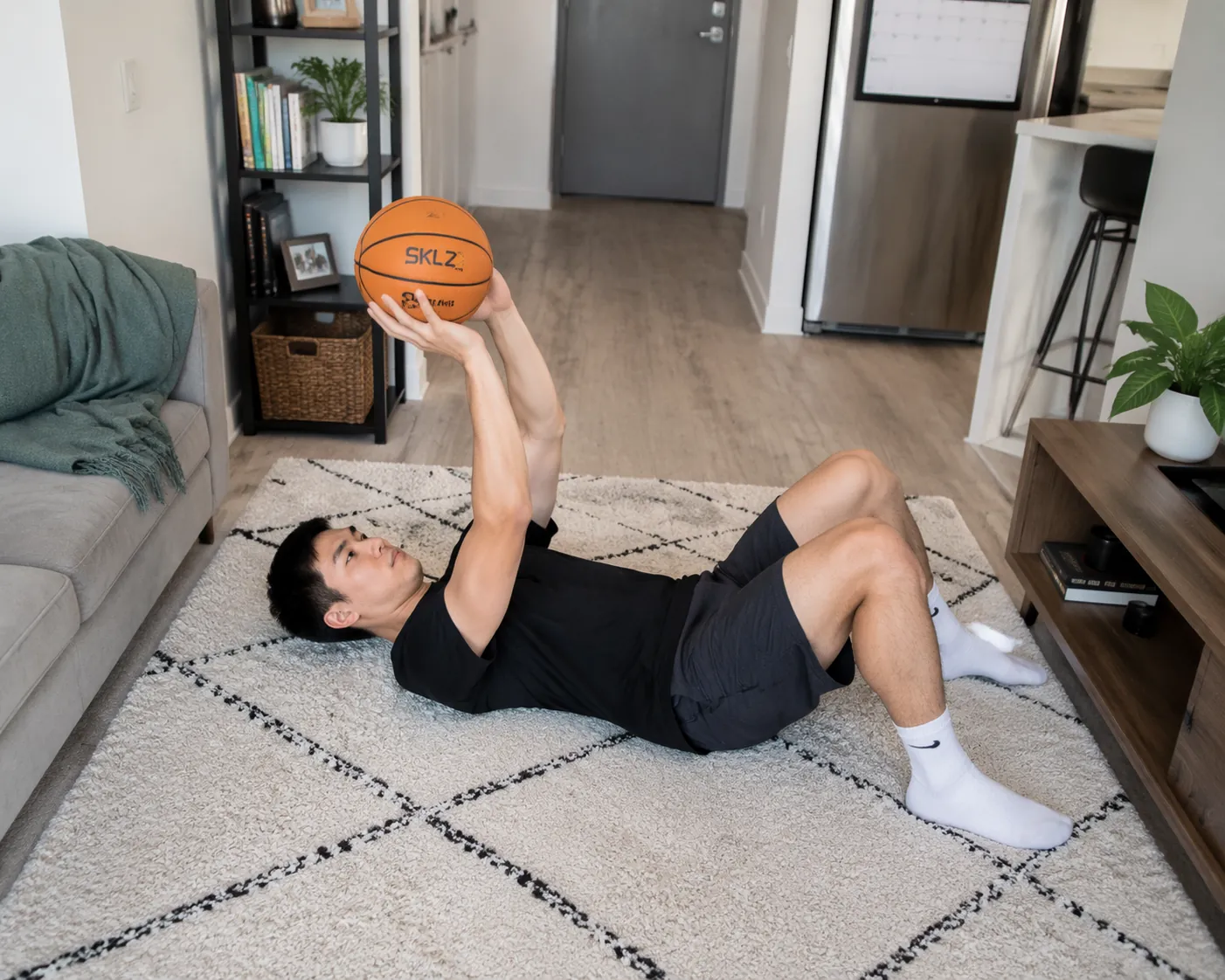
The ball should rise with backspin and fall near the same window. If it keeps drifting toward your guide hand, check whether the guide thumb is pushing. If it falls behind your head, your wrist may be late or your elbow may be sliding back. Keep the reps low enough that you stay precise; this drill gets sloppy fast when the shoulder tires.
Seated chair shooting: remove the jump, keep the shot line
Sit near the front edge of a stable chair with feet flat and knees roughly under hips. Ultimate Hoops uses seated chair shooting to focus on upper-body form and release without the lower body taking over [4]. For apartment work, that makes it useful twice: it is quiet, and it reveals whether your shot depends on a forward lean.
Start with form holds before full releases. Bring the ball to your set point, pause long enough to notice elbow and wrist position, then shoot softly to a wall target, mini hoop, or your own hands. If the chair rocks, the rep is too aggressive. If your feet lift, reset. The goal is a shot that leaves from a stacked position instead of a lunge.
Ball-and-line drill: make left-right misses visible
Place a straight line on the floor between you and the target. Shoot or roll the ball softly along that line and watch whether it returns straight or consistently leaks to one side. Noah Basketball’s shooting-feedback method emphasizes tracking left-right deviation because makes and misses alone do not always tell you why the ball is off [5]. In an apartment, the line drill gives you that feedback without needing a full rim.
Use it after form shooting, not before. First establish a clean release, then ask the line whether your hand path is honest. If three or four reps in a row drift right, do not immediately overhaul everything. Check the simplest causes first: guide-hand pressure, elbow flaring, feet angled away from the target, or a wrist finish that cuts across your body.
Footwork only if you have the space to land softly
A 1-2 step, hop, or pivot can fit into roughly 4×4 feet when the area is clear, and OneUpBasketball treats these footwork patterns as part of building a shot-ready base [6]. In an apartment, the rep should end in a form hold or a very soft release. If your heel strike is audible through the floor, take the footwork out and do it at the park.
- 1-2 step: step right-left or left-right into your shooting base, freeze, then release softly or hold the set point.
- Hop: lift and land on both feet at once, quiet enough that the rug barely shifts, then rise into form.
- Pivot: start with your back or side to the target, pivot into alignment, and check whether your shooting shoulder finishes square.
If you live above someone, put footwork earlier in the evening or skip it during quiet hours. The renter upstairs gets to train; the person downstairs gets to sleep. Both facts can fit in the same program.
How to know the drill is transferring
Apartment shooting work is doing its job when your real-hoop warmup feels cleaner. Look for early signs: fewer guide-hand misses, a steadier set point, less side spin, and a release that repeats before you start chasing range. Do not judge the whole routine by whether you can swish a foam ball into a mini rim from across the room. That skill can become its own little carnival game.
At a real basket, spend the first few minutes close to the rim and compare the feel. Does the ball leave on the same line you practiced? Does your wrist finish through the target? Do your feet land in the same base? Then back up gradually. The regulation ball, true rim height, and real depth perception are the pieces the apartment cannot fully supply.
If you want ball handling to sit next to the shooting work, pair this routine with FitAtHome’s Caitlin Clark home drills on a different day or before the shooting block. For a wider basketball conditioning template, the Ben Simmons home training framework makes more sense than trying to turn a quiet shooting station into a full workout.
A weekly rhythm that respects the apartment
Use the apartment for short, frequent mechanics work: 10–15 minutes of foam-ball shooting, line feedback, and quiet form reps on most days you want to touch a ball. Then schedule one or two real-hoop sessions during the week when you can test distance, arc, depth, and game-speed footwork. The home work keeps the pattern warm; the court tells you whether the pattern survives real conditions.
After longer sessions, especially if you add footwork or a park-hoop workout, use a short cool-down such as FitAtHome’s 10-minute basketball recovery stretch. And if this is the start of a broader training corner, the compact home gym guide is the better place to think about equipment beyond the ball and hoop.
That is the honest trade: quiet daily reps for mechanics, occasional real-rim work for transfer. You do not need a garage to keep your shot from going stale, and your neighbor does not need to become part of the workout.
References
- Silent Basketball — SilentBasketball.net
- Wall Shooting Drill — Pro Skills Basketball
- Basketball Shooting Drills — US Sports Camps
- Chair Shooting — Ultimate Hoops
- Noah Basketball Shooting Feedback Method — Noah Basketball
- Basketball Footwork Drills — OneUpBasketball
What a small equipment investment adds
We don't have a build tagged to this exact tier yet. Browse all builds.
How often should you repeat this?
See our recovery and rest reference for citation-anchored rest-interval guidance.
Spot something off?
Tell us if a movement, tier assumption, or duration didn't match your experience.