
Bear Attack Hiking Safety Tips for Fit Outdoor Exercisers
Fit outdoor exercisers who cover more miles quietly face higher bear encounter risk. This article explains why standard hiking advice isn't enough and provides specific prevention and response strategies tailored for runners and fast hikers.
- Equipment tier required
- none
- Duration
- 30 min
- Difficulty
- intermediate
- Target area
- full body
The fit person is not always the safer person in bear country. A runner or fast hiker can move through miles of trail with good lungs, strong legs, and almost no sound until a bear gets the news too late.
That is what happened to trail runner Karen Williams near Choteau, Montana. In the iRunFar account, Williams surprised a grizzly, was bitten, and survived because she did the one thing that is hardest to improvise while being attacked: she played dead. Her own explanation is blunt enough to remember: "The only thing that saved my life was playing dead, and I knew to do that because I'd read about it." [1]
That sentence is the point of bear attack hiking safety tips for outdoor exercise. The useful protocol is not a vague respect for wildlife. It is a rehearsed sequence for people who are breathing hard, moving quickly, and making decisions with a nervous system that would very much like to sprint.
Fitness Changes the Risk Profile
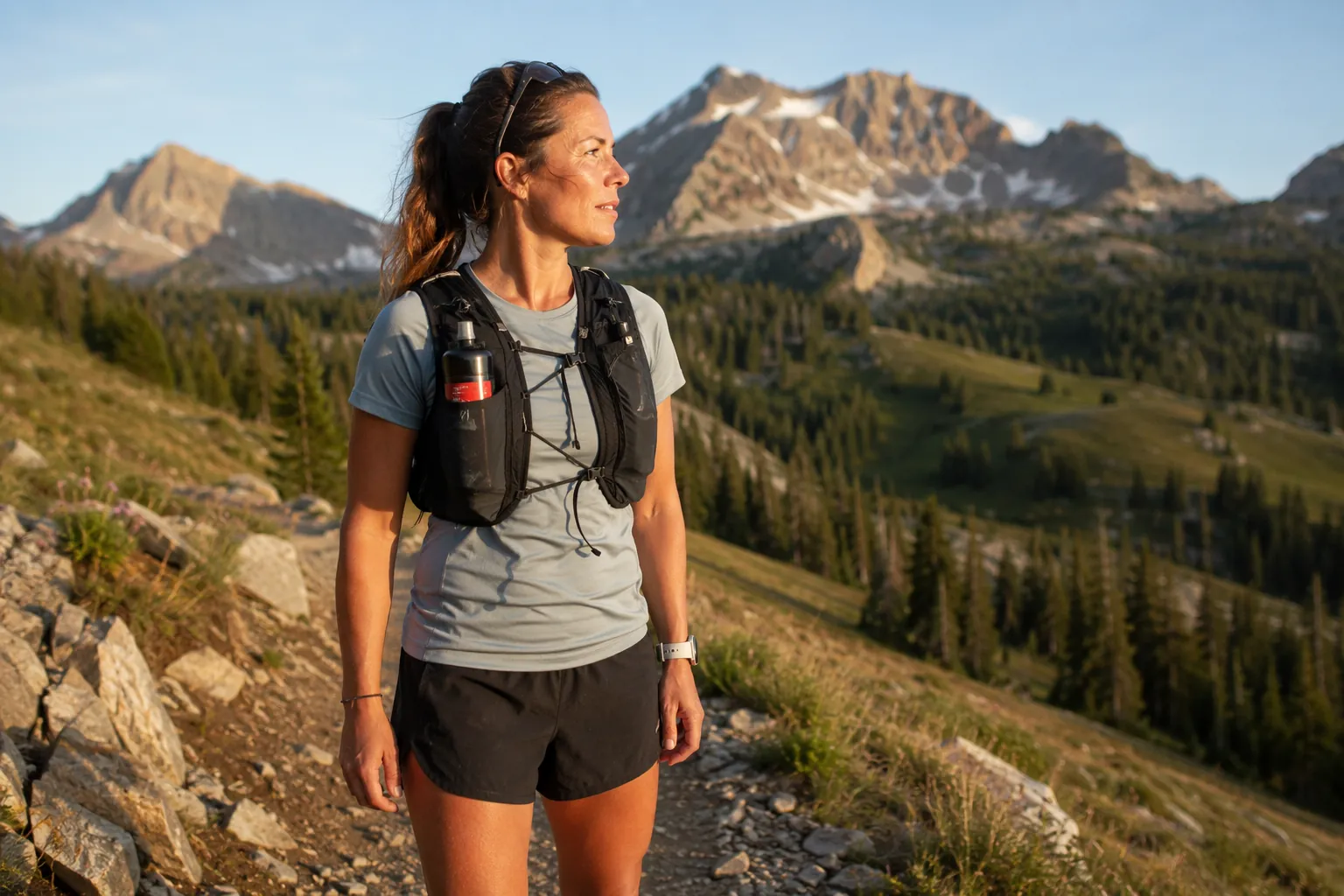
The National Park Service does not treat trail running in bear country as ordinary hiking with better cardio. Its guidance says trail running is "highly discouraged in bear country" because runners move quickly and quietly, increasing the chance of surprising a bear.[2] That warning lands differently if your usual outdoor session is a tempo run, a fast ridge hike, or a long climb where you are proud of holding pace.
The fitness itself is not the problem. The side effects are: more trail covered per outing, less time spent pausing, a softer footfall than a group of casual hikers, dawn or dusk training windows squeezed around work, and the confidence that comes from being able to move away from discomfort. In bear country, speed is not always a tool. Sometimes it is how you arrive before the animal has time to leave.
The risk still needs perspective. BearVault summarizes roughly 180 fatal bear attacks in North America since 1784, an average of fewer than one per year.[3] The American Bear Association says a person is 67 times more likely to be killed by a domestic dog than by a bear.[4] Those numbers should lower the drama, not the standard. Rare events are still worth preparing for when the wrong reaction can make the encounter worse.
The Fast-Mover Version of Prevention
Generic hiking advice often assumes a walking pace, frequent stops, and a group that naturally makes noise. Outdoor exercisers need a tighter version because the encounter can start faster. Before the trail, the working plan is simple:
| Decision point | Better default for runners and fast hikers |
|---|---|
| Route and timing | Avoid dawn and dusk when possible; check local bear activity and closures |
| Noise | Use a human voice on blind corners, near water, in brush, and over rises |
| Group size | Go with others when possible; treat solo speed as a higher-risk choice |
| Spray carry | Carry bear spray on the chest or belt where either hand can reach it |
| Food, dogs, cubs | Secure attractants, keep dogs controlled, never approach cubs |
| Response memory | Know the grizzly-black bear reversal before you need it |
Make Human Noise, Not Gear Noise
Bear bells are comforting because they outsource a job. They are not a reliable substitute for a human voice. REI notes that bear bells may not be loud enough to alert bears, and BearWise recommends making noise with your voice, clapping, or other clear human sounds when visibility is limited.[5][6]
For a runner or fast hiker, the noise rule should be attached to trail features, not mood. Call out before blind turns. Call out when the trail crosses loud water. Call out when brush is shoulder-high, when the wind is in your face, and when you crest a rise where your first view is also the bear's first view of you. A steady conversational group does some of this naturally; a solo runner with earbuds does almost none of it.
If you already use structured training cues, make this one another cue. You do not need a wilderness monologue. You need a repeatable sound habit at the places where a surprise is most likely.
Choose Company When Pace Tempts You Into Solo Miles
Groups are louder, more visible, and less likely to look like an isolated opportunity. CleverHiker, citing interagency bear study data, reports no recorded grizzly fatality in a group of four or more hikers.[7] That does not make a group of four magic armor, and it is a secondary-source statistic. It does make group size a real safety variable rather than a social preference.
The uncomfortable part for fit exercisers is that the safest group may not match your favorite pace. A slower group that talks and stays together can be a better bear-country choice than a perfect solo training effort. If the goal is a workout, you can still get one: carry a little more, take the climbs steadily, or save the harder interval work for lower-risk terrain. For building trail-relevant capacity at home, a structured plan like a home gym routine built for your equipment is a cleaner place to chase numbers than a quiet dawn run through dense bear habitat.
Treat Dawn, Dusk, Food, Dogs, and Cubs as Decision Points
BearVault cites a study of more than 700 large-carnivore conflicts in which about half involved preventable human error, including unsecured food, unleashed dogs, approaching cubs, and dawn or dusk activity.[3] That list is useful because it is not exotic. It is the stuff people do when they are in a hurry, distracted, or sure that the main objective is finishing the route.
If your outdoor exercise window is early morning or evening, the answer is not always "never go." It is to raise the threshold. Check current trail advisories. Skip the route if there is recent bear activity, poor visibility, heavy brush, or a food-conditioned bear report. Keep food and scented items sealed. Do not let a dog range ahead and become the first member of your party to meet the bear. If you see cubs, leave the area without trying to improve the view.
This is also where weather and timing decisions matter. If the hourly forecast pushes you into the exact window when visibility and bear movement make the route worse, choose a different workout. A simple outdoor-decision habit like letting the hourly forecast decide between running outside or using a treadmill carries over well here.
Bear Spray Only Helps If Your Hands Can Reach It
Bear spray is not a lucky charm in the bottom of a pack. For a runner, that might as well be back at the trailhead. BearWise recommends EPA-registered bear spray with 1% to 2% capsaicin and related capsaicinoids, in a canister of at least 7.9 ounces.[8] It should be carried in a holster, not buried with snacks, layers, and a first-aid kit.[8]
The carry position matters because close encounters do not wait for you to take off a vest. A chest holster or front belt position is boring in the best way: same location every time, reachable with either hand, not bouncing against your ribs, not hidden behind a jacket. Practice pulling the canister without firing it. Practice with cold hands. Practice after a hard climb when your breathing is messy.
Effectiveness data is reassuring when the spray is actually deployable. Backpacker summarizes research by Smith et al. finding bear spray stopped aggressive bear behavior 85% to 92% of the time, compared with 76% for long guns and 84% for handguns.[9] CleverHiker, summarizing Alaska wildlife data, reports that 98% of people carrying bear spray were uninjured in close encounters.[7] Those are not guarantees; they are reasons to carry the right tool where you can use it.
Deployment is also specific. BearWise describes a typical range of 30 to 60 feet and recommends a 2- to 3-second burst aimed slightly downward toward the bear's face.[8] The downward angle helps put the cloud in the bear's path instead of sending it over the animal. Wind can complicate that, which is another reason not to wait until the bear is already on top of you.
Check local rules before you pack it. Bear spray regulations vary by park and jurisdiction; the research materials note that Yosemite prohibits it while Glacier requires it. The practical rule is to confirm current local regulations for the exact place you are entering, then carry accordingly.
When You See a Bear, Slow the Whole System Down
The first job in an encounter is not to win. It is to stop making it worse. Do not run. Do not scream. Do not crowd the bear for a photo. Do not assume that being fast gives you an exit plan. Running can trigger pursuit, and a bear is not a hill repeat you can outwork.
If the bear has not noticed you, leave quietly and give it space. If it has noticed you, talk in a calm, low voice, slowly wave your arms so you look human, and back away without turning your back. Pick up small children if they are present. If you are with others, group up and stay together.
This is where speed discipline matters. A fit person often wants an action: move, surge, fix it. In bear country, the safer first action is usually to become less surprising and less interesting.
Identify the Bear Because the Attack Response Reverses
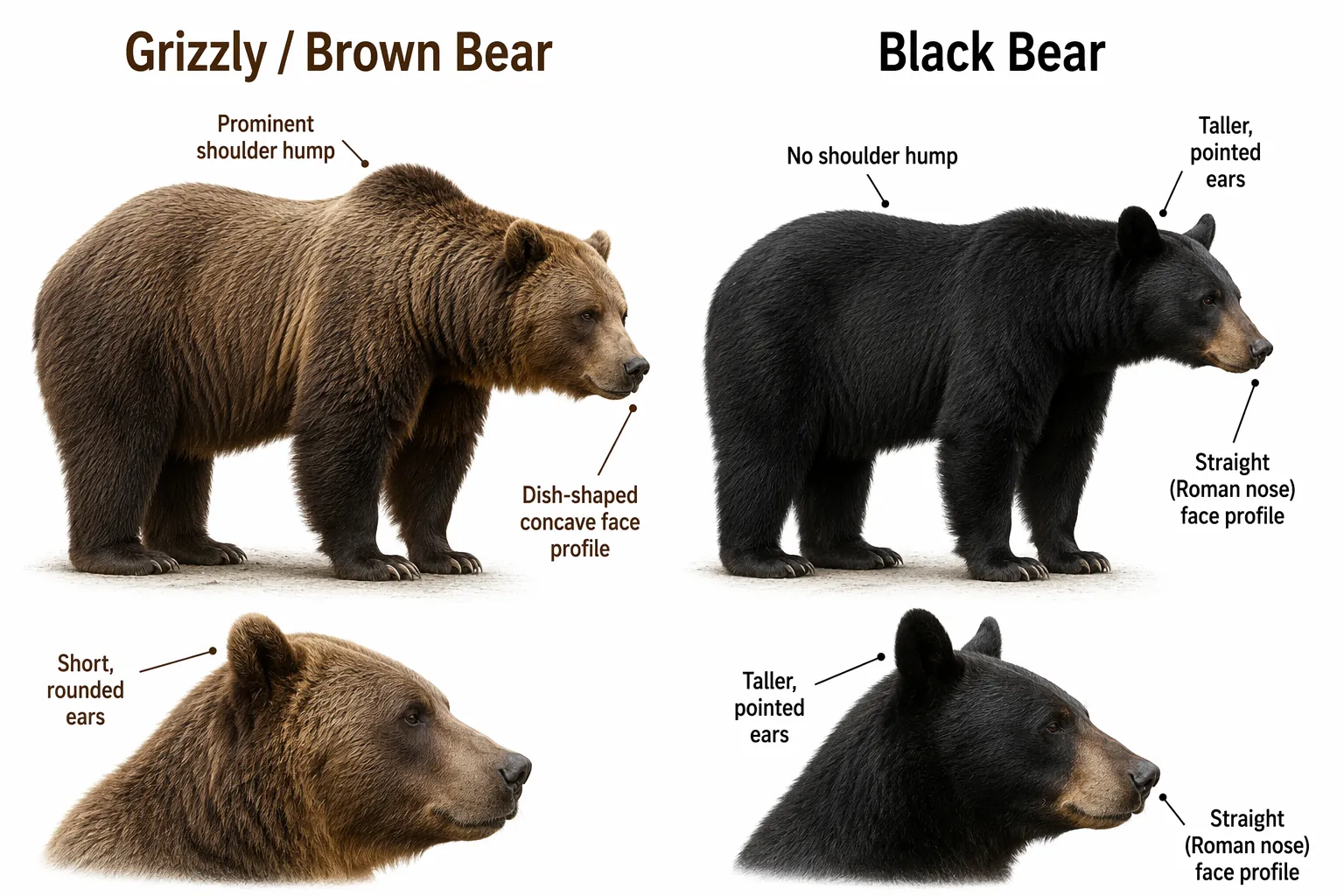
Species identification is not trivia. The Interagency Grizzly Bear Committee describes grizzlies as having a prominent shoulder hump, a dish-shaped face, and short rounded ears; black bears lack the shoulder hump and tend to have a straighter Roman-nose profile and taller, more pointed ears.[10] Color alone is not enough.
| Feature | Grizzly bear | Black bear |
|---|---|---|
| Shoulders | Prominent shoulder hump | No shoulder hump |
| Face profile | Dish-shaped face | Straighter Roman-nose profile |
| Ears | Shorter, rounded ears | Taller, more pointed ears |
| Attack response if contact occurs | Play dead only in a defensive grizzly attack | Fight back |
The last row is the one to memorize. In a defensive grizzly attack, play dead. In a black bear attack, fight back. If the behavior is predatory, if the bear stalks you, attacks at night, or enters a tent, fight back regardless of species. This distinction is too important to leave for the moment when your heart rate is already spiking.
Bluff Charge Does Not Mean Sprint
Bluff charges are more common than actual attacks. A bear may bound toward you, huff, pop its jaws, swat the ground, or veer away. The ugly part is that your body will read the charge as a starting gun. Do not take the bait. Stand your ground, speak calmly, keep your spray ready, and avoid sudden movement.
Spray is for a bear that keeps closing into usable range, not for every bear you see. If it comes within roughly 30 feet and continues toward you, deploy a short burst toward the face and slightly downward, then move away when you have a safe opening.[8] If the bear stops or changes direction, do not chase it with more spray. Your job is to leave the conflict, not score a clean rep.
If Contact Happens, Use the Memorized Branch
For a defensive grizzly attack, play dead: lie face down, keep your pack on if you have one, clasp your hands behind your neck, spread your legs so you are harder to roll, and stay still until the bear leaves. That was the learned response Williams credited with saving her life.[1]
For a black bear attack, fight back with everything available. Aim for the face and muzzle. Use rocks, trekking poles, fists, elbows, or any hard object you can reach. The same fight-back rule applies to predatory behavior, stalking, night attacks, or a bear entering a tent, even if species identification is uncertain.
The split is uncomfortable because it asks for opposite behaviors under maximum stress. That is why reading it once at the trailhead is not enough. Say it out loud before the route: defensive grizzly, play dead; black bear or predatory, fight back. It is not elegant. It is memorable.
Rehearse It Like a Safety Drill, Not a Fear Ritual
A home-gym athlete already understands rehearsed movement. You do not wait until a heavy set to invent bracing. You do not wait until a steep descent to discover whether your shoes hold. Bear safety belongs in that same category: small habits practiced before fatigue and adrenaline start editing your choices.
- Before leaving: check local bear activity, closures, spray rules, route visibility, and time of day.
- Before starting: put spray on your chest or belt, confirm the safety clip orientation, and make sure clothing does not block the draw.
- During the route: make voice noise at blind corners, near loud water, in brush, and over rises.
- If you see a bear: stop running, talk calmly, back away, and group up.
- If a bear closes: prepare spray, stand ground during a bluff charge, and deploy if it enters effective range.
- If contact happens: defensive grizzly means play dead; black bear or predatory behavior means fight back.
For runner-specific avoidance habits, the companion guide on how to avoid bears while running outdoors goes deeper into the running lane. For a broader outdoor-fitness safety frame, how to stay bear-safe during your outdoor fitness routine is the better cross-check.
Do not treat bear safety as fear, and do not treat fitness as protection. Know the local rules, travel noisier and less alone, carry spray where your hands can reach it, and memorize the few response distinctions that cannot be improvised under stress.
References
- Running With The Bears: A Guide For Trail Runners, iRunFar, 2016.
- Hiking in Bear Country, National Park Service.
- Bear Attack Statistics, BearVault.
- Hiking & Camping, American Bear Association.
- Backpacking in Bear Country, REI.
- Bear Safety Tips: Hiking, Camping, Fishing & Outdoors, BearWise.
- Does Bear Spray Really Work?, CleverHiker.
- Bear Spray, BearWise.
- How Effective Is Bear Spray, Really? Here's What Experts Want You to Know, Backpacker.
- Encounter Behavior & Myths, Interagency Grizzly Bear Committee.
What a small equipment investment adds
We don't have a build tagged to this exact tier yet. Browse all builds.
How often should you repeat this?
See our recovery and rest reference for citation-anchored rest-interval guidance.
Spot something off?
Tell us if a movement, tier assumption, or duration didn't match your experience.