
A Beginner's Marathon Training Plan You Can Do at Home
A beginner can realistically train for a first marathon at home with a 16-18 week plan built on treadmill long runs and two short strength sessions a week, paired with apartment-friendly setup steps and an honest 'just finish' goal instead of a time target.
- Equipment tier required
- $300-800
- Duration
- 30 min
- Difficulty
- beginner
- Target area
- legs & core
- Noise level
- ✓
Yes, a beginner can train for a marathon almost entirely at home, usually on a treadmill. The catch is that the printed schedule is only the visible half of the job. The rest is less glamorous: making treadmill pace honest, keeping long runs from turning into punishment, adding two short strength sessions, and setting up the machine so your floor, knees, partner, and downstairs neighbor are not paying for every mile.
The plan below uses the familiar beginner marathon shape: about four run days per week, midweek runs mostly in the 3- to 10-mile range, a long run that builds from 6 to 20 miles, stepback weeks, and a three-week taper before race day. That structure is anchored in Hal Higdon’s Novice 1 marathon program, adapted here for a home-first runner using a treadmill as the default training surface.[1]
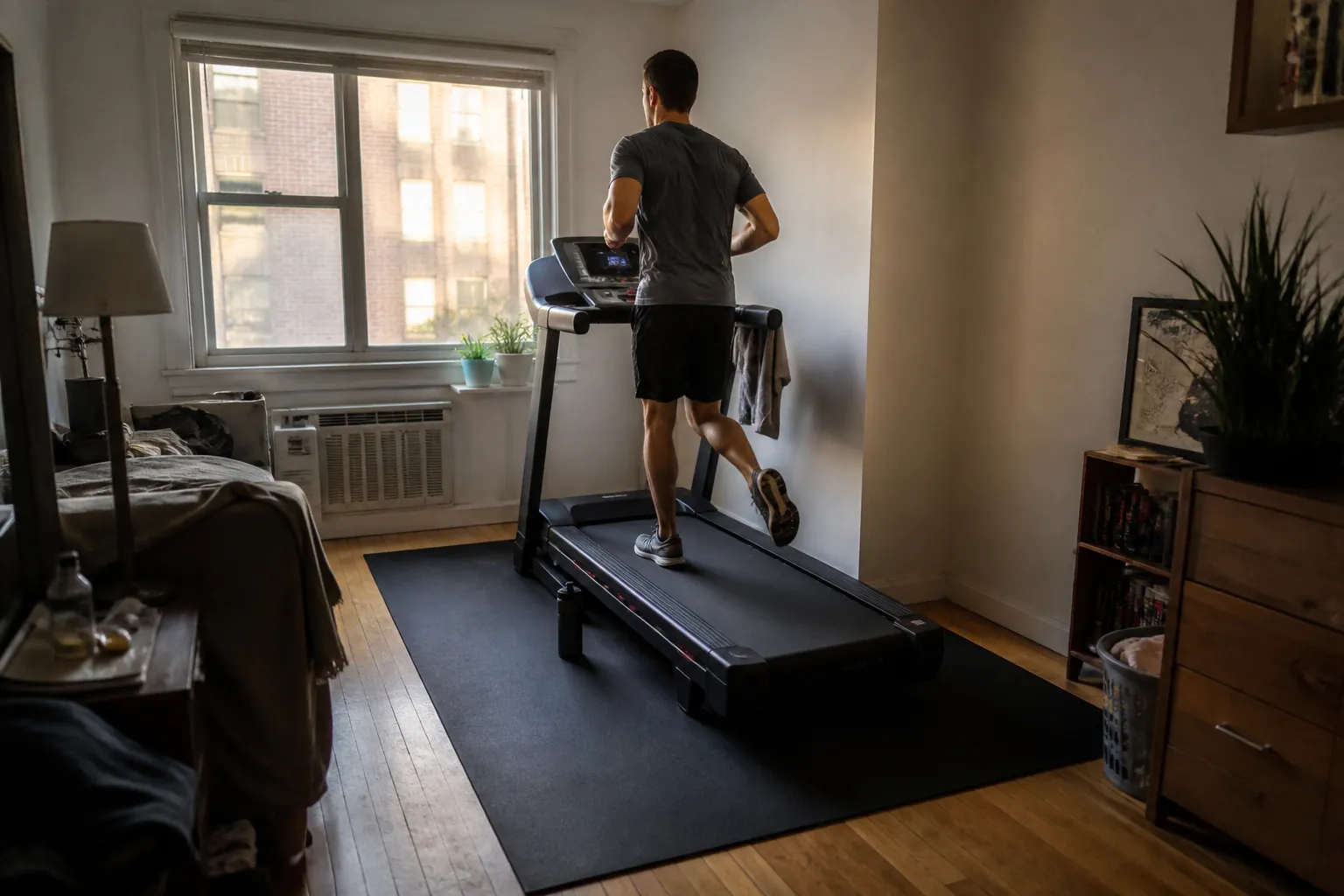
The 18-week home marathon plan
Use this plan if you can already run several times per week and can handle a 5- to 6-mile long run without turning it into a survival event. If you are starting from no running background, this is not the right first move; you need a longer runway before marathon-specific work.
The weekly rhythm stays deliberately boring. Most treadmill miles should feel easy enough that you could speak in short sentences. The long run is not a weekly fitness test. The two strength sessions are short, quiet, and there to make the running more tolerable, not to turn marathon training into a second full program.
| Week | Tue treadmill | Wed treadmill | Thu treadmill + strength | Sat long run | Mon or Sun strength | Notes |
|---|---|---|---|---|---|---|
| 1 | 3 mi easy | 3 mi easy | 3 mi easy + Strength B | 6 mi easy | Strength A | Set your treadmill baseline; keep every run controlled. |
| 2 | 3 mi easy | 3 mi easy | 3 mi easy + Strength B | 7 mi easy | Strength A | Long run grows by 1 mile. |
| 3 | 3 mi easy | 4 mi easy | 3 mi easy + Strength B | 5 mi easy | Strength A | Stepback week; do not “make up” the missing long-run miles. |
| 4 | 3 mi easy | 4 mi easy | 3 mi easy + Strength B | 9 mi easy | Strength A | First longer indoor session; test fueling and boredom controls. |
| 5 | 3 mi easy | 5 mi easy | 3 mi easy + Strength B | 10 mi easy | Strength A | Keep the 10-miler easier than you think you need to. |
| 6 | 3 mi easy | 5 mi easy | 3 mi easy + Strength B | 7 mi easy | Strength A | Stepback week. |
| 7 | 3 mi easy | 6 mi easy | 3 mi easy + Strength B | 12 mi easy | Strength A | Consider splitting the long run mentally into 3-mile blocks. |
| 8 | 3 mi easy | 6 mi easy | 3 mi easy + Strength B | 13 mi easy | Strength A | Practice race-day breakfast timing. |
| 9 | 3 mi easy | 7 mi easy | 4 mi easy + Strength B | 10 mi easy | Strength A | Stepback week; this is a good week for an outdoor pace check if possible. |
| 10 | 3 mi easy | 7 mi easy | 4 mi easy + Strength B | 15 mi easy | Strength A | Use effort, not display speed, as the main guide. |
| 11 | 4 mi easy | 8 mi easy | 4 mi easy + Strength B | 16 mi easy | Strength A | If calves or knees are getting loud, reduce intensity before adding more recovery tricks. |
| 12 | 4 mi easy | 8 mi easy | 5 mi easy + Strength B | 12 mi easy | Strength A | Stepback week. |
| 13 | 4 mi easy | 9 mi easy | 5 mi easy + Strength B | 18 mi easy | Strength A | A treadmill long run this long needs planned breaks, fuel, and cooling. |
| 14 | 5 mi easy | 9 mi easy | 5 mi easy + Strength B | 14 mi easy | Strength A | Stepback week; keep strength light if legs feel beaten up. |
| 15 | 5 mi easy | 10 mi easy | 5 mi easy + Strength B | 20 mi easy | Strength A | Peak long run. This is not a race rehearsal. |
| 16 | 5 mi easy | 8 mi easy | 4 mi easy + Strength B | 12 mi easy | Strength A | Taper begins; reduce volume, do not chase fitness. |
| 17 | 4 mi easy | 6 mi easy | 3 mi easy + light Strength B | 8 mi easy | Light Strength A | Keep everything easy and familiar. |
| 18 | 3 mi easy | 4 mi easy | 2 mi very easy | Marathon | Mobility only | Race week. Rest more than you want to. |
If your race is 16 weeks away, the cleanest adaptation is not to chop off the taper or delete stepback weeks. Start at Week 3 only if you can already run 5 to 6 miles easily and the first two weeks would genuinely be below your current training load. If that sentence does not describe you, the honest answer is to pick a later race.
What “beginner” should mean here
Beginner does not have to mean fast, experienced, or confident. It does have to mean prepared enough for marathon training to start. A plan whose first long run is 6 miles is already assuming some running history. That is not gatekeeping; it is the difference between building fitness and asking your shins, calves, and knees to absorb a sudden new life.
Runner’s World UK’s beginner marathon material also separates beginner options by current background, including plans that assume several months of running, and it pairs run training with two home bodyweight strength sessions of no more than 30 minutes.[2] That is the right spirit for this home version: keep the running plan recognizable, then add the durability work that makes it survivable in a spare room or apartment.
A practical entry check looks like this:
- You can run 3 miles without needing several days to recover.
- You can complete one relaxed 5- to 6-mile run before Week 1.
- You can train four days per week for running and two short sessions for strength.
- You are willing to make most runs easy, even when the treadmill makes pace tempting to stare at.
- You can solve the home setup problem before the long runs get long.
Set treadmill pace by effort first, display speed second
The treadmill is useful because it removes weather, traffic, darkness, and childcare handoffs from the equation. It is also a liar if you treat the console as absolute truth. Belt calibration, room temperature, airflow, cushioning, stride changes, and incline settings can all change how a pace feels.
The old treadmill shortcut is to set the incline to 1% to better simulate outdoor running. That rule comes from a 1996 Jones and Doust finding that a 1% treadmill grade matched the oxygen cost of outdoor running across speeds from 9:11 to 5:22 per mile. But it should not be treated as a universal law. A 2024 ETH Zurich study discussed by RunnersConnect found about 12.6% higher oxygen uptake on one treadmill model, complicating the idea that one incline setting automatically translates indoor running to outdoor running.[3]
For this plan, use 0% to 1% incline as a starting range, not a moral position. If 1% makes easy runs feel oddly strained, back off. If 0% feels suspiciously soft compared with outdoor running, add a small incline. The tiebreaker is perceived effort: easy runs should feel easy; long runs should feel restrained; anything that turns every weekday run into a grind is not helping your first marathon.
A simple treadmill calibration routine
- In Week 1, choose a speed that lets you run 3 miles while breathing comfortably. Write down the speed, incline, heart-rate range if you track it, and how it felt.
- Use that setting as your easy baseline for the next few runs instead of hunting for a new pace every day.
- If you can occasionally run outside, repeat a short easy run outdoors every few weeks and compare effort, not just pace. RunnersConnect describes one hard outdoor session every 2 to 3 weeks as a coaching recommendation for checking whether indoor pacing is transferring.[3]
- When the plan says 8, 12, or 16 miles, resist the urge to convert the run into a pace exam. The goal is time on legs and aerobic durability.
If you never have safe access to outdoor running before race day, you can still train, but you should be more conservative with expectations. Race morning will add terrain, turns, weather, crowds, aid stations, and the simple weirdness of not running in the same room where you watched half your shows.
Make treadmill long runs tolerable without making them fake
The long run is the part of home marathon training that exposes every weak assumption. A 3-mile treadmill run can be tucked between laundry and dinner. A 16- or 18-mile run changes the room: heat builds, sweat pools, the belt noise feels louder, and the same wall starts to look personal.
One coaching compromise is to cap continuous treadmill portions around 90 minutes and complete the remaining volume outdoors when possible, or split the treadmill portion with a short break for cooling, fluids, and resetting form. RunnersConnect presents the 90-minute cap as a coaching recommendation, not a universal physiological rule.[3] Treat it that way. Some runners can handle longer continuous treadmill sessions; others start changing their stride badly once fatigue and boredom pile up.
For a home-first beginner, the best long-run setup is boring on purpose:
- Put water and fuel where you can reach them without stepping off the moving belt.
- Use a fan if the room gets warm; treadmill running removes outdoor airflow.
- Break the run into blocks, such as 3 miles at a time, with tiny form checks at the end of each block.
- Keep entertainment easy to follow. This is not the moment for subtitles, jump scares, or anything that makes you drift across the belt.
- Step off only when the belt has slowed or stopped. Tired runners make bad little decisions.
Do not make the long run harder just because it feels mentally flat indoors. The treadmill already changes the sensory load. Your job is to accumulate the run at the right effort, fuel it, and finish with enough left to train again.
The two strength sessions that belong in this plan
Strength training for a first marathon does not need to be elaborate. It needs to be repeatable when the week is already full of running. Two sessions per week, each 20 to 30 minutes, is enough structure for this plan. The aim is to help hips, calves, hamstrings, quads, and trunk handle the mileage.
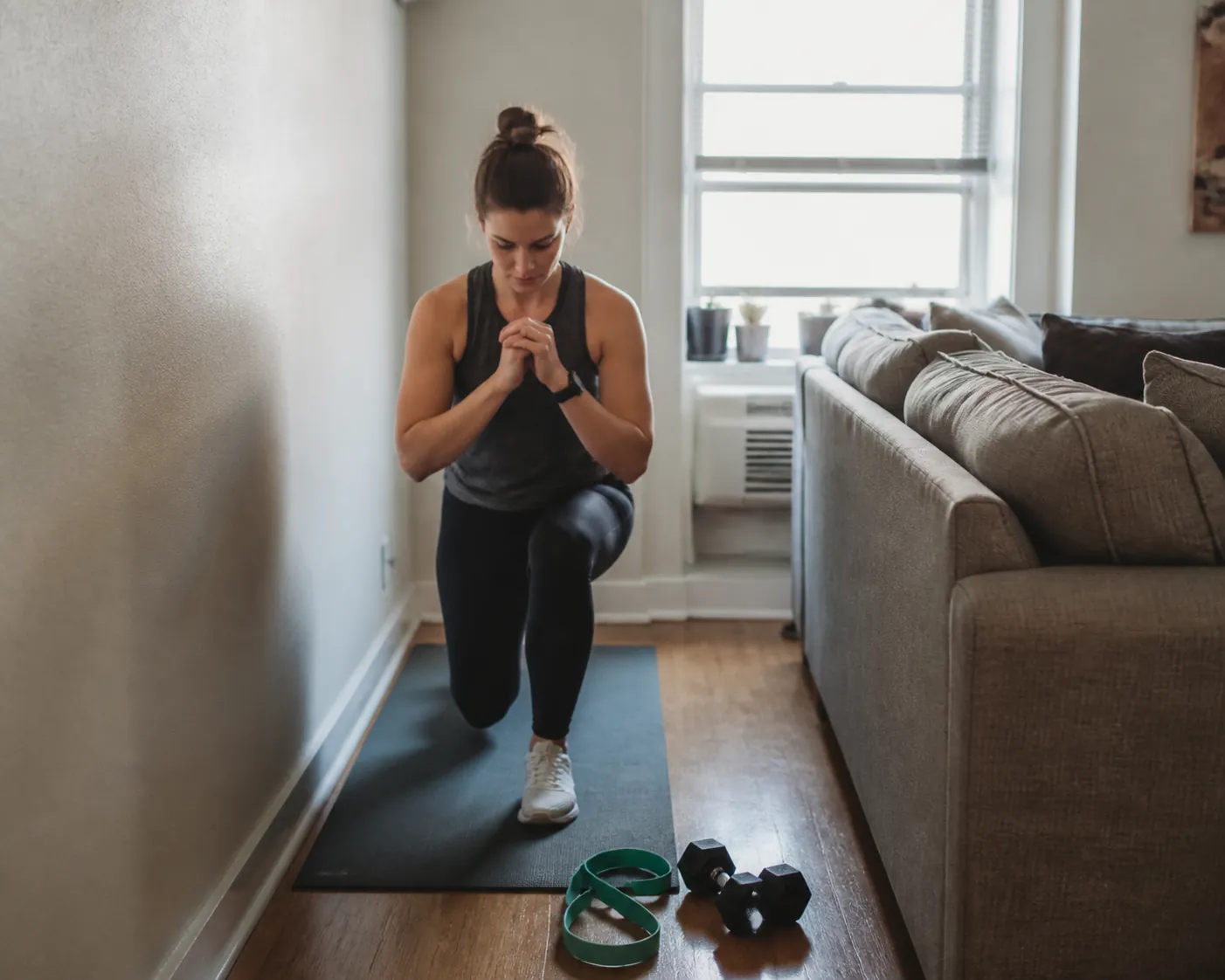
Strength A: hips, quads, calves
| Exercise | How much | Home note |
|---|---|---|
| Reverse lunge or split squat | 2-3 sets of 6-10 reps per side | Step softly; use a wall or chair for balance. |
| Glute bridge | 2-3 sets of 10-15 reps | Pause at the top instead of adding speed. |
| Calf raise | 2-3 sets of 10-15 reps | Use both legs at first; progress to single-leg only if controlled. |
| Side plank | 2 sets of 20-40 seconds per side | Stop before your hips twist or sag. |
Strength B: hamstrings, hips, trunk
| Exercise | How much | Home note |
|---|---|---|
| Single-leg Romanian deadlift | 2-3 sets of 6-10 reps per side | Bodyweight is fine; the point is control. |
| Step-up to a stable low surface | 2 sets of 8-10 reps per side | Skip this if your only option is a wobbly chair. |
| Dead bug | 2-3 sets of 6-10 reps per side | Move slowly enough that your low back stays quiet. |
| Banded lateral walk | 2 sets of 8-12 steps each way | Use a light band; do not turn it into a knee-wrenching contest. |
Put one strength session after an easier run or on a non-running day. Put the other after Thursday’s short run if that keeps Friday free. In Weeks 16 to 18, reduce the sets and keep the movement quality high. You are not trying to get sore during the taper.
The apartment setup is part of the training plan
If you live above someone, the treadmill problem is not only whether the motor sounds loud to you. NordicTrack’s apartment treadmill guidance points out that footstrike impact is what tends to travel to neighbors below, and it recommends using cushioning, a mat that extends beyond the treadmill footprint, placement over structural support, and belt lubrication roughly every three months.[4]
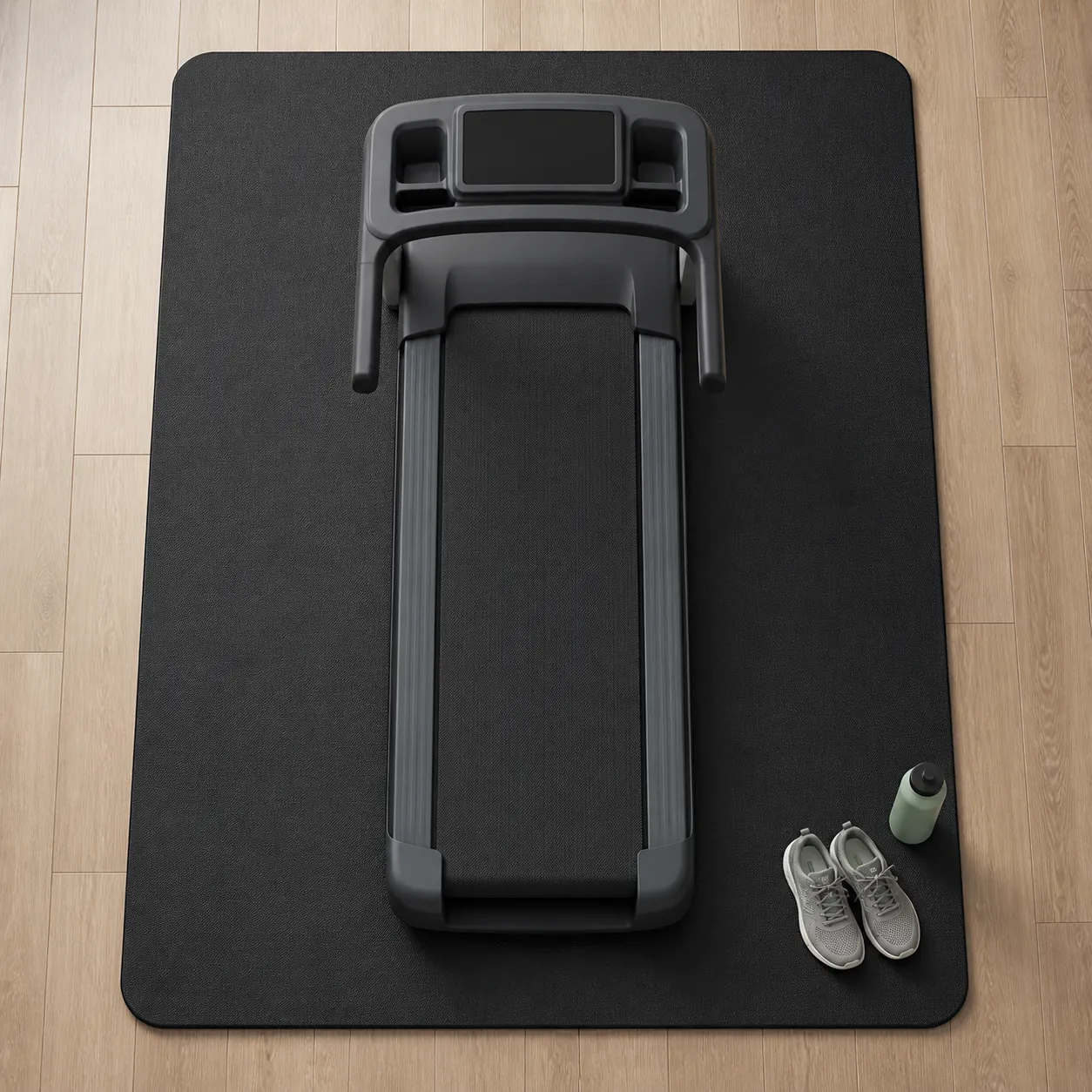
This matters more as the plan gets longer. A treadmill that is tolerable for 25 minutes can become a household negotiation after 90 minutes. Solve it early, before Week 13 asks for an 18-mile long run.
- Use a treadmill mat that extends beyond the front, back, and sides of the machine rather than one that barely matches the frame.
- Place the treadmill on the most stable part of the floor available, ideally away from flimsy interior spans when you have a choice.
- Check that the machine is level; rocking adds noise and makes your stride feel worse.
- Use the treadmill’s deck cushioning if available, but do not assume cushioning eliminates impact for the apartment below.
- Lubricate and maintain the belt on the schedule your machine requires; roughly every three months is a common guidance point, but your manual wins.
- Avoid long runs during the hours when your household or building is least able to tolerate repeated impact.
There is no virtue in becoming the person whose marathon training shakes the ceiling below. If you cannot manage impact noise in your current space, move some long-run volume outdoors, use a different location when available, or choose a later race. The plan has to fit the building you actually live in.
Your first marathon goal should be to finish healthy
Once the workload is visible, the time goal usually gets quieter. Runify’s marathon statistics roundup reports a median U.S. marathon finish time of 4:25:33, about 10:08 per mile, with roughly 24% of marathoners breaking four hours. It also reports that about 95% of starters finish and that roughly half of many major-marathon fields are first-timers.[5]
Those numbers are not a verdict on what you personally can do. They are a useful correction to the internet’s habit of making “beginner” and “sub-4” sound like neighbors. For a home-based first marathon, “finish healthy” is not a weak goal. It is the goal that keeps easy days easy, protects the taper, and stops every treadmill long run from becoming a referendum on your worth.
A better first-marathon target is operational:
- Start the race uninjured.
- Run the first half controlled enough that you are still making decisions late.
- Use fueling you tested during long runs.
- Finish without needing weeks to recover from training mistakes you could have avoided.
When to move a run outside
Almost entirely at home does not have to mean religiously indoors. If you have safe access to outdoor running sometimes, use it where it gives you information the treadmill cannot.
| Situation | Best choice |
|---|---|
| You can safely run outside every 2-3 weeks | Use one outdoor run to check effort and pacing transfer. |
| The treadmill long run will exceed what your household can tolerate | Split the run or move part of it outdoors if conditions are safe. |
| Race day will be hilly or exposed to heat | Add occasional outdoor practice when possible; do not assume the treadmill fully prepares you. |
| Outdoor conditions are unsafe | Stay inside and run by effort, even if the treadmill pace looks slower or faster than expected. |
| You are exhausted or changing your stride late in a treadmill long run | Slow down, take a controlled break, or stop. Do not protect the number at the expense of form. |
The treadmill is a tool, not a confession. Use it because it makes training possible. Then check it against the real world when you safely can.
The readiness test before you commit
This home-first plan is realistic if you can say yes to most of the following before Week 1:
- I can already run a relaxed 5 to 6 miles.
- I can train four running days per week for the next 16 to 18 weeks.
- I can do two short strength sessions most weeks.
- I can keep treadmill runs easy by effort instead of forcing a pace from a chart.
- I can make my treadmill setup stable, cushioned, and neighbor-aware.
- I can occasionally check pacing outdoors, or I am willing to race conservatively if I cannot.
- I am willing to treat finishing healthy as the first goal.
If you cannot meet the running entry point, start with a shorter race or a longer base-building phase. If you cannot manage impact noise, fix the setup before the mileage rises. If you cannot occasionally verify treadmill pacing outdoors, keep the race plan conservative. A beginner can train for a marathon at home, but only when the hidden execution layer is treated as training, not housekeeping.
References
- Novice 1 Marathon Training Program — Hal Higdon
- Beginner marathon training plans — Runner’s World UK
- How to Simulate Outdoor Runs on a Treadmill — RunnersConnect
- Can You Use a Treadmill in an Apartment? — NordicTrack
- Marathon Finishing Time Statistics — Runify
What a small equipment investment adds
We don't have a build tagged to this exact tier yet. Browse all builds.
How often should you repeat this?
See our recovery and rest reference for citation-anchored rest-interval guidance.
Spot something off?
Tell us if a movement, tier assumption, or duration didn't match your experience.