
Ben Simmons' Comeback Workout for Home Training
Adapt Ben Simmons' 2026 NBA comeback training principles—back-safe strength, core stability, and conditioning—into a home workout using dumbbells, bodyweight, and a basketball, scaled for small spaces and realistic volume.
- Equipment tier required
- $0-100
- Duration
- 60 min
- Difficulty
- intermediate
- Target area
- full body
- Noise level
- low
Ben Simmons is reportedly training like basketball is once again his full-time job: 2.5 to 3 hours of lifting and body work, then another 1.5 hours on court, with 1 to 2 rest days each week.[1] That is the useful starting point for a Ben Simmons comeback workout routine for home training, and also the first thing to refuse copying.
Four-plus hours a day makes sense for a 6-foot-10 professional athlete trying to rebuild an NBA body under supervision. It does not make sense for someone training between work calls, below a downstairs neighbor, with a pair of adjustable dumbbells and enough floor space to open a closet door. The better question is what survives the translation: core control before load, progressive strength instead of ego lifting, basketball movement without reckless jumping, and enough conditioning to feel athletic without turning a comeback story into a back flare-up.

The word Simmons has used for the goal is "bulletproof," meaning a body resilient enough to avoid another back setback, not a license to train like pain is a character flaw.[2] That distinction matters because his comeback is tied to nerve-related back injuries and surgeries, not just missed jumpers or bad headlines. He has had multiple back procedures, including a microdiscectomy and a microscopic partial discectomy for a nerve impingement, and he has described a period when he could not walk normally and had to change how he breathed.[3]
So the home version starts where a responsible comeback has to start: with the spine, the hips, and the trunk doing their job before the dumbbells get heavy.
The Home Version Is a Translation, Not a Replica
Simmons' current training volume gives us the scale, not the script. No public source gives a confirmed 2026 exercise-by-exercise plan, set scheme, or weekly split. The routine here is an adaptation built from the reported comeback philosophy and basketball-specific training needs, scaled down to a 45- to 75-minute home session.
The medical logic also shapes the order. In a 2020 discussion of Simmons' back issue, board-certified sports physical therapist Roxanne Smith described the path from nerve impingement as reducing inflammation first, then restoring core stabilization and nerve mobility, then gradually reloading before returning to full function.[4] That does not mean every home trainee has Simmons' injury. It does mean the comeback-inspired routine should not begin with cold burpees, max-effort squat jumps, or a loaded hinge you have not earned.
| Simmons comeback element | Home-training translation | What to protect |
|---|---|---|
| 2.5-3 hours of lifting/body work | 25-40 minutes of dumbbell and bodyweight strength | No grinding reps; stop before form changes |
| 1.5 hours on court | 10-20 minutes of ball handling, footwork, or driveway shooting | Keep cuts controlled and landings quiet |
| Bulletproof resilience goal | Core activation, carries, anti-rotation work, steady progression | Back position, breathing, and trunk control |
| 1-2 rest days per week | 5-6 training days with 1-2 deliberate lower-stress or off days | Recovery is part of the plan, not a missed workout |
If you only have three days a week, use the same session template and leave more recovery between days. If you can train five or six days, alternate full strength sessions with lighter skill and mobility work. The point is not to squeeze an NBA facility into an apartment. It is to keep the sequence that makes the comeback idea useful.
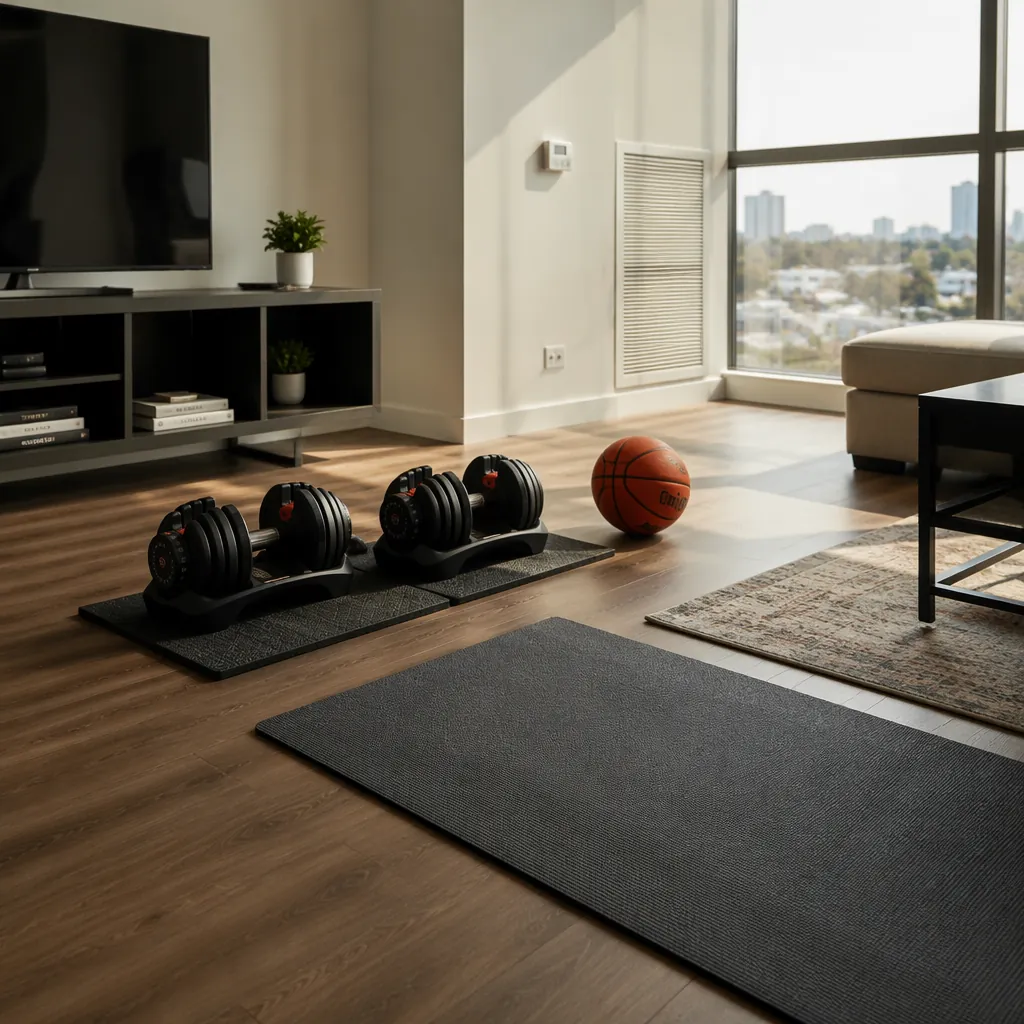
A 45- to 75-Minute Comeback-Inspired Home Session
This is the full flow. On a short day, run one strength circuit and one ball-handling block. On a longer day, add a second strength circuit and a conditioning finisher. The session should feel athletic when you finish, not like you survived a dare.
| Block | Time | Work |
|---|---|---|
| Warm-up and core activation | 8-12 minutes | Breathing reset, hip mobility, dead bug, bird dog, glute bridge |
| Dumbbell strength | 25-40 minutes | Dumbbell bench press, one-arm row, split squat or squat-to-box, Romanian deadlift variation if tolerated, carry or anti-rotation core |
| Basketball movement | 10-20 minutes | Stationary handling, low dribble series, jab-step footwork, controlled defensive slides, driveway shooting if available |
| Conditioning finisher | 6-10 minutes | Low-impact intervals: march, shadow slide, step-back, tempo dribble, or bike/rower if available |
| Cooldown | 5-8 minutes | Easy walk, hip flexor stretch, hamstring flossing only if comfortable, slow breathing |
Use a discomfort rule stricter than normal toughness culture allows: muscular effort is fine; sharp pain, numbness, tingling, radiating symptoms, or a back position you cannot control ends the set. Anyone with a current back injury, post-surgical history, or nerve symptoms should get medical clearance before treating this as a training plan.
Warm Up Like the Back Is Part of the Workout
A good apartment warm-up does not need to be dramatic. It needs to make the ribs, pelvis, hips, and trunk cooperate before you ask them to absorb force. Start on the floor with 60 to 90 seconds of slow nasal breathing, one hand on the lower ribs and one on the abdomen. The goal is not meditation; it is to find a neutral position and feel the trunk expand without arching hard through the low back.
- Dead bug: 2 sets of 5 slow reps per side, stopping before the low back peels away from the floor.
- Bird dog: 2 sets of 5 reps per side, with a long reach instead of a high kick.
- Glute bridge: 2 sets of 8 reps, pausing at the top without overextending.
- Hip airplanes or supported hip circles: 1 to 2 easy sets per side, using a wall or chair for balance.
- Ankle rocks and bodyweight squats to a box or couch: 1 to 2 minutes total.
This block is not filler. It is the part that keeps the later work from becoming a guessing game. If the dead bug already makes your back tense or your hip flexors cramp, that is feedback. Lower the range, slow down, or stay with the activation block and skip the loaded work that day.
The Strength Block: Dumbbells, Control, and No Hero Reps
The cleanest home translation of Simmons' lifting work is not a max-strength program. It is a controlled dumbbell block built around pushing, pulling, single-leg strength, hip strength, and trunk resistance. Older public workout material from 2019 listed dumbbell bench press, one-arm dumbbell rows, and one-handed cable fly pulls among Simmons' basic exercises.[5] That source is pre-injury and pre-surgery, so it should be treated as old directional evidence that those patterns have been part of his training vocabulary, not as a confirmed 2026 comeback plan.
For home training, the movement patterns still make sense. Dumbbells let each side work independently, expose left-right differences, and are easier to store than a barbell. They also make it easier to stop a set safely when your position starts to go.
| Exercise | Sets and reps | Why it fits the adaptation | Back-aware cue |
|---|---|---|---|
| Dumbbell floor press or bench press | 3-4 sets of 6-10 | Upper-body push without needing a full rack | Keep ribs down; do not bridge hard to move heavier weight |
| One-arm dumbbell row | 3-4 sets of 8-12 per side | Pulling strength and shoulder control | Support one hand on a bench, couch, or chair; keep the torso still |
| Split squat or squat to box | 3 sets of 6-10 per side | Basketball-relevant leg strength without high-impact jumping | Use a range where the pelvis stays level |
| Dumbbell Romanian deadlift or hip hinge drill | 2-3 sets of 6-10 | Posterior-chain strength if the hinge is pain-free | Stop when hamstrings load; do not chase depth through the spine |
| Suitcase carry or march in place | 3-5 rounds of 20-40 seconds per side | Anti-lateral-flexion core work with simple equipment | Walk or march quietly; resist leaning toward the dumbbell |
The floor press is the safer default if you do not own a stable bench. It limits shoulder range, reduces setup drama, and keeps the lower body from turning the lift into a full-body arch. If you do use a bench, treat it like a strength tool, not a powerlifting platform. Feet planted, ribs controlled, clean reps.
The one-arm row deserves more respect than it usually gets in home workouts. A sloppy row becomes a twisting contest. A good row teaches you to brace while one side pulls, which is closer to basketball than most symmetrical gym machines. Set the free hand on a couch, bench, or sturdy chair. Pull the elbow toward the back pocket. Pause long enough to prove the dumbbell is not just swinging.
Lower-body work is where the comeback idea can go wrong fast. It is tempting to replace court work with jump squats, lunge jumps, and broad jumps because they look athletic. For this routine, start with split squats, squat-to-box reps, step-ups, and controlled hinges. You are building the brakes before testing the engine.
Use a two-rep reserve on most strength sets. If you think you could do 10 clean reps, stop at 8. If the last rep changes your back position, the set ended one rep too late. Progress by adding reps first, then load, then a harder variation. That order is boring in exactly the way durable training needs to be boring.
If Your Back Is Sensitive, Change the Exercise Before You Change the Goal
| If this bothers you | Use this instead | Keep the same purpose |
|---|---|---|
| Dumbbell Romanian deadlift | Hip hinge to wall, glute bridge, or hamstring walkout | Train hips without forcing loaded spinal flexion |
| Bent-over one-arm row | Chest-supported row on an incline bench or supported row from a high couch | Pull without asking the low back to hold the whole position |
| Split squat | Sit-to-stand from a chair or supported reverse lunge | Build single-leg control with less balance demand |
| Suitcase carry | Suitcase march in place or half-kneeling dumbbell hold | Resist side-bending without needing hallway space |
| Defensive slides | Step-touch slides or shadow slides | Practice lateral rhythm without sharp deceleration |
A substitution is not a downgrade if it preserves the training purpose. That is the whole home-training bargain. You keep the pattern, reduce the threat, and earn your way back toward the harder version.
Basketball Work for a Hallway, Driveway, or Quiet Room
Simmons' reported day includes 1.5 hours on court.[1] A home trainee does not need to pretend that 15 minutes of dribbling beside a couch is the same thing. It is not. But it can preserve some of the coordination, stance endurance, hand speed, and foot rhythm that make the workout feel like basketball instead of generic conditioning.
If you live above someone, use a low-bounce or no-bounce version indoors and save real dribbling for a driveway, garage, outdoor court, or forgiving neighbor situation. A basketball workout that gets you a noise complaint is not more authentic.
- Stationary pound dribbles or low taps: 3 rounds of 30 seconds per hand, done outside or on a surface where noise is acceptable.
- Figure-eight wraps without dribbling: 3 rounds of 30 to 45 seconds, staying low without rounding the back.
- Jab-step to reset: 2 to 3 sets of 5 reps per side, focusing on clean foot placement rather than speed.
- Controlled defensive slides: 4 to 6 short passes across a room, hallway, or driveway, with quiet feet and no hard cuts.
- Driveway shooting or form shooting: 5 to 10 minutes if you have a hoop; if not, use wall targets only where safe and allowed.
The stance matters more than the mixtape. Stay low enough to feel the hips and legs, not so low that you tuck the pelvis under and hang on the low back. Good basketball posture should feel springy. If it feels like you are bracing for a deadlift, stand taller and reset.
Conditioning Without Turning the Floor Into a Trampoline
A comeback-inspired finisher should support the strength work, not erase it. Keep conditioning short, repeatable, and technically clean. The easiest format is 30 seconds of work, 30 seconds of easy movement, repeated 6 to 10 times.
| Option | Work interval | Best for |
|---|---|---|
| Shadow slide to backpedal | Slide two steps each way, then backpedal two steps and reset | Driveway or garage training |
| March with dumbbell front hold | Hold one light dumbbell at chest height and march quietly | Apartments and back-aware conditioning |
| Tempo dribble and stance hold | Dribble or mimic dribble for 20 seconds, hold stance for 10 seconds | Basketball feel without sprinting |
| Step-up intervals | Alternate low step-ups at a steady pace | Small gyms or sturdy home steps |
| Bike, rower, or treadmill incline walk | Moderate effort with nasal breathing as long as possible | Anyone with access to low-impact equipment |
Skip high-volume jump rope, repeated max jumps, and hard change-of-direction intervals at the beginning. Those tools can have a place later, but they are not the first home substitute for an athlete rebuilding trust in his back. The first substitute is controlled effort you can repeat tomorrow.
How to Scale NBA Volume Into a Real Week
The biggest mismatch is not exercise selection. It is volume. Simmons' reported workday stacks hours of lifting, body maintenance, and court time.[1] Most home trainees have a window, not a workday. That window can still be organized like training instead of random exercise.
| Day | Session | Length | Emphasis |
|---|---|---|---|
| Day 1 | Full strength plus short ball-handling block | 60-75 minutes | Push, row, split squat, carry |
| Day 2 | Skill, mobility, and low-impact conditioning | 35-55 minutes | Core activation, handling, slides, easy intervals |
| Day 3 | Full strength plus controlled footwork | 60-75 minutes | Floor press, row, hinge variation, anti-rotation |
| Day 4 | Rest or recovery walk | Off or 20-30 minutes | No loaded spine work |
| Day 5 | Full strength with lighter loads | 45-65 minutes | Technique, unilateral legs, carries |
| Day 6 | Basketball conditioning or driveway shooting | 30-50 minutes | Low-impact intervals and skill |
| Day 7 | Rest | Off | Recovery, sleep, normal movement |
That layout borrows the rhythm of frequent work and deliberate rest without pretending your body has the same recovery support as an NBA player. It also gives the back more than one kind of day. Heavy-ish dumbbell work, skill rhythm, easy conditioning, and true rest all ask different things from the system.
For a three-day version, use Day 1, Day 3, and Day 5. For a four-day version, add Day 2 or Day 6 depending on whether you need more mobility or more basketball feel. Do not add days because motivation is high after watching a comeback clip. Add days because last week's work was clean, repeatable, and quiet in the joints.
Progression Rules That Keep the Routine Honest
- Add reps before load: move from 6 reps to 10 reps with the same dumbbells before increasing weight.
- Add one hard variable at a time: do not increase load, add a set, and extend conditioning in the same week.
- Keep one or two reps in reserve on strength work unless a qualified coach has told you otherwise.
- Treat next-day symptoms as data: stiffness that warms up is different from radiating pain, numbness, or a back that feels unstable.
- Deload every fourth to sixth week by cutting sets or conditioning time, especially if you are training five or six days.
A home routine becomes risky when the athlete inspiration outruns the feedback from your own body. Progress should show up as cleaner reps, steadier breathing, better stance control, and more confidence changing direction. Load matters, but it is not the only scoreboard.
Why July 2026 Matters, and What It Does Not Prove
The current hook is real enough: Simmons is targeting full strength by his 30th birthday on July 20, 2026, and the June 29, 2026 Men's Health interview put his NBA comeback intent back in public view.[6] He is also an unrestricted free agent as of this period, so the training story should not be stretched into a confirmed team return or a guaranteed roster outcome.
That boundary makes the workout more useful, not less. We do not need to know his next jersey to learn from the way the comeback is framed. A tall, explosive player with a serious back history is trying to rebuild durability before performance. A home trainee can borrow that order without borrowing the fantasy around it.
The Routine, Written as a Simple Training Day
Here is the session in one clean pass. Use it as the main template two or three times per week, with lighter skill and conditioning days between.
- Breathing reset: 90 seconds, then dead bug for 2 sets of 5 per side.
- Bird dog and glute bridge: 2 sets each, slow enough to feel the trunk and hips working together.
- Dumbbell floor press: 3 sets of 6 to 10 reps.
- Supported one-arm dumbbell row: 3 sets of 8 to 12 reps per side.
- Split squat or squat to box: 3 sets of 6 to 10 reps per side.
- Suitcase carry or suitcase march: 3 rounds of 20 to 40 seconds per side.
- Ball-handling or footwork block: 10 to 15 minutes, choosing quiet handling, jab steps, slides, or driveway shooting.
- Conditioning finisher: 6 to 8 rounds of 30 seconds moderate work and 30 seconds easy movement.
- Cooldown: 5 minutes of easy walking, hip mobility, and slow breathing.
The routine should leave you feeling like you could train again after a normal recovery day. That is the practical line between athlete-inspired and athlete-cosplay. Simmons can spend hours rebuilding with a professional team around him. At home, the win is smaller and more repeatable: a stronger trunk, better dumbbell control, quieter footwork, a little more basketball in the week, and no pretending that a comeback story cancels out anatomy.
References
- Ben Simmons Talks to Men's Health About Possible NBA Comeback & New Fishing Venture, Men's Health, June 2026
- Ben Simmons opens up on possible NBA return, fishing, back injuries, The Athletic/NYT, Dec. 2025
- Ben Simmons reveals the painful truth behind his career-altering back injuries, Yahoo Sports, June 2026
- Q&A: Local expert explains Ben Simmons' back injury and path forward, PhillyVoice, Feb. 2020
- Ben Simmons' 3 Basic Workouts Essential For Gains, BossHunting, 2019
- Ben Simmons planning NBA comeback, mentions Miami and Philadelphia as potential landing spots, HoopsHype, June 29, 2026
What a small equipment investment adds
Cable Machine Alternatives That Save Space and Money
Compare the best cable machine alternatives for home gyms – from resistance bands and pulley systems to suspension trainers and compact digital units – and find the right option for your space and budget.
Small Treadmill Buying Guide: 7 Critical Specs to Check Before You Buy
A cross-category spec primer for apartment and small-space dwellers comparing walking pads, ultra-compact folding treadmills, and full-size folding treadmills. Learn the concrete thresholds for motor HP, deck length, noise, warranty, and subscription lock-in so you can compare apples to apples.
How to Practice Basketball at Home Without Noise Complaints
Learn how to run a full basketball workout in a small apartment without noise complaints. This guide covers no-dribble handling drills, wall form shooting, and silent ball options that let you train without disturbing neighbors.
How often should you repeat this?
See our recovery and rest reference for citation-anchored rest-interval guidance.
Spot something off?
Tell us if a movement, tier assumption, or duration didn't match your experience.