
How to Do Bryan Johnson's Daily Longevity Workout at Home
Discover Bryan Johnson's exact 35-exercise daily longevity circuit and how to replicate its training effect at home with under $300 in equipment, using smart substitutions that preserve the longevity intent.
- Equipment tier required
- $100-300
- Duration
- 60 min
- Difficulty
- intermediate
- Target area
- full body
The first problem with doing the Bryan Johnson daily workout routine for longevity at home is figuring out which workout people mean. There is the official Blueprint exercise protocol, which is a more beginner-friendly 7-day rotating plan. Then there is Johnson’s filmed personal routine: a fixed daily circuit of roughly 35 exercises, done in about 60 minutes, with a reported volume split of about 70% legs, 20% chest, and 10% back.[1] Most people searching for his “daily workout” are trying to decode the second one.
That distinction matters before anyone buys equipment. The official rotating plan is easier to follow as written, especially if you want a general on-ramp. The personal circuit is the one that creates the apartment problem: dumbbells, cable work, sled-style backward walking, a glute-ham raise, hyperextension work, slant-board movements, and an EMS ab device all get collapsed online into one expensive-looking package.
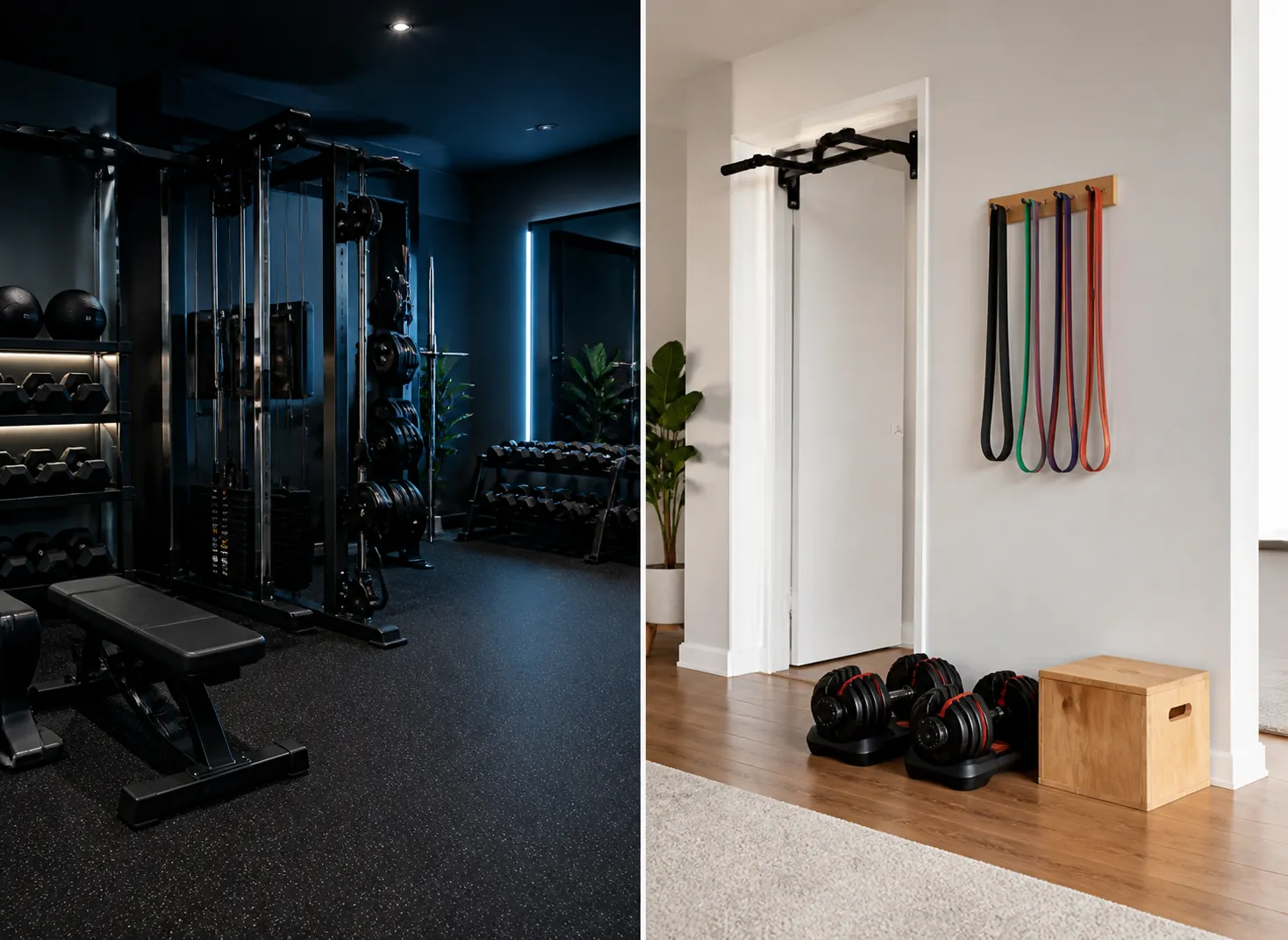
The useful question is not whether a rented apartment can become Bryan Johnson’s exact gym. It cannot, at least not without making the apartment worse at being an apartment. The better question is whether the home version can preserve the parts that appear to drive the training effect: daily full-body circuit work, a heavy leg bias, posterior-chain loading, knee-focused backward movement, some upper-body pulling and pressing, and short bouts of harder conditioning.
What Johnson’s Personal Daily Circuit Is Actually Doing
Johnson’s personal routine is best understood as a daily movement circuit rather than a bodybuilding split. The reported structure is roughly 35 exercises in about an hour, repeated daily, with legs taking most of the work.[1] Men’s Health UK also describes his broader weekly training as including 3 weekly 10-minute HIIT sessions, made up of a 5-minute warmup at 130–140 bpm followed by 5 minutes of intervals on a bike, elliptical, or rower, plus weekend hiking.[2]
The 70% legs figure is the part most home versions accidentally erase. People see the exotic equipment and start shopping for gadgets, when the routine’s shape is much simpler: squatting and stepping patterns, hip extension, hamstring work, calf and tibialis work, backward locomotion, some pushing, some pulling, and a short conditioning layer. If the apartment version keeps those categories, it is a serious translation. If it keeps the brand names and loses the movement balance, it is decoration.
Johnson’s own Blueprint page publishes broader protocol claims, including self-reported markers such as high percentile muscle and bone density and a mortality-risk reduction estimate.[3] Those claims are part of his public longevity project, but they should not be treated as independent proof that this exact circuit is uniquely superior. For building a home version, the more practical evidence is the routine’s structure and whether a substitute keeps the same job in the workout.
| Part of Johnson-style routine | Training job | Apartment-friendly way to preserve it |
|---|---|---|
| Daily circuit | Frequent full-body exposure without turning every day into a max-effort session | Move through leg, push, pull, posterior-chain, core, and mobility blocks with controlled rest |
| Leg-dominant volume | Large muscle-group work and knee/hip capacity | Dumbbell squats, step-ups, split squats, calf raises, tibialis raises, and reverse walking |
| Posterior-chain work | Hamstrings, glutes, and spinal erectors | Floor hamstring slides, glute bridges, Romanian deadlifts, and stability-ball back extensions |
| Backward sled work | Knee-focused backward locomotion and quad demand | Band-resisted reverse walking, bodyweight reverse walking, or reverse lunges |
| Short HIIT sessions | Brief higher-intensity cardiovascular exposure | Jump rope, burpees, bodyweight intervals, or a bike/rower if already available |
The Home-Gym Core: Four Items Before Anything Weird
For a small-space version, the useful core is boring in the best way: adjustable dumbbells, resistance bands, a pull-up option, and a sturdy step or box. That setup is usually the difference between a real routine and a pile of single-use purchases. It also fits the stated budget target better than trying to recreate every station in Johnson’s setup.
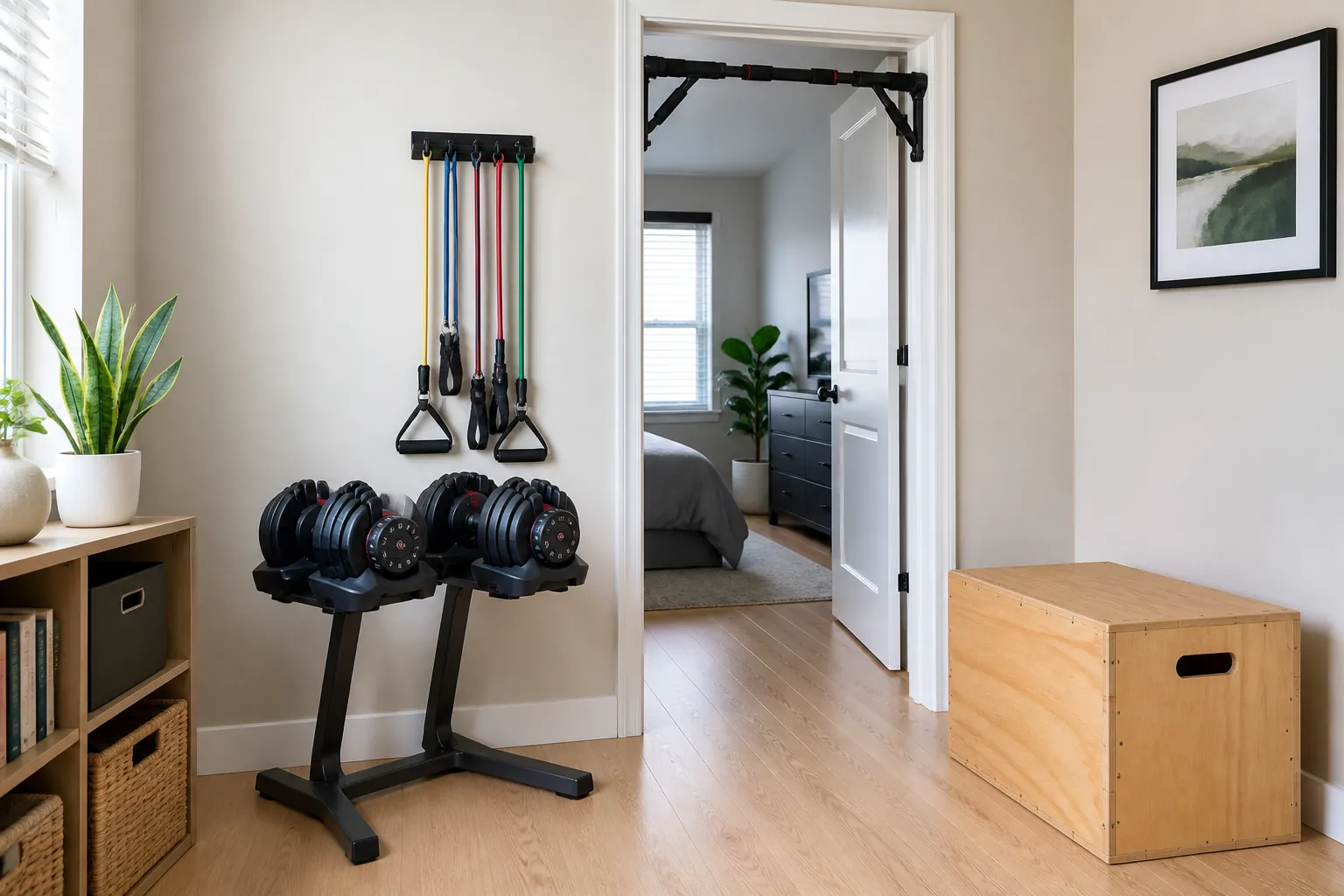
Adjustable dumbbells cover squats, Romanian deadlifts, lunges, step-ups, presses, rows, curls, carries, raises, and weighted core variations. That matters because Johnson’s most-used piece of gear is reportedly a compact set of adjustable dumbbells, used for about 10 of his 35 daily exercises.[4] They are not the glamorous part of the protocol, but they are the part that keeps showing up.
Bands solve the apartment problems that cable machines create. A door anchor and a few resistance levels can stand in for chest flyes, rows, face pulls, triceps work, assisted pulling, and resisted backward walking. Bands are not identical to cables—the resistance curve changes as they stretch—but for a circuit whose purpose is frequent exposure across patterns, they are often the cleaner compromise.
A pull-up bar is optional only if you have another honest pulling option. Doorway bars are not right for every frame or renter, and nobody should sacrifice a security deposit for a few extra reps. But the routine needs upper-back work somewhere: pull-ups, assisted pull-ups, band pulldowns, inverted rows under a sturdy table, or one-arm dumbbell rows.
The step or box is the quiet hero. It handles step-ups, Poliquin-style step-downs, split-squat elevation, calf work, and low-impact conditioning. A 12-inch step or low box is enough for many substitutions, and a slant-board effect can be improvised with a wedge approach rather than buying a dedicated board. The point is heel elevation and controlled knee travel, not owning a branded incline.
How to Substitute the Specialized Pieces Without Losing the Point
The specialized equipment is where people either give up or overbuy. A better approach is to name the training variable first. Is the machine providing load, range of motion, instability, resistance direction, or just novelty? Once that is clear, the substitute stops feeling like a cheap knockoff.
Backward sled work
Johnson has been associated with a knees-focused backward sled protocol, including 6–8 lengths at 95 lb for about 3–5 minutes, in reporting on his use of Ben Patrick/KneesOverToesGuy-style training.[5] In a house, that is easy to write down and annoying to actually do. A sled wants floor space, a surface that tolerates friction, and neighbors who do not care what dragging sounds like.
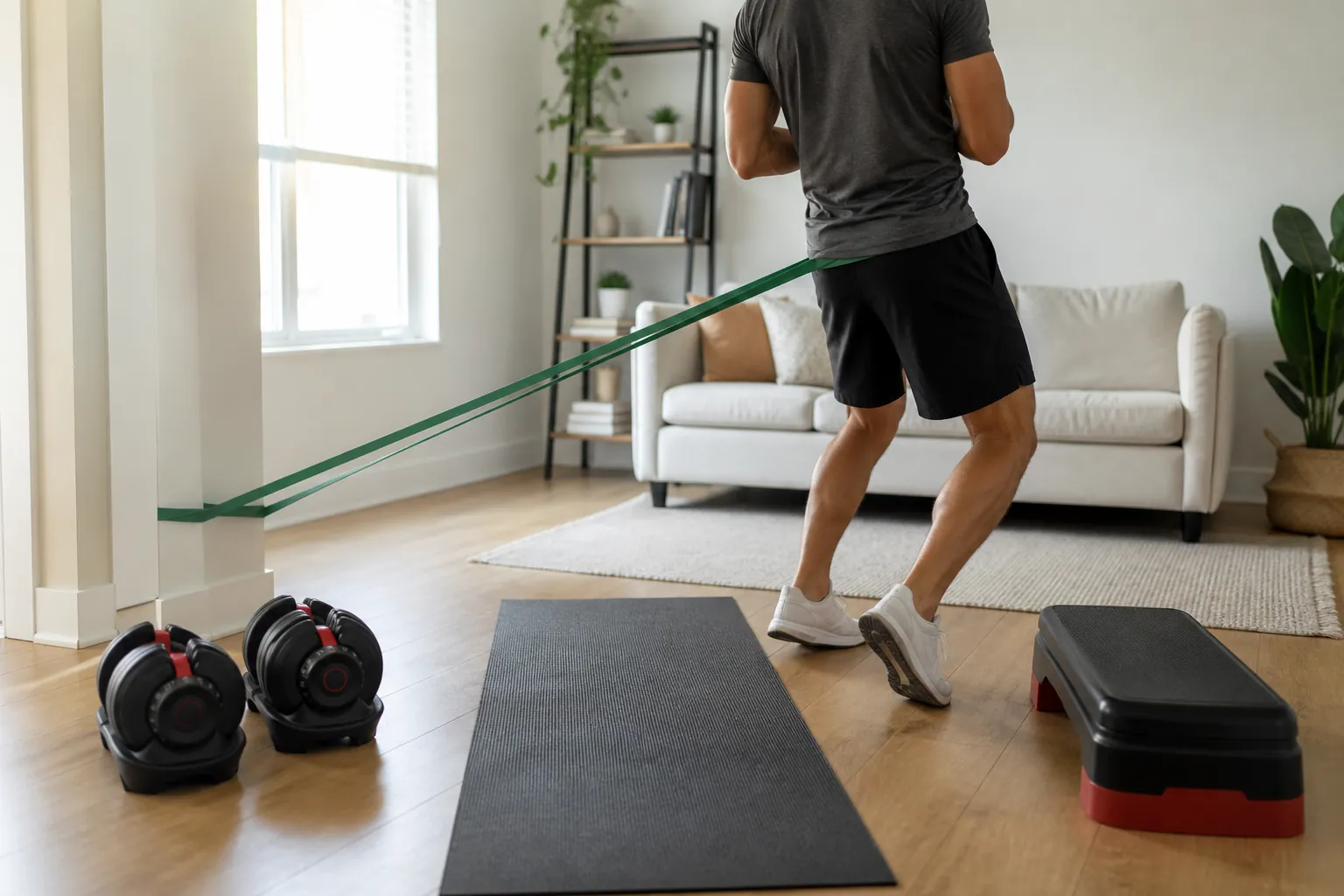
The home translation is band-resisted reverse walking. Anchor a strong band low and behind you, step back until it has tension, then walk backward under control with short, deliberate steps. Keep the torso tall, let the knees travel, and aim for a quad burn rather than a sprint. If anchoring is not safe, use bodyweight reverse walking in a hallway, reverse lunges, or backward walking on a turned-off treadmill in manual mode if you already own one.
Glute-ham raise
A glute-ham raise machine is a terrible apartment guest: large, specialized, and hard to justify unless hamstring training is your hobby. The movement job is knee-flexion hamstring work and posterior-chain control. Floor hamstring slides cover that surprisingly well. Put heels on towels or sliders on a smooth floor, bridge the hips up, slowly slide the feet away, then pull them back in. If that is too hard, start with eccentric-only slides or glute bridges.
Hyperextension bench
The hyperextension station trains hip extension and spinal erector endurance. In a small room, a stability ball back extension is the closest low-cost translation. Anchor the feet against a wall or heavy furniture, place the hips on the ball, and move through controlled extension without snapping the low back. Dumbbell Romanian deadlifts and hip hinges can carry the heavier side of this pattern.
Cable crossover
Cable crossover work is not magic; it is loaded shoulder horizontal adduction with a steady line of pull. A pair of bands anchored around chest height can become band chest flyes. Step forward to set tension, keep the ribs down, and use a controlled arc. If the anchor setup is awkward, dumbbell floor presses and push-up variations are simpler pressing options, though they do not exactly mimic the flye line.
Slant-board squats and step work
Slant boards are useful, but they are not sacred. The training job is heel elevation, controlled knee travel, and quad emphasis. Heels on a small wedge, a weight plate, or a simple DIY incline can preserve the same idea. Poliquin-style step-ups can be done from a low step or box, with the working leg controlling the descent instead of bouncing off the floor.
EMS ab stimulation
The EMS ab machine is the substitution that deserves the least emotional energy. Reporting on Johnson’s home gym puts the EMS ab device around $5,200–$5,700, which means it accounts for more than half of a reported roughly $10,000 setup.[4] There is no independent longevity research showing a mortality benefit from that device; it is better treated as a muscle-toning tool than as the center of the workout.
For the home version, use ordinary core training: dead bugs, hollow holds, planks, side planks, reverse crunches, farmer carries, and slow mountain climbers. None of this replicates electrical stimulation. That is fine. The goal is not to pretend a plank is the same device; the goal is to keep trunk work in the circuit without letting one expensive machine define whether the routine is “real.”
A Practical Apartment Version
A home version should be built as a circuit template, not a museum reproduction. Start with the equipment you can leave accessible. If it takes 15 minutes to drag everything out, the daily part will die first.
| Block | Home exercises | What to keep consistent |
|---|---|---|
| Leg and knee block | Goblet squat, step-up, split squat, calf raise, tibialis raise, band-resisted reverse walk | Most of the session’s volume should still live here |
| Posterior-chain block | Dumbbell Romanian deadlift, glute bridge, floor hamstring slide, stability-ball back extension | Train both hip extension and hamstring knee flexion |
| Push block | Push-up, dumbbell floor press, band chest flye, overhead press | Use controlled reps and avoid turning every set into a grind |
| Pull block | Pull-up or assisted pull-up, one-arm dumbbell row, band row, band face pull | Do enough upper-back work to balance pressing |
| Core and carry block | Dead bug, side plank, hollow hold, farmer carry | Keep the trunk work simple and repeatable |
| HIIT add-on | Jump rope, burpees, fast step-ups, bike, rower, or bodyweight intervals | Use the 5-minute warmup plus 5-minute interval format |
The exact exercise count matters less than the proportions. If a 35-exercise circuit makes the workout sprawl, use fewer exercises and rotate variations across the week while keeping the same movement jobs. A compact session might use 12–18 exercises, one to two sets each, with legs appearing more often than chest and back. That is still a closer translation than doing a random full-body dumbbell workout and calling it longevity training.
The HIIT portion does not require a bike, elliptical, or rower. Johnson’s described format is short: 5 minutes warming up around 130–140 bpm, then 5 minutes of intervals.[2] In a small apartment, jump rope may be too loud, but fast step-ups, low-impact burpees, shadow boxing, or alternating squat-to-reach patterns can fit in a small patch of floor. The constraint is intensity and recovery, not the machine.
The Budget Reality Behind the $10,000 Number
The reported cost of Johnson’s anti-aging home gym is about $10,000.[4] That number is real enough to get attention, but it is a poor shopping list for someone trying to train at home. It bundles together specialized and high-cost items, and the EMS ab machine alone reportedly takes up more than half the total.[4]
A strength-training-focused version is much cheaper because it spends money where movement patterns multiply. Adjustable dumbbells replace a rack of fixed weights. Bands replace many cable patterns. A step replaces several dedicated stations. A pull-up option handles vertical pulling if your doorway and lease allow it. That is why a $100–$300 setup can cover most of the useful work without pretending to be a clone.
- Buy first: adjustable dumbbells or a dumbbell pair heavy enough for squats, hinges, rows, and presses.
- Buy second: a band set with a door anchor or another safe anchoring option.
- Buy third: a sturdy step, low box, or platform that does not wobble.
- Add only if useful: a pull-up bar, sliders, stability ball, or DIY wedge.
- Skip for most people: EMS ab devices, sleds, large specialty benches, and anything that solves only one exercise.
How Much Is Enough?
Johnson’s total exercise volume has been estimated at about 2,400 MET-minutes per week in a NAD.com analysis.[6] That analysis places the estimate near the plateau region of a U-shaped longevity curve, where more exercise does not necessarily keep adding mortality-risk reduction.[6] This is useful context, not a license to turn one person’s protocol into a universal dose.
The caution is important because the curve is population-level and observational, while Johnson’s placement on it depends on estimated exercise volume and assumed MET values.[6] It does not prove that his exact circuit is optimal for every body, every age, or every training history. It does support a more modest point: once the routine is already frequent, full-body, and consistent, piling on more work may be less useful than making the work repeatable.
There is also a training-goal caveat. Men’s Health UK’s assessment questioned whether Johnson’s routine is superior to any other well-rounded resistance training program and noted that it could include more sets closer to failure for people optimizing results.[2] That is a fair criticism. A longevity-oriented circuit can be broad, consistent, and joint-friendly without being the best possible plan for maximal strength or muscle gain.
For most home trainees, the adjustment is simple: keep most sets comfortably hard, not sloppy; push a few strength movements closer to fatigue if muscle or strength is a goal; and avoid making every daily exercise a test. The circuit should leave you able to come back tomorrow. That daily repeatability is part of the design.
The Usable Verdict
If you want the spirit of Bryan Johnson’s daily longevity workout at home, do not aim for a $10,000 replica. Aim for a compact, leg-biased, full-body circuit supported by adjustable dumbbells, bands, a pull-up option, and a sturdy step. Translate the specialty movements by preserving their job: reverse walking for sled work, hamstring slides for the GHR, stability-ball extensions for the hyperextension bench, band flyes for cables, and normal core work instead of EMS.
That version is not fake. It is the sane version for a home gym. Johnson’s self-reported biomarker and longevity claims remain unverified as proof of this exact workout’s superiority, but the training structure itself is adaptable. The win is not owning his equipment. It is keeping the movement patterns, the leg emphasis, the posterior-chain work, the backward-knee stimulus, and the short conditioning dose in a form you can actually repeat.
References
- Analysis of Bryan Johnson’s Blueprint Fitness Routine, Medium
- Bryan Johnson Fitness Routine, Men’s Health UK
- Exercise and Fitness Protocol for Longevity, Blueprint
- Forge Your Own Fountain of Youth: Inside Bryan Johnson’s $10,000 Anti-Aging Home Gym, The Globe and Mail
- Training for Longevity with Bryan Johnson: How to Strengthen Knees to Fight Against Age-Related Frailty, NMN.com
- Living Longevity Experiment: Bryan Johnson — When Does Too Much Exercise Stop Slowing Aging?, NAD.com
What a small equipment investment adds
We don't have a build tagged to this exact tier yet. Browse all builds.
How often should you repeat this?
See our recovery and rest reference for citation-anchored rest-interval guidance.
Spot something off?
Tell us if a movement, tier assumption, or duration didn't match your experience.