
Bryan Johnson's Workout Routine for Small Apartments
Can you really do Bryan Johnson's expensive Blueprint workout in a small apartment on a budget? This article maps each exercise to affordable equipment and shows you the five essential pieces you need to replicate 80% of the routine for $200–$400.
- Equipment tier required
- $100-300
- Duration
- 45 min
- Difficulty
- intermediate
- Target area
- full body
- Space footprint needed
- small
- Noise level
- low
Yes, you can make a small-apartment version of the Bryan Johnson home workout routine. The catch is that you cannot copy the room. You have to copy the movement library.
The routine looks expensive because Johnson’s documented setup includes machines and specialty pieces: a backward sled, a GHD or hyperextension bench, a cable station, a slant board, tibialis equipment, cardio machines, a pull-up bar, and adjustable dumbbells. But the daily routine itself is unusually apartment-friendly in one important way: it moves through many exercises for one set each, with little rest, rather than requiring several loaded stations to stay set up at once. Business Insider described his routine as a 25-exercise daily workout, with one set per movement and a mix of strength, mobility, and cardio work.[1] Medium’s 2023 analysis and the 2025–2026 community-documented version both show the same basic problem for a home user: the exercise list is long, but the equipment patterns repeat.[2][3]
For a renter, that matters more than the celebrity-gym price tag. A $600–$1,000 GHD bench may solve the posterior-chain problem neatly, but it also asks for floor space, storage space, and a landlord’s mercy if it gets dragged across cheap flooring. A mat and smarter progressions solve a narrower version of the same problem without turning the living room into a storage unit.
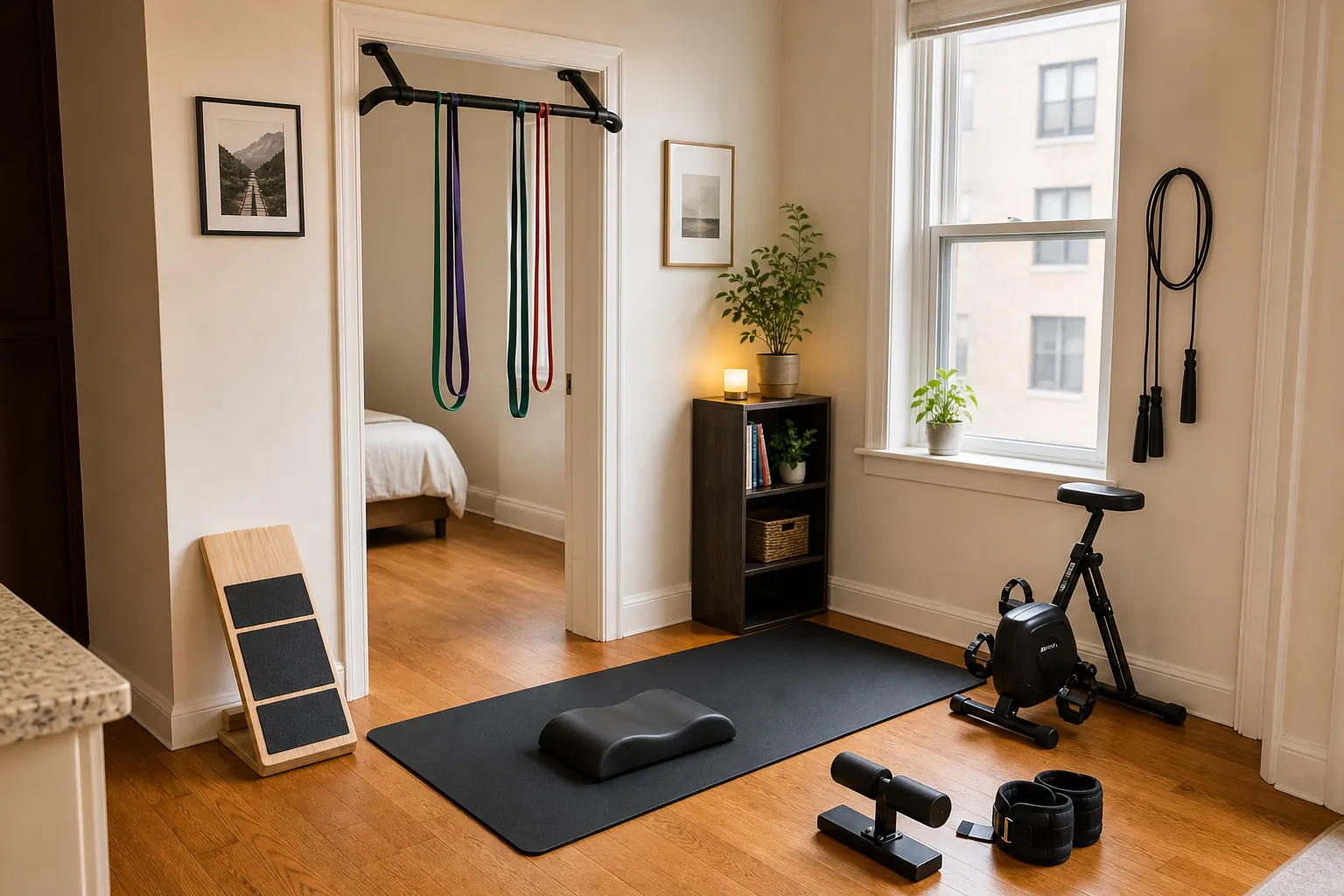
The Five Categories That Actually Matter
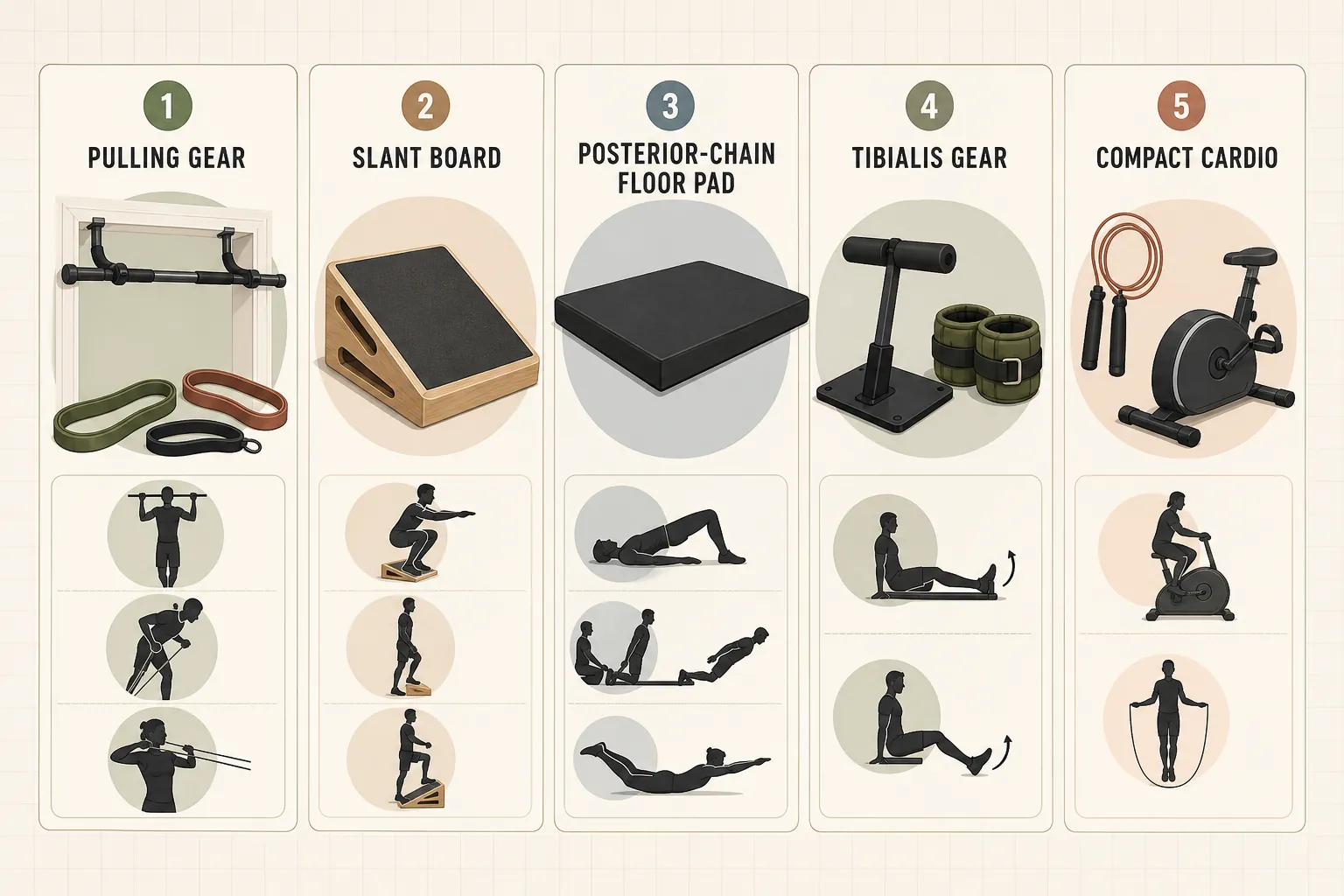
If you strip the routine down to movement access, most of it sits inside five equipment categories:
- Pulling gear: a pull-up bar, resistance bands, and ideally a door-anchor-style setup for rows, face pulls, and cable-like patterns.
- Slant board and elevated surface: for slant-board squats, Poliquin-style step-ups, split-squat progressions, and calf work.
- Posterior-chain floor pad: a thick mat or pad for back extensions, bridges, reverse Nordics, Nordic progressions, and oblique work.
- Tibialis gear: a tib bar, ankle weights, or band setup for tibialis raises and lower-leg work.
- Compact cardio: a jump rope, compact bike, rower, or other low-footprint option for warm-ups and intervals.
That is the useful map. Not “buy Bryan Johnson’s gym,” and not “do 25 exercises from a list and hope the substitutions are close enough.” The official Blueprint site also publishes a general Exercise and Fitness Protocol built around a 7-day split, which is different from the personal daily routine most people are searching for when they look up his workout.[4] The apartment build here targets the personal daily routine documented by Business Insider, Medium, and Superveggie, not the official public 7-day template.[1][2][3]
What Johnson’s Gym Has, and What an Apartment Needs Instead
The high-cost framing is not imaginary. A 2024 third-party press-release article distributed through The Globe and Mail described Johnson’s anti-aging home gym as a $10,000 setup and listed equipment including a backward sled, GHD machine, cable system, tib bar, slant board, cardio machines, pull-up bar, and adjustable dumbbells.[5] That source is useful for identifying the gear, but the exact total should be treated cautiously because it is press-release-style material rather than independent reporting.
The mistake is assuming every listed object is equally important. A sled, a GHD bench, and a cable tower are not the same kind of purchase as a slant board or a band. Some items create a movement option. Others mostly create convenience, load precision, or a more gym-like feel.
| Johnson-style item | Apartment category | What it unlocks | Small-space substitute |
|---|---|---|---|
| Cable station | Pulling gear | Rows, pulldowns, face pulls, assisted patterns | Doorframe pull-up bar, bands, no-drill door anchor if safe for the door |
| Backward sled | Pulling gear / lower-body conditioning | Backward walking against resistance | Band-resisted backward walks or reverse drags with a band |
| GHD or hyperextension bench | Posterior-chain floor pad | Back extension, oblique, Nordic-style work | Mat-based bridges, hip hinges, reverse Nordics, assisted Nordics |
| Slant board | Slant board / elevated surface | Slant-board squats, step-ups, split-squat progressions | Keep the slant board; it is small enough to justify |
| Tib bar and ankle weights | Tibialis gear | Tibialis raises, lower-leg isolation | Tib bar, ankle weights, or banded dorsiflexion |
| Spin bike, rower, elliptical | Compact cardio | Zone work and intervals | Jump rope, compact indoor bike, foldable rower if space allows |
| Adjustable dumbbells | Loading | Loaded squats, curls, presses, carries | Adjustable dumbbells or bands first, dumbbells later |
The sled substitution is the one that needs the most honesty. A band-resisted backward walk is not a sled drag. It will not match the same friction profile, loading curve, or ground contact. But for an upstairs apartment, it solves the part that matters most: you can train backward walking against resistance without pushing metal across a floor or needing a driveway. The Tib Bros’ summary of Johnson’s key longevity exercises highlights the ATG-flavored lower-body pieces around slant-board work, tibialis raises, split squats, and Nordic or reverse-Nordic patterns.[6] Those are the pieces a compact setup can actually support.
The Mid-Tier Build Is the Sweet Spot
There are three reasonable ways to build this. The cheapest version proves the routine is possible. The comprehensive version makes it smoother. The middle version is the one most people should actually care about, because it gives enough equipment coverage to replicate roughly 80% of the exercise library without buying the apartment-hostile pieces.
| Tier | Approximate budget | Buy first | What changes |
|---|---|---|---|
| Minimal | $150 | Resistance bands, thick mat, slant board | You can start the lower-body, mobility, and band-pulling work, but pulling strength and tibialis loading are limited. |
| Mid | $200–$400 | Bands, mat, slant board, pull-up bar, tib bar or ankle weights, adjustable dumbbells, jump rope | This unlocks most of the routine while staying storable, quiet, and renter-plausible. |
| Comprehensive | $800 | Mid-tier gear plus compact bike, better door-anchor cable setup, ankle weights, possibly foldable cardio | You gain convenience, better cardio specificity, and smoother transitions, not a magical recreation of Johnson’s recovery environment. |
Minimal: Bands, Mat, Slant Board
The minimal tier is not a full Bryan Johnson setup. It is a way to stop waiting. With bands, a thick mat, and a slant board, you can cover slant-board squats, step-up progressions, split-squat regressions, band rows, band pull-aparts, floor bridges, reverse-Nordic progressions, and a version of backward walking.
The slant board earns its space. It is one of the few specialty items in the Johnson orbit that is cheap, flat, quiet, and easy to hide beside a shelf. A renter can use it without mounting hardware, impact noise, or a permanent training corner. If the budget is painfully tight, an elevated heel wedge or stable angled surface can approximate some uses, but the slant board is not where I would try to be clever first.
Mid: The Version That Makes the Routine Coherent
The mid-tier version adds the missing levers: a pull-up bar, tibialis gear, adjustable dumbbells, and a compact cardio option such as a jump rope. This is where the routine stops feeling like a collection of compromises and starts behaving like a small-space training system.
The pull-up bar does more than allow pull-ups. Paired with bands, it can support assisted pull-ups, pulldown-like movements, rows from different angles, and shoulder-friendly pulling volume. If you rent, the details matter: no drilling, no questionable wall anchors, no setup that depends on a hollow door holding your body weight. Doorframe bars and door anchors are only useful if the frame and door are suitable. A cheap setup that damages trim is not cheap.
Tibialis gear is also worth adding earlier than most people expect. Johnson’s routine gives unusual attention to feet, ankles, knees, and tendons compared with a standard celebrity workout list. The Tib Bros article specifically connects his longevity exercise selection with tibialis raises, slant-board squats, Poliquin step-ups, ATG split squats, and Nordic-style work.[6] A tib bar is clean and specific; ankle weights are more versatile; bands are cheapest but fussier. Any of the three beats skipping the category entirely.
Adjustable dumbbells are the first item in this build that can become annoying in an apartment, but they are still manageable. They let you load squats, hinges, split squats, curls, presses, and carries without storing a rack of fixed weights. If the floor is thin, the rule is simple: no dropping, no fast set-downs, and use a mat thick enough that the neighbor below does not become part of the program.
For cardio, a jump rope is compact but not always neighbor-safe. If you live above someone, it may be a hallway or outdoor tool, not a living-room tool. A compact bike is quieter and better for intervals, but it costs more and demands permanent storage space. A rower is closer to a full cardio machine experience, but even foldable rowers are still furniture.
Comprehensive: Convenience, Not Completeness
The comprehensive apartment build adds a compact indoor bike, a better band-and-anchor system, ankle weights, and perhaps heavier adjustable dumbbells. This can bring the training flow closer to Johnson’s documented routine, especially if you want a reliable indoor cardio option. It still does not reproduce a cable tower, a sled lane, multiple cardio machines, or a dedicated recovery context.
Spending $800 on small equipment can make the routine easier to execute, but it does not erase the differences in load, space, recovery, or supervision. The goal is not to pretend a rental bedroom is a $10,000 home gym. The goal is to stop buying the wrong large objects.
The Three Big Substitutions
Backward Sled to Band-Resisted Backward Walks
A backward sled is useful because it lets you load backward locomotion heavily and smoothly. It is also ridiculous for most apartments. Even if you could afford it, you would still need a surface, a lane, and a tolerance for noise and scraping.
The apartment version is a heavy band around the waist or hips, anchored safely or held by a partner, followed by controlled backward steps. This keeps the knee-dominant, backward-walking pattern without claiming the load is identical. If you only have a hallway, keep the steps slow, maintain tension, and turn around before you run out of floor. Do not anchor a band to a weak door handle and call it a sled.
GHD Bench to Mat-Based Posterior-Chain Work
The GHD or hyperextension bench is the least renter-friendly item in the whole ecosystem. The press-release equipment breakdown places this kind of bench in the $600–$1,000 range, and the footprint is large enough that it stops being workout gear and starts becoming furniture.[5]
Its job can be divided. Back-extension work can become hip hinges, floor supermans, reverse hypers on a stable surface only if that surface is safe, or controlled bridge progressions. Oblique work can move to side planks, Copenhagen-style regressions, or band-resisted anti-rotation work. Nordic and reverse-Nordic patterns can begin on a thick mat with assistance and limited range.
This is not a perfect trade. A GHD fixes your body in place and makes certain angles easy to repeat. A mat asks for more control and more patience. But for a small apartment, the mat wins because it supports several categories, stores vertically, and does not threaten the floor.
Cable Tower to Bands and Door-Safe Pulling
A cable tower is convenient because the resistance path is predictable and the height is adjustable. Bands are less precise. They get harder as they stretch, they pull from awkward angles if anchored badly, and they can turn a clean movement into a wrestling match.
They are still the right first substitute. A band plus pull-up bar can cover a surprising amount of pulling and shoulder work. Add a no-drill door anchor only if the door closes toward you, the anchor is rated for the task, and the door and frame are not flimsy. If any of those details fail, use the pull-up bar, loop bands around your body, or choose floor-supported pulling variations instead.
Where the Apartment Version Stops Matching Johnson
The compact version is credible, but it has boundaries.
- Load is different: bands do not reproduce sled friction, cable stacks, or machine-guided resistance.
- Cardio is different: a jump rope, compact bike, rower, and elliptical are not interchangeable just because they raise heart rate.
- Recovery is different: Johnson’s personal routine is documented as daily, and Business Insider also reported that he uses physician-supervised testosterone therapy, which changes the context around recovery capacity.[1]
- Exercise selection is not a prescription: the official Blueprint protocol for the public is a 7-day structure, while the personal routine discussed here is a separate documented routine.[4][1]
- Apartment safety matters: quiet equipment can still damage trim, floors, doors, and security deposits if mounted or loaded carelessly.
That third point should not be buried in a tiny disclaimer. A daily routine with many movements may be tolerable for one trainee and too much for another. The one-set format lowers the setup burden, but it does not make daily tendon, knee, and posterior-chain work automatically appropriate for every body. If a movement irritates a joint, regress it, reduce frequency, or remove it.
What to Buy First, Delay, and Skip
Start with the items that unlock the most movements per square foot: bands, a thick mat, and a slant board. Those three cover the most renter-safe ground and create the base for lower-body, mobility, pulling, and posterior-chain work.
Next, add a pull-up bar if your doorframe can handle it, tibialis gear if you want the lower-leg work to be more than an afterthought, and adjustable dumbbells if you need real loading. That is the practical $200–$400 zone: not fancy, not identical to Johnson’s gym, but enough to make the movement map coherent.
Delay the compact bike, premium cable-style anchor system, heavier dumbbells, and extra ankle weights until you know you will actually repeat the routine. Those purchases improve flow and specificity. They do not decide whether the apartment version works.
Skip the GHD bench, sled, and cable tower unless you have the space, surface, budget, and permission to treat your apartment like a garage gym. For most renters, those are not starter tools. They are the objects that make a workable routine look impossible.
The small-apartment version of Bryan Johnson’s workout is believable when it is built around categories: pull, elevate, pad the floor, train the tibialis, and choose quiet cardio. It falls apart when it tries to cosplay the expensive room.
References
- Tech Exec Bryan Johnson's 'Anti-Aging' Daily Workout Routine, Business Insider, 2023-07.
- Analysis of Bryan Johnson's Blueprint Fitness Routine, Medium, 2023-07.
- Bryan Johnson's Blueprint Exercise Routine, Superveggie Delivery.
- Exercise and Fitness Protocol for Longevity – Blueprint Bryan Johnson, Blueprint Bryan Johnson.
- Forge Your Own Fountain of Youth: Inside Bryan Johnson's $10,000 Anti-Aging Home Gym, Globe and Mail / Due Inc., 2024.
- 5 Key Exercises to Achieving Longevity, The Tib Bros.
What a small equipment investment adds
We don't have a build tagged to this exact tier yet. Browse all builds.
How often should you repeat this?
See our recovery and rest reference for citation-anchored rest-interval guidance.
Spot something off?
Tell us if a movement, tier assumption, or duration didn't match your experience.