Caitlin Clark's Home Workout Drills Without a Full Court
Caitlin Clark's famous 300-shot offseason workout requires a full court and hoop — but you can replicate its structure at home with just a basketball and a small patch of pavement or a wall. This guide adapts each segment (conditioning, ball-handling, shooting volume) using common household substitutions so you can train like an elite guard without a regulation court.
What this routine assumes
Equipment required: Basketball, wall or outdoor surface
No equipment required, no purchase needed to follow this routine.
The routine
- Duration
- 30 min
- Difficulty
- Beginner
- Space needed
- Small area (hallway, driveway, or wall)
- Noise level
- Low
The useful part of Caitlin Clark’s known 300-shot workout is not the private court. It is the order: get tired first, make the hands work fast, then stack a lot of shot reps while your legs and focus are no longer fresh.
In the viral 2023 offseason session, the sequence was conditioning runs, ball-handling wall taps, 100 three-pointers, 100 mid-range shots, and 100 free throws.[1] Clark reportedly made 233 of the 300 shots: 63 from three, 81 from mid-range, and 89 free throws.[2] That number is a great hook and a terrible beginner prescription. It tells you the standard was serious; it does not mean your hallway workout has to become a 300-make-or-break test.
For a home version, the question is narrower and more useful: can you preserve the pressure of that workout without a full court or a regulation hoop? Yes, if you keep the same training jobs in the same order and replace the equipment honestly.
The Home Version at a Glance
| Clark workout segment | Training purpose | Home substitute |
|---|---|---|
| Conditioning runs | Raise heart rate before skill work | Timed jump rope, line hops, shuttle steps, or low-noise step patterns |
| Ball-handling wall taps | Hand speed, coordination, eyes-up control | Stationary wall taps, figure-8s, pound dribbles, behind-the-back switches |
| 100 threes | High-volume long-range shooting under fatigue | Wall-form shooting, arc-target tosses, or rebounder reps |
| 100 mid-range shots | Repeatable footwork and touch from closer range | Wall-form shooting with quicker feet, one-dribble pickups, or short-space releases |
| 100 free throws | Calm, repeatable mechanics after volume | Quiet form reps, target-line tosses, or actual free throws if you have a hoop |
You need a basketball, a clear area roughly big enough to move your feet without clipping furniture, and either a sturdy wall or a safe outdoor surface. If you do not have a ball or any clear space, this particular adaptation is the wrong tool. If you live above someone, the workout can still work, but the noisy parts need substitutions instead of wishful thinking.
Start With Conditioning, Even If You Cannot Run
The conditioning block is not a warm-up in the casual sense. In Clark’s sequence, it comes before the handles and shooting volume, so the skill work starts with a little fatigue already in the body.[1] At home, you are trying to create that same condition without needing baselines, sidelines, or a court-length sprint.
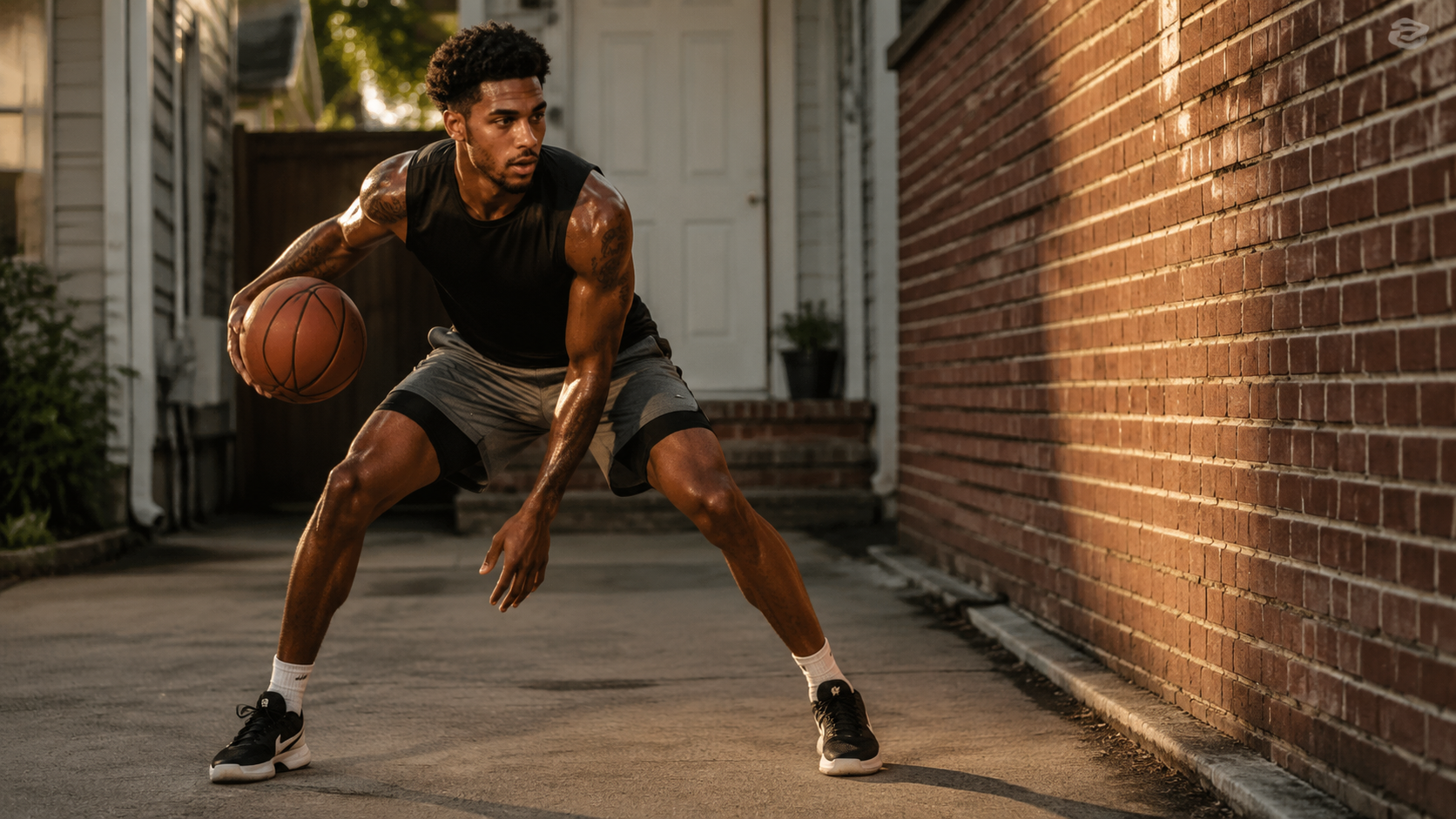
A driveway version can be simple: jump rope for timed rounds, then do short lateral shuffles between two cracks in the pavement. A hallway version can use quick feet in place, forward-back steps over a tape line, or split-stance switches. An apartment version should drop the jumping and use fast step-ups, shadow defensive slides, or marching high-knees with controlled foot contact.
- Outdoor option: 5 rounds of 30 seconds jump rope, 30 seconds rest.
- Small-space option: 6 rounds of 20 seconds lateral line steps, 20 seconds rest.
- Low-noise option: 5 rounds of 40 seconds fast step patterns, 20 seconds rest.
- No-rope option: pretend-rope footwork, but keep the hands moving so the rhythm stays honest.
The point is not to destroy your legs before touching the ball. You should finish this block breathing harder, warmer through the hips and calves, and slightly annoyed that the next drill demands coordination. That is the useful carryover.
Then Make the Ball-Handling Fast and Accountable
The wall-tap drill is the most home-friendly piece of the famous session because it already uses a wall. Clark was described switching the ball behind her back while alternately tapping the wall with each hand, a drill meant to train hand speed, reaction time, and eyes-up ball control.[2] That is a better template than random dribbling for ten minutes while half-watching a video.
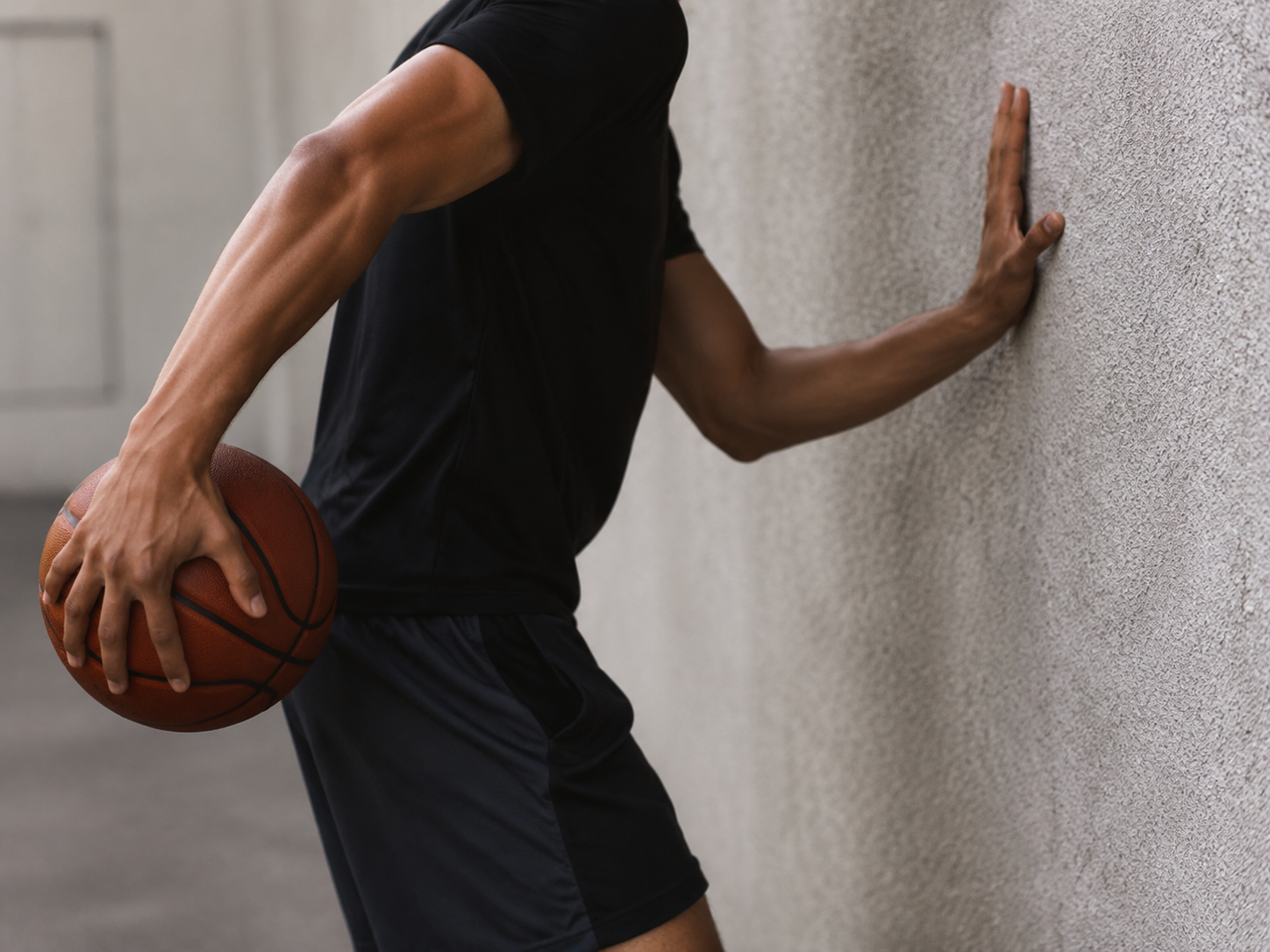
Choose the wall carefully. Brick, concrete, a garage wall, or an outdoor retaining wall makes more sense than painted drywall. If the surface marks easily, do not test your security deposit for the sake of a drill. Put painter’s tape at eye level as a visual target if the surface allows it, and keep enough distance that your shoulders do not crash into the wall when the ball gets loose.
A clean home sequence can look like this:
- Pound dribbles, right hand: 30 seconds.
- Pound dribbles, left hand: 30 seconds.
- Figure-8 wraps around the legs: 45 seconds.
- Behind-the-back switches without a dribble: 45 seconds.
- Wall taps with alternating hands while controlling the ball: 4 rounds of 20 seconds.
For the wall taps, start slower than your pride wants. Tap the wall with the right hand while the left hand controls or transfers the ball, then switch. If you lose the ball every few seconds, the drill has turned into chasing, not training. Shorten the range, soften the switch, and build speed only when the ball stays close to your body.
If you cannot dribble because of noise, keep the ball off the floor: around-the-waist wraps, around-the-leg wraps, figure-8s, behind-the-back hand switches, and wall taps without a bounce. It is not the same as live dribbling, but it still keeps the hands working under time pressure.
Replace Shot Volume With Form Volume
This is where people usually get silly. If there is no hoop, you are not taking 100 threes. You are copying the job those threes performed: repeated shooting mechanics, leg involvement, target focus, and concentration after conditioning and handling.
Clark’s reported 63 makes on 100 threes belongs to a player with elite range working in a real shooting environment.[2] At home, counting “makes” against a wall target can become fake precision fast. Count clean reps instead: balanced feet, full extension, consistent guide hand, soft release, and a catch you can control on the return.
No Hoop: Wall-Form Shooting
Stand close enough to the wall that the ball returns safely, not so close that you jam your release. Pick a target spot above eye level. Shoot with a soft arc into the wall, catch the rebound, reset your feet, and repeat. The rep counts can mirror the famous structure without pretending the result is equivalent:
- Three-point substitute: 50 to 100 wall-form shots with deeper knee bend and full extension.
- Mid-range substitute: 50 to 100 quicker reps with one-dribble pickups or step-in footwork.
- Free-throw substitute: 25 to 100 quiet, identical form reps with a pause before each release.
The “three-point” block should feel slower and stronger. The “mid-range” block can add footwork: right-left step-in, left-right step-in, one hard dribble into a pickup if your surface allows it. The “free-throw” block should remove hurry. Same breath, same hand placement, same finish.
Portable Hoop or Rebounder: Keep the Counts, Shrink the Ego
If you have a driveway hoop, a park hoop, or a rebounder, you can keep more of the shot-volume feel. Still, do not start with 300 shots just because Clark’s session had 300. Try 30, 30, and 30 first. Then 50, 50, and 50. If your form collapses halfway through, the number was too ambitious for that day.
If you do have a hoop, separate makes from attempts. A beginner tracking makes only can turn the workout into a two-hour punishment. Attempts measure whether you did the work. Makes measure whether the work held up. Both are useful, but they are not the same thing.
A Repeatable Caitlin Clark-Inspired Home Session
Here is a full version that fits a small driveway, garage, hallway, or outdoor wall. It borrows the architecture of Clark’s known workout, not the court conditions.
| Block | Beginner | Intermediate | What to track |
|---|---|---|---|
| Conditioning | 5 minutes low-noise steps or rope intervals | 8 to 10 minutes rope, shuffles, or line hops | Total time completed |
| Ball-handling | 6 minutes stationary control drills | 10 to 12 minutes with wall taps | Drops, clean rounds, weak-hand control |
| Long-range substitute | 30 wall-form shots | 75 to 100 wall-form shots | Clean releases |
| Mid-range substitute | 30 form shots with footwork | 75 to 100 form shots with pickups | Balance on catch and finish |
| Free-throw substitute | 25 paused form reps | 50 to 100 paused form reps | Identical routine each rep |
Do the blocks in order. That matters more than inventing a new drill every day. If you condition after shooting, you changed the workout’s pressure. If you skip the handling because shooting is more fun, you removed the part that makes your hands cooperate while tired.
A good first target is 25 to 40 minutes total. The advanced-looking mistake is starting with full 300-rep volume, losing quality, and then deciding the workout is impossible. The better move is to make the session repeatable enough that you can come back to it twice in a week without dreading your knees, neighbors, or wall.
What Makes the Adaptation Legitimate
The home version earns its keep through standards, not celebrity decoration. High volume matters because skill gets exposed when the same movement has to be repeated. Game-speed intent matters because lazy reps teach lazy timing. Progressive overload matters because doing the exact same comfortable circuit forever turns training into maintenance.
The strength-and-performance details around Clark point in the same direction. Fever head performance coach Sarah Kessler emphasized time under tension, balance, and core stability when discussing Clark’s 2024-2025 offseason work.[3] Those ideas transfer cleanly to a home basketball session: stay low in the legs, control the trunk when the ball moves across the body, and finish shooting reps balanced instead of drifting into the wall or sideways across the pavement.
There is also a less glamorous lesson from her Iowa training background: consistent training, proper sequencing with practice, sleep, and nutrition were presented as more important than any one special exercise.[4] That is useful because the internet will always make one drill look like the secret. The sequence is usually doing more work than the novelty.
At-home basketball drill resources commonly use small-space ball-handling and form-work substitutions, which supports the basic idea that a court is not required for every useful basketball rep.[5] The constraint is that home drills have to be judged by what they can actually train. A wall cannot tell you whether a three-pointer went in. It can tell you whether your release, balance, rhythm, and concentration survived repeated reps.
How to Progress Without Turning It Into Noise
Change one variable at a time. Add two minutes to conditioning, or add 10 form shots per block, or reduce rest between handling rounds. Do not add volume, speed, new footwork, and weaker-hand restrictions all on the same day unless your goal is chaos.
- Week 1: Learn the order and finish every block with clean mechanics.
- Week 2: Add a small amount of volume to the shooting substitutes.
- Week 3: Increase handling speed while keeping drops low.
- Week 4: Add conditioning time or shorten rest, but keep the same drill order.
Track simple things: total reps, clean reps, drops, completed rounds, and how long the session took. If you have a hoop, track attempts and makes by zone. If you do not, track form quality honestly. A sloppy wall rep is not magically useful because it appeared in a high-volume block.
Apartment and Small-Space Adjustments
The apartment version needs to be kinder to the floor. Swap jump rope for fast step patterns. Swap hard pound dribbles for ball wraps, fingertip taps, and controlled wall touches if the wall is safe. Use a towel or mat only if it does not create a slipping hazard. Do not dribble late at night and call it dedication.
Hallways create another problem: the ball always wants to escape toward something expensive. Keep the stance narrower, work in shorter intervals, and choose drills where a mistake dies at your feet instead of rolling into a door, pet, or stairwell.
Outdoor pavement solves the noise issue but adds its own limits. Wet concrete, loose gravel, and sloped driveways change the drill. If your feet are sliding or the ball is bouncing unpredictably, slow down or move. The workout is supposed to apply pressure, not create a preventable fall.
What This Is—and Is Not
This is not Clark’s full current training program. The 300-shot session is a known viral offseason workout from 2023, and available reporting does not make it safe to claim that it is her present routine in Q3 2026.[1][2] It is also not a shooting-coach replacement, a strength program, or a guarantee that home reps will transfer cleanly to games.
It is a practical way to copy the useful architecture: conditioning first, fast hands second, high-volume shooting mechanics third, calm repeatable reps last. Choose the smallest safe space you have. Keep the order. Track time or volume. Increase one variable gradually. Treat the wall, hallway, or driveway as a training station, not as proof that you needed a full court all along.
References
- Caitlin Clark's offseason workout includes 100 3-pointers, Just Women's Sports
- Caitlin Clark's brutal offseason workout regime includes 100 3s, tons of free throws and gruelling cardio inside luxury home court, TalkSport
- Caitlin Clark's Offseason Workouts: How The WNBA Star Got Stronger, Women's Health, March 2025
- Caitlin Clark put on 8 pounds of muscle to 'take her game to the next level.' Here's how she did it., Business Insider
- 11 Basketball Drills You Can Do At Home, US Sports Camps / Nike Basketball
Missing the equipment, or need to rest?
- Luis de la Fuente's Bicep Workout You Can Do at Home
- Replicate Chris Hemsworth's Extraction 3 Workout at Home
- Build a Golf Workout Routine for Home on Any Budget
Sore or unsure how much rest you need? Read Recovery & Rest— this routine doesn’t cover injury-specific advice.
Comments
Join the discussion with an anonymous comment.