
How to Train Like a College Athlete at Home with Minimal Equipment
This workout program adapts real NCAA strength and conditioning principles—standing, total-body movements, free weights, and explosive intent—into a dumbbell-and-bodyweight routine you can run in a small apartment or dorm room with minimal gear.
- Equipment tier required
- none
- Duration
- 45-65 min
- Difficulty
- intermediate
- Target area
- full body
- Noise level
- low
Training like a college athlete at home does not mean pretending your dorm room is a varsity weight room. You do not have platforms, racks, turf, timing gates, a full staff, or a coach standing three feet away correcting your landing. The useful move is smaller and better: take the principles that make college strength and conditioning sessions coherent, then translate them into a room where the ceiling is low, the floor is shared, and the equipment has to fit under a bed.
For home training built on college athletics, the starting point is not a random circuit. MidAmerica Nazarene University’s strength and conditioning program describes four principles behind its training: train standing, use total-body movements, use free weights, and explode whenever possible.[1] Those ideas survive the move home better than most people think. Machines disappear. Heavy team-room loads disappear. The order and intent of the session do not have to disappear.
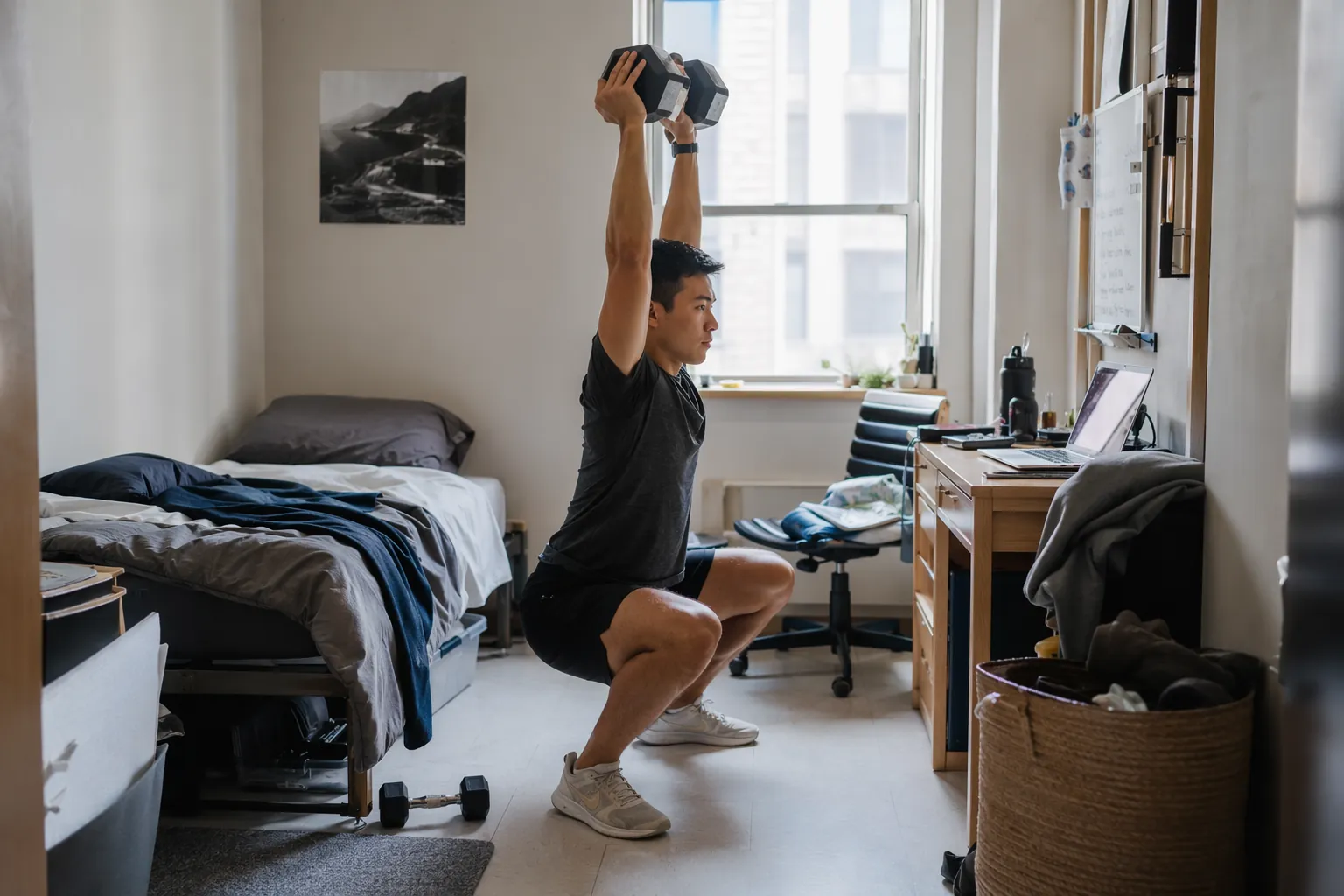
The Four Principles, Translated for a Small Room
The whiteboard version of this program is simple. Every movement needs a job. If it does not improve range of motion, train force, build usable strength, or condition without turning the room into a punishment station, it probably does not belong in the main session.
| College S&C Principle | What It Means in a Weight Room | Home Translation |
|---|---|---|
| Train standing | Athletes produce and resist force from the ground, not from padded machines. | Use standing presses, split squats, hinges, lunges, carries, jumps, and rows instead of seated machine-style work. |
| Use total-body movements | The body learns to coordinate hips, trunk, shoulders, and feet together. | Favor squat-to-press, reverse lunge to knee drive, push-up variations, single-leg hinges, and loaded carries. |
| Use free weights | Free weights require balance, control, and stabilizing effort. | Dumbbells, bands, a backpack, and bodyweight become the main loading tools. |
| Explode whenever possible | Power work teaches athletes to move fast before fatigue blunts quality. | Use low-volume jumps, skips, bounds, med-ball substitutes, fast push-ups, and crisp dumbbell high pulls when space allows. |
That last principle needs restraint at home. “Explode” does not mean stomp through plyometrics until the downstairs neighbor learns your training schedule. It means the reps that are meant to be fast stay fast. A quiet snap-down to athletic stance, a controlled broad jump onto a mat, or an explosive incline push-up can do more for the session than ten minutes of noisy fatigue.
Use the College Session Order: Mobility, Power, Strength, Conditioning
A good home session should feel ordered before it feels hard. The National Institute for Fitness and Sport’s stay-at-home athlete template uses a four-block sequence: mobility, power, strength, then conditioning.[2] That order matters. Mobility prepares positions. Power comes while the nervous system is fresh. Strength takes the main training time. Conditioning finishes the work instead of contaminating every rep before it.
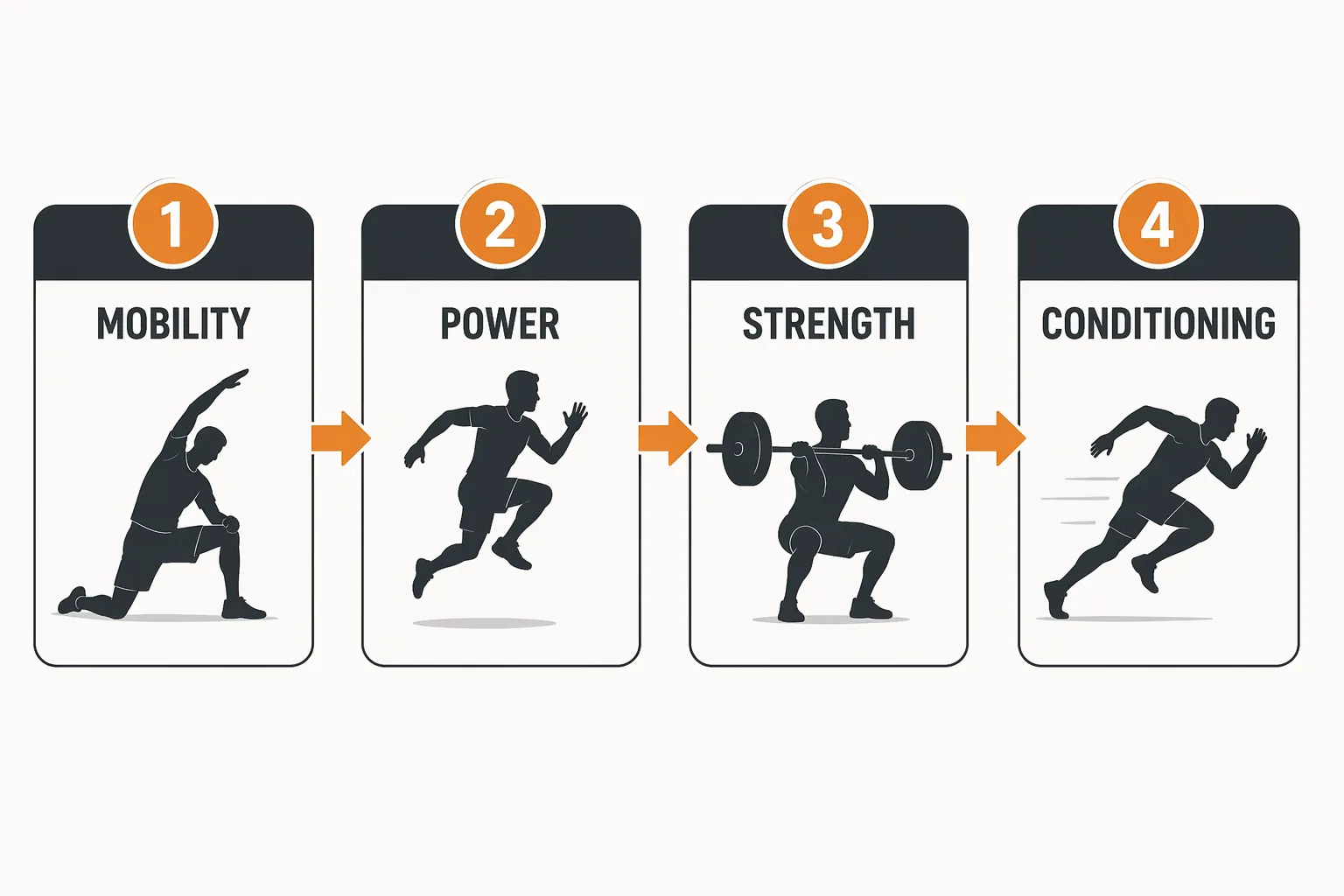
| Block | Time | Purpose | Small-Space Examples |
|---|---|---|---|
| Mobility | 5–10 minutes | Open the positions you will train. | Ankle rocks, hip airplanes, world's greatest stretch, thoracic rotations, squat prying. |
| Power | 5–8 minutes | Move fast before fatigue builds. | Snap-downs, pogo hops, broad jumps, skater bounds, explosive push-ups, dumbbell high pulls. |
| Strength | 20–40 minutes | Load total-body patterns with control. | Goblet squats, split squats, Romanian deadlifts, rows, presses, push-ups, carries. |
| Conditioning | 5–12 minutes | Build repeat-effort capacity without wrecking the next lift. | Tempo circuits, shuttle-free intervals, step-ups, low-impact complexes, EMOM-style finishers. |
This is where home training gets cleaner. Instead of asking whether a workout “looks athletic,” ask where each exercise sits in the order. A jump after twenty minutes of burpees is conditioning with a jump shape. A jump after mobility, done for a few crisp reps, is power work.
Pick the Right Weekly Version Before You Pick Exercises
The most useful college comparison is the time budget. MNU describes off-season athlete workouts as 50–70 minutes, 3 days per week, and in-season workouts as 25–40 minutes, 2 days per week.[1] Those numbers are more helpful than a hype video because they tell you how much training the week is supposed to absorb.
| Version | Best For | Weekly Structure | Session Length |
|---|---|---|---|
| In-season home version | Busy semester, sport practice, heavy work schedule, recovery priority | 2 full-body sessions | 25–40 minutes |
| Base version | Most home trainees | 3 strength and power sessions | 45–65 minutes |
| Expanded version | More time, better recovery, clear conditioning goal | 3 strength sessions plus 1–2 short conditioning or mobility days | Strength days 50–70 minutes; add-on days 20–35 minutes |
Do not choose the 5-day version because it sounds more serious. Choose it only if the fourth and fifth days stay in their lane. They are not extra lower-body beatdowns. They are short conditioning, mobility, tempo, or skill days that help the three main lifts work better.
The 3-Day Home Program
Run this as the default plan for four to five weeks. That length fits how several coaching sources frame short home-training phases; TeamBuildr describes 5-week at-home programs built to help college strength programs maintain power output during breaks,[4] and All Day Athletics presents 5-week, 4-day bodyweight phases aimed at coordination, muscle endurance, and flexibility.[3] The point is not that five weeks is magic. It is long enough to progress, short enough to review, and realistic for a semester calendar.
Each day follows the same block order, but the emphasis changes. Day 1 is lower-body force and push. Day 2 is hinge, pull, and trunk. Day 3 is total-body strength with a conditioning finish.
Day 1: Squat, Push, and Acceleration
| Block | Exercise | Prescription |
|---|---|---|
| Mobility | Ankle rocks, hip flexor stretch with reach, squat pry | 2 rounds, easy pace |
| Power | Snap-down to athletic stance, then broad jump or vertical jump | 3 sets of 3 reps each; stop before landings get loud |
| Strength A | Goblet squat or bodyweight tempo squat | 4 sets of 6–10 reps |
| Strength B | Standing dumbbell press or pike push-up | 3 sets of 6–10 reps |
| Strength C | Reverse lunge | 3 sets of 8 reps per side |
| Strength D | Push-up variation | 3 sets, leaving 1–2 good reps in reserve |
| Conditioning | Step-back lunge, mountain climber, plank shoulder tap | 8-minute controlled circuit |
The squat pattern gets the main work because it is the easiest lower-body pattern to load safely in a small room. If dumbbells are light, slow the lowering phase and pause at the bottom. If knees or noise are an issue, replace jumps with fast calf raises or an aggressive snap-down.
Day 2: Hinge, Pull, and Trunk Control
| Block | Exercise | Prescription |
|---|---|---|
| Mobility | Hamstring floss, thoracic rotation, glute bridge | 2 rounds |
| Power | Skater bound or lateral step-and-stick | 4 sets of 3 reps per side |
| Strength A | Dumbbell Romanian deadlift or single-leg hip hinge | 4 sets of 6–10 reps |
| Strength B | One-arm dumbbell row, band row, or towel row setup | 4 sets of 8–12 reps per side |
| Strength C | Single-leg glute bridge or rear-foot-elevated split squat | 3 sets of 8–12 reps per side |
| Strength D | Side plank, dead bug, or suitcase hold | 3 controlled sets |
| Conditioning | Low-impact hinge-to-row complex or alternating step-ups | 6–10 minutes |
Pulling is the hardest pattern to preserve with no equipment. If you have only bodyweight, use slow reverse snow angels, prone Y-T-W raises, towel isometrics, and long side-plank holds until you can add a band or pull-up bar. It is not a perfect substitute for loaded rowing, but it keeps the upper back in the program instead of letting every home workout become push-ups and squats.
Day 3: Total Body and Repeat Effort
| Block | Exercise | Prescription |
|---|---|---|
| Mobility | World's greatest stretch, cossack squat shift, shoulder wall slide | 2 rounds |
| Power | Explosive incline push-up or dumbbell high pull | 5 sets of 3 reps |
| Strength A | Dumbbell squat-to-press or bodyweight squat to calf raise | 4 sets of 6–8 reps |
| Strength B | Split squat or lateral lunge | 3 sets of 8 reps per side |
| Strength C | Floor press, push-up, or bench press if available | 3 sets of 8–12 reps |
| Strength D | Carry variation, suitcase march, or bear crawl hold | 4 short sets |
| Conditioning | 10-minute alternating-minute finisher: lower-body pattern on minute 1, upper-body or trunk pattern on minute 2 | 5 total rounds |
This day is where people tend to overdo the finisher. Keep it athletic by keeping positions intact. If the squat-to-press turns into a backbend and the bear crawl turns into a carpet collapse, the conditioning block has done enough.
How to Make It 4 or 5 Days Without Turning Every Day Into Conditioning
The expanded week keeps the three main sessions intact. Add days only when they serve recovery, skill, or aerobic work. A fourth day can be a short mobility and tempo session. A fifth day can be an optional low-impact conditioning day. Neither should compete with the next strength day.
| Day | 3-Day Week | 4-Day Week | 5-Day Week |
|---|---|---|---|
| Monday | Day 1: Squat and push | Day 1: Squat and push | Day 1: Squat and push |
| Tuesday | Off or easy walk | Off or easy walk | Mobility and trunk, 20–30 minutes |
| Wednesday | Day 2: Hinge and pull | Day 2: Hinge and pull | Day 2: Hinge and pull |
| Thursday | Off | Tempo conditioning, 20–30 minutes | Off or easy walk |
| Friday | Day 3: Total body | Day 3: Total body | Day 3: Total body |
| Saturday | Optional walk or mobility | Optional walk or mobility | Low-impact conditioning, 20–35 minutes |
| Sunday | Off | Off | Off |
A tempo day can be as plain as step-ups, crawling patterns, band rows, dead bugs, and mobility done at a steady pace. The goal is to leave the session feeling better organized, not emptied out. If the next day’s jumps are slower or your split squats lose range, the add-on day is too hard.
The In-Season Version: Two Sessions, No Fluff
When classes, practices, exams, travel, or work crush the week, use the 2-day version. This matches the in-season time idea better than trying to squeeze a full off-season block into a recovery-poor week. Keep the sessions between 25 and 40 minutes.[1]
| Session | Mobility | Power | Strength | Conditioning |
|---|---|---|---|---|
| A | Ankles, hips, squat position | Snap-downs or quiet jumps, 3 x 3 | Goblet squat, push-up, row, reverse lunge | 6-minute controlled circuit |
| B | Hamstrings, thoracic spine, shoulders | Skater step-and-stick or explosive incline push-up, 4 x 3 | Romanian deadlift, standing press, split squat, trunk hold | 6–8-minute low-impact finisher |
In-season lifting is not where you chase soreness. Use loads or variations that feel crisp. Leave a little room in the tank. If you are also playing a sport, the home lift should support the week, not become the hardest practice on the calendar.
Progression: Add Difficulty Without Losing the Point
Home programs fail when every week becomes the same sweat test. Progress the block with one variable at a time: load, reps, range of motion, tempo, density, or exercise difficulty. If you change all of them, you no longer know what worked.
| Week | What Changes | What Stays Stable |
|---|---|---|
| Week 1 | Find clean variations and conservative loads. | Block order, exercise menu, recovery days. |
| Week 2 | Add 1–2 reps per set where form stays sharp. | Power volume stays low and fast. |
| Week 3 | Add load or choose a harder bodyweight variation. | Conditioning stays short. |
| Week 4 | Add a set to one main strength movement per day. | Do not add sets to everything. |
| Week 5 | Hold quality or slightly reduce volume if fatigue is high. | Review what improved before starting the next block. |
Near-failure strength work can have a place, especially in home training where loads may be lighter. Nourish Move Love’s athlete-style home split uses lower, upper push, upper pull, and full-body days with 3 sets per movement at near-failure intensity as a way to drive strength gains at home.[5] Use that idea selectively. Take push-ups, rows, split squats, and accessory work close to failure when needed. Do not take jumps, fast lifts, or technical hinges there.
Equipment Tiers That Actually Change the Program
Minimal equipment is not a moral victory. It is a constraint. The useful question is what each tier unlocks inside the same mobility-power-strength-conditioning structure.
| Tier | What You Have | What It Handles Well | Main Limitation |
|---|---|---|---|
| $0 | Bodyweight, floor space, maybe a backpack | Squats, lunges, push-up variations, single-leg work, plyometrics, trunk work, mobility | Progressive pulling and heavy hinges are limited. |
| ~$100 | Adjustable or fixed dumbbells plus bands | All four blocks: loaded squats, hinges, rows, presses, complexes, band pulls, loaded carries | Lower-body strength may outgrow the available load. |
| ~$300 | Dumbbells, pull-up bar or bands, and a bench | Better pulling, pressing angles, split squats, floor-to-bench progressions, more complete upper-body balance | Still not a rack, platform, cable system, or coached team room. |
The $0 tier is real training if you respect leverage, tempo, and single-leg work. All Day Athletics’ bodyweight home program frames bodyweight phases as a way to improve coordination, muscular endurance, and flexibility, not merely to hold still until the gym reopens.[3] Start here if you are new, broke, traveling, or worried about noise. Use split squats, tempo squats, push-up progressions, crawling holds, hip bridges, and low-amplitude plyometrics.
The ~$100 tier is the best value for most people. A pair of dumbbells and bands gives the strength block enough load and gives the pulling patterns a fair chance. It also lets you keep the NIFS-style four-block structure intact at home: mobility first, power second, loaded strength third, conditioning last.[2]
The ~$300 tier is not about filling the room with gear. It is about solving obvious pattern gaps. A pull-up bar or stronger bands improve vertical and horizontal pulling. A bench gives you supported rows, presses, step-ups, and rear-foot-elevated split squats. Dumbbells keep the free-weight and standing-exercise bias that college programs value without pretending you own a collegiate facility.[1]
Small-Room Rules That Keep the Program Trainable
- Use a mat, rug, or controlled landing surface for jumps; quiet landings are usually better landings.
- Choose standing lifts when possible, but switch to floor press, half-kneeling press, or incline push-up if the ceiling or shoulders disagree.
- Keep power work low volume; three to five short sets are enough when the goal is speed.
- Separate hard lower-body days with at least one easier day unless you are using the 2-day in-season version.
- Stop conditioning before it damages the next session’s main lift.
None of this requires a performance costume. It does require some honesty. If you cannot land quietly, pick a quieter power drill. If you cannot row with meaningful resistance, buy a band before you buy another push-up handle. If the dumbbells are too light for squats, move to split squats, pauses, and slower eccentrics before adding more random exercises.
What This Can and Cannot Replace
A home plan can copy the logic of college strength and conditioning. It cannot copy the whole environment. NCAA athletes train under coaches who manage loads, watch movement, coordinate with sport practices, and adjust sessions around travel, injury, and competition. A dorm-room plan does not give you that oversight.
The fair promise is still strong: you can train standing, use total-body patterns, load free-weight movements when you have the gear, and keep explosive intent in the program. You can organize the week around off-season or in-season time budgets instead of guessing. You can make a small session feel purposeful.
Choose the 2-day version if recovery is tight. Choose the 3-day version if you want the main college-style home block. Add a fourth or fifth day only when those days support the work rather than compete with it. Then match the lowest equipment tier that fits your space and budget, and run the block as training, not as a random hard workout.
References
- Strength & Conditioning, MNU Sports, 2018.
- The Stay-at-Home Athlete, National Institute for Fitness and Sport.
- Bodyweight Home Workout Program for Athletes, All Day Athletics, 2020.
- 6 Effective At-Home Training Programs, TeamBuildr, 2020.
- How to Train Like an Athlete, Nourish Move Love.
What a small equipment investment adds
We don't have a build tagged to this exact tier yet. Browse all builds.
How often should you repeat this?
See our recovery and rest reference for citation-anchored rest-interval guidance.
Spot something off?
Tell us if a movement, tier assumption, or duration didn't match your experience.