
A 5-Minute Dance Break Is the Home Workout Your Brain Needs
Can five minutes of dancing really sharpen focus, lift mood, and improve memory? Research says yes. This article reviews the science and gives you a simple, no-equipment dance routine you can do in a small space without disturbing neighbors.
Before you start
- Equipment required
- none
- Assumes build tier
- No specific tier required
- Duration
- 5 minutes
- Difficulty
- beginner
- Noise level
- quiet
The best moment for a 5-minute dance break is usually not the moment when you feel energetic. It is the flat part of the workday: the tab you keep rereading, the shoulders that have crept upward, the email you are avoiding because your brain has started moving like a cursor on a weak connection.
At that point, “go work out” is too big. Changing clothes is too big. Moving the coffee table is too big. A useful home workout has to be smaller than the resistance to doing it: one song, no equipment, no jumping, no travel across the room, no reason for a downstairs neighbor to know anything happened.
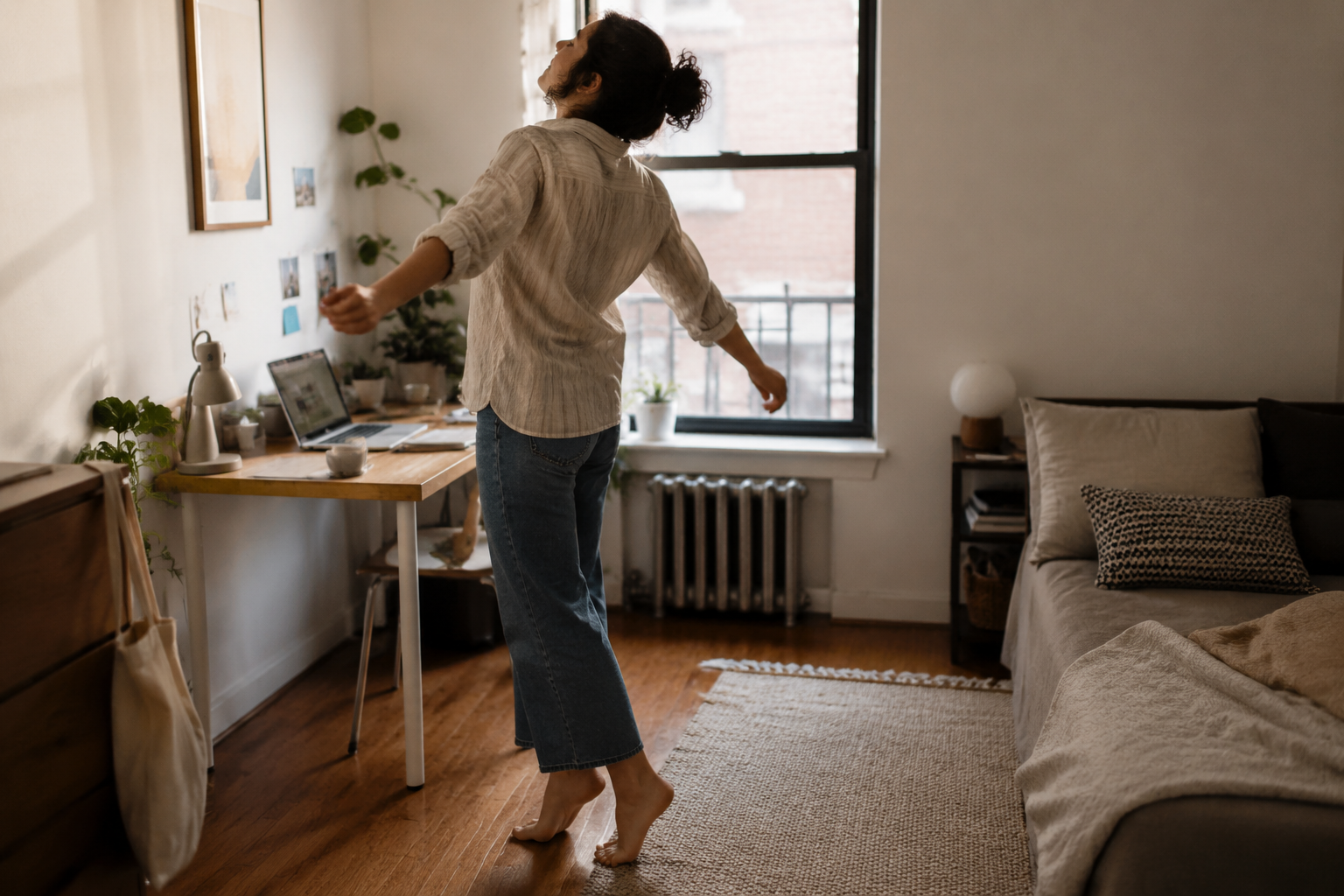
The fair question is not whether dancing is “healthy” in some broad, poster-on-a-studio-wall sense. The fair question is narrower: can five minutes of dancing at home do anything meaningfully different from any other short movement break?
The evidence is strongest if we build it in layers. First, five-minute movement breaks appear to matter for fatigue, mood, productivity, and cognition. Second, dance adds coordination, rhythm, sequencing, memory, and emotional engagement to that movement. That does not make one song a medical intervention. It does make a five-minute dance break for brain benefits at home more plausible than it sounds at first.
Five Minutes Is Short, but It Is Not Nothing
The best recent support for the five-minute idea does not come from dance research. It comes from sitting research, which is probably more relevant to a home worker anyway. In a 2026 British Journal of Sports Medicine study discussed by TIME, Diaz and colleagues tracked more than 19,000 adults and found that 5-minute hourly movement breaks reduced fatigue by about 25% while improving mood and productivity; even 4 to 5 breaks per day delivered meaningful benefits.[1]
That study should not be stretched into “dancing cures your workday.” It was about movement snacks, not dance choreography. Its value is more practical: it makes the duration credible. Five minutes can be long enough to interrupt the physiological drag of sitting, especially when the alternative is another hour of staying folded over a laptop.
A separate 2025 study in Age and Ageing looked at 585 adults aged 65 to 80 and found that reallocating just 5 minutes of sedentary time to moderate-to-vigorous physical activity was associated with better processing speed, working memory, and executive function. The biggest gains came from moving from 0 to 5 minutes, which is exactly the jump most desk-bound people are negotiating in the middle of the day.[2]
Age matters here. Adults in their 60s, 70s, and 80s are not the same population as a 34-year-old renter trying to revive a spreadsheet. But the finding still helps answer the time question. The brain does not require a heroic session before it registers a change in movement intensity.
Where Dance Starts to Look Different
The direct five-minute dance evidence is more limited, but it is worth taking seriously. Chatzopoulos and colleagues studied a single 5-minute synchronized dance active break and found that it improved children’s executive function and subsequent math performance more than aerobic exercise of the same duration.[3]
The limitation is obvious: children in a school setting are not adults working from home. The useful part is not a claim that the same size effect automatically transfers to every adult. It is that, when the duration was held at five minutes, dance beat a simpler aerobic break on tasks that depend on attention, inhibition, and mental control.[3]
That makes sense. Dance is rarely just “move more.” Even a quiet, slightly awkward kitchen version asks the brain to match rhythm, coordinate both sides of the body, remember a short pattern, adjust timing, and stay oriented in space. Those demands are small enough to be doable, but specific enough to wake up more than the calves.
| What a 5-minute break can do | What the evidence actually supports |
|---|---|
| Reduce the drag of prolonged sitting | Movement-break research supports improvements in fatigue, mood, productivity, and blood-flow-related effects, but not dance-specific superiority. |
| Sharpen attention for the next task | Exercise and dance-break studies support acute effects on executive function, processing speed, and working memory. |
| Add a coordination and memory challenge | Dance-specific studies suggest rhythm, sequencing, and bilateral movement may add cognitive load beyond simple movement. |
| Prevent dementia from one song | No. Long-term observational findings on dance and dementia do not prove that a 5-minute break prevents disease. |
The Brain Mechanisms Are Interesting, as Long as We Keep Them Small
The most tempting version of this topic is also the least useful one: stack every brain chemical into a glowing paragraph and imply that a living-room shimmy is a neurological upgrade. The better version is more modest. Dance appears to combine several mechanisms that are already believable on their own.
One important mechanism is brain-derived neurotrophic factor, or BDNF, a protein involved in brain plasticity. In a 2018 PLOS One study comparing 6 months of dance with conventional fitness training, both groups improved fitness, but only the dance group increased blood BDNF levels and hippocampal volume on MRI.[4]
That was not a five-minute desk break. It was a longer training intervention, so it belongs in the “why dance might be special over time” category, not the “what happens before your next Zoom call” category. Still, the contrast is useful: dance may ask enough from memory, balance, rhythm, and navigation to stimulate adaptations that conventional repetitive fitness training does not.
White matter research points in a similar direction. A Colorado State University randomized trial followed 174 adults ages 60 to 79 for 6 months, with training 3 times per week. Dance improved white matter integrity in the fornix, a tract important for memory and processing speed, while aerobic walking did not show the same effect despite identical frequency and duration.[5]
Again, this is not proof that a single five-minute song changes white matter. It is evidence that dance is not merely cardio with music. The pattern-learning part seems to matter.
The mood side is more immediate. Brain & Life’s 2026 mechanisms article cites Julia Basso of Virginia Tech’s Embodied Brain Lab on the release of dopamine, serotonin, and oxytocin from a single dance session, and Dr. Marie Collier on dance’s bilateral brain activation: the left hemisphere contributes sequencing and analytical processing, while the right handles creative, spatial, and rhythmic processing.[6]
Short dance and movement therapy sessions have also been linked with cortisol reduction, according to a 2026 NFPT review on dance fitness and cognition.[7] That is a useful clue for a workday break, because the afternoon slump is often not pure sleepiness. It is also agitation, screen fatigue, and the strange tension of having sat still for too long while feeling mentally chased.
A Quiet 5-Minute Dance Break You Can Do Beside a Desk
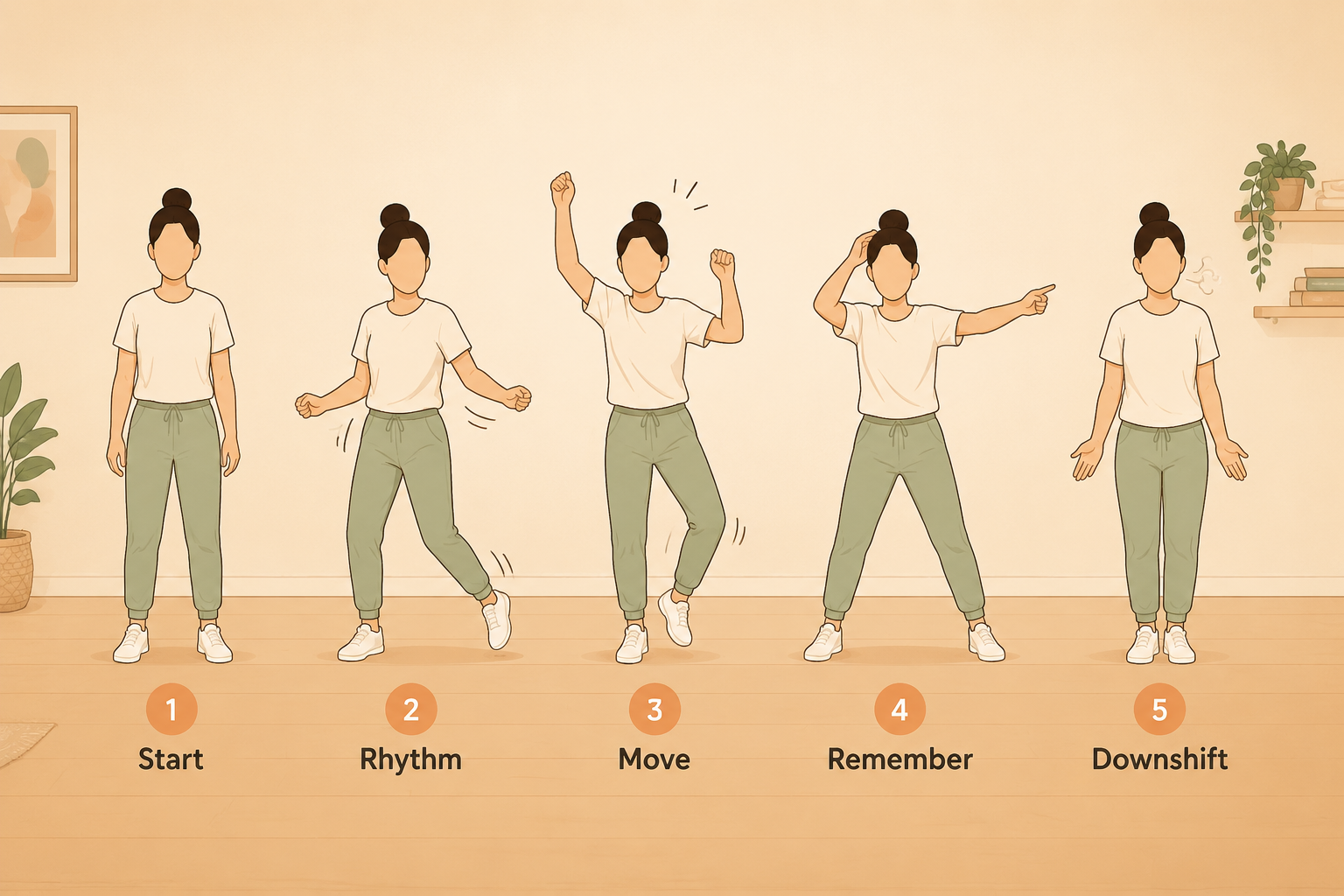
Use one song or a 5-minute timer. Keep your feet low. If you live above someone, think “soft knees, quiet heels, no bouncing.” The goal is to raise arousal and coordination, not to finish sweaty enough to need a shower.
| Time | What to do | What it is for |
|---|---|---|
| 0:00–0:45 | Quiet start: stand tall, breathe, roll shoulders, shift weight right and left without lifting the feet much. | Moves you out of chair posture without shocking cold joints. |
| 0:45–1:45 | Rhythm work: step side to side, tap the free foot in, and add small arm swings below shoulder height. | Adds timing and whole-body coordination while staying apartment-friendly. |
| 1:45–3:00 | More energy: alternate step-touches with soft knee bends, diagonal reaches, and gentle torso turns. | Raises alertness without jumping or traveling. |
| 3:00–4:15 | Memory sequence: choose four moves and repeat them in order: side step, knee lift, reach across, shoulder roll. | Adds the sequencing challenge that makes dance different from plain pacing. |
| 4:15–5:00 | Downshift: slow the steps, breathe through the nose if comfortable, lower the arms, and finish standing still for two breaths. | Lets you return to work without feeling revved past usefulness. |
The memory sequence is the part most people are tempted to skip because it feels silly. Keep it. It is also the part that gives the break its cognitive flavor. You are not trying to perform. You are asking your brain to hold a tiny pattern, update timing, and coordinate movement across both sides of the body.
If music feels like too much during a workday, use a metronome app or count quietly in sets of eight. If turning bothers your back or balance, keep the torso forward and make the arm reaches smaller. If you are in a very small room, the whole routine can happen in a space about the size of a yoga mat, without actually needing a mat.
Make It Feel Less Like a Workout Decision
The easiest way to ruin a five-minute habit is to make it depend on motivation. Attach it to one predictable work lull: after lunch, before the last meeting, or when you notice you have reread the same sentence twice. CNN’s 2026 practical coverage of short movement breaks emphasizes building them into the daily routine rather than treating them as separate exercise events.[8]
You can keep this as a stand-alone break or treat it as the smallest entry in a broader workout-routines habit. On days when dancing feels wrong for your mood, a quiet small-space routine, an air-quality swap, or another no-equipment apartment workout can fill the same slot. The important constraint is that the alternative should stay as frictionless as the dance break: no setup, no gear, no noise problem.
What Not to Claim From One Song
Dance has impressive longer-term associations, but they should not be dragged into a five-minute promise. A 2003 New England Journal of Medicine study of 469 people over age 75 found that, among 11 physical activities studied, dance was the only one associated with reduced dementia risk.[9] That is a regular-activity association in older adults, not evidence that a single short break prevents dementia.
A 2024 University of Sydney systematic review in Sports Medicine found that structured dance, across studies spanning ages 7 to 85, was generally equal to and sometimes more effective than other exercise for psychological and cognitive health outcomes.[10] That broader context supports taking dance seriously as exercise for the brain. It does not erase the difference between acute benefits, long-term adaptation, and disease prevention.
So the honest claim is smaller and more usable: five minutes of dance can be a credible cognitive and mood reset, especially after prolonged sitting. It is not a replacement for longer training, regular exercise, medical care, or sleep. It is a way to make the next block of work easier to enter.
Choose one song. Keep the steps quiet. Use the same five-minute flow during one predictable work lull for a week. Judge it by the thing that actually matters at 2:40 p.m.: whether you come back to the desk with a little more focus, a little less irritation, and fewer reasons to keep avoiding the next task.
References
- A 5-Minute Movement Snack Will Give You More Energy, TIME, July 14, 2026.
- Aging: As little as 5 minutes of exercise may keep the brain healthy, Medical News Today.
- The surprising benefits of a five-minute dance break, BBC, July 17, 2026.
- Dancing or Fitness Sport? The Effects of Two Training Programs on Hippocampal Plasticity and Balance Abilities in Healthy Seniors, PLOS One, 2018.
- Study Shows that Dancing May Offset Aging of Brain, Colorado State University Source.
- Brain & Life dance and brain mechanisms article, Brain & Life, 2026.
- Dance fitness and cognition, NFPT, June 2026.
- Build short movement breaks into daily routine, CNN, May 2026.
- Leisure Activities and the Risk of Dementia in the Elderly, New England Journal of Medicine, 2003.
- Dancing may be better than other exercise for improving mental health, University of Sydney, 2024.
Don't have the gear this routine assumes? Find the build that covers it.
Wondering how much rest you need after this? Read our ACSM-cited recovery reference.
Questions about form, substitutions, or a correction? Leave it below.
Comments
Join the discussion with an anonymous comment.