
Dancing with the Stars Home Workout Dance for Quiet Apartment Cardio
This article explains how to build a quiet, apartment-friendly cardio workout using gliding ballroom steps from Dancing with the Stars. You'll learn which dance styles keep noise low while still getting your heart rate up, and how to structure them into a repeatable routine that fits in a small space.
- Equipment tier required
- none
- Duration
- 30 min
- Difficulty
- beginner
- Target area
- full body
- Noise level
- low
If jumping cardio is off the table because someone lives below you, the quietest Dancing with the Stars home workout dance is not the flashiest one. It is the ballroom work that keeps your weight traveling across the floor instead of dropping into it: rumba, waltz, foxtrot, and a slowed-down samba.
That distinction matters in an apartment. “Low impact” can still be loud if the routine uses quick hops, stompy grapevines, or sneakers squeaking over hardwood. A quieter dance-cardio session asks a different question: does the foot peel, slide, roll, or land? The more the answer is “peel and roll,” the better the odds that your workout feels like dancing to you and not like ceiling percussion to the person downstairs.
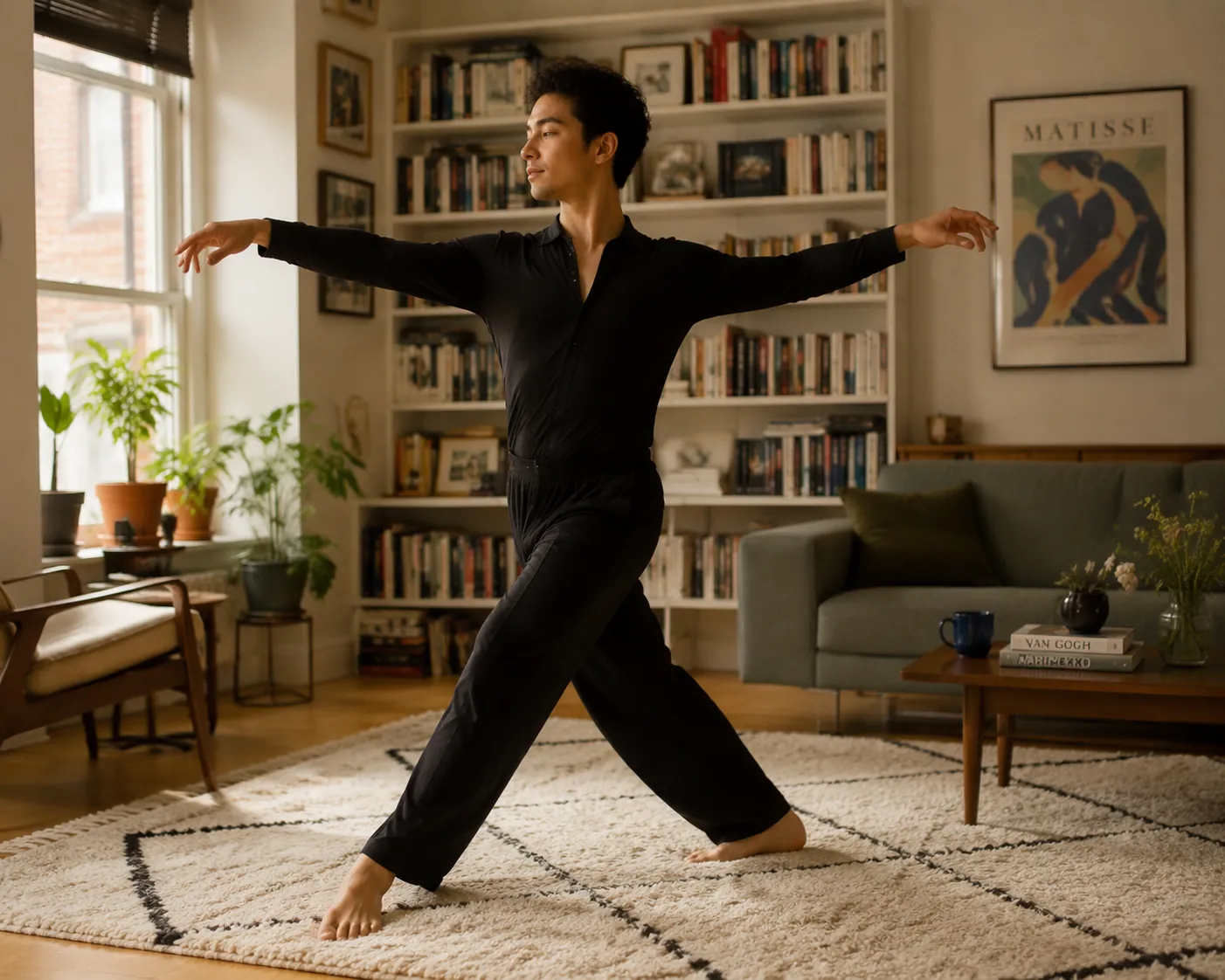
The quiet part is in the footwork
Ballroom-inspired cardio can raise your heart rate without borrowing the impact pattern of burpees or plyometrics. The work comes from staying in motion: transferring weight, holding posture, using the arms, changing direction, and repeating patterns long enough for the session to become aerobic.
For a practical benchmark, Healthline estimates that a 150-pound person burns about 118 calories in 30 minutes of ballroom dancing, while noting that calorie burn varies with body weight and intensity.[1] That is not a miracle number. It is useful because it puts this routine in the same neighborhood as moderate, brisk-walk-style cardio rather than pretending that a quiet living-room rumba replaces every harder conditioning workout.
The other useful benchmark is weekly volume. Public-health guidance commonly points adults toward 150 minutes per week of moderate exercise, and a quiet 30-minute ballroom session can contribute to that total when it is continuous enough to feel like cardio rather than a few isolated steps.[1]
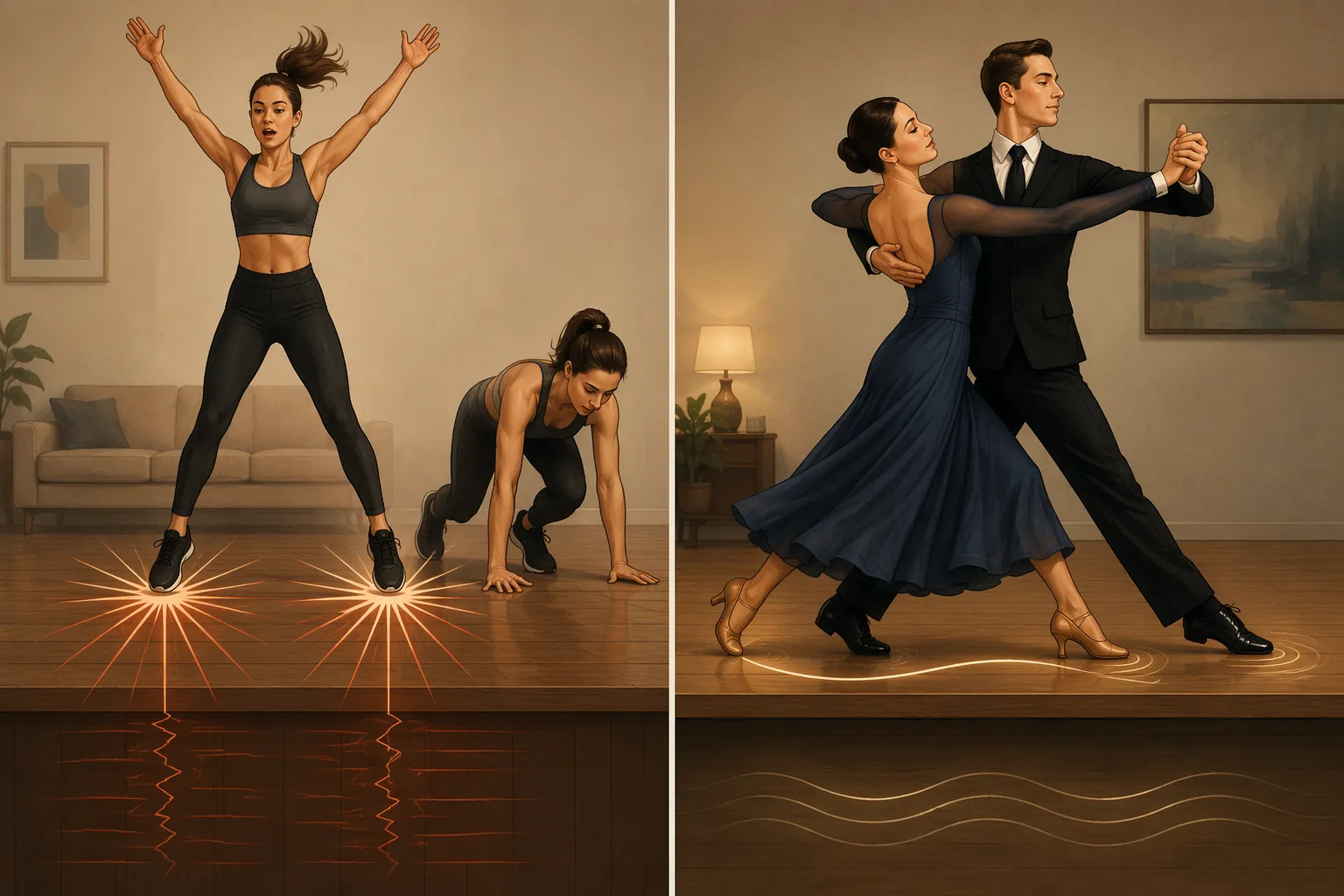
Choose dances that glide instead of bounce
DWTS makes ballroom look big because it is made for a stage and a camera. At home, especially above another apartment, the useful version is smaller. Keep foot lift around 1–2 inches, avoid springing off the floor, and let the working foot skim close enough that you could almost feel the surface under your toes the whole time.
| Style | Why it works in an apartment | How to keep it quiet |
|---|---|---|
| Rumba | Slow weight transfers keep both feet close to the floor and make the hips and core do more of the work. | Step ball-flat, peel the back foot off the floor, and avoid snapping the step into a stomp. |
| Waltz | The rise-and-fall can feel graceful without becoming a jump if the knees soften and the feet roll. | Think heel-toe, toe-heel, and travel in a small box rather than floating across the whole room. |
| Foxtrot | Smooth walking patterns create steady cardio with very little vertical lift. | Use slow-slow-quick-quick timing, keep steps narrow, and let the foot brush through before placing weight. |
| Slow samba | The rhythm adds heat and coordination while the tempo stays controlled. | Keep the bounce internal through the knees and hips; do not turn it into hops. |
Rumba: the best starting point for quiet cardio
Rumba is the easiest place to begin because it teaches the apartment-friendly habit that the whole routine depends on: transfer weight before you decorate the movement. Step side, replace, close. Step forward, replace, close. Step back, replace, close. The feet stay near the floor, but the body is not idle; the standing leg, hips, ribs, and arms all have to organize themselves over each transfer.
For cardio, do not make rumba precious. Use a basic box or side basic and repeat it for two to four minutes at a time. Add arm lines after the feet are steady. If the foot makes a tap you can hear clearly through your own music, soften the knee and place the ball of the foot before letting the heel settle.
Waltz: graceful does not have to mean floaty
Waltz is tempting to overdo. The TV version travels, turns, and fills the floor. The apartment version can live inside a small box step: forward, side, close; back, side, close. Count it 1-2-3, 1-2-3, and let the ankles and knees create a gentle rise rather than pushing upward into a bounce.
The quiet cue is roll, not land. On a forward step, the heel meets first and the rest of the foot lowers. On a closing step, the foot arrives lightly and takes weight only after the body is ready. That small delay is what keeps the movement from sounding like marching.
Foxtrot: walking, but with better manners
Foxtrot is useful because it resembles walking without the heavy heel strike many people bring to treadmill-style cardio. A simple pattern can be as plain as slow forward, slow forward, quick side, quick close; then the same idea backward. In a small room, shorten the forward steps and angle the pattern slightly so you are not running into the sofa every eight counts.
This is where posture starts to matter for intensity. Lift through the chest, widen the collarbones, hold a soft dance frame, and keep moving through the full song. The legs are not pounding, but the body is still working to stay tall, balanced, and continuous.
Slow samba: use the rhythm, edit the bounce
Samba is the one to treat carefully. It can get noisy quickly when taught as party cardio with hops and big traveling steps. For this routine, slow it down and keep the bounce inside the knees, ankles, and hips. A small side-together-side or back basic gives enough rhythm change without asking the floor to absorb a landing.
If the beat makes you want to spring, reduce the range. Smaller feet, stronger arms, taller posture. The goal is not to flatten the dance until it feels dull; it is to keep the rhythm from turning into impact.
A repeatable 30-minute quiet DWTS-style routine
You do not need a partner, mirror wall, or full choreography. You need a patch of floor, a timer, music you can count, and a willingness to repeat simple patterns longer than feels glamorous at first. The repetition is not a flaw here; it is what turns steps into cardio.
| Time | Work | Quiet cue |
|---|---|---|
| 0:00-4:00 | Warm up with weight shifts, small side steps, shoulder rolls, and easy arm reaches. | Keep the whole foot soft and listen for taps. |
| 4:00-9:00 | Rumba block: side basics, forward-and-back basics, then the same steps with arms. | Peel the foot off the floor before replacing it. |
| 9:00-10:00 | Reset: march silently in place or sway side to side. | Use this minute to lower noise, not to stop completely. |
| 10:00-15:00 | Foxtrot block: slow-slow-quick-quick walking patterns in a small rectangle. | Brush the feet through instead of picking them up high. |
| 15:00-16:00 | Reset: breathe, shake out calves, return to posture. | Stay light through the heels. |
| 16:00-21:00 | Waltz block: box step, quarter turns if space allows, then box step with frame. | Rise through the ankles; do not jump. |
| 21:00-22:00 | Reset: slow rumba side steps. | Check whether the floor is still quiet under fatigue. |
| 22:00-27:00 | Slow samba block: small side-together-side, back basic, controlled arm patterns. | Keep bounce internal and steps low. |
| 27:00-30:00 | Cool down with slow foxtrot walks, side reaches, calf and hip mobility. | Let the feet get quieter as the heart rate comes down. |
The blocks are long enough to matter but short enough that a beginner-to-intermediate mover is not trapped in one pattern forever. If coordination is new, spend the first week doing only rumba and foxtrot. Add waltz when the feet stop feeling busy. Add slow samba last, because it asks for the most restraint.
Intensity comes from four levers: duration, posture, arm use, and uninterrupted movement. Raise your arms into a frame and the same foot pattern becomes harder. Keep the frame lifted for a full song and your upper back joins the session. Travel slightly farther, if your room and floor allow it, and the legs have to work more. None of those changes require you to leave the floor.
The simplest progression is weekly, not heroic. In week one, dance for 20 minutes and learn the quiet mechanics. In week two, use the full 30-minute structure. After that, make one block longer or reduce one reset. Do not add hops just because the routine starts to feel easier; add cleaner arms, better posture, or more continuous timing first.
Make the floor part of the workout setup
Shoes and flooring can change the whole experience. Barefoot practice on a thick rug may reduce footfall noise compared with trainers on hardwood, and soft-soled dance sneakers may be quieter than bulky running shoes. Treat that as practical apartment wisdom, not a lab-tested guarantee. Floors, buildings, rugs, and personal force all vary.
- Use a thick rug or exercise mat only if it lets your feet move safely; a sticky surface can twist the knee during turns.
- Avoid hard-heeled shoes, outdoor trainers with squeaky tread, and anything that makes you grip the floor with your toes.
- Keep music low enough that you can hear your own footfalls; if you cannot hear them, your downstairs neighbor may still feel them.
- Test one block at your intended intensity, then adjust step size, footwear, or surface before doing the full session.
- Use turns sparingly on carpet or rugs; small direction changes are usually safer and quieter than full spins.
A useful test is to dance one minute of rumba, one minute of foxtrot, and one minute of slow samba while listening for three sounds: heel drops, toe taps, and shoe squeaks. Heel drops usually mean you are placing weight too abruptly. Toe taps often mean you are decorating the rhythm instead of transferring weight. Squeaks may be a shoe-and-floor mismatch rather than a technique problem.
Where follow-alongs fit
Follow-alongs can help if you choose them for the right reason. LaBlast Fitness, created around partner-free ballroom dance fitness, is a natural place to look when you want ballroom flavor without needing another person in the room.[2] Ballroom Feed also offers dance-fitness and beginner-friendly tutorial material that can help you see timing and shape before you build your own quiet blocks.[3]
The caution is that not every ballroom fitness video is apartment quiet. Preview the first few minutes before committing. If the instructor adds jumps, fast cha-cha chasses, big traveling grapevines, or stompy Latin styling, borrow the timing and replace the footwork with the gliding options here.
The show’s professional training culture can be inspiring, and interviews with DWTS pros such as Witney Carson make clear that dance fitness can sit inside a serious training life.[4] For this routine, though, the useful lesson is not celebrity-level volume. It is that dance can be structured, repeatable work. Your apartment version simply edits out the parts that make the floor complain.
What this routine can and cannot promise
This is a strong quiet-cardio option if you accept the tradeoff clearly. It can give you moderate, repeatable movement; a calorie burn estimate comparable to brisk walking for some bodies and intensities; and more balance and coordination than most living-room cardio plans. It cannot promise silence in every building, and it should not be treated as a complete replacement for strength training, higher-intensity conditioning, or outdoor walking if those are available to you.
If you want a louder, higher-energy DWTS-style session and your floor can handle it, move to this Dancing with the Stars home workout routine for apartment cardio. If you want more dance variety after the gliding basics feel natural, try the Derek Hough dance workout at home. And if the real project is building a whole week of neighbor-friendly training, pair this cardio with a quiet strength plan for small spaces.
For the upstairs renter who wants to sweat without becoming the building’s problem, gliding ballroom is the sensible DWTS-inspired lane: modest foot lift, continuous motion, controlled tempo, and enough theatrical posture to make a small living room feel less like a compromise.
References
- Dancing to Lose Weight, Healthline
- LaBlast Fitness, LaBlast Fitness
- Dance Fitness, Ballroom Feed
- Witney Carson Workout Routine Dancing with the Stars, Women's Health
What a small equipment investment adds
We don't have a build tagged to this exact tier yet. Browse all builds.
How often should you repeat this?
See our recovery and rest reference for citation-anchored rest-interval guidance.
Spot something off?
Tell us if a movement, tier assumption, or duration didn't match your experience.