
How to Do a Derek Hough–Style Dance Workout at Home
Learn how to replicate Derek Hough’s high-energy ballroom and Latin dance style into a solo, no-equipment cardio workout you can do in a small apartment. This routine adapts five signature footwork patterns into a structured session that delivers a full-body burn without a partner or prior experience.
- Equipment tier required
- none
- Duration
- 31 min
- Difficulty
- beginner
- Target area
- full body
- Space footprint needed
- 6x6 feet
- Noise level
- low
A Derek Hough-style dance workout at home does not need a mirror wall, a partner, or enough floor to travel across a ballroom. The useful part to borrow is smaller and more practical: quick weight changes, Latin hip action, sharp arm lines, musical pauses, and the feeling that the move has a reason beyond “keep bouncing until the timer ends.” In a living room, that can become a solo cardio session built from salsa lateral shuffles, cha-cha chassés, samba bounce, rumba walks, and jive kicks, all kept inside roughly a 6-by-6-foot space.
Hough has talked about fitness in terms of “motion equals emotion,” a phrase that matters here because dance cardio tends to work best when it changes the room you are in, not just the number on a watch.[1] His own training is broader than dance alone; a Men’s Health interview describes a five-day-a-week mix that includes dance, yoga, strength training, boxing, and other athletic work.[2] So this routine is not “how Derek Hough trains every day.” It is one home-friendly pillar inspired by the ballroom and Latin vocabulary he is known for.
The credibility is not only celebrity sparkle. Hough won six seasons as a professional on Dancing with the Stars and has competed or performed across styles including quickstep, samba, cha-cha, jive, rumba, Argentine tango, paso doble, foxtrot, and Viennese waltz.[3] For a home workout, the point is not to copy performance choreography. The point is to translate the mechanics: how the feet collect, how weight moves from one leg to the other, how the upper body turns a step into full-body work, and how musical timing makes effort feel less like punishment.
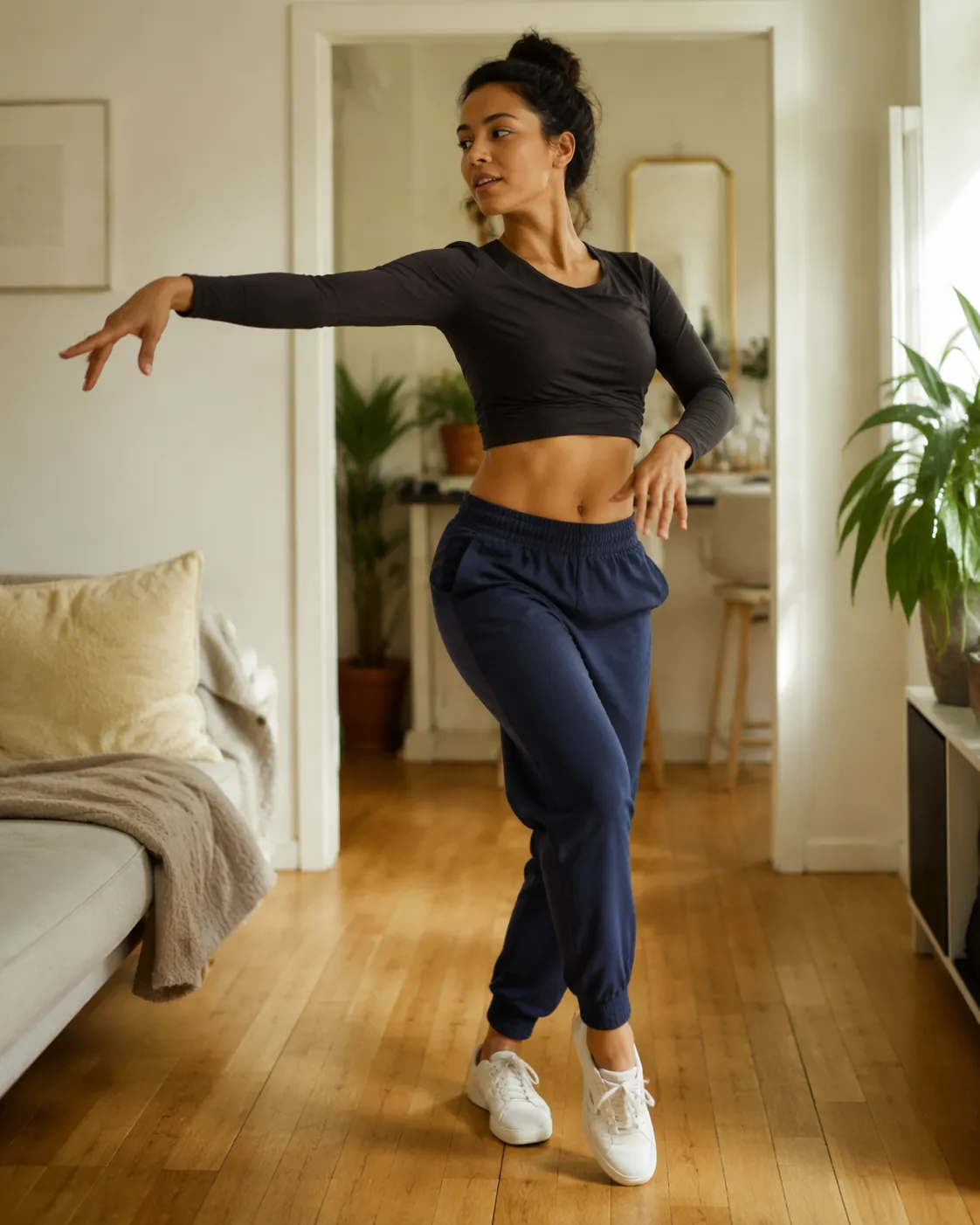
The Small-Space Session
Clear a square about the size of a small rug. You should be able to step side to side, rock forward and back, and lift one knee without clipping a coffee table. Keep sneakers or dance-friendly shoes on if your floor is slippery; go barefoot only if you already know your floor gives you enough traction without grabbing your knees.
| Part | Time | What You Do |
|---|---|---|
| Warm-up | 4 minutes | March, step-touch, easy hip rocks, shoulder rolls |
| Main round 1 | 10 minutes | Five patterns, 45 seconds each, 15 seconds reset; repeat twice |
| Main round 2 | 10 minutes | Same patterns with more arm styling, sharper rhythm, or longer intervals |
| Optional finisher | 3 minutes | Favorite two patterns back to back at strong but controlled effort |
| Cool-down | 4 minutes | Slow rumba walks, side reaches, calf and hip flexor release |
For a first try, stop after the first main round and cool down. The full version lands around 28 to 31 minutes depending on whether you use the finisher. The timer matters less than continuity: dance cardio becomes cardio when you keep returning to the beat after every reset.
Warm Up Like You Mean to Dance, Not Just Sweat
Start with a plain march for 30 seconds, then step-touch side to side. Let the arms swing naturally before you add shape. Roll the shoulders, open and close the ribs gently, and shift weight from ball of foot to heel so your ankles wake up before the quicker patterns arrive.
Then add small hip rocks: step right, settle weight, step left, settle weight. Nothing needs to be dramatic. In Latin-style movement, the hip often follows the weight transfer; forcing it before the foot is actually supporting you is where beginners start to feel awkward. Put the foot down, accept weight into that leg, then let the hip respond.
Five Ballroom and Latin Patterns Adapted for Home Cardio
Solo ballroom practice is not a strange workaround; ballroom instruction commonly uses footwork drills, weight-transfer exercises, and arm styling practice away from a partner.[4] That is good news for an apartment workout. You can train rhythm, posture, coordination, and stamina without pretending your hallway is a competition floor.
Salsa Lateral Shuffle
Think of this as your engine. Step right, bring the left foot in, step right again, then tap or lightly close the left foot. Reverse left. The pattern stays lateral, so it fits in a narrow room, but the repeated side drive raises the heart rate quickly.
- Feet: step-together-step-tap to the right, then step-together-step-tap to the left.
- Weight: fully commit to each side step instead of hovering in the middle.
- Arms: open one arm in the direction of travel, then draw it back toward the ribs as the feet collect.
- Apartment version: keep the steps low and gliding; no hops are required.
- Harder version: add a torso rotation toward the lead foot or make the third step sharper.
The common beginner mistake is tapping without transferring weight. If both legs stay half-loaded, the move feels like nervous side-stepping. Let one leg become the standing leg, then change. That tiny decision gives the shuffle its dance quality and makes the glutes and outer hips do real work.
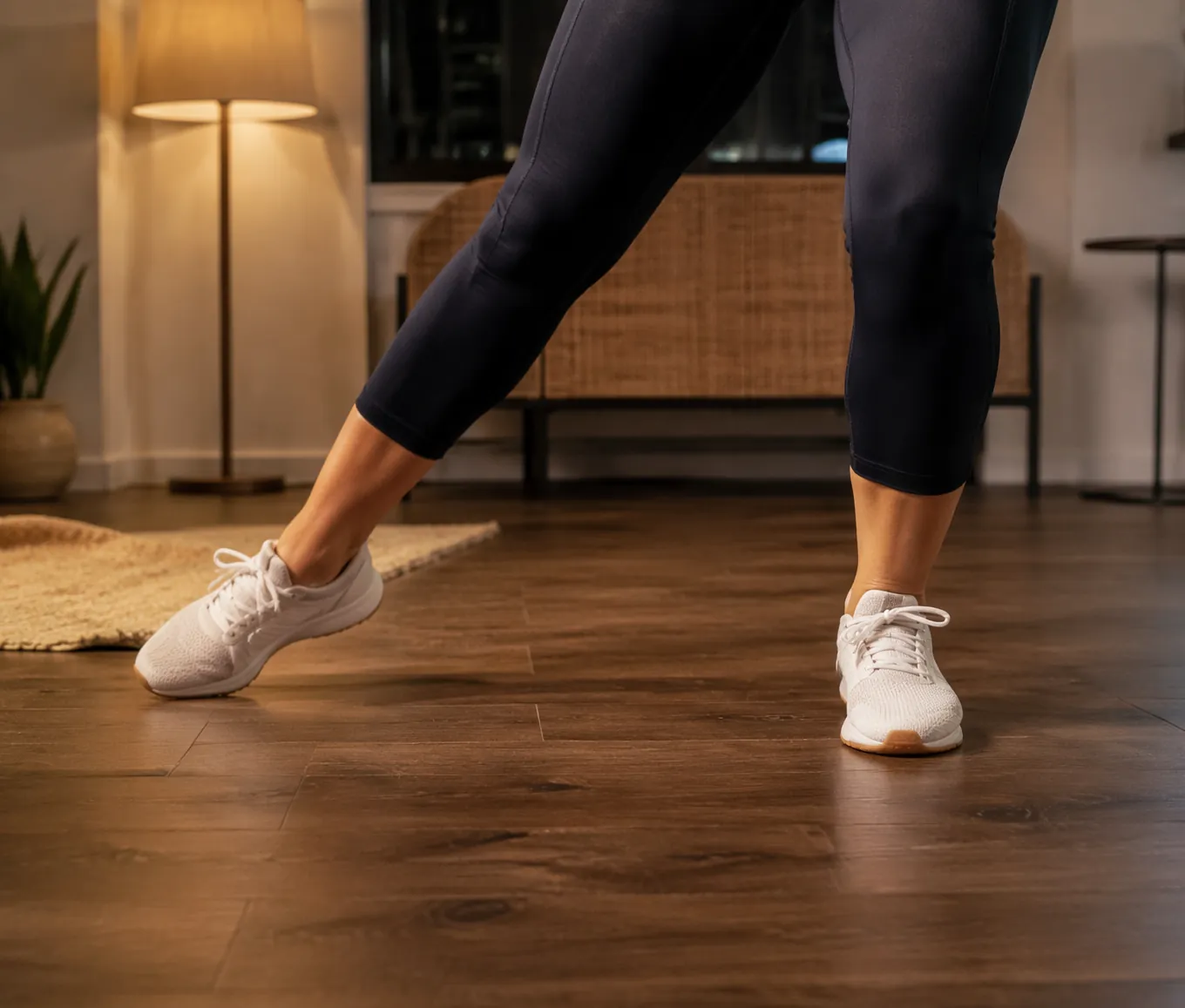
Cha-Cha Chassé Intervals
The cha-cha chassé is the easiest place to feel Hough-style speed without needing travel. Count it as “one, two, cha-cha-cha” or simply “slow, slow, quick-quick-quick.” Step to the side, replace weight, then take three compact side steps. The last three steps are the cardio spike.
Keep your knees soft and your feet close to the floor. On hardwood, imagine brushing the floor rather than stomping through it. The supporting leg bends a little as you receive weight; the free foot collects under you before it goes out again. That collect-and-release action is what keeps the pattern crisp instead of turning it into a sideways jog.
- Beginner interval: 30 seconds chassé, 30 seconds easy march.
- Standard interval: 45 seconds chassé, 15 seconds reset.
- Stronger interval: 60 seconds chassé, then 20 seconds slow rumba walks.
Arms can stay simple at first: one arm reaches side, the other crosses lightly in front of the body, then switch. Once the feet are steady, sharpen the elbows and use the back muscles to place the arms. That turns a lower-body step into a fuller workout without adding impact.
Samba Bounce Without Annoying the Downstairs Neighbor
Samba is where home dancers often go too big too soon. The bounce should not be a jump. Use a soft bend-straighten action through the knees and ankles while the feet mark a small forward-and-back or side-and-together pattern. Your head should not bob wildly; the energy is elastic, not noisy.
Try this apartment version: step right, close left, step right in place; then step left, close right, step left in place. Add a gentle pulse through the standing leg. Keep the heels kissing the floor or hovering just slightly rather than springing off it. If you hear thuds, reduce the range before you reduce the rhythm.
To make it more athletic, add alternating diagonal arms: right arm reaches up and across as the right foot leads, then left arm reaches up and across as the left foot leads. The core has to stabilize the ribs against the hip action, which is why this pattern can feel surprisingly full-body even when the feet barely travel.
Rumba Walks for Control and Recovery
Rumba walks are the reset button, but they are not filler. Step forward on the ball of the foot, lower the heel, transfer weight, then let the back hip release. Step back the same way: ball, heel, weight, settle. In a 6-by-6-foot space, take two walks forward and two walks back, or walk in place with alternating forward taps.
This is where beginners learn not to rush. The slower tempo gives you time to notice whether you are stacking ribs over hips, whether your knees are tracking comfortably, and whether your arms are floating with intention or just hanging around waiting for the next fast song. Use rumba walks between harder intervals when you want active recovery without leaving the dance frame.
Jive Kicks, Kept Low and Fast
Jive gives the workout its bright, athletic finish. For home cardio, skip the big competition bounce and use low kicks. Step in place right-left, then flick the right foot forward with a flexed ankle. Step right-left again, then flick the left foot. Keep the kick below knee height until your balance and rhythm are reliable.
- Low-impact option: tap the heel forward instead of kicking.
- Balance option: keep hands at the hips and reduce arm swing.
- Cardio option: add compact pumping arms and increase tempo.
- Coordination option: kick forward, tap side, then return to step-step.
The jive section should feel playful, not frantic. If your kicks start pulling your torso backward, lower them. A clean small kick on the beat looks and feels better than a high kick that steals your posture.
How to Put the Patterns Together
After the warm-up, run the five patterns in this order: salsa lateral shuffle, cha-cha chassé, samba bounce, rumba walks, jive kicks. The order matters. Salsa opens the hips and builds lateral rhythm. Cha-cha raises intensity. Samba adds pulse and torso control. Rumba lets you recover while staying musical. Jive finishes with quickness.
| Pattern | Work | Reset | Fitness Purpose |
|---|---|---|---|
| Salsa lateral shuffle | 45 seconds | 15 seconds | Lateral cardio, hips, coordination |
| Cha-cha chassé | 45 seconds | 15 seconds | Fast footwork, calves, heart-rate lift |
| Samba bounce | 45 seconds | 15 seconds | Low-impact pulse, core control |
| Rumba walks | 45 seconds | 15 seconds | Active recovery, balance, posture |
| Jive kicks | 45 seconds | 15 seconds | Quickness, light cardio peak |
Repeat that circuit twice for a manageable 10-minute main block. If you feel coordinated and want more conditioning, repeat it four times or extend the work periods to 60 seconds. If you start losing the beat, do not automatically push harder. Go back to the smaller version of the same step and keep the timing clean.
There is existing demand for Dancing with the Stars-style instruction at home, and beginner-to-advanced online dance formats often build around simplified versions of performance movement.[5] The useful filter is whether a routine gives you repeatable mechanics. A move with a ballroom name is not automatically a dance workout; it has to teach the step clearly enough that you can repeat it under fatigue.
Intensity: Use the Beat Before You Chase Calories
Home dance workouts can be effective cardio because they keep large muscle groups moving continuously and combine lower-body steps with upper-body coordination.[6] This Derek Hough-style version can feel comparable to an easy or moderate run when you keep the intervals moving, especially during cha-cha, samba, and jive sections. That comparison is about cardiovascular demand, not identical mechanics.
The commonly used 300–500+ calories-per-hour range for vigorous dance cardio should stay a rough estimate, not a promise. Calorie burn changes with body weight, fitness level, music tempo, range of motion, rest periods, and how much upper-body effort you add. It is also not a Derek Hough-specific lab result.
A better gauge is perceived effort. During the first round, aim for a 5 or 6 out of 10: warm, breathing harder, still able to speak in short phrases. During the second round, let cha-cha and jive rise to a 7 or 8. Rumba should bring you back down without stopping completely. If every pattern feels like a 9, the workout is too fast for learning; if every pattern feels like a 3, make the arms sharper or reduce the resets.
- For beginners: choose music that lets you step cleanly before you add arm styling.
- For cardio focus: use 45- to 60-second intervals and keep resets active.
- For quiet floors: reduce bounce, keep heels close to the floor, and avoid jumpy transitions.
- For more full-body work: increase arm reach, torso rotation, and posture control before increasing impact.
Make It Look Less Awkward
Most awkwardness in home dance cardio comes from being between choices. The feet are doing one thing, the arms are apologizing, and the face says the music has not been consulted. Pick one focus at a time. First, get the feet on rhythm. Then add weight transfer. Then add arms. Styling before timing usually feels pasted on.
For arm lines, imagine the movement starts from your back rather than your wrists. In salsa, the arm opens because the torso rotates. In cha-cha, the elbow has tone instead of flopping. In rumba, the arm can float more slowly because the step is slower. You do not need theatrical hands; you need the upper body to participate.
Musicality is also a practical tool. Hold the tap for a breath in salsa. Hit the quick-quick-quick in cha-cha like punctuation. Let samba pulse under the count instead of hammering every beat. Slow down the rumba walk enough that you can feel the weight arrive. When the movement matches the music, people tend to stay with it longer because the workout gives something back while it takes effort.
Modifications for Neighbors, Knees, and First-Timers
A small apartment routine succeeds only if you can repeat it without worrying about the floor, the people below you, or your joints the next morning. Keep the pattern; change the amplitude. That means the salsa still travels side to side, the cha-cha still has quick triples, the samba still pulses, the rumba still transfers weight, and the jive still flicks forward. They just get smaller.
| Issue | Change |
|---|---|
| Downstairs neighbors | Replace hops with heel taps, keep knees soft, and brush the floor |
| Knee sensitivity | Reduce bounce depth and avoid twisting on a planted foot |
| Low coordination confidence | Do feet only for one round before adding arms |
| Limited space | Use in-place versions of rumba and jive; keep salsa and cha-cha compact |
| Too easy | Increase tempo, arm range, or interval length before adding jumps |
If you want a simple progression, do the same routine twice a week for two weeks before changing it. In week one, learn the steps. In week two, improve the transitions. Only then decide whether you need faster music or longer intervals. Dance cardio gets more athletic when the nervous system stops treating every step like a surprise.
Where This Fits in a Home Fitness Week
Use this as a cardio day, not as a complete training identity. Dance gives you rhythm, coordination, conditioning, and mood. It does not replace all strength work, mobility work, or recovery.
A balanced small-space week could include this routine once or twice, a strength session once or twice, and an easier mobility or walking day. If you like performance-style cardio, the Broadway dance workout at home makes a natural companion because it uses a different theatrical movement vocabulary with the same no-equipment constraint. If you want another 6-by-6-foot bodyweight option, the Preseason Double Session No Equipment routine keeps the small-space structure but shifts the feeling away from dance. For strength days that will not turn your apartment into a weight room, use the Quiet Strength Plan.
A Derek Hough-style dance workout at home is credible when it is built from real footwork ideas, kept low-impact enough for a living room, and organized like cardio instead of celebrity imitation. You need music, a little cleared floor, and enough patience to let rhythm become skill.
References
- Derek Hough Shared His Perfect Meal for Busy Days Interview, EatingWell
- Derek Hough Diet and Exercise, Men’s Health
- Derek Hough, Wikipedia
- Dance Fitness, Ballroom Feed
- Dancing with the Stars Beginner to Advanced, DANCE & CO
- Home Dance Workouts, Red Bull
What a small equipment investment adds
We don't have a build tagged to this exact tier yet. Browse all builds.
How often should you repeat this?
See our recovery and rest reference for citation-anchored rest-interval guidance.
Spot something off?
Tell us if a movement, tier assumption, or duration didn't match your experience.