
Dia Mirza's Home Workout Routine With Minimal Equipment
This article breaks down Dia Mirza's actual home workout routine and diet plan, showing how to replicate her 6-day/week training with bodyweight exercises, light dumbbells, and resistance bands in a small apartment.
- Equipment tier required
- none
- Duration
- 60 min
- Difficulty
- beginner
- Target area
- full body
- Space footprint needed
- small (yoga mat area)
- Noise level
- low
The useful thing about Dia Mirza’s home workout routine and diet plan is not that it sounds luxurious. It is that the training part, at least in the most current account from her trainer Kunal Vijay More, is built from things many apartment exercisers can actually fit somewhere: bodyweight work, light dumbbells, resistance bands, TRX, yoga, walking, and about an hour of training 6 days a week.[1]
The beginner doorway is even smaller. More told The Indian Express that people without equipment can begin with a 20-minute brisk walk followed by a bodyweight circuit of squats, lunges, push-ups, and planks.[1] That matters more than any polished celebrity-gym photo, because it gives the routine a version that still counts when the only open space is the strip of floor between a couch and a coffee table.
What Her Trainer Actually Confirmed
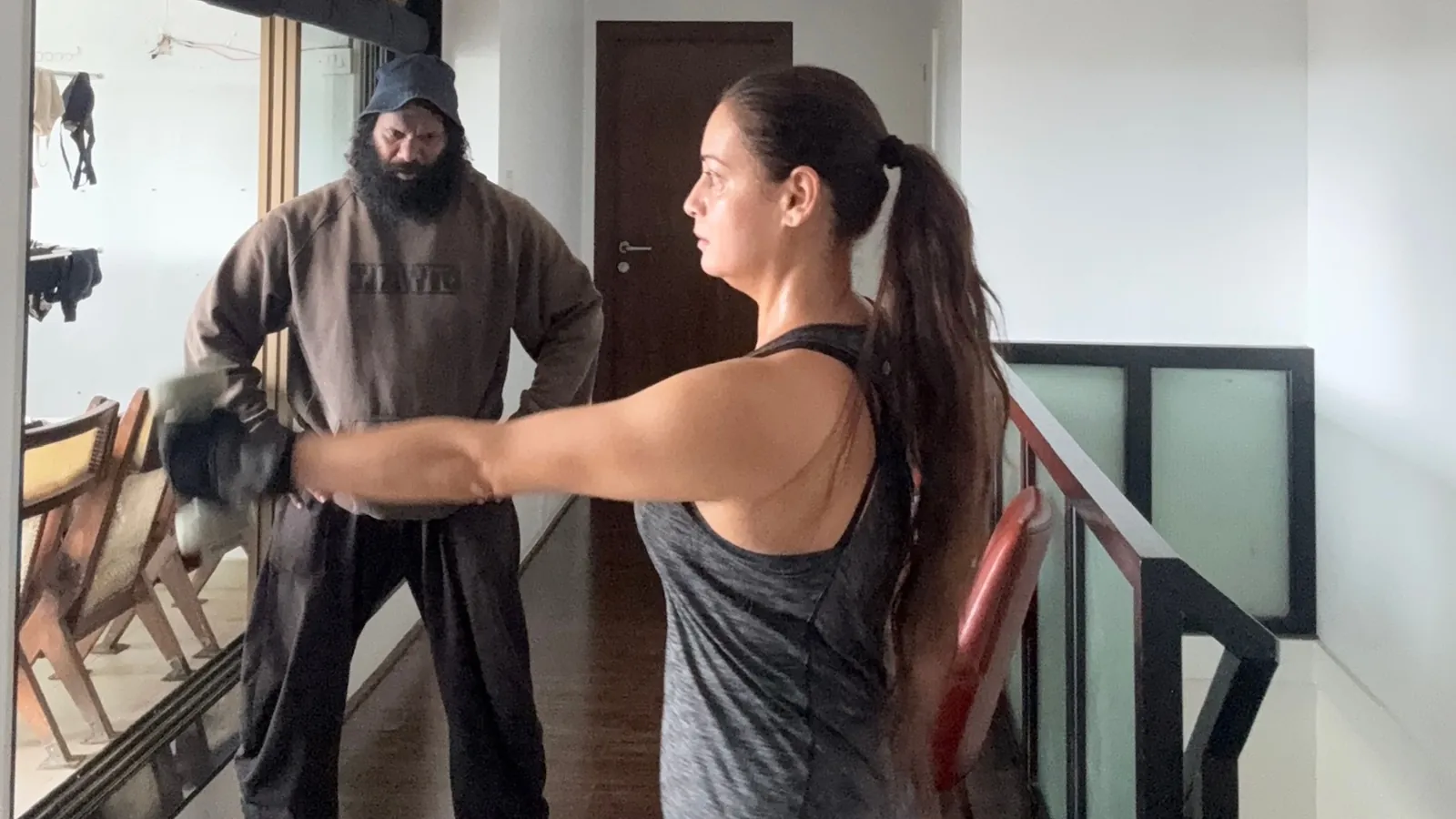
The current anchor is the July 29, 2026 trainer interview, not a vague “fitness secrets” roundup. More said Mirza trains 6 days per week for about an hour and relies mostly on bodyweight exercises, light dumbbells, resistance bands, and TRX.[1] He also pointed to a 110-plus consecutive training day streak, which is the detail that makes the routine interesting: it reads less like a short transformation campaign and more like a system that has become livable.[1]
The movement menu is straightforward: squats, lunges, push-ups, planks, yoga, walking, and functional training. Earlier coverage adds surya namaskar, dhanur asana, pranayama, meditation, and a long-standing walking baseline of 10,000 daily steps.[2][3][4] For US readers, surya namaskar is a flowing “sun salutation” sequence, dhanur asana is bow pose, and pranayama is structured breathing work rather than a separate cardio workout.
There is one distinctive warm-up detail: More described mini-trampoline or rebounder jumps for lymphatic stimulation.[1] A rebounder may be useful as a low-footprint warm-up tool if noise and ceiling height cooperate, but the cited interview supports it as part of her routine, not as proof that rebounding produces a guaranteed performance outcome for everyone.
The Small-Space Setup
The most apartment-friendly version of this routine does not start with a full rack, bench, treadmill, or cable machine. It starts with a mat, a pair of light dumbbells, a resistance band or two, and optional suspension straps if there is a safe anchor point. Times of India coverage of Mirza’s pregnancy-era terrace-to-gym setup described a yoga mat, light dumbbells, and TRX bands, showing that a functional setup can exist in a compact home area rather than a dedicated gym room.[5]
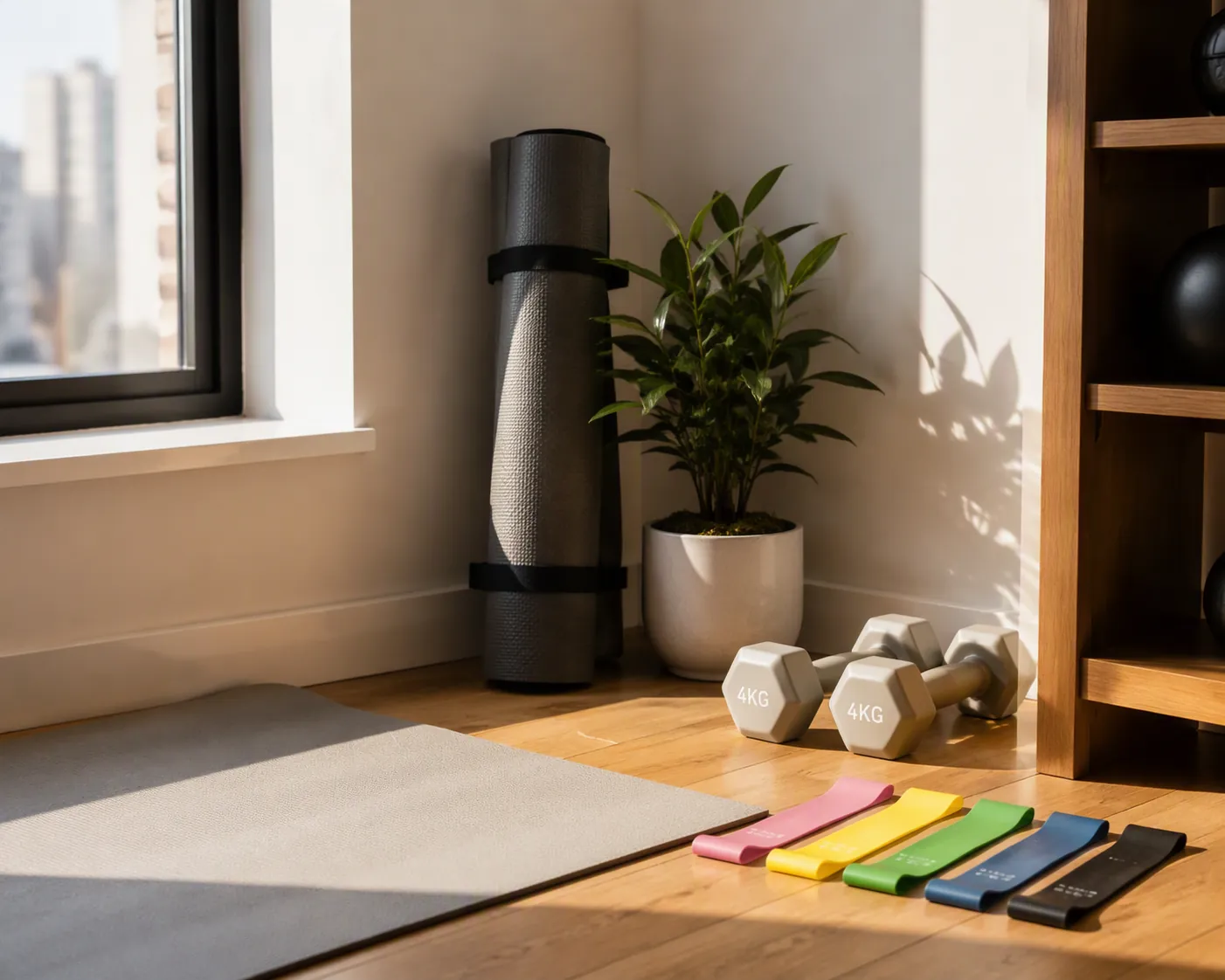
That pregnancy-era context is important. It proves the equipment choices were compact and practical, but it should not be copied as a prenatal training prescription. Pregnancy training depends on medical clearance, symptoms, trimester, prior training history, and individual modifications. For a general home exerciser, the useful takeaway is the footprint: this is a corner setup, not a renovation project.
| Item | What it adds | Small-space reality check |
|---|---|---|
| Yoga mat | Floor work, planks, push-ups, mobility, yoga | The one non-negotiable if your floor is hard or slippery |
| Light dumbbells | Loaded squats, lunges, presses, rows, carries | Store under a couch, in a closet, or beside the mat |
| Resistance bands | Rows, presses, glute work, warm-ups, travel workouts | Cheapest and easiest upgrade after bodyweight work |
| TRX or suspension trainer | Rows, assisted squats, core work, adjustable difficulty | Only makes sense if you have a safe door, beam, or wall anchor |
| Rebounder | Warm-up jumps and light cardio texture | Optional; check noise, ceiling height, and storage first |
If there are neighbors underneath, the rebounder and jump-heavy options are the first things to question. A brisk walk outside, marching in place, step-ups on a stable low step, or a quiet mobility warm-up can fill the same “start moving” slot without turning the apartment into a complaint generator.
A Careful Weekly Reconstruction
No source in the available material gives a complete leaked Monday-to-Saturday calendar. The reasonable reconstruction is this: 6 training days, about an hour each, with yoga on 3 to 4 days and functional or weight training on the remaining days, supported by walking, meditation, and pranayama.[1][2] Swimming, kickboxing, or cycling appear as cardio options in older coverage, but they are not required for the home version.[2]
| Day | Home version | Main work |
|---|---|---|
| Day 1 | Functional strength | Squats, lunges, push-ups, rows or band pulls, planks |
| Day 2 | Yoga flow | Surya namaskar, standing poses, mobility, breathing |
| Day 3 | Functional strength | Lower-body and core emphasis with dumbbells or bands |
| Day 4 | Yoga flow | Vinyasa-style movement, dhanur asana if appropriate, longer cool-down |
| Day 5 | Functional strength | Upper-body pushing, pulling, squats or hinges, planks |
| Day 6 | Yoga or mixed conditioning | Yoga plus walking, or a lighter circuit depending on recovery |
| Day 7 | Rest or gentle walking | No formal workout required |
The schedule is less rigid than it looks. If yoga is the anchor that keeps the habit alive, use 4 yoga days and 2 strength days. If strength training feels more motivating, use 3 strength days and 3 yoga or mobility days. The sourced point is the 6-day consistency and the blend of yoga plus functional training, not a sacred order of weekdays.
What an Hour at Home Can Look Like
For a functional training day, the first 5 to 10 minutes can be a warm-up: rebounder jumps if that fits your space, or a quiet alternative such as brisk walking, marching, dynamic lunges, arm circles, and hip mobility. Then come the movements that More named for equipment-free beginners and the tools he listed for Mirza’s routine: squats, lunges, push-ups, planks, dumbbells, bands, and TRX.[1]
- Squat pattern: bodyweight squats, goblet squats with one dumbbell, or TRX-assisted squats.
- Lunge pattern: reverse lunges, split squats, or alternating lunges if knees and balance tolerate them.
- Push pattern: wall push-ups, incline push-ups on a sturdy surface, floor push-ups, or dumbbell floor presses.
- Pull pattern: band rows, TRX rows, or band pull-aparts to balance the pushing work.
- Core: forearm planks, side planks, dead bugs, or slow mountain climbers if impact is not an issue.
A compact circuit might run 3 to 5 rounds, depending on experience and available time: squats, push-ups, lunges, rows, and planks, resting enough to keep form clean. The point is not to turn every session into a punishment test. Mirza’s cited streak is evidence of repeatability, and repeatability usually depends on leaving enough in reserve to train again tomorrow.
Where Yoga Fits
Yoga is not just decoration in this routine. India Today’s 2023 interview material points to yoga 3 to 4 days a week, including Vinyasa flow, with meditation and pranayama as regular anchors.[2] Vogue India has also highlighted Mirza’s use of yoga, meditation, surya namaskar, and dhanur asana.[4]
At home, a yoga day can be simpler than a studio class: 5 minutes of breathing, 20 to 30 minutes of sun salutations and standing poses, 10 minutes of floor work, and a short cool-down. Brahmari, often translated as humming bee breath, and Anulom Vilom, an alternate-nostril breathing practice, are pranayama techniques mentioned in the source material.[2] They should feel steady and controlled; anyone with respiratory, cardiovascular, or pregnancy-related concerns should get qualified guidance before treating breathwork as a daily prescription.
The 20-Minute No-Equipment Entry Point
The most useful line in the trainer interview may be the one that removes gear completely: a 20-minute brisk walk plus squats, lunges, push-ups, and planks.[1] That is the version to start with if the dumbbells are still in an online cart or the TRX anchor feels unrealistic.
| Time | Action |
|---|---|
| 0:00-20:00 | Brisk walk outside, in a hallway, on a treadmill, or around the block |
| After the walk | 2-4 rounds of bodyweight squats |
| Next | Reverse lunges or stationary split squats |
| Next | Push-ups from a wall, counter, couch edge, or floor |
| Finish | Forearm plank or side plank holds |
For someone starting from low activity, the circuit does not need heroic volume. One careful round after the walk is still a start. Add a second round when soreness and schedule allow it. Add bands or dumbbells only when the habit is already showing signs of survival.
Walking Is Not Filler
Mirza’s older fitness coverage included a 10,000 daily steps baseline, which helps explain why the home routine does not have to carry every bit of conditioning by itself.[3] Walking adds low-friction volume. It can happen before work, after dinner, during errands, or as the first 20 minutes of the trainer’s beginner option.
For apartment dwellers, this is also the cleanest cardio solution. It uses no storage, makes no downstairs-neighbor impact, and does not require pretending that a living room is a spin studio. If the day has already included a long walk, the home session can be shorter and more strength-focused.
Diet: Keep It as Context, Not a Copy-Paste Meal Plan
The available material supports a broad picture of Mirza’s wellness habits more clearly than it supports a precise diet plan. That distinction matters. A “Dia Mirza diet plan” with exact meals, calories, macros, and timing would need sourcing that is not present in the brief. The safer reading is that food supports the training pattern rather than replacing it.
So for a home exerciser, the practical translation is modest: eat enough to recover from 6 training days, keep protein and fiber present across meals, hydrate, and do not let a celebrity routine turn into a restrictive menu you cannot verify. If a source mentions a specific item such as beetroot juice, it should be treated as an individual habit unless backed by stronger evidence for the exact use, amount, and outcome.
What Is Realistic to Copy
The realistic copy is not Mirza’s exact body, exact recovery capacity, exact coaching access, or exact calendar. It is the structure: 6 days of movement, a mix of yoga and functional strength, walking as a baseline, and simple tools that make bodyweight movements easier to progress.
- Start with the trainer’s no-equipment version: brisk walking, squats, lunges, push-ups, and planks.
- Add yoga days before adding more equipment if mobility, stress, or consistency are the weak links.
- Buy resistance bands before heavier gear; they are cheap, quiet, and easy to store.
- Add light dumbbells when squats, lunges, presses, or rows need more challenge.
- Use TRX only if the anchor is safe and the setup does not become a daily hassle.
Dia Mirza’s routine is aspirational mainly in consistency, not in equipment cost. The most useful way to copy it is to begin with the 20-minute walk-plus-bodyweight circuit, keep walking and yoga as anchors, and layer in bands, light dumbbells, or TRX only after the routine is actually sticking.
References
- Dia Mirza trainer interview, The Indian Express, July 29, 2026
- Dia Mirza exclusive interview, India Today, November 2023
- Dia Mirza fitness motto feature, Hindustan Times, 2019
- Dia Mirza yoga and meditation features, Vogue India
- Dia Mirza terrace gym coverage, Times of India, 2021
What a small equipment investment adds
We don't have a build tagged to this exact tier yet. Browse all builds.
How often should you repeat this?
See our recovery and rest reference for citation-anchored rest-interval guidance.
Spot something off?
Tell us if a movement, tier assumption, or duration didn't match your experience.