
How Dia Mirza Stays Fit at Home With Minimal Equipment
This article breaks down Dia Mirza's complete at-home workout and diet system, based on her trainer's direct confirmation and her long-documented daily habits. Readers will learn the exact weekly training split, simple bodyweight exercises, and plant-based meal plan they can replicate in a small space without expensive gear.
- Equipment tier required
- none
- Duration
- 60 min
- Difficulty
- beginner
- Target area
- full body
- Space footprint needed
- yoga mat area
- Noise level
- low
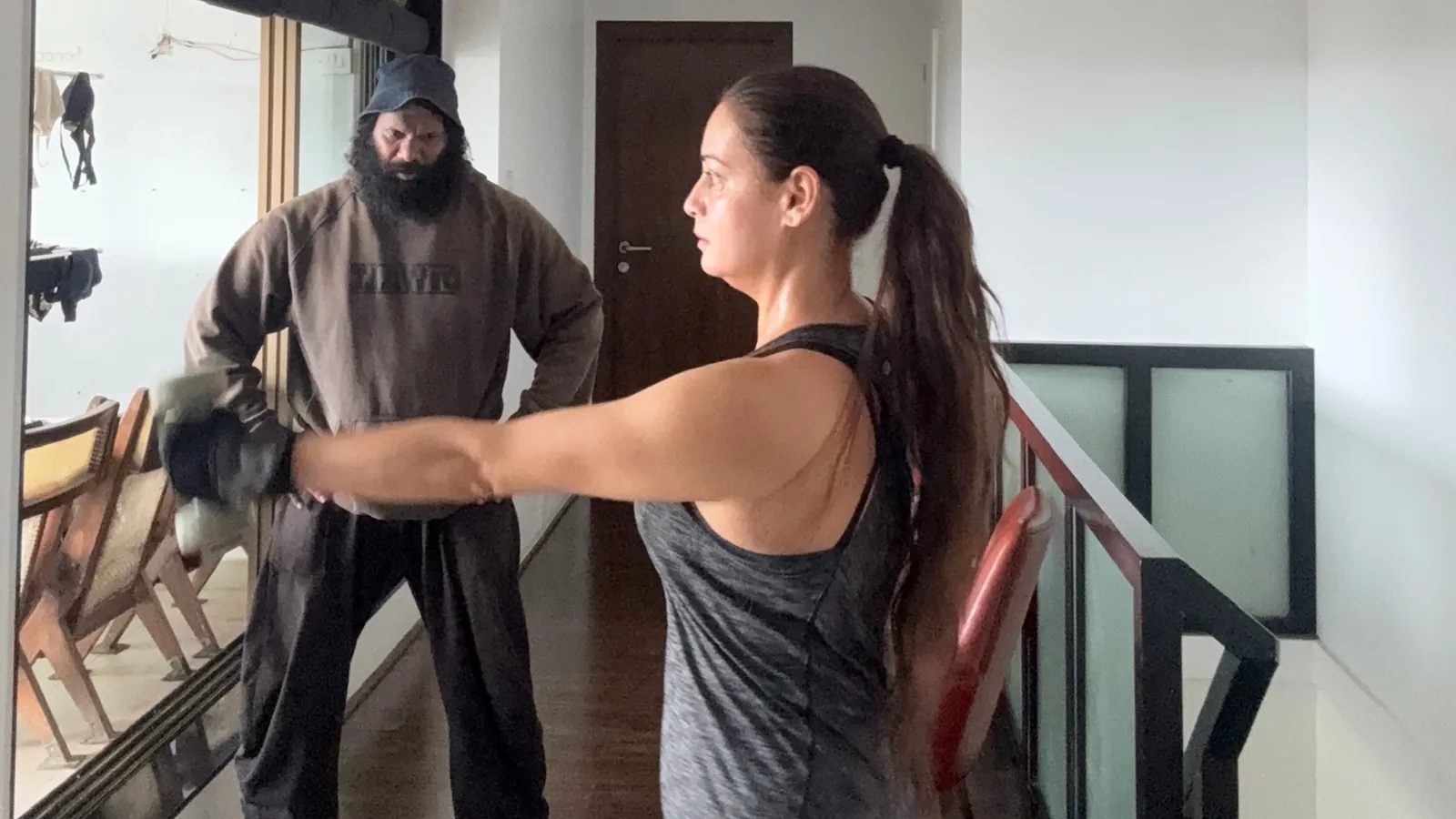
The useful question behind Dia Mirza workout and diet secrets at home is not whether a celebrity can stay fit with a trainer. It is whether the routine still makes sense when the “home gym” is a yoga mat between a sofa and a coffee table. In July 2026, her trainer Kunal Vijay More gave the answer renters actually need: Dia trains six days a week for about an hour, uses bodyweight work with light dumbbells or resistance bands, and he says bodyweight exercises plus a 20-minute brisk walk can be sufficient without expensive equipment. [1]
That does not make the routine effortless. Six days of training, daily walking, refined-sugar avoidance, structured meals, hydration, breathing practice, and regular yoga are not casual habits. What makes Dia’s system interesting is that the hard part is repetition, not access. There is no single hidden exercise here. There is a layered routine that keeps reappearing across interviews: movement in the morning, strength and mobility work, daily steps, simple plant-forward food, and enough water to make the whole plan feel less like a celebrity cleanse and more like a schedule.
The At-Home Frame: Six Training Days, One Hour, Minimal Gear
More’s 2026 breakdown gives the clearest current frame for Dia’s routine. Her week includes rebounder warm-ups, strength training with bodyweight exercises and light resistance, functional combination moves, yoga three to four days a week, and varied cardio such as swimming, kickboxing, or cycling. [1]
For a small apartment, the important part is not copying every cardio option. Most people cannot swim between meetings or store extra equipment in a one-bedroom. The transferable structure is simpler: warm up, train strength, add mobility or yoga several days a week, keep one reliable daily walking baseline, and rotate cardio only if life allows it.
| Part of Dia’s System | What Is Confirmed | Small-Apartment Translation |
|---|---|---|
| Training frequency | Six days a week, about one hour | A regular slot matters more than a perfect gym setup |
| Strength work | Bodyweight exercises plus light dumbbells or resistance bands | Start with bodyweight; add bands or light weights only if useful |
| Warm-up | Rebounder warm-ups | Use a quiet low-impact warm-up if a rebounder would annoy neighbors |
| Yoga | Three to four days a week | Keep enough floor space for a mat and mobility work |
| Cardio | Swimming, kickboxing, cycling, and brisk walking are mentioned | Treat walking as the baseline; treat the rest as optional variety |
The rebounder is the one item that can look like a gear requirement, but the trainer’s own statement cuts against that reading. If a mini-trampoline fits your space and floor situation, fine. If it does not, the larger principle is a joint-friendly warm-up before strength work, not the purchase itself.
What the Workout Looks Like When You Strip Away the Celebrity Gloss
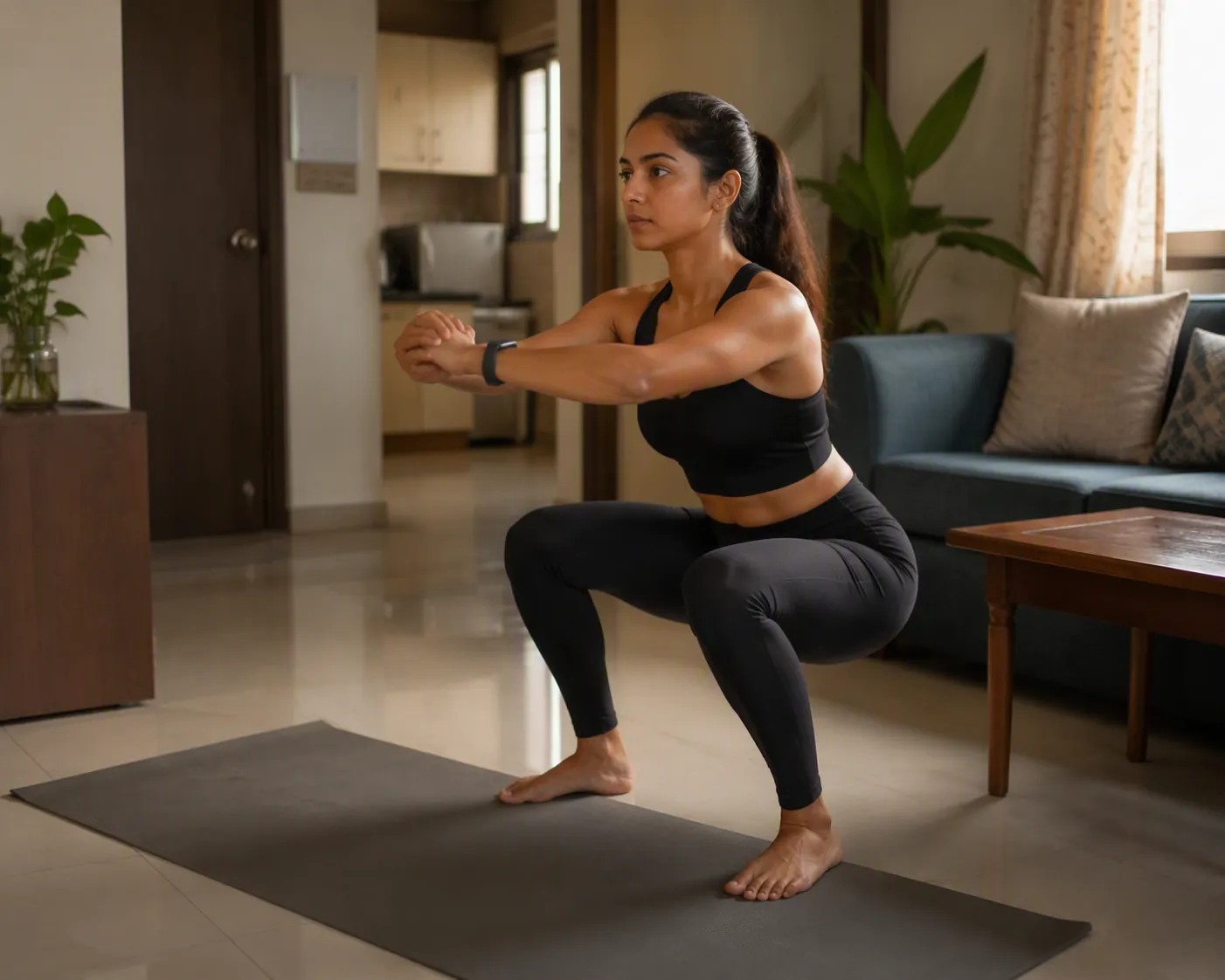
Dia’s confirmed workout is not a bodybuilding split and not a random collection of wellness activities. It sits closer to a functional home routine: bodyweight strength, light resistance, movement combinations, yoga, walking, and occasional cardio variety. That matters because a small-space routine has to solve two problems at once. It has to train the body, and it has to be repeatable without rearranging the living room into a studio every morning.
Bodyweight Strength Is the Base
More specifically names bodyweight exercises as part of Dia’s strength training, along with light dumbbells and resistance bands. [1] That is the part most people can replicate immediately. Bodyweight work does not mean “easy”; it means the load comes from your own body, tempo, range of motion, balance, and consistency. In a small room, it also means fewer excuses. You need enough space to stand, step, hinge, squat, lower yourself, and move safely around a mat.
The available sources do not list Dia’s exact exercise menu, so it would be dishonest to invent a branded sequence and call it hers. A faithful home adaptation would keep the category, not fake the choreography: lower-body bodyweight moves, upper-body pushing or pulling patterns if your setup allows them, core stability, and functional combinations that move more than one joint at a time.
Light Resistance Is Optional, Not the Price of Entry
Light dumbbells and resistance bands appear in the trainer’s description, but the more practical takeaway is that resistance can stay modest. [1] A pair of small dumbbells or a band can make pulling, pressing, and controlled combination work easier to program. They are not the reason the routine works. The reason is that the strength work shows up repeatedly across the week.
If you are starting with no equipment, do not let bands become the new gym membership excuse. Begin with bodyweight training and walking. Add one inexpensive resistance tool only when you know exactly what gap it fills.
Yoga Is Not a Decorative Add-On
Dia’s trainer says yoga appears three to four days a week. [1] In the context of a six-day schedule, that is not an occasional stretch after a workout. It is part of the structure. For apartment training, yoga also solves a real problem: it lets a routine include mobility, breath control, balance, and quieter movement on days when jumping or loud cardio would be a poor neighborly decision.
This is where Dia’s longer-documented habits line up with the 2026 trainer interview. Yoga, breathing, and meditation are not new accessories attached to the current routine; they have been part of how she describes fitness for years.
Walking Does the Unshowy Work
In a 2019 Hindustan Times interview, Dia described 10,000 steps a day as her fitness motto and said she walks that amount daily regardless of other training. [2] More’s 2026 comment that a 20-minute brisk walk can pair with bodyweight work reinforces the same idea from a different angle: walking is not filler. It is the daily baseline that keeps the routine from depending entirely on one formal workout. [1]
For a renter, this may be the least glamorous and most useful part of the plan. Walking moves cardio out of the apartment. It reduces the need for noisy jump intervals. It also gives the day a second movement anchor, so missing a perfect workout does not mean the whole system collapses.
A Realistic Day Built From Dia’s Habits
The cleanest way to understand Dia’s system is as a day with several small commitments rather than one heroic training block. None of these pieces is strange on its own. Together, they explain why the routine has survived across years of interviews.
- Morning: breathing and meditation before checking the phone.
- Pre-workout: beetroot and carrot juice, as described by her trainer.
- Training: about one hour, six days a week, with strength, yoga, warm-ups, and cardio variety.
- Daily movement: a walking baseline, historically described as 10,000 steps a day.
- Meals: mostly plant-based, gluten-free, refined-sugar-free, seasonal, and simple.
- Hydration: water and simple infused or boiled drinks throughout the day.
The Morning Reset Comes Before the Phone
Dia has described starting the morning with 15 minutes of pranayama, including Brahmari and Anulom Vilom, followed by meditation before touching her phone. [3] That detail matters because it puts recovery and attention before the day starts making demands. It is also one of the easiest parts to replicate in a small space. No equipment, no noise, no outfit, no commute.
It would be too neat to claim that breathing exercises alone produce a specific physique result; the sources do not support that. What they do show is that Dia treats breathwork and meditation as part of the fitness routine, not as a separate wellness hobby.
The Pre-Workout Drink Is Simple
More says Dia has beetroot and carrot juice before workouts. [1] There is no need to turn that into a supplement stack. In practical terms, it is a light pre-workout habit built from ordinary produce. If juicing is not realistic, the broader pattern is still clear: she does not appear to rely on complicated packaged pre-workouts in the routine described by her trainer.
The Diet: Plant-Forward, Indian, and More Structured Than It Sounds
Dia’s diet is often summarized as clean or plant-based, but those labels are too vague to be useful. The reported pattern is more specific: chia seeds in almond milk with blueberries and pomegranate for breakfast; gluten-free rotis, dal, sabzi, salad, and a small portion of rice for lunch; and soup, leafy salad, sprouts, and avocado for dinner. [4] She has also described eating snacks every two hours. [5]
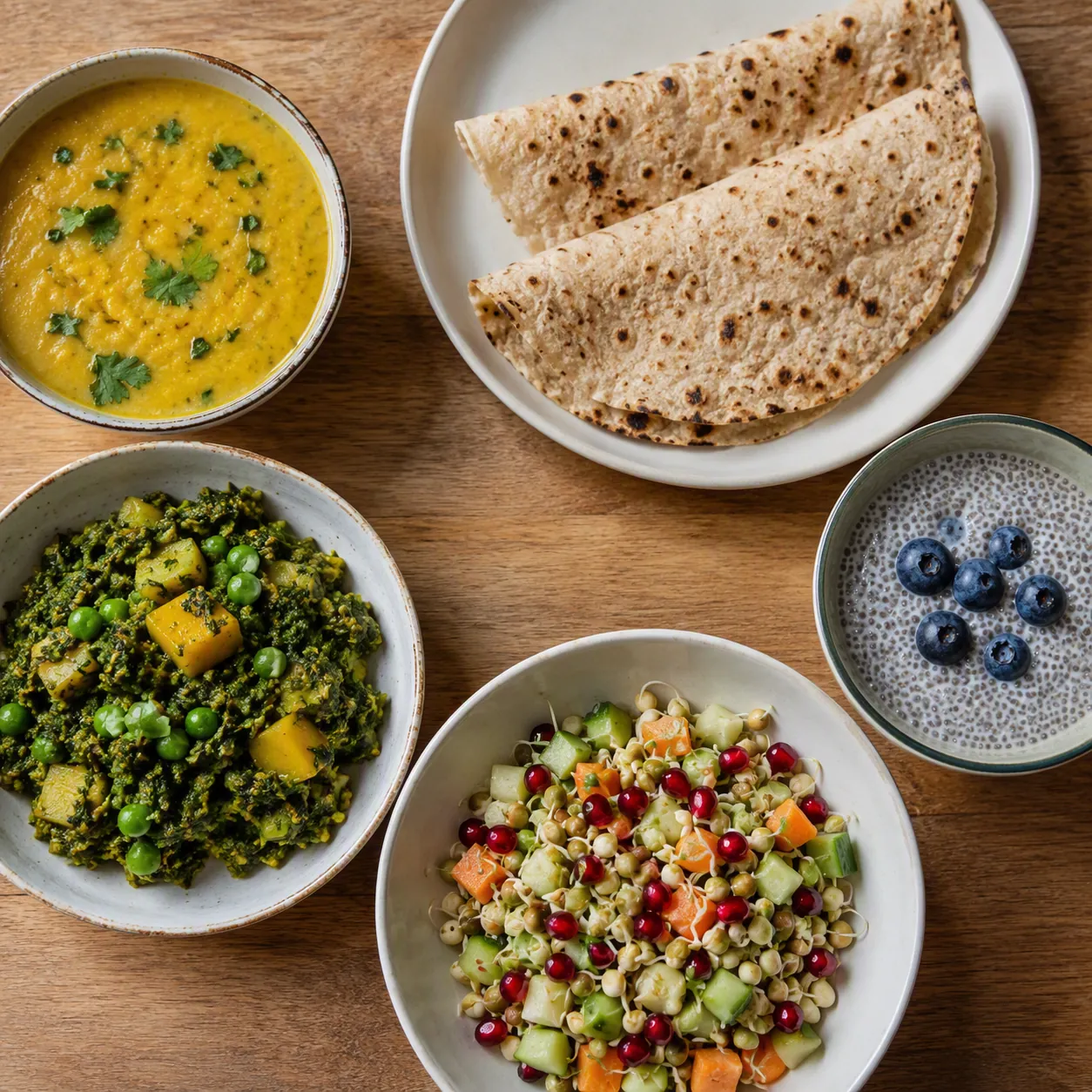
This is not a pantry full of powders. It is a meal pattern built around legumes, vegetables, greens, seeds, fruit, and simple cooked food. For an en-US kitchen, the closest translation is not to erase the Indian meals. Keep the logic: dal is the lentil or bean anchor, sabzi is the cooked vegetable anchor, roti is the flatbread or grain anchor, salad and sprouts add freshness and texture.
| Meal | Reported Dia Pattern | Practical Substitution If Needed |
|---|---|---|
| Breakfast | Chia seeds in almond milk with blueberries and pomegranate | Chia pudding with any berries; keep added sugar out |
| Lunch | Gluten-free roti, dal, sabzi, salad, small rice portion | Lentils or beans, cooked vegetables, salad, rice or quinoa, gluten-free tortilla if roti is unavailable |
| Dinner | Soup, leafy salad, sprouts, avocado | Vegetable soup, greens, sprouted lentils or beans, avocado or another simple fat source |
| Snacks | Snacks every two hours | Fruit, sprouts, nuts, or other simple plant-forward options |
The 90% Plant-Based Rule Leaves a Little Room
Dia has described her food approach as 90% vegan, with occasional allowance for meat, and connected it to seasonal, local Indian produce. [7] That distinction is useful. It is not the same as saying she follows an absolutely vegan diet at all times. It also means the system is less about rare imported ingredients and more about repeating a plant-heavy template with what is locally available.
For home replication, the easiest mistake would be to chase the exact fruit or the exact roti brand while missing the pattern. Most meals need a plant protein, vegetables, fiber, and enough structure that snacks do not become grazing by accident. Dia’s version stays recognizable as Indian home food: dal, sabzi, roti, rice, sprouts, greens, soup, and seasonal produce.
Gluten-Free and Refined-Sugar-Free Are Constraints, Not Magic
The reported diet is gluten-free and avoids refined sugar. [4][5] Those choices may work well for her, but the available sources do not prove that either rule is necessary for every reader. What they do show is dietary consistency. If you choose to adapt the plan, treat those constraints seriously only if they fit your health needs, preferences, or medical advice. The more transferable habit is reducing highly sweetened, low-satiety foods and keeping meals simple enough to repeat.
Hydration Is Part of the Blueprint, Not a Wellness Footnote
Femina reported that Dia drinks 3 liters of water daily. The same account describes alkalized water with mint and cucumber in summer, boiled carom and fennel seed water, and black tea with lemongrass and jaggery. [6]
The exact drinks are less important than the system: water is planned, not remembered at 5 p.m. The mint-cucumber version makes sense in hot weather; fennel and carom seed water fits a traditional Indian kitchen; black tea with lemongrass and jaggery gives her a warm drink without turning the day into a dessert parade. If 3 liters is too much or too little for your body, climate, or medical situation, adjust with common sense and professional guidance. The source supports what she reportedly does, not a universal prescription.
What Not to Overcopy
The tempting version of a celebrity routine is to copy the visible object: the rebounder, the exact breakfast bowl, the trainer-approved juice, the yoga aesthetic. The sturdier version is to copy the commitments that keep showing up.
- Do not assume you need a rebounder; the trainer explicitly says expensive equipment is not required.
- Do not treat swimming, kickboxing, and cycling as mandatory; they are cardio options, while walking is the more transferable baseline.
- Do not invent Dia’s exact exercise list from broad categories; use the confirmed structure instead.
- Do not flatten dal, sabzi, roti, sprouts, and seasonal produce into generic “clean eating.”
- Do not confuse 90% plant-based with absolute veganism; the source describes occasional flexibility.
There is also older material from a different training phase in Dia’s career, including film-prep style work. That can be interesting historically, but it should not be mistaken for the current at-home system confirmed by her trainer in 2026.
How to Adapt Dia Mirza’s Routine in a Small Apartment
A faithful adaptation does not need to look cinematic. It can look like a mat that rolls out in the same corner every morning, a walk that happens even when the workout is imperfect, and meals that repeat often enough to remove decision fatigue.
| If You Have | Use This Part of Dia’s System | Skip or Modify |
|---|---|---|
| No equipment | Bodyweight strength, yoga, walking, breathwork | Skip dumbbells, bands, and rebounder until needed |
| One yoga mat | Yoga three to four days a week plus floor-based strength | Avoid noisy cardio if neighbors are close |
| A resistance band | Add light resistance to strength work | Do not turn the band into a complicated routine |
| Outdoor walking access | Use brisk walks as the daily cardio anchor | Do not force indoor jumping workouts |
| A simple kitchen | Repeat dal or lentils, vegetables, salad, sprouts, chia, fruit | Skip expensive specialty ingredients |
The one place this routine may feel incomplete for some readers is progression. The available sources confirm Dia’s categories, frequency, and habits, but they do not provide a periodized training plan with week-by-week overload. If you want that kind of structure, use Dia’s system as the lifestyle base and pair it with a progressive no-equipment program, such as the site’s 6-week no-equipment home MMA workout program, rather than pretending a celebrity snapshot answers every programming question.
The replicable part of Dia Mirza’s routine is not celebrity access, expensive equipment, or a hidden trick. It is the consistency across ordinary behaviors: bodyweight training, light resistance when useful, yoga, brisk walking, plant-forward Indian meals, hydration, and a quiet morning reset. If those are realistic for your apartment and your week, the system is adaptable. If they are not, buying more gear will not fix the actual bottleneck.
References
- How Dia Mirza stays fit: Trainer Kunal Vijay More reveals her workout and diet secrets, Indian Express, July 2026
- My fitness motto is 10k steps a day, no matter what, Hindustan Times
- Dia Mirza's fitness mantra revolves around meditation, breathing exercises and yoga, Vogue India
- 5 fitness lessons you need to learn from Dia Mirza, Vogue India
- Dia Mirza on her skincare secrets, diet and workout routine | Exclusive interview, India Today, 2023-11-02
- Unlocking Dia Mirza's TOP FIVE wellness secrets!, Femina, 2023
- Dia Mirza On Her Love For Plant-Based Diet, Slurrp, 2023
What a small equipment investment adds
We don't have a build tagged to this exact tier yet. Browse all builds.
How often should you repeat this?
See our recovery and rest reference for citation-anchored rest-interval guidance.
Spot something off?
Tell us if a movement, tier assumption, or duration didn't match your experience.