
How Many Minutes to Burn Off a DQ Blizzard at Home?
A source-backed table converts every DQ Blizzard flavor and size into minutes of home exercises at 125, 155, and 185 lb — plus the MET formula to calculate your own burn time. One Blizzard isn't one calorie number.
- Equipment tier required
- none
- Duration
- 30 min
- Difficulty
- intermediate
- Target area
- full body
- Space footprint needed
- small
- Noise level
- moderate
There is no honest single answer to “how long does it take to burn off a DQ Blizzard at home?” A mini Blizzard sits in a very different workout category than a large one: the current national Dairy Queen Treat Allergen & Nutrition Facts list minis at roughly 330–480 calories, while larges run roughly 990–1,370 calories depending on flavor, with the data current as of March 30, 2026.[1] That means a mini can plausibly fit into one demanding home session for many people; a large usually asks for more than one session, or for a wider calorie trade-off elsewhere.
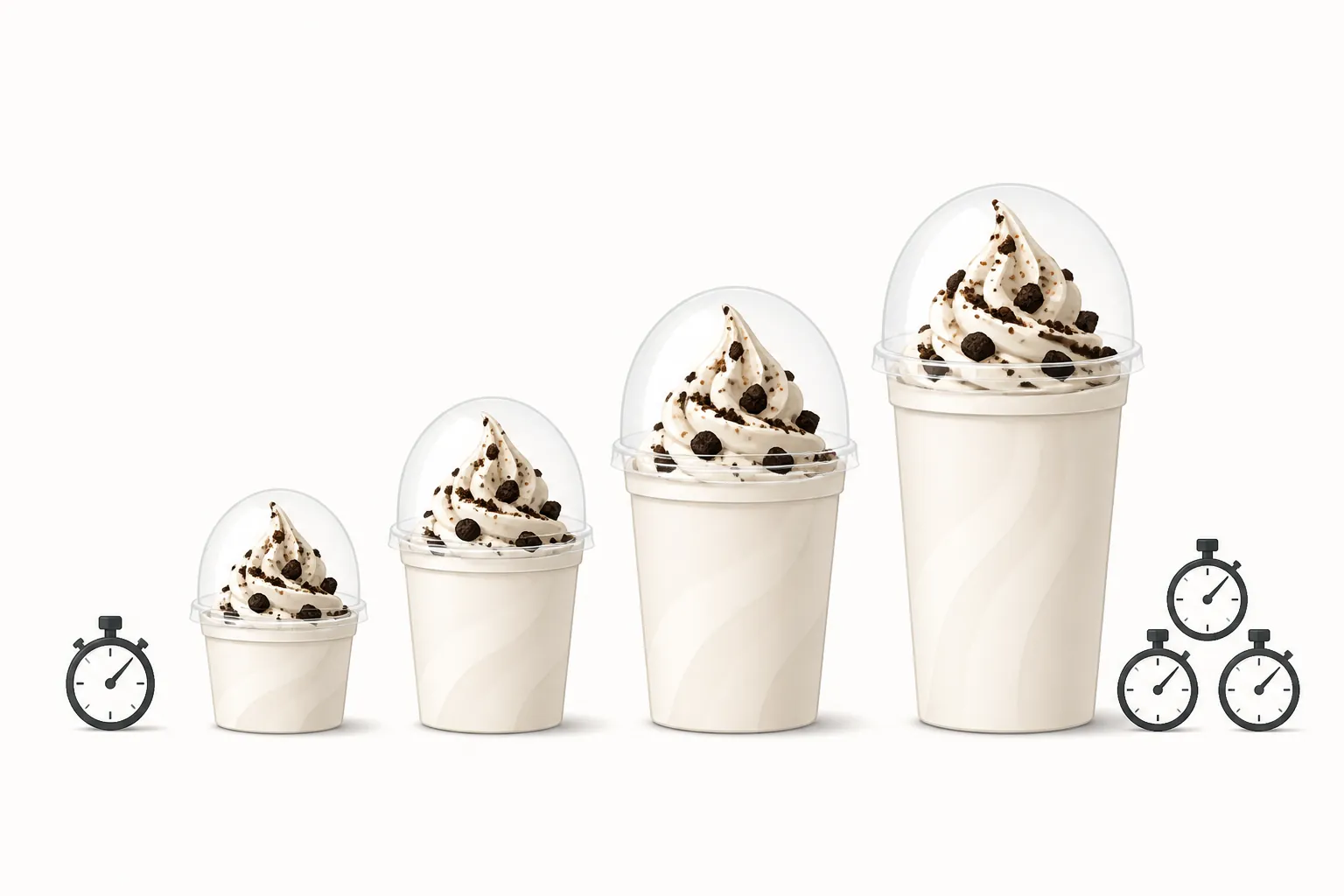
The table below converts each listed Blizzard flavor and size into minutes of vigorous calisthenics at three reference weights: 125, 155, and 185 lb. I use vigorous calisthenics because Harvard Health publishes reference-weight calorie burns for it: 240, 306, and 336 calories in 30 minutes at those three body weights.[2] That works out to about 8.0, 10.2, and 11.2 calories per minute.
DQ Blizzard calories converted to home-workout minutes
Read each minutes cell as “125 / 155 / 185 lb.” So an OREO Cookie Blizzard in a small size is 600 calories nationally; at Harvard’s vigorous-calisthenics rate, that is about 75 / 59 / 54 minutes. Calories come from the national DQ treats nutrition sheet current as of March 30, 2026, and minutes are rounded to the nearest whole minute.[1][2]
| Blizzard flavor | Mini kcal | Mini min, vigorous calisthenics | Small kcal | Small min, vigorous calisthenics | Medium kcal | Medium min, vigorous calisthenics | Large kcal | Large min, vigorous calisthenics |
|---|---|---|---|---|---|---|---|---|
| OREO Cookie | 330 | 41 / 32 / 29 | 600 | 75 / 59 / 54 | 820 | 103 / 80 / 73 | 1,050 | 131 / 103 / 94 |
| REESE’S Peanut Butter Cup | 360 | 45 / 35 / 32 | 570 | 71 / 56 / 51 | 760 | 95 / 75 / 68 | 1,020 | 128 / 100 / 91 |
| Chocolate Chip Cookie Dough | 420 | 53 / 41 / 38 | 710 | 89 / 70 / 63 | 1,030 | 129 / 101 / 92 | 1,370 | 171 / 134 / 122 |
| M&M’S Milk Chocolate Candies | 370 | 46 / 36 / 33 | 630 | 79 / 62 / 56 | 850 | 106 / 83 / 76 | 1,100 | 138 / 108 / 98 |
| Butterfinger | 350 | 44 / 34 / 31 | 590 | 74 / 58 / 53 | 800 | 100 / 78 / 71 | 1,060 | 133 / 104 / 95 |
| HEATH | 370 | 46 / 36 / 33 | 600 | 75 / 59 / 54 | 860 | 108 / 84 / 77 | 1,150 | 144 / 113 / 103 |
| SNICKERS | 350 | 44 / 34 / 31 | 590 | 74 / 58 / 53 | 800 | 100 / 78 / 71 | 1,060 | 133 / 104 / 95 |
| Choco Brownie Extreme | 400 | 50 / 39 / 36 | 620 | 78 / 61 / 55 | 800 | 100 / 78 / 71 | 1,080 | 135 / 106 / 96 |
| Turtle Pecan Cluster | 460 | 58 / 45 / 41 | 730 | 91 / 72 / 65 | 900 | 113 / 88 / 80 | 1,310 | 164 / 128 / 117 |
| Royal New York Cheesecake | 450 | 56 / 44 / 40 | 770 | 96 / 75 / 69 | 1,040 | 130 / 102 / 93 | 1,350 | 169 / 132 / 121 |
| Royal OREO | 400 | 50 / 39 / 36 | 720 | 90 / 71 / 64 | 980 | 123 / 96 / 88 | 1,310 | 164 / 128 / 117 |
| Royal REESE’S Brownie | 480 | 60 / 47 / 43 | 760 | 95 / 75 / 68 | 1,030 | 129 / 101 / 92 | 1,340 | 168 / 131 / 120 |
| Caramel Fudge Cheesecake | 390 | 49 / 38 / 35 | 640 | 80 / 63 / 57 | 890 | 111 / 87 / 79 | 1,210 | 151 / 119 / 108 |
| OREO Fudge Brownie | 380 | 48 / 37 / 34 | 620 | 78 / 61 / 55 | 850 | 106 / 83 / 76 | 1,110 | 139 / 109 / 99 |
| Mint OREO | 340 | 43 / 33 / 30 | 610 | 76 / 60 / 54 | 840 | 105 / 82 / 75 | 1,090 | 136 / 107 / 97 |
| Chocolate Dipped Strawberry | 330 | 41 / 32 / 29 | 550 | 69 / 54 / 49 | 760 | 95 / 75 / 68 | 990 | 124 / 97 / 88 |
The size jump is the part that matters most at the menu board. OREO is a clean example: mini 330, small 600, medium 820, large 1,050 calories.[1] Moving from mini to small adds more workout time than switching among many home exercises can realistically erase. Chocolate Chip Cookie Dough is even steeper at the top end: small 710, medium 1,030, and large 1,370 calories.[1]
Which home exercise number should you use?
For the main Blizzard table, I used Harvard’s vigorous calisthenics line because it is dated, weight-specific, and broad enough for hard bodyweight work at home.[2] Burpees, mountain climbers, fast squat thrusts, and high-knee intervals may fit that bucket when they are actually vigorous. Slow reps with long phone breaks do not.
| Home activity | Best number to use here | 125 lb | 155 lb | 185 lb | How to treat it |
|---|---|---|---|---|---|
| Vigorous calisthenics | Harvard Health 30-minute table | 8.0 kcal/min | 10.2 kcal/min | 11.2 kcal/min | Best default for hard bodyweight circuits. |
| Jump rope, fast | Harvard Health 30-minute table | 11.3 kcal/min | 14.0 kcal/min | 16.8 kcal/min | Highest source-backed option here, but not neighbor-friendly in many apartments. |
| Jump rope, slow | Harvard Health 30-minute table | 7.5 kcal/min | 9.4 kcal/min | 11.2 kcal/min | Still high-impact; useful if you can do it safely and quietly. |
| High-impact aerobics | Harvard Health 30-minute table | 7.0 kcal/min | 8.4 kcal/min | 9.8 kcal/min | Reasonable proxy for continuous jumping-jack or high-knee style intervals. |
| Jumping jacks | Healthline estimate | About 8–16 kcal/min, not weight-table specific | About 8–16 kcal/min, not weight-table specific | About 8–16 kcal/min, not weight-table specific | Useful for context, but less precise than Harvard’s reference-weight table. |
| Burpees | Healthline estimate | About 8–12 kcal/min | About 8–12 kcal/min | About 8–12 kcal/min | Hard to sustain; counting reps can be more honest than pretending it is steady-state cardio. |
| Mountain climbers or high knees | Secondary exercise-site estimates | Often discussed near 8–12 kcal/min | Often discussed near 8–12 kcal/min | Often discussed near 8–12 kcal/min | Use as context unless you have a device or formula-based estimate. |
The intensity label matters. CDC classifies moderate activity as 3.0 to 5.9 METs and vigorous activity as 6.0 METs or higher.[3] If your “burpee workout” is five burpees, two minutes of scrolling, and then another five burpees, the average session probably should not be treated like uninterrupted vigorous calisthenics.
Jumping jacks and burpees are good examples of why source quality matters. Healthline gives jumping jacks as roughly 8–16 calories per minute and cites an example of about 47 calories in 5 minutes for a 150-lb person.[4] Healthline also gives burpees around 8–12 calories per minute.[5] Those ranges are useful for sanity-checking, but they are not as clean as Harvard’s table because they are not presented as the same three reference weights used throughout the Blizzard table.

Apartment practicality is not a nutrition fact, but it is still real. Fast jump rope has the best Harvard burn rate in this set, at 340, 421, and 503 calories per 30 minutes for 125, 155, and 185 lb people.[2] It is also loud, repetitive, and ceiling-dependent. For many home exercisers, vigorous calisthenics or high-impact aerobics are easier to actually complete than “just jump rope for an hour,” especially after minute eight.
How to calculate your own Blizzard burn time
If you are not 125, 155, or 185 lb, rerun the number instead of borrowing the nearest column. The standard MET equation is: METs × 3.5 × body weight in kilograms ÷ 200 = calories burned per minute.[6]
kcal per minute = METs × 3.5 × body weight in kg ÷ 200
minutes to burn Blizzard = Blizzard calories ÷ kcal per minute
For body weight, convert pounds to kilograms by dividing pounds by 2.2. If you weigh 170 lb, that is about 77.3 kg. If you choose jump rope at 12.3 METs, Healthline’s listed MET value for jumping rope, the formula gives about 16.6 calories per minute: 12.3 × 3.5 × 77.3 ÷ 200.[6]
Now divide the Blizzard by that rate. A 600-calorie small OREO Cookie Blizzard would be about 36 minutes at that calculated jump-rope intensity for a 170-lb person. That is math, not a guarantee. If the rope session becomes stop-start practice, the real average burn drops.
A quick rerun example
- Pick the exact Blizzard and size from the DQ table. Example: small OREO Cookie, 600 calories.
- Pick an activity with a defensible burn rate. Example: vigorous calisthenics at 155 lb, 10.2 calories per minute from Harvard.
- Divide calories by calories per minute. 600 ÷ 10.2 = about 59 minutes.
- If your weight is different, use the MET formula instead of forcing yourself into a reference-weight column.
What changes when you switch exercises
Changing the exercise helps, but it does not make size disappear. At 155 lb, Harvard’s rates put vigorous calisthenics at about 10.2 calories per minute, fast jump rope at about 14.0, slow jump rope at about 9.4, and high-impact aerobics at about 8.4.[2] Here is what that does to one familiar order.
| Order | Calories | Vigorous calisthenics, 155 lb | Fast jump rope, 155 lb | Slow jump rope, 155 lb | High-impact aerobics, 155 lb |
|---|---|---|---|---|---|
| OREO Cookie Blizzard, mini | 330 | 32 min | 24 min | 35 min | 39 min |
| OREO Cookie Blizzard, small | 600 | 59 min | 43 min | 64 min | 71 min |
| OREO Cookie Blizzard, medium | 820 | 80 min | 58 min | 88 min | 98 min |
| OREO Cookie Blizzard, large | 1,050 | 103 min | 75 min | 112 min | 125 min |
That is why a “20 minutes of burpees burns a Blizzard” answer is usually too blunt. Twenty hard minutes can be meaningful. It just does not cover most small, medium, or large Blizzards under the rates above. At 155 lb, 20 minutes of vigorous calisthenics is about 204 calories using Harvard’s table.[2]
Two caveats before treating the table like a receipt
First, restaurant nutrition systems can vary by region and update date. This article uses Dairy Queen’s national treats nutrition page current as of March 30, 2026.[1] Texas Dairy Queen publishes its own nutrition system; as one small example, a small OREO Blizzard appears as 610 calories in the Texas system versus 600 calories in the national DQ treats table used here.[7] If you are ordering from a region-specific DQ site, use that site’s number.
Second, exercise burn is an estimate even when the source is good. Harvard’s table is valuable because it gives the same activity at three body weights, but it still cannot know your pace, rest periods, room temperature, conditioning, or whether your “mountain climbers” became a plank after 40 seconds. For high knees and mountain climbers, secondary fitness estimates often place the work near 8–12 calories per minute, but those numbers are better used as rough context than as the anchor for a calorie ledger.[8]
The practical answer is visible in the table: if you want the Blizzard and you want the home-workout cost visible, pick the exact size before you worry about the cleverest exercise. A mini can land inside one hard session for many people. A large often becomes multiple sessions, or a broader weekly calorie decision. The math is useful precisely because it does not pretend otherwise.
References
- Treat Allergen & Nutrition Facts — Dairy Queen — current as of March 30, 2026
- Calories burned in 30 minutes of leisure and routine activities — Harvard Health Publishing
- How to Measure Physical Activity Intensity — CDC
- How Many Calories Do Jumping Jacks Burn? — Healthline
- How Many Calories Do Burpees Burn? — Healthline
- What Are METs, and How Are They Calculated? — Healthline
- Nutrition Facts — Texas Dairy Queen
- High Knees vs Jumping Jacks: Calories Burned, Muscles Worked — SOLE Fitness
What a small equipment investment adds
We don't have a build tagged to this exact tier yet. Browse all builds.
How often should you repeat this?
See our recovery and rest reference for citation-anchored rest-interval guidance.
Spot something off?
Tell us if a movement, tier assumption, or duration didn't match your experience.