Ethan Suplee's Home Workout Routine on Any Budget
Ethan Suplee's quarantine home workout used light weights, high reps, and near-daily training to maintain a lean, muscular physique. This article maps his documented routine to three home-gym budget tiers ($0–100, $100–300, $300–800) with apartment noise and floor-protection notes so renters can replicate it in a small space.
- Equipment tier required
- $0-100
- Duration
- 30 min
- Difficulty
- beginner
- Target area
- full body
- Noise level
- quiet
The useful version of the Ethan Suplee weight loss workout routine is not the fan-circulated gym template that gets passed around as if it were a training diary. The version worth copying at home is narrower and better documented: during quarantine, Suplee trained with “weights, an elliptical and an assault bike,” and explained the whole adjustment in one plain sentence: “Since I don’t have anything heavy, I do much more reps and I just go until failure every day” [1].
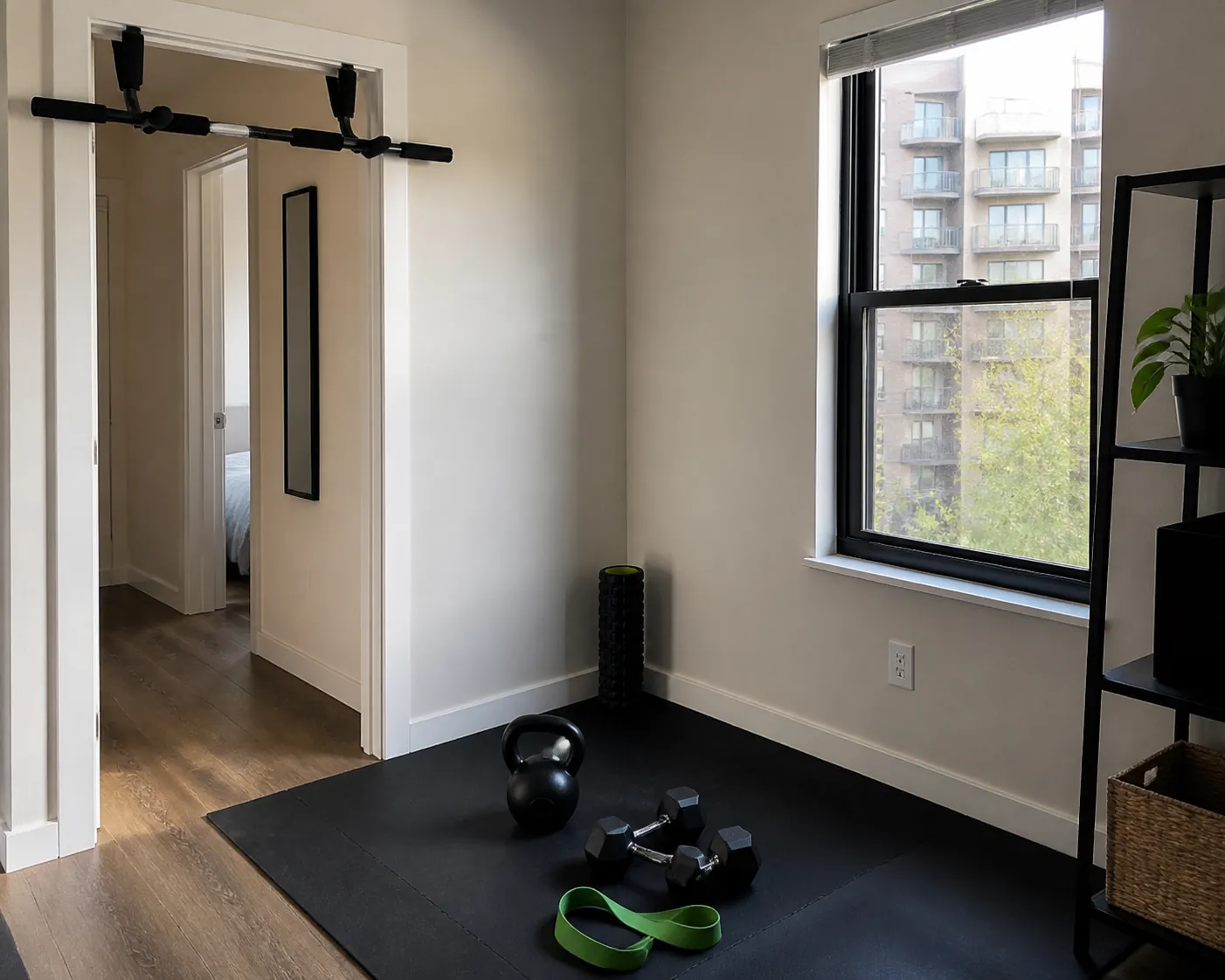
That matters if you live in an apartment. A routine built around heavy barbells usually turns into a shopping list fast: rack, plates, platform, more plates, apologies to the downstairs neighbor. Suplee’s quarantine setup points in the other direction. CinemaBlend’s quarantine write-up listed pull-ups, push-ups, kettlebell work, other weights, and an assault bike as the moving parts of the home routine [2]. Strip away the celebrity frame, and the pattern is simple: pull, push, load the body with something you can control, and do conditioning.
What Suplee actually documented at home
The quarantine routine was not presented as a perfect program for strangers. It was a snapshot of how a strong, already-trained person kept training when the usual heavy equipment was unavailable. The hinge is the quote from Men’s Health: no heavy weights, more reps, failure, every day [1]. That is not the same thing as saying everyone should max out effort daily. It says how Suplee solved the equipment problem in that specific window.
The movement list from CinemaBlend gives the routine its shape: pull-ups, push-ups, kettlebell and weight work, and assault-bike conditioning [2]. There is no need to overbuild it into a full commercial gym. The home version is closer to a compact strength-and-conditioning circuit than a powerlifting plan.
There is also a reason the routine was credible for him. Suplee was not inventing fitness from a couch during lockdown. TODAY reported that he had reached 536 pounds on a freight scale at age 24, had dealt with congestive heart failure, and was later around 255 pounds in 2021 [3]. In a Men’s Health essay, he also wrote about the cost of earlier dieting, saying a DEXA scan showed that roughly four of every 10 pounds he lost on low carb had been lean muscle [4]. By quarantine, the question was not whether he knew how to train. It was how he would keep effort high with lighter tools.
The principle: light equipment only works if effort is honest
Light weights are not magic. A ten-pound dumbbell moved lazily for a few easy reps is not the same training stimulus as a light weight taken near the point where another clean rep is doubtful. Suplee’s home method depended on the second version. He did not replace heavy loading with vibes; he replaced it with high-rep effort.
That changes what the home gym has to provide. You do not need the heaviest possible implement. You need enough resistance, grip options, and movement variety to make the last part of a set demanding without wrecking your floor or your joints. For renters, this is the practical opening: if the set can be made hard safely and quietly, the tool has done its job.
His later and gym-era training supports the same bias without replacing the quarantine source. In a May 2025 r/loseit AMA, Suplee described a broader split of about six training days per week, with two pure cardio days and one major muscle group on each of the other four days [5]. In a Men’s Health chest workout at Granite Gym, he used supersets and said, “I don’t give a crap about how many plates I have on there,” putting the emphasis on hypertrophy and execution rather than plate-count theater [6]. Useful context, but still secondary here: the apartment routine stands on the quarantine documentation.
What the routine needs in a small home
A small-space version has to preserve the movements, not the exact equipment. Suplee had an assault bike and elliptical available [1]. Most renters should judge cardio equipment by noise, vibration, and storage before they judge it by how tough it looks on camera.
| Routine need | Home-gym job | Apartment constraint |
|---|---|---|
| Pull-ups or pulling work | Train the back and grip with a doorway bar, bands, rows, or loaded backpack variations | Doorframe fit, no drilling, controlled reps, no swinging into trim |
| Push-ups or pressing | Make bodyweight pressing harder with tempo, elevation, bands, or dumbbells | Wrist comfort, floor grip, room to extend fully |
| Kettlebell or weight work | Load squats, hinges, carries, presses, and rows without a barbell | Protect vinyl plank, avoid dropping, keep swings controlled or skip them |
| Conditioning | Raise heart rate with a bike, elliptical, brisk walking, step work, circuits, or low-impact intervals | Noise through the floor matters more than the machine’s reputation |
| Recovery and repeatability | Use effort you can repeat across the week without turning every session into damage control | Neighbors, joints, and sleep are part of the program whether the internet likes it or not |
If you already think in square footage, the same filter shows up in our compact home gym by space tier guide: the question is not “Can this room look like a gym?” It is “Can this room support the movement without causing a problem?”
$0–100: enough to start, weak if you ignore pulling
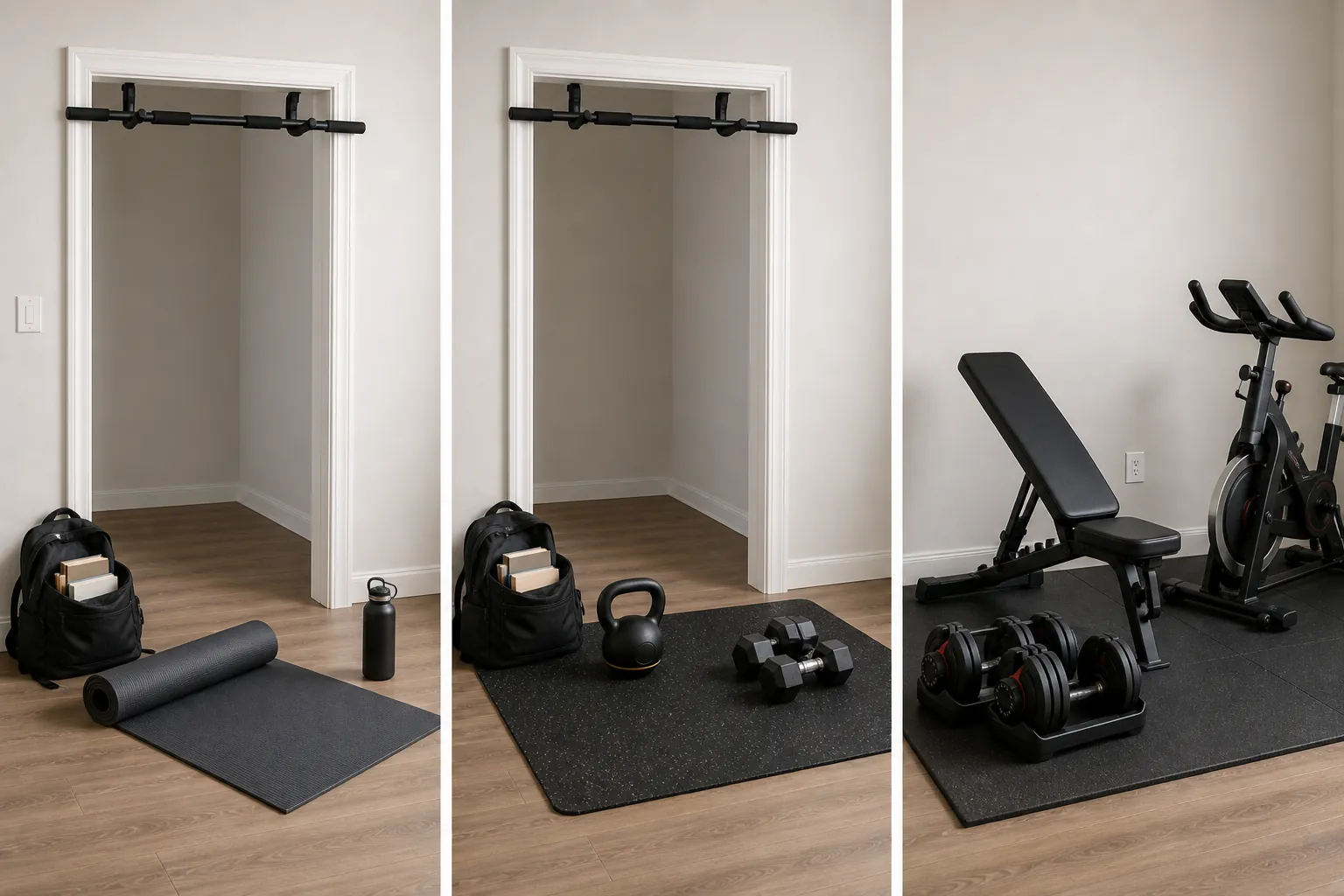
The cheapest version can run the Suplee logic, but only if it is honest about pulling strength. Push-ups cost nothing. Loaded backpacks cost almost nothing. Low-impact conditioning can be done with walking, stairs, controlled step-ups, or quiet bodyweight circuits. The missing piece is usually a real pull.
- Doorway pull-up bar if the frame can handle it and the lease does not forbid marks or pressure-mounted equipment
- Yoga mat, folded towel, or budget rubber mat for push-ups, core work, and floor protection
- Backpack loaded with books, water bottles, or soft household items for rows, squats, lunges, and carries
- Resistance band if a pull-up bar is not realistic, though it is a compromise rather than a perfect substitute
This tier works best when the pull-up bar is possible. Pull-ups were part of the documented quarantine routine [2], and a no-drill doorway bar is the closest small-apartment match. Without one, you can still row a backpack, do band pulldowns, and train grip with loaded carries, but the routine becomes push-heavy unless you pay attention.
The floor rule is simple: nothing gets dropped. A backpack is quieter than a dumbbell when it slips, but it still should not be slammed onto vinyl plank. Put the loading inside the bag securely, start and finish sets from the floor under control, and avoid jump-heavy conditioning if someone lives below you. This is the tier for people who can tolerate repetition and do not need much variety to train hard.
$100–300: the best practical tier for most renters
This is where the home version starts to feel less like a workaround. Add one useful kettlebell or a pair of light dumbbells, keep the doorway pulling option, and put the whole thing on a small rubber mat. You still are not buying a celebrity gym. You are buying enough load variety to make high-rep failure training less awkward.
- Doorway pull-up bar or bands for pulling
- One kettlebell that you can press, row, squat, hinge, and carry safely
- Optional light dumbbells if you want easier loading for lateral raises, curls, presses, and high-rep arm work
- A rubber mat large enough for the bell, your feet, and the spot where the weight returns to the floor
A kettlebell fits Suplee’s documented quarantine list directly [2]. It also solves several apartment problems at once. It has a small footprint, it can be moved to a closet, and it loads lower-body work better than most backpacks. Goblet squats, Romanian deadlifts, rows, floor presses, carries, and controlled clean-to-press variations all fit the “lighter weight, harder set” idea.
Swings are the one place to be conservative. They are useful, but they also multiply the consequences of a bad grip, a slick floor, or a tired hinge. In a rental, a controlled deadlift or squat pattern is often the better first choice. If the bell ever has to be bailed out, the setup is not apartment-safe enough yet.
For conditioning, this tier does not need an assault bike. Use low-impact circuits, outdoor walks, stairs if your building tolerates it, or a compact cardio option only if it is quiet and stable. The assault bike was Suplee’s tool; the conditioning slot is what matters for the renter.
$300–800: more complete, not more virtuous
The higher budget tier makes the routine smoother. It does not make it more real. If you can already take light loads close to failure, recover, and repeat, the extra money mostly buys faster adjustments, more exercise options, and less fiddling between sets.
- Adjustable dumbbells for pressing, rowing, high-rep isolation work, squats, hinges, and loaded carries
- Compact bench if you have the storage space, or a floor-press setup if you do not
- Thicker matting under the lifting area, especially on vinyl plank or older apartment floors
- Quiet cardio option such as a compact indoor bike if the footprint, drivetrain noise, and floor vibration make sense
Adjustable dumbbells are the cleanest upgrade because they keep the high-rep method honest across more movements. Push-ups can be made hard for a long time, but dumbbells make presses, rows, raises, lunges, and loaded hinges easier to scale. A compact bench adds angles, though floor presses are often enough if storage is tight.
Cardio is where people overspend most quickly. Suplee had both an elliptical and an assault bike in the quarantine setup [1]. In an apartment, an assault bike can be a bad neighbor: fan noise, vibration, and aggressive intervals are not subtle. A compact bike on a mat may be a better match. So may outdoor walking or quiet conditioning circuits. The right answer is the one you can use hard without making the room shake.
If you want a fuller equipment map, our $1,000 compact home gym system uses the same kind of logic: adjustable dumbbells, folding bench, bands, and a doorway pull-up option before big machines. Suplee’s home routine does not require that full spend, but the equipment order is sensible.
Running the movement flow without pretending it is his diary
The safest way to copy the routine is to copy the categories, not invent exact sets and call them Suplee’s. His documented home movements give enough to build a session structure, but not enough to claim a precise personal log.
| Documented category | Small-space version | How to keep the Suplee principle |
|---|---|---|
| Pull-ups | Doorway pull-ups, assisted pull-ups, band pulldowns, or backpack rows | Make the last clean reps hard without swinging or kipping into the doorframe |
| Push-ups | Standard, incline, decline, tempo, band-resisted, or feet-elevated push-ups | Use range of motion and tempo before adding noisy or awkward loading |
| Kettlebell and weights | Goblet squats, hinges, rows, presses, carries, floor presses, curls, extensions | Choose a load you can control all the way back to the floor |
| Assault bike or elliptical conditioning | Quiet bike, outdoor walk, low-impact circuit, step work, or controlled intervals | Raise effort without pounding the ceiling below you |
A renter’s session might start with pull-ups or rows while grip is fresh, move into push-ups or dumbbell pressing, then use kettlebell or dumbbell lower-body work, and finish with conditioning. That is a constructed home version, not a verified Suplee workout. The point is to preserve the pressure he described: lighter tools, more reps, and sets taken close enough to failure to matter [1].
This is also where floor protection becomes part of programming. If the only way to make conditioning hard is jumping, sprinting in place, or dropping weights, the plan is badly matched to the room. Slow eccentric push-ups, strict rows, high-rep goblet squats, loaded carries, and quiet bike intervals are boring in the best way. They let you train again tomorrow without negotiating with the neighbor downstairs.
Nutrition context, kept in its lane
The quarantine training did not sit by itself. CinemaBlend reported that Suplee held maintenance calories through lockdown, kept protein constant, and slightly raised carbs and fat [2]. Men’s Health also described his meal-prep structure as having food prepared one to two days ahead and eating roughly six meals a day [1].
That is useful context, not a prescription. For this home-gym question, the takeaway is smaller: the routine was aimed at maintaining a lean, muscular body with consistent training and controlled food, not crash-dieting through quarantine. That distinction fits his own lesson from losing lean mass during earlier dieting [4].
The apartment-safe judgment
Suplee’s quarantine routine is not locked behind a celebrity gym budget. The documented version used ordinary home categories: pull-ups, push-ups, kettlebell or weight work, and conditioning [1][2]. The hard part is not buying the most impressive machine. It is making light equipment hard enough, often enough, without turning your floor into a drum.
At $0–100, get a real pulling option if you can and accept the limits. At $100–300, a kettlebell or light dumbbells make the routine much easier to run. At $300–800, adjustable dumbbells, better matting, and quiet cardio add comfort and range, not moral superiority. If you can train near failure consistently, protect the floor, and choose conditioning that does not punish the people below you, the method travels just fine into a small rental.
References
- Ethan Suplee's Gym & Fridge Diet — Men's Health
- Newly Ripped Ethan Suplee Explains His Routine During Quarantine — CinemaBlend
- Ethan Suplee's Weight Loss: Actor Went From 550 to 255 Pounds — TODAY
- Actor Ethan Suplee Opens Up About His 200-Pound Weight Loss and Diet Confessions — Men's Health
- My name is Ethan Suplee, I've lost 300 lbs and... — Reddit r/loseit — May 2025
- Ethan Suplee's Workout Plan Video — Men's Health
What a small equipment investment adds
Cable Machine Alternatives That Save Space and Money
Compare the best cable machine alternatives for home gyms – from resistance bands and pulley systems to suspension trainers and compact digital units – and find the right option for your space and budget.
Small Treadmill Buying Guide: 7 Critical Specs to Check Before You Buy
A cross-category spec primer for apartment and small-space dwellers comparing walking pads, ultra-compact folding treadmills, and full-size folding treadmills. Learn the concrete thresholds for motor HP, deck length, noise, warranty, and subscription lock-in so you can compare apples to apples.
How to Practice Basketball at Home Without Noise Complaints
Learn how to run a full basketball workout in a small apartment without noise complaints. This guide covers no-dribble handling drills, wall form shooting, and silent ball options that let you train without disturbing neighbors.
How often should you repeat this?
See our recovery and rest reference for citation-anchored rest-interval guidance.
Spot something off?
Tell us if a movement, tier assumption, or duration didn't match your experience.